A 750 kVA three-phase pad-mounted transformer is the steel cabinet you see sitting on a concrete pad behind a shopping center, a data hall, or a factory. The utility feeds it with an underground medium-voltage cable, it steps that down to 480Y/277 or 208Y/120, and the low-voltage cables leave through the base into a switchboard. No fence, no separate building, no exposed live parts. That is the whole idea of the format.
This page is about the machine itself: the cabinet, the terminations, the current, the losses, the pad, the oil, and the money. For the rating as a capacity class, our pad-mounted transformer sizes and prices guide takes the catalog view across the whole ladder. For the neighboring rating in the same cabinet format, the 1000 kVA pad-mounted transformer page covers 1000 kVA and above. For who to buy from and what that costs, we keep a separate comparison of US and China sourcing options.
Three numbers decide most of a 750 kVA pad-mount job, and this page gives you all three with the arithmetic attached:
- 902 A at 480Y/277, which sets your device frame and your conductor count.
- 99.40% at 50% load, which is the federal floor this unit has to clear today, and which several live product pages do not clear on their own numbers.
- 12.0 to 18.0 kA of transformer-side fault current across the whole normal impedance band at 480 V, which is why 750 kVA is the last standard rating where a 22 kA switchboard still works.
What a 750 kVA pad-mounted transformer actually is
A pad-mount is a liquid-immersed distribution transformer with the core and coil in one welded tank and the electrical connections in separate compartments in front of it. The high-voltage compartment sits on the left, the low-voltage compartment on the right, and a stainless steel barrier runs the full length between them. Cables enter from below through the base plate, and two hinged doors close over the front. The doors lock with a padlock, and the tank is finished in Munsell Green 7GY 3.29/1.5, which is the utility-standard color.
The product standard is IEEE C57.12.34, which covers three-phase, 60 Hz, liquid-immersed, self-cooled, pad-mounted, compartmental-type distribution transformers, 10 MVA and smaller, with high voltage up to 34.5 kV nominal system voltage. The current edition also covers the connector, bushing, and terminal arrangements for radial or loop feed systems. A second standard, IEEE C57.12.28, governs enclosure integrity, which is the tamper-resistance part.
Two things sit outside those standards and matter anyway. The federal energy standard is 10 CFR part 431, which sets a minimum efficiency for this class of machine. And the electrical code that governs the site is the NEC, which governs working space, clearances, and how the secondary conductors are protected. Vendor pages almost never connect those three, and that is where buyers lose money.
750 kVA is a standard rating. It appears in the three-phase preferred list published by NEMA in the Federal Register notice of November 12, 1998 (63 FR 63360), in the middle of the ladder: 15, 30, 45, 75, 112.5, 150, 225, 300, 500, 750, 1000, 1500, 2000, 2500. Because it is on the list, it has its own row in the federal efficiency table. You are not interpolating.
The construction words you need before you read a quote
Pad-mounts come in a small vocabulary, and vendors use the words loosely. Here is what each one costs you.
Dead front versus live front. On a dead-front unit, every primary connection is made inside the locked cabinet with a 200 A load-break elbow that you plug into a bushing. Nothing is exposed when the door is closed, so the unit can sit in a public area without a fence. On a live-front unit, the primary terminations are exposed spade or stud terminals, and you need physical separation and qualified access. Live front is cheaper and it is the right answer for a fenced utility yard. Dead front is the right answer almost everywhere else. Of the sixteen pages I checked on this keyword, none mentioned live front at all.
Loop feed versus radial feed. A radial-feed unit has one incoming cable and three primary elbows. A loop-feed unit has two incoming cables and six elbows, so the cabinet can be tapped into a loop and either side can be opened without dropping the other. Loop feed also gets you parking stands, which are welded brackets that hold a parked elbow safely while a section is out of service. Larson’s copper 750 kVA unit, for instance, lists six primary connections for elbow connectors and six welded parking-stand brackets. That is the loop-feed configuration, and it is the one most commercial sites want. Only one of the sixteen pages I checked mentioned parking stands.
Compartmental. This means the high-voltage devices, the transformer tank, and the low-voltage terminations are separated by metal barriers, so a fault in the low-voltage compartment does not vent into the high-voltage compartment. It is not a marketing word. If a quote does not say compartmental, ask.
Sealed versus conservator. A sealed unit uses a corrugated tank wall that flexes with oil temperature, so there is no expansion tank and the unit is shorter. A conservator design uses a separate oil reservoir and is taller. Both are common. The corrugated design keeps oxygen and moisture out of the oil, which is why some vendors advertise “no oil change needed for the life of the unit.” That claim is a design claim, not a guarantee, and it does not remove the need for oil sampling.
ONAN. Oil natural, air natural. The oil circulates by convection and the tank radiates to the air. It is the default cooling class for this size, and fans are not normally offered. If a quote lists ONAF, you are paying for capacity you probably do not need on a 750 kVA distribution unit.
Currents: the table every spec sheet should carry
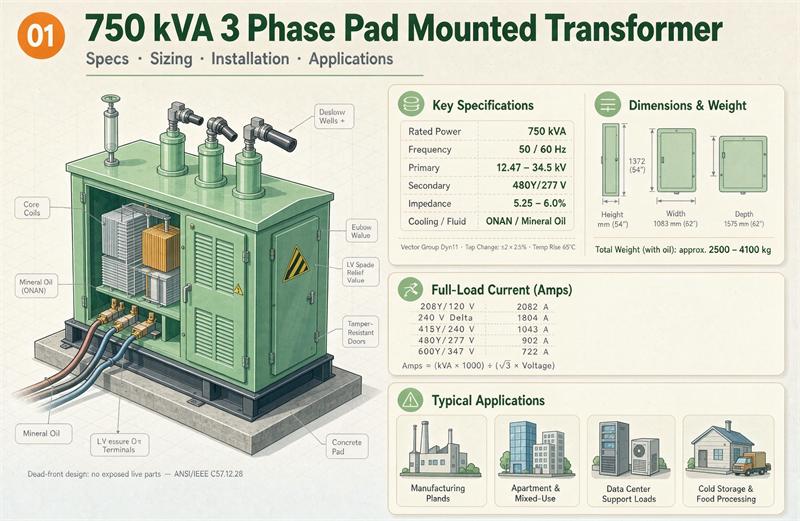
Secondary current is where the money goes, so the first thing to check on any spec sheet is the amp table. The formula is simple: for a three-phase unit, current equals kVA times 1,000, divided by the square root of 3 times the line-to-line voltage.
| Secondary voltage | Full-load current | Where it shows up |
| 208Y/120 | 2,082 A | Older commercial and light industrial |
| 240 delta | 1,804 A | 240 V industrial panels |
| 415Y/240 | 1,043 A | IEC-spec export jobs |
| 480Y/277 | 902 A | The common North American choice |
| 600Y/347 | 722 A | Canada and some heavy industrial |
Bear Power publishes this table for its 750 kVA unit and every number matches the formula, which is a good sign for the rest of their page. Transformer4U publishes the same arithmetic but adds a 277 V row reading 1,563 A, which is a phase-to-neutral number. On a 480Y/277 system the line current is 902 A. If a spec sheet hands you 1,563 A for a 480 V service, someone has divided by the wrong voltage.
Primary current is smaller but it still belongs on the submittal, and it is computed on the winding voltage:
| Primary | Full-load current |
| 12,470GY/7200 | 35 A |
| 13,200Y/7620 | 33 A |
| 13,800Y/7970 | 31 A |
| 24,900Y/14,400 | 17 A |
| 34,500GY/19,920 | 13 A |
| 7,200 delta | 60 A |
| 12,470 delta | 35 A |
| 13,800 delta | 31 A |
| 34,500 delta | 13 A |
A 12,470GY/7200 primary uses 7,200 V in the denominator, not 12,470. One of the four Larson Electronics 750 kVA listings shows “Primary Amps: 12.55 A” against a 12,470Y/7200 rating, which is the 34.5 kV current pasted onto a 12.47 kV unit. The correct figure is 35 A. Getting that wrong by a factor of 2.8 on a submittal is the kind of error that survives review and then fails at the first fault study.
The federal efficiency floor, and how to test any vendor’s loss numbers
This is the part almost no vendor page touches, and it is the part that tells you whether you are buying a compliant machine.
Since January 1, 2016, a liquid-immersed three-phase distribution transformer at 750 kVA has to hit 99.40% efficiency measured at 50% of nameplate load. That number is Table 2 to paragraph (b)(2) of 10 CFR 431.196. Turn it into a loss budget and it becomes a number you can hold a quote against:
Allowed loss = output x (1/efficiency – 1) = 375,000 W x (1/0.9940 – 1) = 2,263.6 W at 375 kW of output.
Now check the pages that claim compliance. Transformer4U’s 750 kVA padmount specifications page lists no-load loss of 1,200 W and load loss of 7,200 W. At 50% load the total is 1,200 + 7,200 x 0.25 = 3,000 W, which is 736 W over the floor, and it works out to 99.21% efficiency. The same page states “Efficiency 99.2%, DOE 2016 compliant.” Both statements are on the page, and they cannot both be true. CHBEB and Winley both publish a 980 W no-load and 7,500 W load loss table, which gives 2,855 W at half load, 591 W over the floor, and an implied 99.24%. Loong’s listing claims “Efficiency 99” outright. Apexto claims 99.15%.
None of those pages is necessarily lying about the hardware. Some of them may be quoting an older design, or a unit built for a market with no federal floor. But a buyer cannot tell, and that is the point: the loss numbers are the cheapest thing on the page to verify and the most expensive thing to get wrong. Ask for no-load loss and load loss in watts, at a stated reference temperature, and ask for the routine test report that proves them with the serial number on it. A routine test report on a distribution unit covers ratio, winding resistance, no-load loss and current, load loss and impedance, and applied and induced voltage, and it is the document the efficiency claim is supposed to rest on.
There is a reverse calculation too, and it works on any efficiency claim. If a vendor says 99.0% at 750 kVA, the loss at half load is 375,000 x (1/0.990 – 1) = 3,788 W, which is 1,524 W above the floor. If they say 99.4%, the loss is 2,264 W, which is exactly at the floor. Larson’s 12,470Y/7200 aluminum unit claims 99.4%, which is a pass at the boundary. The same vendor’s hermetically sealed 750 kVA unit claims 98.00% at 50% load, and that one fails badly: it is a single-phase secondary machine, so the applicable floor is interpolated between the 667 kVA row (99.52%) and the 833 kVA row (99.55%), which lands at 99.535% and an allowed loss of about 1,752 W. Their claim implies 7,653 W, roughly 5,900 W over.
One more regulatory note that saves arguments. A hermetically sealed unit is still covered by the federal standard. The “sealed transformer” exclusion in 10 CFR 431.192 applies to dry-type transformers only, by the plain text of the definition. A sealed oil-filled pad-mount has to meet the same floor as any other liquid-immersed distribution transformer.
What April 23, 2029 actually changes, and what it does not
Table 3 to paragraph (b)(3) of 431.196 raises the 750 kVA three-phase liquid-immersed floor from 99.40% to 99.43% for units manufactured on or after April 23, 2029. In watts that is a move from 2,263.6 W to 2,149.8 W of allowed loss at half load, a difference of 113.8 W.
Put a price on that: 113.8 W running 8,760 hours a year at $0.10 per kWh is about $100 a year. Discounted over 30 years at 7%, using the standard factor of 12.409, that is about $1,237 in present value. That assumes the unit sits at half load, which is generous for a real feeder.
So the compliance date is worth roughly one crane rental at this rating. It is not a reason to wait, and it is not a reason to pay a premium for a “2029 ready” unit. The thing worth buying is the guaranteed watts in the test report, because a unit running 500 W below the floor saves more in a year than the whole 2029 update is worth in thirty. Note also that the same rule leaves submersible units completely unchanged at 750 kVA, which tells you something about who the rule was written for.
Impedance: the one number that decides your switchgear rating
Impedance is printed on the nameplate as a percentage, and it does two opposite things. Higher impedance means better fault containment but worse voltage regulation. Lower impedance means better regulation and a bigger fault. For a 750 kVA three-phase liquid-immersed unit, the federal definition of a “special-impedance transformer” in 10 CFR 431.192 carries a table of normal ranges, and the row that covers 750 kVA through 5,000 kVA reads 5.0% to 7.5%. Anything inside that band is a normal transformer. Anything outside it is, by definition, a special-impedance transformer, and that has a regulatory consequence: special-impedance transformers are excluded from the federal efficiency standard. Loong’s 750 kVA listing shows 4.5% impedance, which is below the band. If you want that unit, you are also signing up for a machine with no federal floor. Now the part that decides your switchboard. Fault current from the transformer alone, on an infinite bus, is full-load current divided by impedance:
| Secondary | 902 A at 5.0% | at 5.75% | at 6.0% | at 7.5% | Inside a 22 kA board? |
| 480Y/277 (902 A) | 18.0 kA | 15.7 kA | 15.0 kA | 12.0 kA | Yes, at every value in the band |
| 208Y/120 (2,082 A) | 41.6 kA | 36.2 kA | 34.7 kA | 27.8 kA | No, at any value in the band |
| 240 delta (1,804 A) | 36.1 kA | 31.4 kA | 30.1 kA | 24.1 kA | No |
| 600Y/347 (722 A) | 14.4 kA | 12.6 kA | 12.0 kA | 9.6 kA | Yes |
Read the first row again. At 480 V, a 750 kVA pad-mount cannot exceed 22 kA from the transformer side anywhere in the normal impedance band, because even the most aggressive in-band value of 5.0% gives 18.0 kA. To breach 22 kA at 480 V you would have to build the unit at 4.10% impedance or lower, which is outside the normal band. Compare that with the next rating up: a 1000 kVA unit at 480 V and 5.0% impedance produces 24.1 kA, which is over the line. To hold 22 kA at 1000 kVA you need Z of at least 5.47%.
So 750 kVA is the last standard rating where a standard 22 kA switchboard works at 480 V with no impedance games. That is a real, checkable, and completely unreported fact about this machine, and it is worth knowing before someone sells you a 42 kA or 65 kA lineup you do not need.
Two caveats, because the arithmetic above is a floor and not an answer. First, this is infinite-bus arithmetic. The utility source contributes its own fault current, and the two add. If the utility tells you it has 12 kA available at your point of connection, then a 750 kVA unit at 5.0% puts you at 30 kA, not 18 kA. Get the fault duty letter from the utility before you order gear. Second, splitting into two units does not help unless the secondaries feed separate buses. Two 750 kVA units at 5.75% on the same 480 V bus produce about 31.4 kA, which is worse than one. On separate buses each sees 15.7 kA.
The low-voltage side: device ratings and conductor counts
The secondary current of 902 A drives a chain of NEC rules that most vendor pages ignore completely.
The first rule is transformer secondary protection. NEC 450.3(B) caps secondary overcurrent protection at 125% of the transformer’s secondary full-load current, and where 125% does not land on a standard rating, the next higher standard rating is allowed. At 750 kVA and 480 V: 902.1 A x 1.25 = 1,127.6 A. The next standard rating in NEC 240.6(A) is 1,200 A.
The second rule is the one that costs money. NEC 240.4(C) says that above 800 A, the next-size-up allowance does not apply, so the protected conductors must have an ampacity at least equal to the device rating. A 1,200 A device therefore needs conductors rated 1,200 A or more, not 902 A. Two runs of 750 kcmil copper at 75 C carry 950 A, which is not enough. You need three runs of 750 kcmil (1,425 A) or four runs of 500 kcmil (1,520 A). This is the single most common surprise on a 750 kVA job, and it is invisible on every vendor page I checked.
Here is the full picture:
| Secondary | FLA | 125% | Device (240.6(A)) | Minimum conductors, 75 C copper, per phase |
| 208Y/120 | 2,082 A | 2,602 A | 3,000 A | 6 x 1000 kcmil (3,270 A) or busway |
| 240 delta | 1,804 A | 2,255 A | 2,500 A | 6 x 750 kcmil (2,850 A) or 5 x 1000 kcmil (2,725 A) |
| 415Y/240 | 1,043 A | 1,304 A | 1,600 A | 3 x 750 kcmil (1,425 A) or 4 x 500 kcmil (1,520 A) |
| 480Y/277 | 902 A | 1,128 A | 1,200 A | 3 x 750 kcmil (1,425 A) |
| 600Y/347 | 722 A | 902 A | 1,000 A | 3 x 500 kcmil (1,140 A) |
The 208 V row is the one to look at twice. Six runs of 1000 kcmil per phase is 18 large conductors into one termination area, and that is a busway job, not a cable job. If your site can take a 480 V secondary instead, the whole problem shrinks by a factor of six, and the transformer costs the same. Bear Power’s own page lists 2,082 A at 208Y/120 and 902 A at 480Y/277 side by side and never draws the conclusion.
If your secondary voltage goes above 600 V, you have left this product class entirely. The federal definition of a distribution transformer in 10 CFR 431.192 caps output at 600 V, so a 750 kVA unit with a 4,160 V secondary has no federal efficiency floor and is not a C57.12.34 pad-mount in the usual sense. Some vendors will still sell you one and call it a pad-mount. Ask which standard it is built to.
What is inside the cabinet
The accessories are where the price hides, and they are the part of the quote that is easiest to compare line by line. A fully specified loop-feed dead-front 750 kVA unit carries:
- Six 200 A load-break elbow bushings on the primary, sized for 4/0 AWG cable
- Six welded parking-stand brackets so elbows can be parked safely
- Three high-voltage elbow surge arresters on the primary, typically 15 kV class with an MCOV near 12.7 kV rms
- Bayonet expulsion fuses plus current-limiting fuses in the high-voltage compartment
- One or three two-position load-break switches, depending on whether the unit is radial or loop feed, so the transformer and each incoming cable can be opened under load
- Four low-voltage bushings, typically eight-hole with support brackets
- Liquid level, temperature, and pressure/vacuum gauges, usually analog
- A fault pressure device and a rapid-rise relay for internal fault detection
- A pressure relief device, a drain valve with a sampler, an oil fill plug, and a filter press connection
- Pentahead bolt entry hardware, a stainless rodent barrier at the base, and a hot stick mounted inside the high-voltage door
- Tank grounding provisions in both compartments, in copper
Everything on that list is optional in the sense that you can delete it, and every deletion shows up later as a change order or a utility rejection. The surplus listing I found for a 2024 Giga Energy unit spells out most of this hardware explicitly, including lifting lugs “positioned for and capable of lifting entire pad mount unit,” which is the line to check on any used or surplus purchase. A used cabinet that has been set down and picked up three times is not necessarily a cabinet with intact lifting lugs.
For the tank and fluid side, our oil-immersed transformer reference covers the construction options in more depth, including when FR3 or natural ester fluid is worth the premium. The short version: ester fluid buys a higher fire point and matters indoors or near occupied space, and it changes the oil volume and sometimes the tank dimensions.
Siting: pad, weight, crane, oil, working space
The pad. Transformer4U’s installation data for this rating calls for a minimum 108 x 108 inch pad with 6 inches of overhang on all sides, 4 to 6 inches thick, reinforced concrete at 3,000 PSI minimum, level within 1/4 inch per foot, sloped slightly away from buildings, and cured a minimum of 28 days before the unit is set. The 28-day cure is the number that kills schedules, and it starts the day the concrete is poured, not the day the transformer ships.
Weight and rigging. Shipping weights for this rating run from about 5,600 lb (2,540 kg, Transformer4U) through 6,074 lb (CHBEB, 2,755 kg), 6,500 lb (Larson), and 6,797 lb (Apexto, 3,083 kg), up to 8,380 lb for a surplus Giga unit that measures 75 x 75 x 75 inches. Every one of those needs a crane, not a forklift, and the crane has to be able to reach over the pad. Ask for the shipping weight and the core weight separately. The core weight is what a rigger needs if the cabinet has to be stripped indoors.
Oil and SPCC. Oil volume for this rating runs from about 141 gallons (535 kg, CHBEB’s figure) through 175 gallons (Larson’s copper unit) up to 290 gallons (1,100 L, Transformer4U). The federal SPCC threshold in 40 CFR part 112 is more than 1,320 gallons of above-ground oil storage with a reasonable expectation of discharge to navigable waters, and oil in electrical equipment counts toward the total. At 290 gallons per unit you cross the line at five units. At 175 gallons you cross at eight. At 141 gallons you cross at ten. If your site has three or more of these on one pad, put the SPCC plan in the budget from the start rather than discovering it at the inspection. Confirm your state threshold separately, because several states are stricter.
Working space and clearance. NEC 110.26 sets the working space in front of the low-voltage compartment. At 480 V to ground that is a 3 foot depth under condition 1 and 3.5 feet under condition 2, with a width of 30 inches or the equipment width, whichever is greater, and 6.5 feet of headroom. Transformer4U’s page also cites a 10 foot minimum clearance from buildings per the NEC and local fire codes, which is the number to confirm with your own AHJ, because local amendments vary more than the national code does.
Grounding. CHBEB’s FAQ specifies a grounding resistance of 4 ohms or less with multiple grounding points. That is a vendor figure, not a code figure, and the utility’s standard usually governs. Ask for the utility’s grounding detail before you pour.
Price: what these units actually sell for
Here is what was actually listed on the dates shown, with nothing averaged and nothing invented:
| Source | Configuration | Listed price | Notes |
| Loong (china-transformers.com) | 750 kVA, 13.8 kV to 480 V, copper, 4.5% Z | $3,799 to $3,999 per set | No UL, IEEE, or DOE evidence on the page; impedance outside the normal band |
| Yawei | 750 kVA pad-mount, 13.2 / 13.8 / 24.9 / 34.5 kV | $18,000 to $32,000 FOB China | ANSI and IEEE claimed, no loss data published |
| Larson Electronics | 750 kVA, 43.8 kV delta single-phase to 120/240 V, copper, loop | $69,893.74 | Single-phase unit, 1,150 lb |
| Larson Electronics | 750 kVA, 12,470 delta to 480Y/277, copper, loop | $78,371.00 | Six elbows, six parking stands, three arresters |
| Bear Power Solutions | 750 kVA three-phase pad-mount, 105 configurations, aluminum | $79,050.72 to $107,855.00 | Lead time 12 to 16 weeks |
| Larson Electronics | 750 kVA, 12,470Y/7200 to 480Y/277, aluminum, 6.0% Z | $128,069.28 | 6,500 lb, 64 x 89 x 57 inches, claims 99.4% |
| Larson Electronics | 750 kVA, 27,600Y/15,936 hermetically sealed, single-phase 480 V secondary | $130,072.00 | Claims 98.00% at half load |
Two things jump out of that table. The first is the spread. The same 750 kVA nameplate runs from under $4,000 to over $130,000, a factor of more than thirty. The second is that the spread is not random. A China FOB number excludes ocean freight, insurance, destination duty, UL or cUL listing, IEEE C57.12.34 type testing, inventory carrying cost, and warranty administration. A US listing includes all of it. Those are different products in an economic sense even when the nameplate is identical, and the gap between $32,000 FOB and $79,050 US is mostly the items on that list rather than margin.
The strangest row is the pair of Larson listings. The copper-wound unit at 12,470 delta is $78,371. The aluminum-wound unit at 12,470Y is $128,069. Copper costs more than aluminum, so the more expensive machine has the cheaper winding. The difference lives in impedance, accessories, enclosure rating, and configuration, and you cannot see any of it from the price. This is the whole argument for comparing spec sheets line by line rather than comparing prices, and it is the same lesson as the Bear Power 240 V versus 208 V table error we found on the 1000 kVA rating.
On lead time, Bear Power states 12 to 16 weeks from order confirmation for this rating, depending on configuration and factory loading. The China listings advertise 30 days, which is a factory slot, not a delivered and listed unit. Surplus stock exists, and the Giga unit I found was in stock with five available, but surplus means someone else’s specification, and you inherit their impedance and their loss figures. Our sourcing comparison goes deeper on how to structure that decision.
Where 750 kVA pad-mounts get used
Data centers and edge sites. Apexto’s project references include 750 kVA pad-mounts for an edge compute facility and a battery energy storage system, and Giga Energy’s FAQ pushes 750 kVA for edge data centers and modular AI deployments. The pattern is real: a 750 kVA unit supports IT load plus cooling plus some redundancy without the footprint of a full substation. Watch the harmonic content if the unit feeds rectifiers or inverter loads, and ask about a K-factor rating. Winley lists K-1, which is the standard, meaning no special harmonic capability.
Industrial plants and parks. A single 750 kVA unit feeds a mid-size factory floor or a cold storage facility. Bear Power’s applications list names manufacturing plants, apartment and mixed-use developments, cold storage and food processing, and mid-size commercial buildings.
Renewables and storage. A 0.75 MVA block is a common step-up size for a section of a solar plant, and it is the size that shows up in BESS integrations. Two cautions. First, IEEE C57.12.34 describes these units as generally used for step-down duty from an underground primary cable supply, and several vendor pages state plainly that the unit is not approved for step-up operation. If your application is bidirectional, that is a direct question for the manufacturer, not an assumption. Second, if the unit feeds an inverter, the duty cycle is not a steady distribution load and the specification has to account for it.
Commercial and institutional. Shopping centers, hospitals, universities, and airports, where one cabinet replaces several pole-mounts and simplifies the switchboard. This is where dead front earns its price, because the unit sits where the public walks.
The specification sheet to send to every vendor
A short list catches most of the expensive mistakes:
- Rated capacity, phase, frequency, and confirmation that 750 kVA is the rating being quoted, in writing, on the quote.
- Primary and secondary voltages, including whether a grounded-wye primary is specified, plus the vector group and BIL.
- Impedance with tolerance, and confirmation it sits inside the 5.0% to 7.5% band unless you intend otherwise.
- Guaranteed no-load loss and load loss in watts, with the reference temperature, plus the routine test report that proves them.
- Which federal paragraph and test load the efficiency claim is made against, or a statement that the unit falls outside the definition.
- Cooling class, tap range, tap changer type, and whether the unit is approved for the duty you need, including bidirectional service if that applies.
- Feed type, dead front or live front, bushing and elbow count, parking stands, fusing, switches, and surge arresters.
- Shipping weight, core weight, and dimensions, against the pad, the door, and the access route you actually have.
- Oil volume, and whether the site crosses the SPCC threshold with this unit added.
- Lead time in weeks from order confirmation, warranty terms, and what happens to the schedule if a routine test fails.
Send the identical list to every vendor. The answers side by side tell you more than any price comparison, and the vendors who cannot fill in line 4 have told you something.
Frequently asked questions
How many amps does a 750 kVA pad-mounted transformer produce at 480 V?
902 A on the secondary of a 480Y/277 unit, computed as 750,000 divided by the square root of 3 times 480. At 208Y/120 it is 2,082 A, at 240 delta 1,804 A, at 415Y/240 1,043 A, and at 600Y/347 722 A. On the primary side a 12,470GY/7200 winding draws 35 A. Use the winding voltage in the denominator, so 7,200 V for a grounded-wye 12,470GY/7200 primary, not 12,470.
What is the difference between dead front and live front?
Dead front means every primary connection is made inside the locked cabinet with a 200 A load-break elbow plugged into a bushing, so no live part is exposed when the door is closed. It is what allows the unit to sit in a public area without a fence. Live front means exposed primary terminals, which requires physical separation and qualified access but costs less. Choose dead front unless the unit is going inside a fenced utility yard.
Loop feed or radial feed, and what is a parking stand?
Radial feed has one incoming cable and three primary elbows. Loop feed has two incoming cables and six elbows, so the cabinet can be tied into a loop and either side can be opened without dropping the other. A parking stand is a welded bracket that holds a removed elbow safely out of the way while a section is worked on. Loop feed with parking stands is the standard commercial configuration, and it costs more than radial for a reason.
How much does a 750 kVA pad-mounted transformer cost?
Listed prices on the retrieval date ranged from $3,799 to $3,999 for an unlisted China unit, $18,000 to $32,000 FOB China, and $69,893 to $130,072 for US listings, with one US distributor quoting $79,050.72 to $107,855.00 across 105 configurations. The gap between FOB China and a delivered US unit is freight, duty, listing, type testing, inventory, and warranty administration, not just margin. Compare spec sheets, not price tags, because one vendor’s copper unit lists below its own aluminum unit.
What efficiency does a 750 kVA pad-mount have to meet?
99.40% measured at 50% of nameplate load for liquid-immersed three-phase units manufactured since January 1, 2016, which is Table 2 to paragraph (b)(2) of 10 CFR 431.196. That converts to an allowed loss of 2,263.6 W at 375 kW of output. From April 23, 2029 the floor rises to 99.43%, or 2,149.8 W. Several live product pages claim compliance while publishing loss figures that work out to 99.15% to 99.24%, so ask for the routine test report.
Will a 750 kVA pad-mount work with a 22 kA switchboard at 480 V?
Yes, from the transformer side, at any impedance inside the normal 5.0% to 7.5% band. At 5.0% the unit produces 18.0 kA and at 7.5% it produces 12.0 kA, all below 22 kA. A 1000 kVA unit at 5.0% produces 24.1 kA and does not. At 208 V the picture reverses completely: even 7.5% gives 27.8 kA. Add the utility’s available fault current to the transformer’s contribution before you commit to gear, and get that number in writing from the utility.
How big is the concrete pad, and how much does the unit weigh?
Plan on a 108 x 108 inch pad minimum with 6 inches of overhang, 4 to 6 inches thick, 3,000 PSI reinforced concrete, level within 1/4 inch per foot, and a 28-day cure before setting. Shipping weights for this rating run from about 5,600 lb to 8,380 lb, so every one of them needs a crane. Ask for shipping weight and core weight separately.
How many of these can I put on one site before SPCC applies?
The federal threshold is more than 1,320 gallons of above-ground oil storage with a possible discharge path to navigable waters, and transformer oil counts. Published oil volumes for this rating run from about 141 to 290 gallons per unit, so the site crosses the line at five units on the high end and ten on the low end. Check your state threshold, because several are stricter than the federal one.
Aluminum or copper windings?
Copper has lower losses and carries current better in a given space, and it costs more. Aluminum is common in utility-standard production units and is perfectly acceptable if the loss figures meet the floor. Both appear on the same vendor’s price list at this rating, which is why the loss table and the routine test report matter more than the winding material. If the quote does not state guaranteed watts in both no-load and load loss, it does not matter which metal is inside.
How long does a 750 kVA pad-mount take to get?
One US distributor lists 12 to 16 weeks from order confirmation depending on configuration and factory loading. China factory listings advertise 30 days, which covers a build slot and not a delivered, listed, and type-tested unit. Surplus units are available immediately, as one 2024 listing in stock showed, but you inherit the original buyer’s specification, including impedance and losses. Build the 28-day concrete cure into the schedule as well, because it runs in parallel and often finishes last.
Bottom line
750 kVA is a standard three-phase rating, it is a genuine pad-mounted product rather than an adapted substation unit, and it is the last rating on the ladder where a 480 V secondary stays inside a 22 kA switchboard across the entire normal impedance band. At 902 A it needs a 1,200 A device and three runs of 750 kcmil per phase, which is a very different cable schedule from the 1,000 kVA unit above it.
Three things to carry into the purchase:
Check the loss numbers against the floor, not against the marketing. The floor is 99.40% at half load, which is 2,263.6 W of allowed loss. Any quote that will not state guaranteed watts in both no-load and load loss is incomplete, and any page that claims compliance while publishing numbers that imply 99.2% is telling you something about its own quality control.
Put impedance on the spec sheet with a tolerance. At 480 V it decides whether you are buying a 22 kA board or a 42 kA lineup, and at 208 V it does not matter because you are over 22 kA either way. Also confirm it sits inside the 5.0% to 7.5% band, because outside that band the unit becomes a special-impedance transformer and loses its federal efficiency floor entirely.
Buy the site, not just the box. The pad, the 28-day cure, the crane, the oil volume against the SPCC line, and the working space in front of the low-voltage compartment are all line items that appear after the transformer is paid for. On a 750 kVA job they routinely cost more than the difference between two competing quotes.
Everything above is arithmetic you can redo yourself. The formulas are in this page, the federal tables are linked, and the efficiency values come straight from the Electronic Code of Federal Regulations. If a vendor’s numbers do not survive these checks, that is your finding.
Cite this article
TransNine Electric. “750 kVA 3 Phase Pad Mounted Transformer: Guide.” TransNine Electric Technical Resources, 2026. https://www.transnineelectric.com/resources/750-kva-3-phase-pad-mounted-transformer-guide/
Efficiency values are taken from 10 CFR 431.196 as published in the Electronic Code of Federal Regulations, retrieved 2026-10-12. Scope, definitions, and the normal impedance range are from 10 CFR 431.192. The SPCC threshold is from 40 CFR part 112. Product construction references are from IEEE C57.12.34 and IEEE C57.12.28 as described by the cited manufacturer pages. Third-party prices, loss figures, weights, and lead times are as listed by Transformer4U, Bear Power Solutions, Larson Electronics, CHBEB, Winley Electric, Yawei, Apexto, Loong, and Giga Energy on 2026-10-12, are quoted on differing terms, and are not quotations from TransNine Electric.
Start at the TransNine Electric homepage, then browse the rest of our technical resources, the product range, or recent project work.