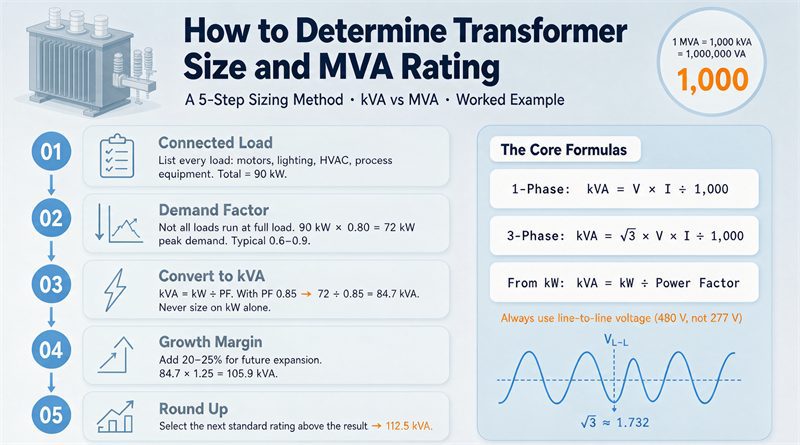
Before any math, get the unit straight. A transformer is rated in kVA (kilovolt-amperes) or MVA (megavolt-amperes). One MVA is exactly 1,000 kVA, and both are measures of apparent power, not real power. The two units are not two different quantities. They are the same quantity on two scales, the way meters and kilometers are the same distance.
You rate a transformer in kVA because the unit has to carry current, and current is what makes it hot. A 100 kW load at 0.8 power factor pulls the same current as a 125 kVA load, so the transformer has to be sized for 125 kVA no matter how much of that power is doing useful work. The apparent power (kVA) is what sets the winding size. The real power (kW) is what the bill measures.
The only reason people switch to MVA is size. Once you pass about 2,500 kVA, writing “2.5 MVA” reads cleaner than “2,500 kVA,” and at the substation or generator step-up level the numbers are almost always in MVA. A distribution transformer on a pad is talked about in kVA. A 230 kV to 34.5 kV substation transformer is talked about in MVA. The crossover is loose, but if your rating lands at 2,500 kVA or above, expect to see MVA on the drawings.
This article walks from a load list to a nameplate in nine steps, and it adds three checks that most sizing guides skip: what the secondary can actually carry, what the federal efficiency floor says about the quote, and what the number costs over thirty years.
Step 1: add up the load and convert it to kVA
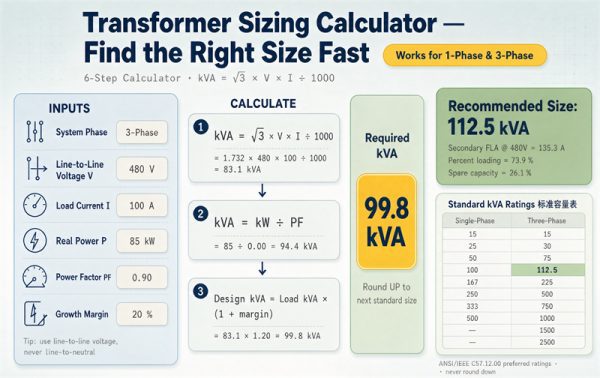
List every load the transformer will feed. For each one, write down its voltage, phase, full-load current, or its kW and power factor. If you have kW, convert with:
kVA = kW / power factor
A 200 kW motor at 0.85 PF needs 235 kVA. A 50 kW lighting and HVAC block at 0.95 PF needs 53 kVA. Do this for every branch, then total them. Resist the urge to grab the main breaker size and call it the answer. A panel rated 400 A at 480 V can carry 333 kVA, but the actual connected load on a typical commercial floor runs well under that, and the design demand runs under the connected load.
If you only have amps, you can skip the kW step and go straight to the phase formulas in Step 2. If you have a mixed list, convert everything to kVA first so you are adding the same unit.
Step 2: pick the phase, single or three
Most commercial and industrial services are three-phase. Most residential and light commercial services under about 15 kVA are single-phase. The formula changes with the phase, and mixing them up is the single most common sizing error.
Single-phase: kVA = V x I / 1,000
Three-phase: kVA = V x I x 1.732 / 1,000
In the three-phase formula, V is line-to-line voltage, not line-to-neutral. On a 480Y/277 V system, you use 480, not 277. Using 277 here undersizes the transformer by a factor of 1.732, which is a silent and expensive mistake. A 240 V single-phase load drawing 100 A is 24 kVA. A 480 V three-phase load drawing 100 A is 83 kVA.
There is a neat relationship between the two phase systems in the standard size lists. The preferred three-phase sizes are, with rare exception, three times the preferred single-phase sizes: a 50 kVA single-phase frame pairs with a 150 kVA three-phase frame, a 100 kVA single-phase frame pairs with a 300 kVA three-phase frame, a 250 kVA single-phase frame pairs with a 750 kVA three-phase frame. If you are deciding between the two, the phase is set by your load, and our single-phase transformer guide covers where each one belongs.
Step 3: apply demand and diversity factors
Connected load is the sum of everything. Design demand is what actually runs at the same time. A 2,000 kVA connected total in an office building may produce a 1,200 kVA demand because not every floor, every kitchen, and every server rack peaks together.
Diversity factors (the fraction of connected load that runs simultaneously) run roughly 0.6 to 0.8 for commercial sites and 0.4 to 0.6 for residential. Motor loads get an extra wrinkle: a motor draws 6 to 8 times its running current for a few seconds at startup, so if a large motor starts across the line, the transformer has to survive that transient even though the steady number is smaller. Many sizing guides fold this into a “round up” margin. It belongs in the demand step, not as a mystery fudge later.
Step 4: add room to grow
After you have a design demand, add 20 to 25 percent for future expansion. Five to ten years of added load is normal, and a transformer is not something you swap on a whim. Undersized units run hot, age fast, and hum loud enough to hear two rooms away. Oversized units waste money on idle losses. The 20 to 25 percent band is the usual compromise, wider if you know growth is coming.
Step 5: round up to a standard NEMA rating, and do not custom-build
This step is where a lot of money is won or lost. The preferred transformer ratings in the United States come from the NEMA list published in the Federal Register on November 12, 1998 (63 FR 63360). The three-phase ladder runs:
15, 30, 45, 75, 112.5, 150, 225, 300, 500, 750, 1000, 1500, 2000, 2500 kVA
Pick the standard size at or just above your demand. If your number lands at 420 kVA, you do not order a 420 kVA unit. You order 500 kVA. If it lands at 1,359 kVA, you do not order a custom 1,359 kVA unit. You order 1500 kVA.
Two reasons. First, a standard rating has its own tested row in the federal efficiency table, ships from stock or near stock, and costs less. A non-standard rating has to be interpolated for efficiency, built to order, and quoted with a longer lead time. Second, the “in between” number is usually an illusion. A 1,359 kVA demand is so close to 1500 kVA that the extra headroom is free insurance, and it keeps you on a frame that the whole supply chain understands. Our 500 kVA reference shows what a standard frame actually looks like on a specification sheet.
Step 6: set the voltages and the vector group
The primary voltage is set by what feeds the transformer. The secondary voltage is set by what the transformer feeds. Pick line-to-line voltages, and confirm whether the primary is grounded wye or delta, because that decides the winding voltage you use in any current check.
The vector group matters once voltage is fixed. Dyn11 is the common distribution arrangement feeding mixed linear and nonlinear loads. YNd1 is the typical generator step-up grouping. If you are matching an existing system, the vector group is not optional. Get it from the utility or the existing nameplate, and write it on the spec.
Step 7: choose the type, oil or dry
Where the unit sits decides the cooling medium. Indoor units near people are almost always dry-type, because there is no oil to burn and often no vault required. Outdoor ground-level units are usually oil-filled pad-mounts, sealed and tamper resistant. Substation and utility-scale units are oil-filled power transformers because that is where oil wins on efficiency at high voltage and high power.
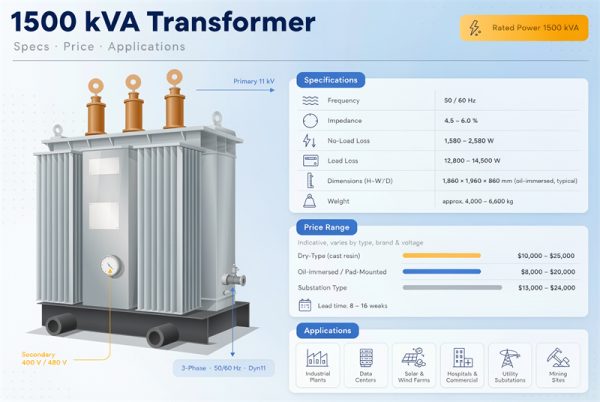
Dry-type units run hotter at the surface and need ventilation and clearance. Oil units need secondary containment thinking, because the oil volume adds up. A single 1500 kVA oil-filled unit holds about 500 gallons, and the federal SPCC threshold in 40 CFR 112 is 1,320 gallons of aboveground oil with a reasonable chance of reaching navigable water. Three of these on one pad crosses the line and triggers a written spill plan, so the count of oil units on a site is part of the sizing decision, not an afterthought. The trade is fire safety indoors versus efficiency and cost at scale. Browse the full product range to see how the two families are built.
Step 8: cooling class and overload headroom
The default cooling is ONAN (oil natural, air natural). Add forced air, ONAF, and you buy roughly 30 to 40 percent more continuous capacity for the same core. Fans are a maintenance item and a failure mode, so the extra capacity has to be worth it. For a unit that runs above about 85 percent of nameplate or sits in a hot climate, ONAF pays for itself. For a unit that runs light, it is dead weight and a noise source.
Note that the cooling class changes the usable rating. A 1500 kVA ONAN unit becomes roughly a 2000 kVA equivalent under ONAF, but only while the fans run. If the fans fail, you are back to 1500 kVA, so the nameplate rating is the ONAN number and the forced-air number is a bonus, not a license to oversize the base.
Step 9: the NEC rules that change the number
Two National Electrical Code rules turn a kVA figure into a permitted installation, and most sizing guides never mention them.
First, continuous loads. A load that runs three hours or more at full value is a continuous load, and NEC 215.2 and 230.42 require the conductors to be sized at 125 percent of that load. A 100 kVA transformer at 480 V draws about 120 A, but if it feeds a continuous process, the minimum conductor ampacity is 150 A. That is the same transformer, a different wire.
Second, overcurrent protection. NEC 450.3(B) sizes the primary protector at 125 percent of primary current (or the next standard rating above), and if you protect both windings, the secondary protector also lands at 125 percent. The standard device ratings, from NEC 240.6(A), step up in jumps, so the transformer rating decides the breaker you can use:
| Transformer at 480 V | Full-load amps | 125 percent | Standard device |
| 500 kVA | 601 A | 752 A | 800 A |
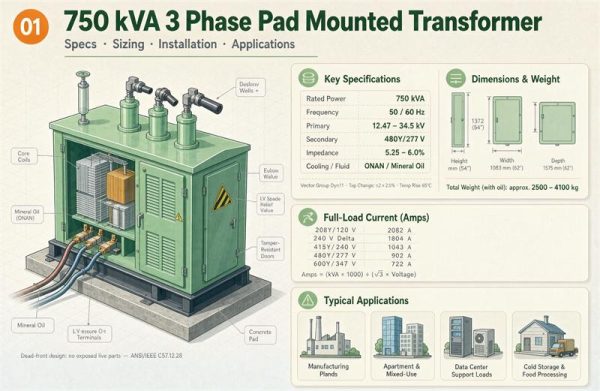
| 750 kVA | 902 A | 1,128 A | 1,200 A |
| 1000 kVA | 1,203 A | 1,504 A | 1,600 A |
| 1500 kVA | 1,804 A | 2,255 A | 2,500 A |
| 2000 kVA | 2,406 A | 3,007 A | 4,000 A |
Notice that a 1500 kVA unit jumps to a 2,500 A device, and a 2000 kVA unit jumps to a 4,000 A device. Those are not gradual steps, and the switchboard section has to be built around them before the transformer arrives.
Step 10: the constraint nobody mentions, what the secondary can carry
Here is the part most buyers never see until the panel shop calls. At 480 V, the conductor carrying the secondary current runs out of practical wire count at a specific size.
Three 1000 kcmil copper conductors per phase, rated 545 A each at 75 degrees C, carry 1,635 A together. At 480 V that is 1,360 kVA. So 3 wires per phase reach 1,359 kVA and stop. A 1000 kVA unit fits comfortably on three wires per phase. A 1500 kVA unit does not. It needs four wires per phase, or a busway. This is the 480 V conductor cliff, and it sits right between the two most common “big” distribution frames.
| Conductors per phase (copper, 75 C) | Ampacity | Reaches at 480 V |
| 3 x 1000 kcmil | 1,635 A | 1,359 kVA |
| 4 x 1000 kcmil | 2,180 A | 1,813 kVA |
| 3 x 500 kcmil | 1,140 A | 948 kVA |
| 3 x 750 kcmil | 1,425 A | 1,186 kVA |
The second hidden ceiling is fault current. A transformer is also a source of short-circuit current, and the downstream switchgear has a rating for that. At 480 V, with a transformer built to the normal impedance band of 5.0 to 7.5 percent (that band is defined in 10 CFR 431.192), the fault current works out as follows:
| Rating at 480 V | Full-load amps | Fault current at 5.75 percent impedance |
| 750 kVA | 902 A | 15.7 kA |
| 1000 kVA | 1,203 A | 20.9 kA |
| 1500 kVA | 1,804 A | 31.4 kA |
| 2000 kVA | 2,406 A | 41.8 kA |
A 22 kA rated switchboard, which is a very common catalog rating, covers 750 kVA and most of 1000 kVA, but a 1500 kVA unit at 480 V produces 31.4 kA and blows past it. You either buy a 42 kA or 65 kA switchboard, or you split the load into two smaller units on separate buses, each of which stays under the limit. A single 1500 kVA unit on one bus does not get you out of that decision, and it is far cheaper to know it on paper than on a rejected panel.
Step 11: check the quoted losses against the federal floor
Once you have a rating, the quote should list no-load loss and load loss in watts. The federal efficiency tables in 10 CFR 431.196 set a minimum for that exact rating, and you can test any vendor’s number against it. The relationship is simple:
Allowed loss (watts) = output watts x (1 / efficiency minus 1)
At 50 percent load, the liquid-immersed three-phase floor is 99.40 percent at 750 kVA, 99.43 percent at 1000 kVA, and 99.48 percent at 1500 kVA. Those become allowed losses of 2,264 W, 2,866 W, and 3,920 W. If a vendor quotes total losses above that at the stated test point, the unit does not meet the federal floor, and you should ask why. This check takes five minutes and it catches units that were designed for a market with no floor or were simply mislabeled.
The April 23, 2029 update tightens these numbers by a fraction of a point. For a 1500 kVA liquid-immersed unit the 2029 floor moves 99.48 to 99.51 percent, about 227 W of extra loss avoided, worth roughly $2,500 over thirty years at $0.10 per kWh. That is real money, but it is not the reason to choose a rating. The rating is chosen by load. The floor is the checkpoint.
Step 12: if you go big, you are in MVA territory
Above 2,500 kVA the conversation shifts to MVA and to a different kind of equipment. A solar or wind plant interconnects through generator step-up transformers sized in MVA, because the plant output is measured in megawatts and the unit ties into a transmission or sub-transmission voltage. A 50 MW solar plant might use two 40 MVA step-ups at 33 kV to 132 kV. A data center feeding 5 MW of IT load might use four 2,000 kVA dry-type units, still expressed as 2.0 MVA each.
The sizing method does not change. You still convert load to apparent power, still round to a standard frame, still respect the downstream limits. What changes is the voltage, the cooling, and the engineering team around the unit. Our renewable step-up guide covers that application in detail, and the project portfolio shows the frames that actually get built.
The quick conversion you will use constantly at this scale:
| Rating | Equals | 480 V full-load amps | 4,160 V full-load amps |
| 1.0 MVA | 1,000 kVA | 1,203 A | 139 A |
| 1.5 MVA | 1,500 kVA | 1,804 A | 208 A |
| 2.5 MVA | 2,500 kVA | 3,007 A | 347 A |
| 5.0 MVA | 5,000 kVA | 6,014 A | 694 A |
| 10.0 MVA | 10,000 kVA | 12,028 A | 1,389 A |
Worked example 1: a 40-home residential subdivision
Each home peaks around 8 kVA, but they do not peak together. Connected load is 320 kVA. Diversity of 0.5 brings the demand to 160 kVA. Add 25 percent for growth and you are at 200 kVA. Standard frame above that is 225 kVA, three-phase pad-mounted, 13.2 kV to 480Y/277 V. At 480 V that is 271 A, a 350 A conductor on the continuous rule, and a 400 A device. Fits on three 350 kcmil wires per phase. No surprises.
Worked example 2: a small manufacturing plant
The plant has 700 kW of motor and process load at 0.85 PF, plus 150 kW of office and lighting at 0.95 PF. Converted, that is 824 kVA plus 158 kVA, or 982 kVA connected. Demand factor 0.85 gives 835 kVA. Add 25 percent and you reach 1,044 kVA. Round to 1500 kVA (not 1000, which would leave zero margin). At 480 V the unit draws 1,804 A, needs four wires per phase or a busway, and produces 31.4 kA of fault current, so the switchboard has to be rated 42 kA. The 1000 kVA frame would have looked cheaper until you read the panel spec.
Worked example 3: a 20 MW solar array
The inverter output is 20 MW at 0.99 PF, which is about 20.2 MVA of apparent power, but it does not feed a transformer the way a building does. It feeds a pair of generator step-up units at the collection voltage to the interconnect. Two 40 MVA units at 34.5 kV to 132 kV cover it with one spare path. The sizing here is driven by the inverter DC-to-AC ratio and clipping, not by a load list, but the same conversion math applies and the same standard frames show up in the vendor catalogs.
Common sizing mistakes
- Skipping the power factor. Ordering an 80 kVA unit for an 80 kW load at 0.8 PF overheats it, because the transformer still carries 100 kVA.
- Using line-to-neutral voltage in the three-phase formula. It undersizes by 1.732.
- Stopping at the calculated number. The standard frame is the answer, not the raw kVA.
- Ignoring continuous loads. The conductors, not just the transformer, need the 125 percent.
- Forgetting harmonics. VFDs and rectifiers raise heating independent of the fundamental kVA, so K-rated or oversized dry-type units enter the picture.
- Custom-building an in-between size. A 1,359 kVA custom unit costs more and ships later than a 1500 kVA standard unit.
- Over-sizing to be safe. Every step up adds no-load loss that runs forever, and over thirty years that is a real bill.
Putting a price on the decision
The rating you pick sets the purchase price, the installation price, and the idle loss bill for the next thirty years. A bigger standard frame costs more to buy and more to run, and the gap between frames is wider at the top of the ladder than the bottom. Our 2026 transformer price guide lays out what each frame actually sells for, so you can weigh the capital against the loss savings instead of guessing.
A useful rule: size to the demand plus margin, then stop. The federal floor in 10 CFR 431.196 means every compliant unit already meets a loss standard, so you are not trading efficiency for price within a frame. You are trading frame size for headroom. Spend the money on the next standard frame only when the demand plus margin actually reaches it.
Frequently asked questions
What is the difference between kVA and MVA?
kVA and MVA are the same unit of apparent power on two scales. One MVA equals 1,000 kVA. Smaller distribution transformers are rated in kVA, and larger substation and generator step-up units are rated in MVA, but the math is identical.
How do I convert kW to kVA for sizing?
Divide the real power in kW by the power factor. A 200 kW load at 0.85 PF needs 235 kVA. If you do not know the power factor, 0.8 is a conservative default for mixed commercial loads.
What size transformer do I need for a 100 amp 480V three-phase load?
A 100 A load at 480 V three-phase is 83 kVA. Round up to the next standard frame, which is 100 kVA. If the load runs continuously, size the conductors at 125 percent, or about 125 A of ampacity.
How much bigger should I size a transformer than the load?
Add 20 to 25 percent for future growth on top of the demand, not the connected load. Round the result up to the next standard NEMA frame rather than a custom in-between number.
Why can a 1500 kVA transformer need a bigger switchboard than a 1000 kVA one?
At 480 V, a 1000 kVA unit produces about 20.9 kA of fault current, which fits a common 22 kA switchboard. A 1500 kVA unit produces about 31.4 kA, which does not, so it needs a 42 kA or 65 kA board or two smaller units on separate buses.
What does the 480V conductor cliff at 1359 kVA mean?
Three 1000 kcmil copper wires per phase carry 1,635 A, which reaches 1,359 kVA at 480 V. A 1000 kVA unit fits on three wires per phase. A 1500 kVA unit needs four wires per phase or a busway.
Does the federal efficiency standard affect what size I buy?
Not directly. The standard in 10 CFR 431.196 sets a loss floor for each rating, so every compliant unit clears it. Use it to check a vendor quote, not to pick the frame. A quote whose losses exceed the floor for that kVA is a red flag.
Can I use a single-phase transformer instead of three-phase to save money?
Only if your load is single-phase. The phase is set by the service. The preferred single-phase frames are 15, 25, 37.5, 50, 75, 100, 167, 250, 333, 500, 667, and 833 kVA, and the three-phase frames are roughly three times those.
What happens if I oversize a transformer?
You pay more to buy it and more to run it. The no-load loss runs continuously, and over thirty years that idle draw is a real cost. Size to demand plus a sensible margin and stop.
When should the rating be expressed in MVA instead of kVA?
Once you pass about 2,500 kVA, MVA reads cleaner on drawings and quotes. Substation transformers, generator step-ups, and large renewable interconnects are almost always stated in MVA, but the conversion is just 1 MVA equals 1,000 kVA.