1500 kVA is the same thing as 1.5 MVA, and it is a fully standard three-phase rating. Divide by three and you get 500 kVA, which is a standard single-phase rating, so the arithmetic that checks most sizes lands cleanly here. Three-phase, this unit draws 4,164 A at 208Y/120 V, 3,608 A at 240 V delta, 1,804 A at 480Y/277 V, and 1,443 A at 600Y/347 V. That spread is the whole buying decision, and at 480 V it puts you at a 2,500 A device.
Here is the part almost nobody writes about. At 480 V, 1500 kVA is the first standard rating where three copper conductors per phase stop being enough, and the first where standard 22 kA switchgear stops being an option. Three 1000 kcmil copper conductors per phase carry 1,635 A at 75 °C, which is fine up to about 1,359 kVA. A 1500 kVA unit at 480 V draws 1,804 A, so you need four. And the fault current coming out of a standard-impedance 1500 kVA at 480 V lands between 24 and 36 kA, which is above the 22 kA rating on the switchgear most projects price by default. Both of those are arithmetic, and both are in this page.
Where this page fits: this is the capacity layer. It is about 1500 kVA as a rating, whether it is standard, what current it draws, what the federal floor is, what it does to everything downstream, what it weighs, and what it actually costs. If you already know you want a pad-mount cabinet, our 1000 kVA pad-mounted transformer guide is the enclosure-level page and it covers 1500 kVA too. If you are shopping the neighboring rating, the 1600 kVA and 2000 kVA oil-immersed band is covered on our industrial power distribution page, and you should read the note below about why 1600 kVA is not a standard rating before you order one.
The numbers up front:
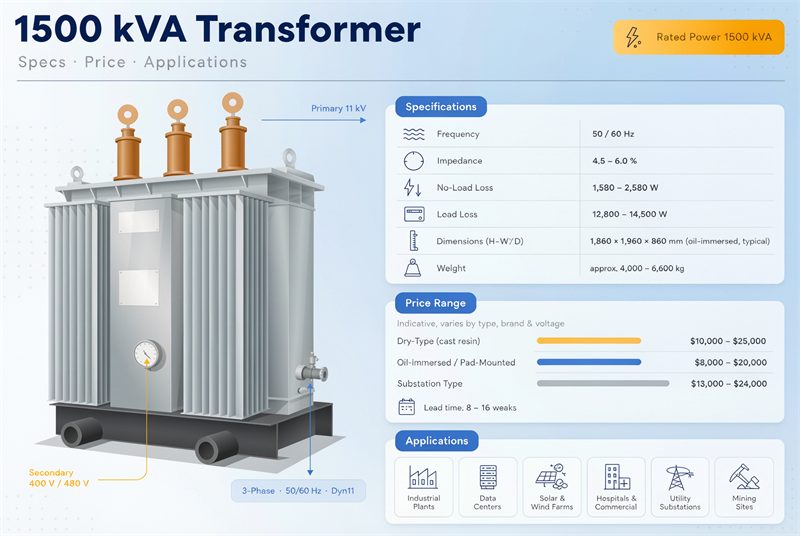
- Full-load amps, three-phase secondary: 4,164 A at 208Y/120, 3,608 A at 240 V delta, 1,804 A at 480Y/277, 1,443 A at 600Y/347.
- Full-load amps, primary: 208 A at 4,160 V, 120 A at 7,200 V (12,470GY/7200), 70 A at 12,470 V, 63 A at 13,800 V, 43 A at 19,920 V (34,500GY/19,920), 25 A at 34,500 V.
- Federal efficiency floor, liquid-immersed three-phase, today: 99.48% at 50% load, which permits 3,920 W of total loss.
- Federal efficiency floor, liquid-immersed three-phase, from April 23, 2029: 99.51% if the unit is not submersible, 99.48% if it is.
- Federal efficiency floor, medium-voltage dry-type three-phase at 1500 kVA: 99.37%, 99.30%, or 99.21% depending on BIL.
- Overcurrent device at 480 V: 2,500 A, which is 139% of full-load current.
- Copper per phase at 480 V: four 1000 kcmil conductors, or a busway.
- Fault current at 480 V, standard impedance: 24.1 to 36.1 kA. Standard 22 kA gear does not cover it.
- Weight: about 9,600 lb filled for a pad-mount unit, about 4,500 lb for a cast resin dry unit.
- Oil: roughly 502 gallons on a published 1500 kVA pad-mount data sheet, which means three units on one site cross the federal spill-planning threshold.
- Price reality: China FOB quotes run from about $18,000 to $46,000. A US dealer listing for the same rating starts at $97,407. That is a 12x spread and almost none of it comes from the kVA.
Is 1500 kVA a standard rating?
Yes, and the check is short. The preferred three-phase ratings come from the NEMA list published in the Federal Register on November 12, 1998, and 1500 sits in the middle of it: 15, 30, 45, 75, 112.5, 150, 225, 300, 500, 750, 1000, 1500, 2000, 2500. That list is also what the federal efficiency tables in 10 CFR 431.196 are built on, so 1500 kVA has its own row rather than needing interpolation.
The divide-by-three shortcut works here too. 1500 divided by 3 is exactly 500, and 500 kVA is a standard single-phase rating, so a 1500 kVA three-phase unit is three standard single-phase-sized cores’ worth of capacity. That shortcut has failed at other sizes. At 1000 kVA, for instance, dividing by three gives 333.33, the single-phase ladder lists 333, and 333 times 3 is 999, not 1000, so you have to go back to the table. At 1500 kVA you do not.
Two related points that save arguments:
There is no 1500 kVA single-phase transformer. The preferred single-phase ladder runs 15, 25, 37.5, 50, 75, 100, 167, 250, 333, 500, 667, 833 and stops. The federal tables stop in the same place. If someone offers you a 1500 kVA single-phase unit, it is a non-standard build.
1600 kVA is not a standard rating either, and it is not in any federal table. It does not appear in the 1998 preferred list and it does not appear in 431.196, so a 1600 kVA unit has to be built to order and its efficiency has to be interpolated. The standard rating directly below it is 1500 kVA. If a spec sheet says 1600 kVA and you have the freedom to change it, 1500 kVA is the rating with the standards behind it.
One more boundary worth knowing. The federal rules only cover a distribution transformer, defined in 10 CFR 431.192 as a unit with an input line voltage of 34.5 kV or less, an output line voltage of 600 V or less, rated for 60 Hz, and a capacity between 10 and 5,000 kVA for liquid-immersed units or 15 and 5,000 kVA for dry-type units. A 1500 kVA unit that steps 34.5 kV down to 480 V is squarely inside that. A 1500 kVA unit feeding a 4,160 V secondary is not, because the output is above 600 V, and no federal efficiency floor applies to it at all. Ask which one you are buying before you compare prices on efficiency.
Full-load current at every voltage you will be quoted
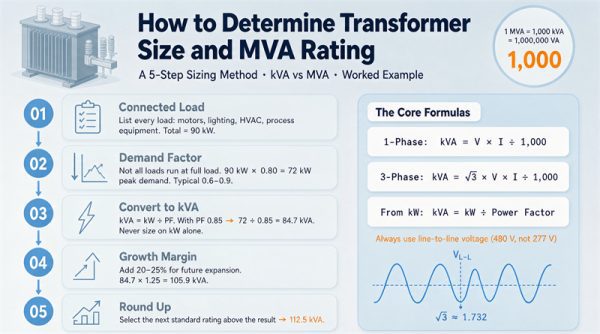
The formula is the same one every other page on this keyword uses: amps equals kVA times 1000, divided by the square root of 3, divided by volts. The reason to put a table here anyway is that the numbers move by a factor of 2.9 across the secondary voltages you will actually see quoted, and that factor is what drives the device ratings, the conductor count, and the switchgear class.
| Secondary voltage | Full-load amps | 125% (NEC 450.3(B)) | Standard device | Conductors per phase, copper 75 °C |
| 208Y/120 | 4,164 A | 5,205 A | 6,000 A | 8 x 1000 kcmil (4,360 A) |
| 240 V delta | 3,608 A | 4,511 A | 5,000 A | 7 x 1000 kcmil (3,815 A) |
| 480Y/277 | 1,804 A | 2,255 A | 2,500 A | 4 x 1000 kcmil (2,180 A) |
| 600Y/347 | 1,443 A | 1,804 A | 2,000 A | 3 x 1000 kcmil (1,635 A) |
Two things to read out of that table. First, at 208 V this is an 8-conductor-per-phase termination, which in practice means a busway or a low-voltage switchboard with a main bus rated for it, not cable. Second, at 600 V the same transformer is a 2,000 A service with three conductors per phase, which is a normal, boring, in-stock installation. The secondary voltage changes the cost of the project more than the manufacturer does.
On the primary side the currents are small enough to be an afterthought, but they still belong on the submittal. Note that a grounded-wye primary is computed on the winding voltage, so a 12,470GY/7200 primary uses 7,200 V in the denominator, not 12,470. Getting that wrong by a factor of 1.73 on a submittal is a common and embarrassing mistake.
| Primary voltage | Full-load amps |
| 4,160 V | 208 A |
| 7,200 V, from a 12,470GY/7200 primary | 120 A |
| 12,470 V | 70 A |
| 13,200 V | 66 A |
| 13,800 V | 63 A |
| 14,400 V, from a 24,900GY/14,400 primary | 60 A |
| 19,920 V, from a 34,500GY/19,920 primary | 43 A |
| 22,860 V delta | 38 A |
| 34,500 V | 25 A |
The 2,500 A wall, and why the conductor count jumps at 1500 kVA
NEC 450.3(B) lets you protect a transformer secondary at up to 125% of full-load current when both the primary and the secondary have overcurrent protection. NEC 240.6(A) then says the device has to be a standard rating, and the standard ratings above 1,200 A are 1,600, 2,000, 2,500, 3,000, 4,000, 5,000, and 6,000.
At 480 V, 125% of 1,804 A is 2,255 A, so the next standard rating up is 2,500 A. That is 139% of the transformer’s full-load current. Fine, and normal.
Then NEC 240.4(C) bites. Above 800 A, the next-size-up rule does not apply, which means the conductor ampacity has to be at least the rating of the overcurrent device, not the load. You cannot round down. With copper at 75 °C, 1000 kcmil is rated 545 A, so:
- 1,635 A gets you three conductors per phase, which covers up to 1,359 kVA at 480 V.
- 1,804 A needs four conductors per phase, or four 750 kcmil at 1,900 A.
So 1000 kVA is the last standard rating where three conductors per phase carry a 480 V secondary, and 1500 kVA is the first standard rating where they do not. That is the practical difference between the two ratings, and it is the reason a 1500 kVA job at 480 V suddenly needs a bigger secondary termination, a bigger switchboard section, and a different cable schedule. Almost no page on this keyword mentions conductor count at all, let alone where the cliff sits.
| At 480 V | 1000 kVA | 1500 kVA |
| Full-load amps | 1,203 A | 1,804 A |
| 125% of full-load current | 1,504 A | 2,255 A |
| Standard overcurrent device | 1,600 A | 2,500 A |
| Conductors per phase, copper 75 °C | 3 x 1000 kcmil | 4 x 1000 kcmil |
| Conductor ampacity | 1,635 A | 2,180 A |
| Fault current at 5.75% | 20.9 kA | 31.4 kA |
| Standard 22 kA switchgear | Works | Does not work |
At 208 V the same logic gives 4,164 A, a 6,000 A device at 144% of full-load current, and eight conductors per phase. Eight runs of 1000 kcmil per phase is 24 large conductors into one termination. That is a busway job.
Why one 1500 kVA at 480 V cannot stay inside 22 kA switchgear
This is the finding that changes the most money, and it is the one no competitor on this keyword touches. Prospective fault current on the secondary of a transformer, ignoring the utility source, is full-load current divided by impedance. For a 1500 kVA unit at 480 V, full-load current is 1,804 A:
| Impedance | Fault current at 480 V | Inside 22 kA gear? |
| 5.0% | 36.1 kA | No |
| 5.75% | 31.4 kA | No |
| 6.0% | 30.1 kA | No |
| 6.5% | 27.8 kA | No |
| 7.0% | 25.8 kA | No |
| 7.5% | 24.1 kA | No |
| 8.0% | 22.6 kA | No |
| 8.20% | 22.0 kA | Exactly at the line |
Now compare that to the impedance band a 1500 kVA liquid-immersed three-phase unit is normally built to. The definition of a special-impedance transformer in 10 CFR 431.192 carries a table of normal impedance ranges, and for three-phase liquid-immersed units from 750 to 5,000 kVA that range is 5.0% to 7.5%. Read the two together: every impedance a 1500 kVA unit would normally be built to produces between 24.1 and 36.1 kA, and all of it is above 22 kA.
To get a single 1500 kVA at 480 V down to 22 kA you need 8.20% impedance, which is above the top of the normal band. And here is the trap: a transformer built to operate outside the normal impedance range is, by definition, a special-impedance transformer, and special-impedance transformers are on the list of thirteen exclusions from the definition of a distribution transformer. Order the high-impedance unit to solve your switchgear problem and you have quietly taken the unit outside the federal efficiency standards. That may be the right trade on a given project, but it should be a decision, not an accident.
At 208 V it is not close. 4,164 A at 5.75% is 72.4 kA, and getting that under 22 kA would take 18.93% impedance, which nobody builds. Plan on 42 kA or 65 kA rated gear, or on splitting the service.
One 1500 kVA, or two 750 kVA?
1500 divides neatly by two into 750, and 750 is a standard rating, so the two-unit option is a real option rather than a compromise. Here is the comparison at 480 V, both units fed from the same primary:
| One 1500 kVA | Two 750 kVA, separate secondary buses | |
| Full-load amps each | 1,804 A | 902 A |
| Overcurrent device | 2,500 A | 1,200 A each |
| Conductors per phase | 4 x 1000 kcmil | 2 x 1000 kcmil each |
| Fault current at 5.75% | 31.4 kA | 15.7 kA each |
| Switchgear class | 42 kA or 65 kA | 22 kA is fine |
| Federal loss floor at 50% load | 3,920 W total | 2,264 W each, 4,527 W total |
| Footprint | One pad | Two pads, two sets of clearances |
| Redundancy | None | One unit can carry part of the load |
The switchgear line is the whole argument. Splitting the secondary onto two separate buses drops each half to 15.7 kA, comfortably inside standard 22 kA gear, and it buys you a spare. If you put two 750 kVA units on the same secondary bus, the fault current is still about 31 kA, because both units feed the same bus. Splitting only works if the bus is actually split.
The counterargument is losses and space. One 1500 kVA is permitted 3,920 W of total loss at the 50% test load; two 750 kVA units are permitted 2,264 W each, or 4,527 W together. That 607 W difference is worth about $531 a year at $0.10 per kWh, or roughly $6,600 in present value over thirty years at a 7% discount rate. On top of that you are buying two pads, two sets of primary and secondary terminations, two oil volumes to keep track of, and double the maintenance visits.
Our recommendation is the boring one: if the site can take 42 kA gear and a 2,500 A main, buy the single 1500 kVA. If the switchgear is the expensive part of the job, or if the load genuinely has two halves that can be separated, two 750 kVA units on separate buses is the better engineering answer.
The federal efficiency floor at 1500 kVA
All of these numbers come straight out of the efficiency tables in 10 CFR 431.196. All of the liquid-immersed values are at 50% of nameplate load, and the dry-type values are at the load each paragraph specifies. The allowed-loss column is the arithmetic version of the same requirement: output at the test load, times (1 divided by efficiency, minus 1).
| Category | Paragraph | Today | From April 23, 2029 | Allowed loss today | Allowed loss 2029 |
| Liquid-immersed, three-phase, not submersible | (b)(2) to (b)(3) | 99.48% | 99.51% | 3,920 W | 3,693 W |
| Liquid-immersed, three-phase, submersible | (b)(2) to (b)(4) | 99.48% | 99.48% | 3,920 W | 3,920 W |
| Medium-voltage dry-type, BIL 20 to 45 kV | (c)(2) to (c)(3) | 99.37% | 99.43% | 4,755 W | 4,300 W |
| Medium-voltage dry-type, BIL 46 to 95 kV | (c)(2) to (c)(3) | 99.30% | 99.37% | 5,287 W | 4,755 W |
| Medium-voltage dry-type, BIL 96 kV and above | (c)(2) to (c)(3) | 99.21% | 99.29% | 5,972 W | 5,363 W |
Read the dry-type rows twice, because this is where 1500 kVA gets strange. A dry-type unit’s category is decided by its primary voltage. A dry-type transformer with an input of 600 V or less is a low-voltage dry-type unit and is governed by paragraph (a). A dry-type transformer with a rated primary between 601 V and 34.5 kV is a medium-voltage dry-type unit and is governed by paragraph (c), which splits the requirement three ways by basic impulse insulation level.
Here is the catch. The low-voltage dry-type tables list three-phase ratings only through 1,000 kVA. There is no 1,500 kVA row. The rule says ratings not appearing in the table get their minimum efficiency by linear interpolation of the values immediately above and below, and at 1,500 kVA there is no value above to interpolate from. If you are buying a 1500 kVA cast resin unit with a 480 V primary and a 208Y/120 secondary, that is the table you land in, and the honest answer is that the requirement has to be settled with the manufacturer and the authority having jurisdiction rather than read off a page. Ask the vendor which paragraph they are claiming compliance against, and ask for guaranteed losses in watts rather than a percentage.
A 1500 kVA dry-type unit with a 13.8 kV primary is a different animal. That one is medium-voltage dry-type, it has its own row, and the row splits three ways by BIL: 99.37% at BIL 20 to 45 kV, 99.30% at 46 to 95 kV, and 99.21% at 96 kV and above. The same 1500 kVA cast resin unit has three different federal efficiency requirements depending on its insulation level, and the highest-BIL version is allowed 1,217 W more loss than the lowest. If a vendor quotes one efficiency number for a medium-voltage dry-type unit without naming the BIL, the number is meaningless.
One exclusion worth knowing, because it gets misquoted: the thirteen exclusions include a “sealed transformer,” but the definition of that term is a dry-type transformer designed to remain hermetically sealed. A hermetically sealed oil-filled pad-mount is not excluded on that ground. It is still covered.
What the April 2029 update is actually worth at 1500 kVA
Plenty of pages will tell you a compliance date is coming. Very few will tell you what it is worth in dollars, which is the only number that should change a purchase decision. Here is the 2029 increment at 1500 kVA, converted to watts at the test load, then to money at $0.10 per kWh, 8,760 hours a year, and a present-value factor of 12.409 over thirty years at 7%:
| Category | Change | Watts | Per year | Present value |
| Liquid-immersed, not submersible | +0.03 points | 227 W | $199 | $2,465 |
| Liquid-immersed, submersible | none | 0 W | $0 | $0 |
| Medium-voltage dry-type, BIL 20 to 45 kV | +0.06 points | 455 W | $398 | $4,939 |
| Medium-voltage dry-type, BIL 46 to 95 kV | +0.07 points | 532 W | $467 | $5,797 |
| Medium-voltage dry-type, BIL 96 kV and above | +0.08 points | 609 W | $533 | $6,616 |
Two things fall out of that table. First, on the liquid side the 2029 update at 1500 kVA is worth about $2,465 over thirty years, and for a submersible unit it is worth exactly nothing, because the submersible table does not move. Second, the dry-type increment keeps shrinking as capacity grows. For medium-voltage dry-type at BIL 20 to 45 kV the increment runs +0.11 points at 300 kVA, +0.09 at 500, +0.08 at 750, +0.07 at 1000, +0.06 at 1500, +0.06 at 2000, and +0.05 at 2500. The low-voltage dry-type series does the same thing: +0.20 at 300, +0.17 at 500, +0.15 at 750, +0.14 at 1000.
The practical conclusion: do not buy a 1500 kVA transformer because of the 2029 date. On the liquid side the update is worth less than a service call. What is worth real money is how far a specific unit sits above the floor that already applies today, and that number you can only get from the routine test report. Buy on measured losses, not on a compliance calendar.
How to read a data sheet against the floor
You do not need a lab to check a vendor’s efficiency claim. You need two numbers from the data sheet, no-load loss and load loss, and one line of arithmetic.
Allowed loss equals output at the test load times (1 divided by efficiency, minus 1). At 1500 kVA and 50% load the output is 750,000 W, so a non-submersible liquid-immersed unit is allowed 750,000 times (1/0.9948 minus 1), which is 3,920 W. A unit’s own losses at the same load are no-load loss plus load loss times 0.25, because load loss scales with the square of the load.
Now run two published data sheets through it.
A widely copied 1500 kVA pad-mount specification lists no-load loss of 2,100 W and load loss of 12,500 W at full load. At the 50% test load that is 2,100 plus 3,125, or 5,225 W, against a floor of 3,920 W. That is 1,305 W, or 33%, above what the federal floor allows, and it computes to 99.31% efficiency at the test load. Either that unit is not built to the federal floor, or those two numbers are not the tested values. Both are worth knowing before you sign.
A UL-listed 1500 kVA pad-mount unit marketed for data centers publishes no-load loss of 1,442 W and load loss of 19,331 W at 85 °C. At 50% load that is 1,442 plus 4,833, or 6,275 W, which is 60% above the floor. There is a legitimate reason it might not apply, though, and it is worth checking: that unit is described as an isolation transformer with a 416Y/240 V secondary, and the federal definition of a drive (isolation) transformer excludes any unit whose rated output voltage is neither 208Y/120 nor 480Y/277. A 416Y/240 V secondary is neither. So that unit may be outside the definition entirely, in which case the floor does not apply to it and comparing its price to a compliant unit’s price is not a like-for-like comparison.
That is the real lesson. Before you apply the federal floor to any quote, confirm the unit is a distribution transformer at all, then confirm which paragraph and which test load apply, then confirm the reference temperature the losses were corrected to. Three questions, thirty seconds each, and they catch most of the bad comparisons in this market.
Weight, size, and getting it in the door
At 1500 kVA the physical side stops being a footnote. A published 1500 kVA pad-mount data sheet gives a total weight of 9,600 lb, or 4,354 kg, with oil, on a footprint of 66 inches high by 98 inches wide by 74 inches deep. The same source calls for a concrete pad of 132 by 132 inches, 4 to 6 inches thick, reinforced, leveled to within a quarter inch per foot, and cured for 28 days before the unit lands on it. At that weight you are scheduling a crane, not a forklift.
The dry-type version is lighter. A published 1500 kVA cast resin unit at 480 V to 208Y/120 comes in around 4,500 lb, or 2,041 kg, at 84 by 48 by 42 inches, which is tall and narrow enough to go through a door but still needs a structural check on the floor above grade. Other manufacturers in this band publish 4,500 to 5,200 kg for oil-filled units, which brackets the same answer.
Two practical rules. First, measure the door, the hatch, the corridor, and the turning radius before you order, not after. Second, ask for the shipping weight and the core-and-coil weight separately, because the rigging crew needs the core weight to plan the lift and the shipping weight to plan the truck.
Oil, and the three-unit spill line
A published 1500 kVA pad-mount data sheet lists an oil volume of 502 gallons, about 1,900 liters. Under the federal spill-prevention rules in 40 CFR Part 112, a facility with more than 1,320 gallons of aboveground oil storage capacity, where a discharge could reach navigable waters, needs a Spill Prevention, Control and Countermeasure plan. Oil-filled electrical equipment counts toward that total.
So the arithmetic is short. One 1500 kVA pad-mount is 502 gallons. Two are 1,004. Three are 1,506, which is over the line. At 1000 kVA the published oil volumes put the same threshold somewhere between five and seven units depending on radiator design, so the margin you had there is gone. If your project has three or more of these on one pad, the SPCC plan is a line item, not an afterthought, and it needs to be in the budget from the start.
Price: what the published numbers actually say
Every page on this keyword publishes a price range. Almost none of them say where the range comes from, and the ranges disagree by a factor of four. Here is what is actually on the record, with the source and the date, retrieved October 12, 2026:
| Source | What it is | Numbers |
| toptransformer.com | China FOB, 1500 kVA oil-immersed | S11 $18,000 to $24,000, S13 $22,000 to $30,000, S15 $28,000 to $38,000, S15 with OLTC $34,000 to $46,000 |
| ztelecgroup.com | China FOB Shanghai, oil-immersed | $22,000 to $42,000 depending on cooling, voltage, certification, tap changer |
| daelimtransformer.com | Unsourced range, plus its own pricing | $9,800 to $23,000 generally, $13,600 to $19,800 for its own units |
| doscable.com | Unsourced range | $10,000 to $40,000 |
| Giga Energy, Los Angeles | US dealer listing, in stock | from $97,407 for a 1500 kVA pad-mount, 22860 delta to 480Y/277 |
| That last row is the one to sit with. A US dealer’s in-stock listing for a 1500 kVA pad-mount starts at $97,407, which is more than twice the top of the highest China FOB range, and about twelve times the bottom of the lowest. None of the twelve competitor pages explain the gap, and it is not a mystery. A China FOB number excludes ocean freight, insurance, destination clearance, and local taxes, and it assumes a factory build slot. A US listing includes freight, inventory carrying cost, warranty administration, and a margin on a unit somebody already paid for. They are different products in an economic sense even when the nameplate is identical. |
What actually moves the number, in rough order, based on the same sources: the tap changer (an on-load tap changer adds roughly $2,000 to $4,000 over a de-energized one), third-party certifications (10 to 15%), a 33 kV class primary instead of 10 kV (15 to 20%), expedited delivery (8 to 15%), and order quantity (3 to 8% off for consolidated buys). Winding material matters too, and copper costs more than aluminum up front while losing less to load loss over thirty years.
The honest way to use a price range is to compare like with like. Get every vendor to quote the same written specification, including the same efficiency requirement, the same cooling class, the same tap range, and the same accessories, then compare. If two quotes on the same specification are more than about 20% apart, one of them is not quoting the same machine.
Applications: where 1500 kVA earns its keep
1500 kVA is about 1,200 kW of real power at 0.8 power factor, which is a useful number to hold in your head. It is the size of unit that shows up in a handful of predictable places.
Industrial plants and parks. A single 1500 kVA unit feeds a mid-size factory floor, and the 1600 to 2000 kVA band above it is where you go when several heavy loads run at once. That step up is covered on our industrial oil-immersed page.
Renewables. A 1.5 MVA block is a common step-up size for a section of a solar or wind plant. If the unit is feeding an inverter, the duty is not a steady distribution load, and the specification has to account for harmonic content and clipping behavior. Our step-up transformer work covers that pattern in more detail. Above this rating, the 35 kV large-capacity oil-immersed range picks up at 6,300 kVA and runs to 31,500 kVA, which is a different class of machine and a different buying conversation.
Data centers and large campuses. This is where the 480 V to 416Y/240 V variant shows up, feeding imported 400 V class equipment from a 480 V system. If that is your application, read the isolation-transformer exclusion note above before you compare prices, because a unit outside the federal definition is a different product.
Heavy duty with swinging load. Furnace and regulating duty is the extreme case. Our furnace transformer supply for a steel plant modernization programme is a worked example of specifying against a melt cycle rather than a nameplate kVA, with ONAF cooling and impedance chosen to limit fault current through repeated electrode shorts. The lesson transfers: if your load swings hard, the kVA rating is the least interesting number on the nameplate.
Hospitals, universities, and airports. Large institutional loads where a single 1500 kVA unit replaces several smaller ones and simplifies the switchboard.
One published 1500 kVA pad-mount page gives a worked load split that is worth copying as a sanity check, because it shows how quickly a nameplate fills up:
| Load | Estimated demand |
| Heavy industrial loads | 750 kVA |
| HVAC chillers | 375 kVA |
| Auxiliary systems | 225 kVA |
| Total | 1,350 kVA of a 1,500 kVA rating |
That is 90% of nameplate on three loads, with nothing left for growth. If your load list adds up to more than about 1,200 kVA, the next standard rating up, 2000 kVA, is the honest answer rather than running a 1500 kVA unit at the edge of its rating.
Spec choices that change the price and the risk
On-load tap changer versus de-energized. A DETC requires the unit to be de-energized to change taps. An OLTC regulates under load, which is what you want on a feeder with wide voltage swing, and it costs $2,000 to $4,000 more plus an AVR cabinet. If your voltage is stable, do not pay for it.
ONAN versus ONAF. ONAN is natural cooling and is the default. ONAF adds forced air and buys roughly 15 to 25% more capacity, which is worth it if you run above about 85% of nameplate or sit in a hot climate. Fans are a maintenance item and a failure mode, so the extra capacity has to be worth the extra parts.
Impedance. Specify it deliberately, with a tolerance, and check it against your fault study. Low impedance gives better voltage regulation and a higher fault level. Higher impedance does the reverse. And remember the band: for a three-phase liquid-immersed unit between 750 and 5,000 kVA, 5.0% to 7.5% is normal, and going outside that band changes the unit’s regulatory status.
BIL, windings, and fluid. For a medium-voltage dry-type unit the BIL decides which efficiency row applies, so specify it rather than accepting whatever is standard. Copper windings cost more and lose less than aluminum. Mineral oil is standard; FR3 or ester fluid costs more and buys a higher fire point, which matters indoors and near occupied space.
What to put in the RFQ
A short list that catches most of the expensive mistakes:
- Rated capacity, phase, frequency, and whether the rating is standard or built to order.
- Primary and secondary voltages, including whether a grounded-wye primary is specified, and the vector group.
- Impedance with tolerance, and confirmation it sits inside the normal band unless you intend otherwise.
- Guaranteed no-load loss and load loss in watts, with the reference temperature, plus the routine test report that proves them.
- Which federal paragraph and test load the efficiency claim is made against, or a statement that the unit is outside the definition.
- Cooling class, tap range, tap changer type, and BIL.
- Weight, shipping weight, core weight, dimensions, and the door and pad sizes you need to hit.
- Oil volume, and whether the site crosses the SPCC threshold with this unit added.
- Accessories and monitoring, including the communication protocol if you want SCADA.
- Lead time, warranty terms, and what happens to the schedule if a routine test fails.
Send the same list to every vendor. The answers, side by side, tell you more than any price comparison.
Frequently asked questions
How many amps does a 1500 kVA transformer draw?
At 480Y/277 V, 1,804 A per phase. At 208Y/120 V it is 4,164 A, at 240 V delta it is 3,608 A, and at 600Y/347 V it is 1,443 A. The formula is kVA times 1000, divided by the square root of 3, divided by volts.
Is 1500 kVA the same as 1.5 MVA?
Yes. 1 MVA is 1,000 kVA, so 1500 kVA is 1.5 MVA. Both notations show up on nameplates and in specifications, and they mean the same thing.
Is 1500 kVA a standard transformer size?
Yes, for three-phase. It is on the NEMA preferred rating list published in the Federal Register on November 12, 1998, and it has its own row in the federal efficiency tables in 10 CFR 431.196. There is no standard 1500 kVA single-phase rating; the single-phase ladder stops at 833 kVA.
What is the difference between 1500 kVA and 1600 kVA?
1500 kVA is a standard rating with its own row in the federal tables. 1600 kVA is not on the preferred list and is not in the federal tables, so it is a build-to-order rating whose efficiency has to be interpolated. If a specification can move, 1500 kVA is the rating with the standards behind it.
How much does a 1500 kVA transformer cost?
China FOB quotes for a 1500 kVA oil-immersed unit run from about $18,000 to $46,000 depending on efficiency grade, tap changer, and certification. A US dealer’s in-stock listing for the same rating starts at $97,407. Those are different commercial terms, not a like-for-like comparison, and the spread comes mostly from freight, inventory, and warranty rather than from the transformer.
How much does a 1500 kVA transformer weigh?
A published 1500 kVA pad-mount data sheet gives 9,600 lb, or 4,354 kg, with oil. A cast resin dry-type unit at the same rating is around 4,500 lb, or 2,041 kg. Other manufacturers publish 4,500 to 5,200 kg for oil-filled units in this band.
What size breaker does a 1500 kVA transformer need at 480 V?
With primary and secondary protection, NEC 450.3(B) allows up to 125% of full-load current, which is 2,255 A at 480 V. The next standard rating in NEC 240.6(A) is 2,500 A. Above 800 A the next-size-up rule in NEC 240.4(C) does not apply, so the conductors have to carry the device rating, not the load.
Can a 1500 kVA transformer run on 22 kA switchgear?
Not at 480 V as a single unit. A standard-impedance 1500 kVA unit, built anywhere in the normal 5.0% to 7.5% band, produces 24.1 to 36.1 kA at 480 V. Holding 22 kA would take 8.20% impedance, which is outside the normal band and turns the unit into a special-impedance transformer excluded from the federal efficiency rules. Plan on 42 kA or 65 kA gear, or split into two 750 kVA units on separate secondary buses.
How much oil does a 1500 kVA transformer hold?
A published pad-mount data sheet lists 502 gallons, about 1,900 liters. Under 40 CFR Part 112, three of those on one site is 1,506 gallons, which is over the 1,320 gallon federal threshold and triggers an SPCC plan.
Does the 2029 DOE efficiency rule matter at 1500 kVA?
On the liquid side, barely. The floor moves from 99.48% to 99.51% for a non-submersible unit, which is 227 W at the test load and about $2,465 in present value over thirty years. For a submersible unit it does not move at all. Dry-type moves more, up to $6,616 depending on BIL. Either way, measured losses today tell you more than the compliance date does.
Bottom line
1500 kVA is a standard three-phase rating, it draws 1,804 A at 480 V and 4,164 A at 208 V, and the interesting decisions all live downstream of the nameplate. At 480 V you are buying a 2,500 A device with four copper conductors per phase, which is a step up from the three conductors that carry a 1000 kVA unit, and you are buying switchgear rated above 22 kA unless you split the service. The federal efficiency floor is 99.48% today and 99.51% from April 2029 for a liquid-immersed non-submersible unit, the 2029 change is worth about $2,465 over thirty years, and the dry-type floor splits three ways by BIL. Three of these units on one site cross the federal spill-planning threshold. And the price spread on this rating runs from about $18,000 FOB China to $97,407 from a US dealer, which is a commercial gap, not a technical one.
If you are specifying one of these, the two questions that save the most money are which secondary voltage you are committing to and what the guaranteed losses are in watts. Everything else follows from those.
If you are still working the problem, the rest of the site is organised the same way. The product pages carry the per-series data sheets, the resources library covers the neighboring ratings and the standards behind them, and TransNine Electric is the front door if you would rather start from your single-line diagram.
How to cite this article
TransNine Electric. “1500 kVA Transformer: Specs, Price & Applications.” TransNine Electric Resources, October 12, 2026. https://www.transnineelectric.com/resources/1500-kva-transformer-specs-price-applications/
Figures in this article were verified against 10 CFR 431.192 and 10 CFR 431.196 as published on eCFR, against the NEMA preferred rating list published at 63 FR 63360 (Federal Register, November 12, 1998), and against 40 CFR Part 112, all retrieved October 12, 2026. Third-party prices and data sheets are cited in the text with their source and retrieval date, are quoted on differing commercial terms, and are not quotations from TransNine Electric. Current, overcurrent device, and conductor values are the author’s arithmetic from the cited formulas and should be confirmed against the project’s fault study and the local authority having jurisdiction.