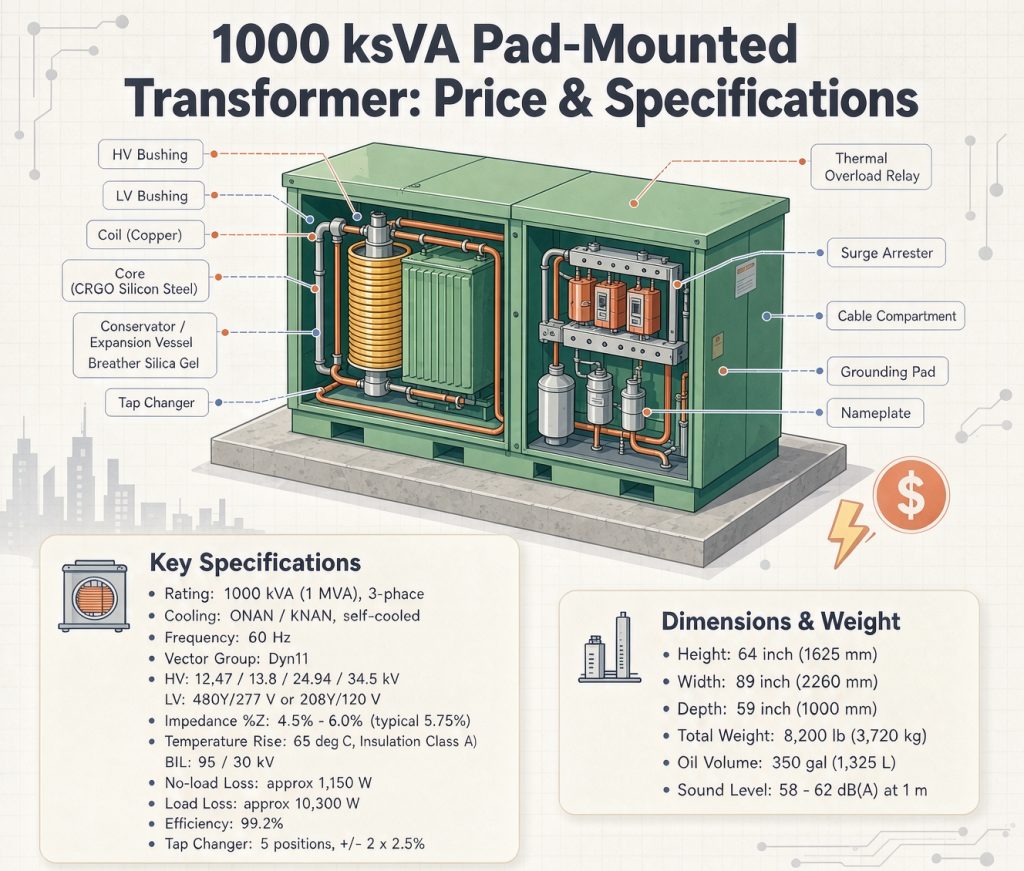
A 1000 kVA (1 MVA) three-phase pad mounted transformer steps 12.47–13.8 kV down to 480Y/277 V, delivers 1,203 A of secondary current at that voltage, weighs roughly 7,000–9,700 lb filled, and in 2026 runs 35,000–90,000 for the unit plus 22,000–40,000 to install. It is built to IEEE C57.12.34, must hit a DOE minimum efficiency of 99.43% today, and 99.46% if it is manufactured on or after April 23, 2029.
Governing documents: IEEE C57.12.34 (construction) · IEEE C57.12.28 (enclosure integrity) · IEEE C57.12.90 (test code) · DOE 10 CFR 431 Subpart K, §431.196 (efficiency) · CSA C227.4 (Canada)
1. The 60-second version
If you already know you need a 1 MVA pad-mount and you just want the numbers, here they are.
| Spec | Value |
| Rated power | 1000 kVA (1 MVA), three-phase, 60 Hz |
| Common primary | 12,470 GrdY/7,200 · 13,200 · 13,800 V (15 kV class); 24,940 GrdY/14,400 (25 kV); 34,500 (35 kV) |
| Common secondary | 480Y/277 V (the North American default at this size) · 208Y/120 V · 600Y/347 V (Canada) |
| Secondary full-load current | 1,203 A @ 480Y/277 V · 2,776 A @ 208Y/120 V · 962 A @ 600Y/347 V |
| Primary full-load current | 46 A @ 12.47 kV · 44 A @ 13.2 kV · 42 A @ 13.8 kV · 17 A @ 34.5 kV |
| BIL | 95 kV (15 kV class) · 125 kV (25 kV class) · 150 kV (35 kV class) |
| Impedance | 5.75% typical; 4.5–7.0% available |
| Cooling | ONAN / KNAN, self-cooled |
| Temperature rise | 65 °C standard (55 °C and 55/65 dual-rated available) |
| Efficiency floor (DOE) | 99.43% now → 99.46% on/after April 23, 2029, at 50% load |
| Filled weight | ~3,200–4,400 kg (7,000–9,700 lb) |
| Oil volume | ~200–350 gal depending on class and design |
| Dimensions (W × D × H) | roughly 1,650–2,200 × 1,500–1,900 × 1,600–1,900 mm (65–87 × 59–75 × 63–75 in) |
| 2026 unit price | 35,000–90,000; ester-filled copper builds with full accessories run higher |
| Installed cost | Add 22,000–40,000 for pad, cable, labor, crane, testing and permits |
One framing note before we go deeper: this page is the 1 MVA deep dive. If you are still deciding which size you need across the whole pad-mount range, start with our pad mounted transformer sizes and prices guide — it covers every rating from 75 kVA up, and this page picks up where it leaves off at exactly 1000 kVA.
2. What a 1000 kVA pad-mount actually is — and who buys one
A pad-mount is a ground-level, locked, tamper-resistant steel cabinet sitting on a concrete pad. Medium-voltage cable comes up from below into the high-voltage compartment; low-voltage cable leaves the adjacent compartment and runs to your switchgear. The core and coils sit in a sealed, liquid-filled tank behind the doors. No vault, no building, no fence in most utility standards.
At 1000 kVA you are at the top of “distribution” and the bottom of “substation.” That is exactly why this rating is such a common decision point.
Typical homes for a 1 MVA pad-mount:
- Mid-size commercial and mixed-use buildings — HVAC plants, vertical transportation, tenant panels
- Apartment and condo complexes — one unit serving the house load plus EV readiness
- Manufacturing and light industrial plants — motor loads, compressors, process equipment
- Data center mechanical and support loads — chillers, pumps, UPS input, not the IT busway itself
- Cold storage and food processing
- EV charging depots and fleet electrification sites
- Solar PV, BESS and microgrid interconnection — collector step-down to 480 V
- Water and wastewater treatment — where the load is continuous and the duty is ugly
The through-line: 1000 kVA is the rating people pick when calculated demand lands around 700–850 kVA and they want 15–25% of headroom for growth without paying for a second unit.
For a sense of how these units land in the field, see this utility EPC compact substation programme — the same rating class, delivered as part of a wider distribution build.
3. 1000 kVA pad-mount specifications
Here is the full spec sheet you should expect to receive. Anything missing from a vendor’s submittal is a question, not a detail.
| Parameter | Standard / typical value | Notes |
| Rated power | 1000 kVA | = 1 MVA. At 0.9 pf that is 900 kW of real power |
| Phase / frequency | 3-phase, 60 Hz | 50 Hz must be raised at quote stage, not after |
| Construction standard | IEEE C57.12.34-2022 | Active version, published Dec 21, 2022; ANSI approved May 7, 2024 |
| Enclosure integrity | IEEE C57.12.28 | Pry resistance, three-point latching, penta-head bolts |
| Test code | IEEE C57.12.90 | Routine tests for liquid-immersed units |
| Primary voltage | 2,400–34,500 V | Class chosen from the serving utility |
| Secondary voltage | 208Y/120 · 480Y/277 · 600Y/347 · 240/480 delta | 480Y/277 dominates at 1 MVA |
| BIL (HV / LV) | 95 / 30 kV (15 kV class) · 125 / 30 kV (25 kV) · 150 / 30 kV (35 kV) | Match the class, don’t overspec for nothing |
| Impedance | 5.75% typical | Sets your secondary fault current — see §5 |
| Vector group | Dyn1 (common) · YNyn0 · Dyn11 | Must match any unit you plan to parallel |
| Cooling | ONAN (mineral oil) / KNAN (ester or less-flammable fluid) | Self-cooled; fans are rare at this size |
| Temperature rise | 65 °C average winding | 55 °C or 55/65 dual-rating available |
| Insulation class | A (65 °C rise) | |
| Tap changer | 5-position DETC, ±2 × 2.5% | De-energized only; OLTC is not a pad-mount feature |
| Feed configuration | Radial (3 HV bushings) or loop (6 HV bushings) | Loop adds a switching position |
| Front | Dead-front standard, live-front on request | Dead-front uses loadbreak elbows |
| Protection | Bay-O-Net fuse + ELSP current-limiting backup | Dual-sensing or overload-sensing |
| Winding material | Aluminum standard, copper on request | Copper typically +20–40% |
| Fluid | Mineral oil, or FR3 / natural ester | Ester changes gasket and labeling requirements |
| Noise | 55–65 dB(A) depending on design | Ask whether it is guaranteed or “typical” |
| Ambient | −40 °C to +50 °C operating, depending on design | Altitude above 1,000 m requires derating |
Watch for a stale spec sheet. The older IEEE C57.12.22 – the 1995 pad-mount standard – was withdrawn on January 15, 2001. If a vendor’s cut sheet still cites C57.12.22 as its governing document, you are looking at a template that has not been refreshed in two decades. The current document is IEEE C57.12.34.
If any of these fields look unfamiliar on the submittal drawing, our guide to reading a transformer nameplate and technical parameters walks through each one.
4. Full-load current at 1000 kVA: every common voltage
This is the table that sizes your conductors, your breakers and your bus. It is pure arithmetic — I = kVA × 1000 / (√3 × V_LL) — but almost nobody publishes it complete for 1 MVA.
Secondary side (low voltage)
| Secondary voltage | Full-load current |
| 208Y/120 V | 2,776 A |
| 240 V delta | 2,406 A |
| 415Y/240 V | 1,391 A |
| 480Y/277 V | 1,203 A |
| 480 V delta | 1,203 A |
| 600Y/347 V | 962 A |
Primary side (medium voltage)
| Primary voltage | Full-load current |
| 2,400 V delta | 241 A |
| 4,160 V | 139 A |
| 4,800 V delta | 120 A |
| 7,200 V delta | 80 A |
| 12,000 V delta | 48 A |
| 12,470 GrdY/7,200 V | 46 A |
| 13,200 V | 44 A |
| 13,800 V | 42 A |
| 22,900 GrdY/13,200 V | 25 A |
| 24,940 GrdY/14,400 V | 23 A |
| 34,500 V | 17 A |
Two practical consequences that catch people out at 1 MVA:
- 1,203 A does not fit in one set of conductors. At 480Y/277 V you are normally into parallel conductor runs or busway on the low-voltage side. Confirm the LV compartment wireway dimensions and the spade terminal count before you buy cable.
- Secondary voltage is an installation-cost decision, not just an electrical one. Dropping from 480Y/277 V to 208Y/120 V more than doubles your secondary current (1,203 A → 2,776 A). That is a great deal more copper.
5. Is 1000 kVA the right size? 750 vs 1,000 vs 1,500
Most 1 MVA pad-mounts are bought either correctly or one size too large. Here is the honest comparison at 480Y/277 V.
| 750 kVA | 1000 kVA | 1500 kVA | |
| Secondary full-load current | 902 A | 1,203 A | 1,804 A |
| Sensible continuous demand | 520–640 kVA | 700–850 kVA | 1,050–1,275 kVA |
| Secondary fault current @ 5.75% Z (transformer only) | ~15.7 kA | ~20.9 kA | ~31.4 kA |
| Filled weight (approx.) | 2,755–3,300 kg | 3,200–4,400 kg | ~5,800 kg |
| 2026 unit price band | 30,000–60,000 | 35,000–90,000 | 68,000–92,000 |
| Choose it when | Demand is under ~640 kVA and flat | Demand is 700–850 kVA, or 800–900 kVA with 3–5 year growth | Demand already exceeds ~1,050 kVA, or you need two LV feeders |
Read the fault-current row carefully. Available secondary fault current is roughly I_FL ÷ Z_pu, so 1,203 A ÷ 0.0575 ≈ 20.9 kA with an infinite utility source. Your real number drops once you add utility source impedance, but your switchgear AIC rating has to be specified against the calculated value, not a guess. If your gear is sitting at 22 kA, moving to 7.0% impedance drops you to ~17.2 kA and may save a switchboard upgrade. That single line can be worth more than the transformer.
The sizing rule of thumb: land your calculated demand at 70–85% of nameplate. At 1000 kVA, that means serving 700–850 kVA of demand. Oversizing costs you twice — once in the purchase price, and again in no-load losses you pay for every hour of a 30-year life.
You can compare adjacent ratings and build configurations across the full transformer product range.
6. What a 1000 kVA pad-mount costs in 2026
Published 2026 listings cluster into three bands. Treat these as budget anchors, not quotes — the spread between two “identical” 1000 kVA units is routinely 3×.
| Build | 2026 unit price | What you get |
| Aluminum windings, mineral oil, dead-front, 15 kV class | 35,000–55,000 | Catalog construction, standard accessories |
| Copper windings, UL listed, upgraded fusing and gauges | 60,000–90,000 | Utility-spec build, better short-circuit strength |
| Sealed tank, natural ester (FR3), full tap and arrester package | 100,000–150,000+ | Less-flammable fluid, biodegradable, coastal-grade coating |
Installation adds 22,000–40,000 at this rating — concrete pad, primary and secondary cable, terminations, grounding, crane, electrical labor, civil work, permits and commissioning. A realistic installed budget for a mainstream 1 MVA pad-mount is 77,000–115,000.
Two things to keep straight:
- Unit price is roughly half the project. Contractors who quote only the transformer are not quoting the project.
- Offshore FOB looks dramatically cheaper — sometimes half — and then you add freight, duty, the cost of utility approval risk, and the cost of being wrong about a drawing. Compare landed cost, not FOB.
7. Efficiency and losses: the 2029 rule, and the arithmetic check
This is where most buying guides stop at “meets DOE 2016.” Here is what that actually means at 1000 kVA.
The rule. DOE defines a distribution transformer in 10 CFR 431.192 as 60 Hz, input ≤34.5 kV, output ≤600 V, and 10–5,000 kVA for liquid-immersed units. Minimum efficiency sits in 10 CFR 431.196, certified at 50% per-unit load with reference temperatures of 20 °C for no-load loss and 55 °C for load loss.
The numbers for 1000 kVA, three-phase liquid-immersed:
| Manufactured before 4/23/2029 | Manufactured on or after 4/23/2029 | |
| Minimum efficiency at 50% load | 99.43% | 99.46% |
| Allowed total loss at the test point (500 kW output) | 2,866 W | 2,715 W |
The check nobody publishes. Because the test point is 50% load, the allowed loss budget is:
If a vendor hands you a no-load loss and a load loss, do this sum before you sign. Two things go wrong in the field: the load loss is quoted at an 85 °C reference instead of 55 °C, which inflates it by roughly 10%; and listings often print “losses are typical only, not guaranteed.” Ask which reference temperature applies, and ask for the certified efficiency value on the test report.
Notice how small the 2029 step is at this rating. 2,866 W → 2,715 W is a 151 W cut, about 5%. DOE leaned far harder on small single-phase and dry-type units than on large three-phase liquid units. So the honest advice for a unit you buy in 2026: the rule governs manufacture and import, not retrofit — your pre-2029 unit stays legal in service. But a 1 MVA pad-mount is a 30-year asset that will spend about 28 of those years under the 2029 regime, and utilities update approved lists. Specifying 99.46% now is cheap insurance.
Turning watts into dollars. No-load loss runs 24/7 whether you use the transformer or not; load loss scales with the square of loading.
Worked example, assumptions stated up front: P₀ = 1,300 W, P_k = 8,500 W (representative published values for an aluminum-wound 1 MVA build), 50% average load factor, 8,760 h/yr, $0.12/kWh.
- No-load: 1,300 × 8,760 = 11,388 kWh/yr
- Load: 8,500 × 0.25 × 8,760 = 18,615 kWh/yr
- Total: 30,003 kWh/yr → $3,600/yr → about $90,000 over 25 years
That is the headline worth remembering: over 25 years, the electricity lost inside the transformer costs about as much as the transformer.
Now the upgrade question. Suppose a low-loss design at P₀ = 1,050 W and P_k = 7,200 W carries an $8,000 premium:
| Load factor | Annual saving | Payback on $8,000 |
| 50% | ~5,037 kWh → $604/yr | ~13 years |
| 75% | ~8,591 kWh → $1,031/yr | ~7.8 years |
The counter-intuitive recommendation: on a lightly loaded 1 MVA pad-mount, the low-loss core premium takes 13 years to pay back. Unless you know the unit will run hot, spend that $8,000 on copper windings, a coastal-grade coating system, and monitoring instrumentation instead — those pay back in avoided failures, not in kilowatt-hours.
8. Copper vs aluminum, mineral oil vs ester at 1 MVA
| Choice | Cost | Why you’d pick it | Why you wouldn’t |
| Aluminum windings | Baseline | Standard catalog build, lighter, fastest lead time | Lower short-circuit strength; many utility specs exclude it |
| Copper windings | +20–40% | Better fault withstand, lower I²R loss, utility-friendly | Heavier, longer lead time, more expensive copper exposure |
| Mineral oil | Baseline | Cheapest, best understood, easiest to service | Flammable — drives fire-code review and SPCC containment |
| Natural ester (FR3) | Fluid +10–25%, plus gasket and labeling upgrades | Fire point above 300 °C, biodegradable, better moisture tolerance, longer insulation life | Higher cost; needs a full flush and gasket compatibility check before any retrofit |
Two warnings worth repeating:
- Never top up a mineral-oil unit with ester without a full flush and gasket compatibility check. Ester attacks some Buna-N and nitrile gaskets.
- A sealed tank has no gas path, so it cannot take a Buchholz relay. Protection comes from a pressure-relief valve, a sudden-pressure relay, and upstream protection. “Maintenance-free” is a real benefit, but it also means you have given up gas-in-oil detection. Know what you traded.
9. Weight, footprint, pad and rigging — the site reality
The specs that actually rearrange your schedule are the physical ones.
- Filled weight: 3,200–4,400 kg (7,000–9,700 lb). This drives the pad design, the crane size and the off-load route. Pull the number from the manufacturer’s outline drawing — never estimate it.
- Oil volume: 200–350 gal. Above threshold volumes, 40 CFR Part 112 SPCC rules apply where a spill could reach a waterway.
- Footprint: roughly 1,650–2,200 mm wide × 1,500–1,900 mm deep. Pad should be reinforced concrete, level, sized to the footprint plus working clearance, with cable entry provisions.
- Clearances: the door side needs room for cabinet swing and hot-stick operation. Remaining sides need less. The serving utility’s standard governs — and they vary.
- Grounding: ground grid tied to tank, enclosure and secondary neutral per NEC Article 250 and IEEE 142.
- Altitude: above 1,000 m (3,300 ft), derating applies. Give the OEM the site altitude up front.
- Noise: if the pad sits near a building line or a property boundary, specify a dB(A) limit. Residential-adjacent sites commonly target 55 dB(A). Order the low-noise option at quote time — you cannot add it later.
- Harmonics: data centers, LED lighting and EV chargers generate triplen harmonics. If non-linear load is more than a modest share of the total, ask about a K-factor rating (K-4, K-13, K-20).
10. When a 1000 kVA pad-mount is the wrong answer
This is the section no competitor writes, and it is the one that saves you the most money.
Go a different route when:
- The unit has to go indoors, or the site is fire-sensitive. Oil-filled pad-mounts are outdoor equipment. Look at cast resin dry-type in a ventilated room.
- You need more than one protected low-voltage feeder. A pad-mount gives you Bay-O-Net fusing and a terminal compartment. It does not give you a feeder lineup. The moment you need 2–4 individually protected LV feeders, metering, or space for future sections, a prefabricated compact substation usually prices out better and installs in one lift.
- You need on-load tap changing. Pad-mounts are 5-position de-energized tap changers. If your voltage regulation needs are dynamic, you are into substation-class equipment.
- You are above ~2,500 kVA. DOE coverage and utility practice both shift, and the cabinet stops being the cheapest answer.
- The utility requires a vault or a network protector. That is a submersible network transformer, a different animal entirely.
- You have heavy MV switching duty. Frequent load-break switching argues for separating the switchgear from the transformer.
Rule of thumb: at 1 MVA, pad-mount wins on cost and speed. At 1 MVA plus switching, metering and multiple feeders, a compact substation wins on total installed cost.
11. RFQ checklist: lock these before you send it out
A 1 MVA pad-mount quote that comes back wrong is almost always a quote where one of these was left blank.
Ratings
- kVA and phase — 1000 kVA, 3-phase
- Primary voltage and connection — e.g. 12,470 GrdY/7,200 V
- Secondary voltage — e.g. 480Y/277 V
- BIL — 95 / 125 / 150 kV by class
- Frequency — 60 Hz (state 50 Hz now if it applies)
- Site altitude, if above 1,000 m
Construction 7. Impedance — 5.75% typical; confirm against your fault-duty study 8. Vector group — must match anything you intend to parallel 9. Tap changer — 5-position DETC, ±2 × 2.5% 10. Feed configuration — radial (3 bushings) or loop (6 bushings) 11. Front — dead-front standard, live-front on request 12. Winding material — aluminum or copper 13. Fluid — mineral oil, FR3, or silicone
Protection and accessories 14. Bay-O-Net fuse catalog number and ELSP current-limiting backup rating 15. Load-break switch — 2- or 4-position (V-blade / T-blade), if required 16. Pressure-vacuum gauge, liquid level gauge, liquid temperature gauge 17. Drain valve with sampling port, pressure-relief device, optional sudden-pressure relay 18. Surge arresters on the primary
Enclosure and compliance 19. Color (ANSI 70 gray, Munsell green 7GY 3.29/1.5) and coating system — specify salt-spray hours, and 304 stainless for coastal sites 20. Security level per IEEE C57.12.28 — captive penta-head bolts, three-point latching 21. Standards: IEEE C57.12.34, IEEE C57.12.28, DOE 431.196 level (2016 or 2029), CSA C227.4 if Canadian, UL listing where required 22. Sound level in dB(A), and whether it is guaranteed or typical
Documentation and commercial 23. Routine tests per IEEE C57.12.90, plus certified efficiency and sound level 24. Drawing package — outline, base wireway dimensions, nameplate diagram, wiring diagram 25. Lead time, warranty, delivery terms, and what happens if the test report is late
12. FAQ
How much does a 1000 kVA pad mounted transformer cost? Budget 35,000–55,000 for an aluminum-wound, mineral-oil, dead-front 15 kV class unit; 60,000–90,000 for a copper-wound, UL-listed build; and 100,000–150,000+ for a sealed tank with natural ester and a full accessory package. Installation adds 22,000–40,000, putting a mainstream installed project at 77,000–115,000.
How many amps is a 1000 kVA transformer at 480 V? 1,203 A at 480Y/277 V or 480 V delta. The same unit delivers 2,776 A at 208Y/120 V and 962 A at 600Y/347 V.
Is 1000 kVA the same as 1 MVA? Yes. 1 MVA = 1000 kVA. At a 0.9 power factor, 1000 kVA delivers 900 kW of real power.
How much does a 1000 kVA pad-mount weigh? Roughly 3,200–4,400 kg (7,000–9,700 lb) filled, depending on winding material, fluid volume and enclosure gauge. Always take the figure from the manufacturer’s outline drawing, because it drives the pad design and the crane.
What BIL do I need at 1000 kVA? Match the voltage class: 95 kV for 15 kV class, 125 kV for 25 kV class, 150 kV for 35 kV class. Low-voltage BIL is typically 30 kV. Specifying 150 kV on a 15 kV system buys nothing and costs money.
What impedance should I specify? 5.75% is the common default for three-phase pad-mounts at this rating, with 4.5–7.0% available. It sets your secondary fault current: at 5.75%, expect roughly 20.9 kA of transformer-only contribution at 480 V. Confirm against your switchgear AIC rating.
Does the DOE 2029 efficiency rule apply to a unit I buy in 2026? The rule governs what may be manufactured or imported on and after April 23, 2029 — it does not require you to replace anything already installed. A unit bought in 2026 can stay in service legally. But since a 1 MVA pad-mount is a 30-year asset, specifying the 99.46% level now avoids a stranded spec if your utility refreshes its approved list.
Should I buy copper or aluminum windings? Aluminum is the catalog default and runs 20–40% cheaper. Copper buys better short-circuit strength, lower I²R loss and easier utility acceptance. If the unit will run at a high load factor for decades, or your utility spec calls for it, copper earns its premium. On a lightly loaded unit, it may not.
What is the lead time for a 1000 kVA pad-mount? Catalog stock builds can ship in roughly 6–12 weeks; engineered-to-order 1 MVA units typically run 12–24 weeks in 2026. Custom voltages, copper windings, ester fluid and non-standard enclosures all extend it. Confirm the delivery date in writing before you commit a project schedule to it.
Do I need a K-factor rating? Only if a meaningful share of the load is non-linear — data center IT, LED lighting, large VFD populations, EV chargers. If so, ask about K-4, K-13 or K-20. If your load is mostly motors and resistive, a standard K-1 unit is correct and cheaper.