
A pad mounted transformer is a ground-level distribution transformer in a locked, tamper-resistant steel cabinet, set on a concrete pad and fed by underground cable. Standard three-phase ratings run 75 kVA to 5,000 kVA; a 500 kVA unit measures roughly 71 × 46 × 70 in and weighs about 4,200 lb filled. In 2026 that unit costs $38,000–$56,000 with aluminum windings, and $56,000–$88,000 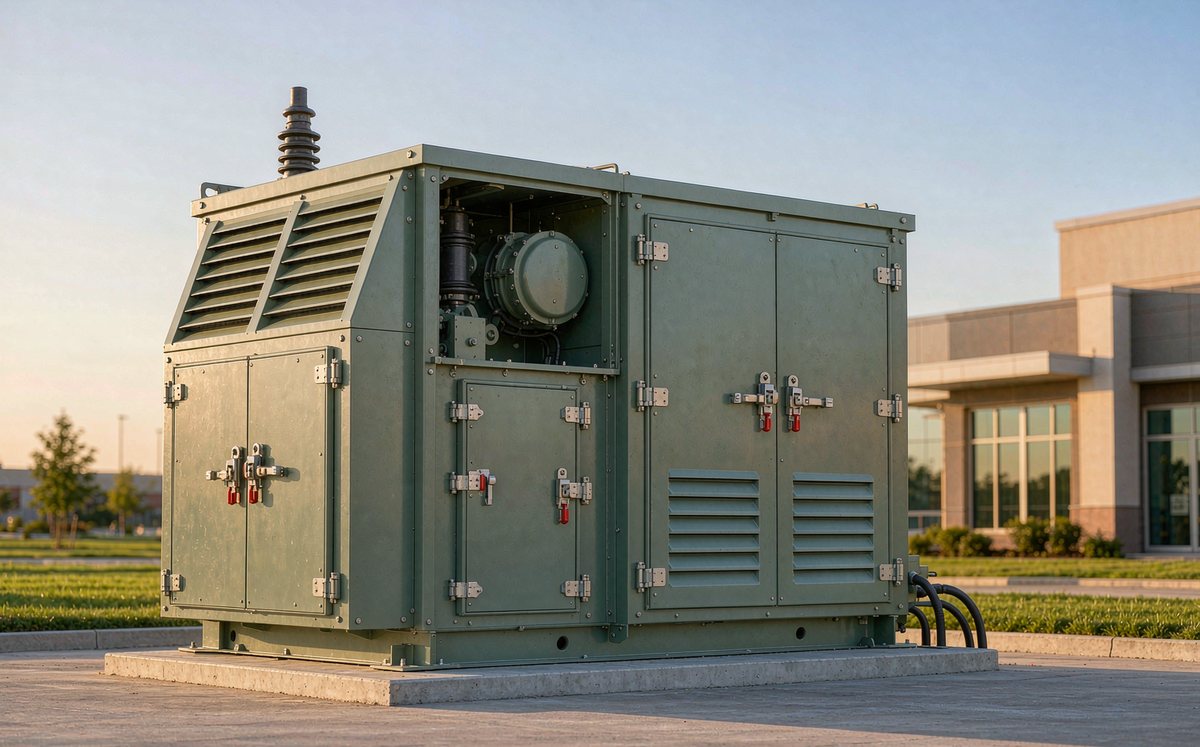
installed. Getting the right one comes down to five decisions: kVA, voltage ratio, feed configuration, fluid, and efficiency tier.
Here’s the thing most guides won’t tell you: the transformer is rarely the hard part. The hard part is whether your site actually fits it, whether your utility will accept it, and whether you ordered early enough to get it. This guide covers all three, with the numbers attached.
The 60-second version
If you only read one section, read this one.
- Three numbers decide 90% of the spec: kVA rating, primary voltage class (15 / 25 / 35 kV), and secondary voltage (120/240, 208Y/120, 480Y/277, or 4,160 V).
- Buy a standard kVA rating. Three-phase pad mounts come in 75, 112.5, 150, 225, 300, 500, 750, 1000, 1500, 2000, 2500, 3000, 3750, and 5000 kVA. Asking for 3,200 kVA buys you a custom unit, a longer wait, and a higher price for no benefit.
- Size from demand, not from connected load. Apply a diversity factor before you divide by power factor. Skipping it can inflate your kVA by 33–100% — and you pay for that mistake twice: once in the purchase price, and every hour afterward in no-load losses.
- A 500 kVA three-phase unit is about 71 in wide, 46 in deep, 70 in tall, and 4,200 lb filled. Give the pad at least 6 in of margin on every side, and confirm the utility’s pad detail before you pour.
- Clearances kill more schedules than prices do. Over 100 kVA, one large US utility wants 20 ft of clear space in front of a building door and 10 ft to each side. That is a site-planning number, not an electrical one.
- Equipment is typically only 55–65% of what you write the check for. A 500 kVA unit at $38,000–$56,000 lands at $56,000–$88,000 installed.
- Quotes for the same 500 kVA unit range from about $4,500 to $65,000. That spread is real, and it is almost entirely about scope — EXW versus delivered, aluminum versus copper, catalog versus utility-spec. There’s a section on it below.
- US efficiency is a legal floor with a date on it. DOE compliance tightens on April 23, 2029, and the date that matters is when the unit was manufactured or imported — not when you signed the PO.
- Not every pad mount is in DOE scope. Output above 600 V, a tap range of 20% or more, and step-up duty all sit outside the federal definition. Solar collector units usually do.
- Budget 12–18 months from spec freeze to energization. Published pad-mount lead times ranged from 16 weeks to 65 weeks in 2026 depending on whose numbers you read.
What is a pad mounted transformer?
A pad mounted transformer is a distribution transformer housed in a locked, grounded, weather-resistant steel cabinet mounted on a concrete pad at grade level. It steps medium-voltage distribution power (typically 12.47–34.5 kV) down to utilization voltage, and it’s the standard way to serve underground distribution in subdivisions, commercial developments, campuses, and industrial sites.
The cabinet is divided into two compartments — a high-voltage side and a low-voltage side — separated by a full-height steel barrier. In a dead-front design, every energized connection is behind an insulated, shielded elbow connector, so nothing live is exposed when a technician opens the door. That’s the default today, and anything a member of the public can walk up to should be dead-front. Live-front construction uses exposed bushings with clamp connections; you’ll mostly see it in legacy utility specs.
One distinction worth making early: a pad-mounted transformer changes voltage. A pad-mounted switchgear switches and protects. They look similar from twenty feet away and they are not interchangeable. If your application is indoors rather than on a pad, our dry type transformer guide covers that branch of the decision.
Standard sizes: dimensions, weights, and oil volume
“Sizes” is the question this page gets asked most, and it’s the one most guides answer with a paragraph instead of a table. Here are typical catalog dimensions for three-phase compartmental pad mounts. Treat them as planning numbers — always design against the manufacturer’s certified outline drawing for the unit you’re actually buying.
| Rating | Width | Depth | Height | Filled weight | Oil volume |
|---|---|---|---|---|---|
| 75 kVA | 1,390 mm (55 in) | 910 mm (36 in) | 1,430 mm (56 in) | 645 kg (1,420 lb) | ~138 L (36 gal) |
| 112.5 kVA | 1,420 mm (56 in) | 920 mm (36 in) | 1,430 mm (56 in) | 729 kg (1,610 lb) | ~159 L (42 gal) |
| 150 kVA | 1,510 mm (59 in) | 980 mm (39 in) | 1,530 mm (60 in) | 989 kg (2,180 lb) | ~231 L (61 gal) |
| 225 kVA | 1,600 mm (63 in) | 1,000 mm (39 in) | 1,660 mm (65 in) | 1,195 kg (2,635 lb) | ~264 L (70 gal) |
| 300 kVA | 1,660 mm (65 in) | 1,080 mm (43 in) | 1,680 mm (66 in) | 1,415 kg (3,120 lb) | ~299 L (79 gal) |
| 500 kVA | 1,810 mm (71 in) | 1,160 mm (46 in) | 1,790 mm (70 in) | 1,905 kg (4,200 lb) | ~374 L (99 gal) |
| 750 kVA | 2,030 mm (80 in) | 1,300 mm (51 in) | 2,030 mm (80 in) | 2,755 kg (6,075 lb) | ~615 L (162 gal) |
| 1,000 kVA | 1,651 mm (65 in) | 1,549 mm (61 in) | 1,854 mm (73 in) | 3,235 kg (7,130 lb) | ~747 L (197 gal) |
| 1,500 kVA | 2,210 mm (87 in) | 1,470 mm (58 in) | 2,150 mm (85 in) | 5,835 kg (12,860 lb) | ~860 L (227 gal) |
| 2,000 kVA | 2,380 mm (94 in) | 1,600 mm (63 in) | 2,220 mm (87 in) | 6,430 kg (14,180 lb) | ~1,092 L (288 gal) |
| 2,500 kVA | 3,070 mm (121 in) | 1,650 mm (65 in) | 2,330 mm (92 in) | 8,865 kg (19,540 lb) | ~1,172 L (310 gal) |
| 3,000 kVA | 3,260 mm (128 in) | 1,850 mm (73 in) | 2,460 mm (97 in) | 11,300 kg (24,910 lb) | — |
| 3,750 kVA | 4,080 mm (161 in) | 2,060 mm (81 in) | 2,680 mm (106 in) | 14,400 kg (31,750 lb) | — |
Typical three-phase pad-mount catalog values; oil volume converted from oil mass at roughly 0.87 kg/L. Confirm against the certified drawing before you design the pad or book the crane.
Two practical notes. First, the 1,000 kVA row is narrower but deeper than the 750 kVA row — footprints don’t scale smoothly with kVA, so never interpolate a footprint. Second, filled weight drives two budgets: the pad design and the rigging. A 2,500 kVA unit at 19,540 lb is a different crane than a 500 kVA unit at 4,200 lb.
Sizing the pad
The pad is reinforced concrete, level, and bigger than the base. A commonly used rule is at least 6 in (150 mm) of margin on all sides, 4–8 in thick depending on rating, with cable entry provisions cast in — but your serving utility’s detail governs, and they vary. Pull the filled weight and the base footprint from the manufacturer’s drawing rather than estimating.
What a pad mounted transformer costs in 2026
These are one US distributor’s published 2026 ranges for new units: mineral oil, ONAN cooling, DOE 2016 compliant, aluminum or copper windings. They assume delivery to site and exclude installation.
Single-phase
| kVA | Aluminum | Copper | Approx. weight |
|---|---|---|---|
| 25 | $8,000–$11,000 | $9,500–$13,000 | 800–1,000 lb |
| 50 | $10,000–$14,000 | $12,000–$16,500 | 1,000–1,400 lb |
| 75 | $11,500–$16,000 | $13,500–$18,500 | 1,200–1,700 lb |
| 100 | $12,000–$18,000 | $14,500–$21,000 | 1,400–2,000 lb |
| 167 | $15,000–$22,000 | $18,000–$26,000 | 1,800–2,600 lb |
| 250 | $18,000–$27,000 | $22,000–$32,000 | 2,200–3,200 lb |
| 333 | $22,000–$33,000 | $26,000–$38,000 | 2,800–4,000 lb |
Three-phase
| kVA | Aluminum | Copper | Approx. weight |
|---|---|---|---|
| 75 | $16,000–$22,000 | $19,000–$26,000 | 1,600–2,200 lb |
| 150 | $20,000–$28,000 | $24,000–$33,000 | 2,200–3,000 lb |
| 300 | $28,000–$40,000 | $33,000–$47,000 | 3,000–4,200 lb |
| 500 | $38,000–$56,000 | $45,000–$65,000 | 4,500–6,500 lb |
| 750 | $48,000–$68,000 | $55,000–$78,000 | 5,500–8,000 lb |
| 1,000 | $55,000–$75,000 | $65,000–$88,000 | 7,000–10,000 lb |
| 1,500 | $68,000–$92,000 | $80,000–$108,000 | 9,000–13,000 lb |
| 2,500 | $88,000–$130,000 | $105,000–$155,000 | 13,000–19,000 lb |
What it costs installed
| System | Unit price | Installation | Total installed |
|---|---|---|---|
| 50 kVA, 1-phase | $10,000–$14,000 | $8,100–$14,000 | $18,100–$28,000 |
| 100 kVA, 1-phase | $12,000–$18,000 | $10,000–$18,000 | $22,000–$36,000 |
| 300 kVA, 3-phase | $28,000–$40,000 | $16,000–$28,000 | $44,000–$68,000 |
| 500 kVA, 3-phase | $38,000–$56,000 | $18,000–$32,000 | $56,000–$88,000 |
| 1,000 kVA, 3-phase | $55,000–$75,000 | $22,000–$40,000 | $77,000–$115,000 |
| 2,500 kVA, 3-phase | $88,000–$130,000 | $32,000–$55,000 | $120,000–$185,000 |
Notice the shape: on small units, installation roughly equals the equipment price. On large units it drops to a smaller percentage, because civil work and labor are fairly fixed regardless of kVA. On a published 500 kVA commercial retrofit, a $58,000 unit produced a $101,000 project — installation added 74%, mostly in existing-infrastructure work.
Why two quotes for the same 500 kVA differ by 5–10×
This is the single biggest source of confusion on this topic, and almost nobody explains it. Search for “500 kVA pad mount price” and you’ll see numbers from roughly $4,500 to $65,000. Both can be true.
| Quote you received | What it most likely is |
|---|---|
| $4,500–$9,000 | Offshore factory EXW. Excludes freight, insurance, duty, tariffs, and any testing beyond routine. Winding metal may be unspecified. |
| $10,000–$25,000 | Offshore FOB budgetary range for a standard-spec build. |
| $38,000–$56,000 | US distributor, aluminum windings, mineral oil, DOE 2016 compliant, delivered to site. Excludes installation. |
| $45,000–$65,000 | Same, copper windings. |
| $2,500–$7,000 | Used or new-surplus, at $5–$14/kVA for the 500–1,500 kVA band. Different risk profile entirely. |
Six variables account for nearly all of it: winding metal, voltage class, fluid, efficiency tier, accessories, and commercial scope (EXW vs. FOB vs. delivered vs. installed). Then there’s market timing — distribution transformer pricing rose 60–80% in some classes after 2020, and as much as 95% since 2019 depending on whose index you use, driven by copper, grain-oriented electrical steel, and demand that’s up roughly 34% since 2019.
What to do with this: never compare a number to a number. Compare a scope to a scope. Ask every bidder for an itemized quote that states winding metal, fluid, efficiency tier, included testing, freight, and delivery terms. Then the spread collapses to something you can actually negotiate.
The seven things that move the price
| Factor | Impact | Detail |
|---|---|---|
| kVA rating | Largest single driver | More copper, more steel, more oil, bigger enclosure |
| Single vs. three phase | +40–70% at the same kVA | Three-phase needs a third winding and a larger core |
| Copper vs. aluminum | +15–25% | Copper runs cooler and lasts longer; aluminum wins on first cost at light loading |
| Voltage class | +10–20% | 34.5 kV needs more insulation and higher BIL than 13.8 kV |
| Insulating fluid | +8–30% | Mineral oil baseline, FR3 / natural ester +8–15%, silicone +20–30% |
| Efficiency tier | Built into the base | The DOE 2016 tier added roughly 15–20% industry-wide versus pre-2016 designs |
| Lead time / rush | +10–25% | Rush orders and late spec changes both cost money |
How to size one: five steps, with real numbers
Let’s work a 45,000 sq ft office building.
- Add up connected load. Lighting, HVAC, plug loads, elevators: 620 kW.
- Apply a diversity factor. Not everything runs at once. At 0.75, coincident demand is 465 kW.
- Divide by power factor. At 0.90, that’s 517 kVA.
- Add growth. At 20%, you need 620 kVA.
- Round up to a standard rating. Next standard three-phase rating above 620 kVA is 750 kVA.
Now check it: peak demand of 517 kVA on a 750 kVA unit is 69% loading — right in the efficient band. Good.
Here’s what skipping step 2 costs you. Without a diversity factor: 620 ÷ 0.90 × 1.20 = 827 kVA, which rounds up to 1,000 kVA. That’s a third more kVA, a third more purchase price, and permanently higher no-load losses for the 30-year life of the unit. Do it with no diversity and no growth discipline, as some published examples do, and 800 kW of connected load gets you a 1,500 kVA unit where 1,000 would do.
One more check. If your largest motor is more than about 30% of the transformer’s kVA, get a starting study done. Pad-mount three-phase impedance typically lands in the 4.5–6% range, and that number cuts both ways: lower impedance means more available fault current your switchgear has to interrupt, higher impedance means worse voltage regulation and deeper motor-starting dip. Specify it rather than let it default.
Turning watts into dollars: the loss calculation
Every guide says “look at the losses.” Almost none show you the arithmetic. It’s four steps.
- No-load kWh/year = no-load watts × 8,760 ÷ 1,000. This runs 24/7 from the moment you energize.
- Load kWh/year = full-load watts × (average load fraction)² × 8,760 ÷ 1,000. The square matters — at half load you get a quarter of the load loss.
- Annual cost = total kWh × your $/kWh.
- Compare against the premium, then decide.
Worked example, 500 kVA three-phase, 45% average load, 8,760 hours, $0.13/kWh:
| Design | No-load loss | Full-load loss | Annual kWh | Annual cost |
|---|---|---|---|---|
| A — meets the DOE 2016 floor | 620 W | 4,100 W | 12,705 | $1,652 |
| B — low-loss design | 480 W | 3,700 W | 10,771 | $1,400 |
Difference: $252/year. Over 30 years that’s about $7,560 undiscounted, or roughly $3,900 at a 5% discount rate.
Now the honest part. The premium for design B is commonly $3,000–$8,000. Simple payback is therefore 12–30 years, not the “under 6 years” you’ll see quoted. Loss reduction is a genuinely good buy on 24/7 or heavily loaded sites — data centers, hospitals, process plants. On lightly loaded commercial duty, it’s a weak one. Run your own numbers before you pay for it.
The insight nobody publishes: match the upgrade to your load profile
The same two designs behave completely differently depending on how hard you run them.
| Average load | Savings from better core (no-load) | Savings from better windings (load) | Where the money is |
|---|---|---|---|
| 30% | 1,226 kWh/yr | 315 kWh/yr | 80% core |
| 75% | 1,226 kWh/yr | 1,971 kWh/yr | 62% windings |
Bottom line: if your unit sits at 30% most of the time, buy a better core (amorphous metal or a lower-loss electrical steel grade). If it runs at 75%, buy copper and heavier conductor. Ordering a copper upgrade on a lightly loaded unit is paying for capacity you’ll never use.
Efficiency rules: what changes on April 23, 2029
DOE’s April 2024 final rule (89 FR 29834) amended the distribution transformer standards. The rule took effect July 8, 2024; compliance with the amended levels is required for units manufactured or imported on or after April 23, 2029. Three things matter for pad-mount buyers:
- The trigger is the manufacturing or import date, not your PO date and not your delivery date. A unit built in late 2028 and delivered in 2029 is judged on the old table.
- The rule doesn’t require anyone to replace installed equipment. It governs what can be made and imported.
- Coverage expands. Ratings above 2,500 kVA were outside federal scope entirely; from 2029, coverage reaches 5,000 kVA.
Minimum efficiency, three-phase liquid-immersed, at 50% load (10 CFR 431.196):
| kVA | Manufactured before 4/23/2029 | Manufactured on or after 4/23/2029 |
|---|---|---|
| 75 | 99.03% | 99.22% |
| 150 | 99.16% | 99.33% |
| 300 | 99.27% | 99.42% |
| 500 | 99.35% | 99.38% |
| 750 | 99.40% | 99.43% |
| 1,000 | 99.43% | 99.46% |
| 1,500 | 99.48% | 99.51% |
| 2,000 | 99.51% | 99.53% |
| 2,500 | 99.53% | 99.55% |
| 3,750 | Not covered | 99.54% |
| 5,000 | Not covered | 99.53% |
Look at the right-hand column between 300 and 500 kVA. It goes down. A 300 kVA unit is held to 99.42% while a 500 kVA unit is held to only 99.38% — a bigger transformer is allowed to be less efficient than a smaller one. The curve steps backward again between 2,500 and 5,000 kVA.
The practical consequence: “Meets DOE 2029” is a meaningless claim without the kVA attached. Ask for certified no-load and load loss values at your specific rating, not a compliance sentence on a cut sheet.
What’s not covered
The federal definition of a distribution transformer requires an input of 34.5 kV or less, an output of 600 V or less, 60 Hz operation, and a rating of 10–2,500 kVA for liquid-immersed units. A lot of pad mounts fall outside that:
- Secondary above 600 V — a 4,160 V secondary pad mount isn’t covered.
- Step-up duty — solar and BSS collector units stepping 480 V up to 34.5 kV have an output above 600 V, so they’re outside the definition.
- Tap range of 20% or more.
- Also excluded: autotransformers, drive (isolation) transformers, grounding transformers, rectifier transformers, UPS transformers, welding transformers, sealed and non-ventilated transformers, special-impedance and regulating transformers, and testing transformers.
This cuts both ways. It means you can’t assume a compliance claim applies, and it also means a spec writer shouldn’t be paying for DOE-tier core steel on a unit that was never in scope.
Site requirements: clearances, pad, grounding
This is where projects actually break. Clearances are set by your serving utility and the AHJ, and they’re dimensional constraints on your site plan, not electrical afterthoughts.
Here’s one large US utility’s published standard (Con Edison EO-6242 Rev 4). Yours will differ — pull it before you lay out the site.
| Situation | Requirement |
|---|---|
| Open door / operating side | 10 ft clear, in addition to the door swing radius |
| Around the pad | Add 3 ft to any wall, door, or window opening, accounting for cabinet overhang |
| Unit over 100 kVA, near a building door | 20 ft out, 10 ft to each side |
| Unit over 100 kVA, near a window | 20 ft out, 6 ft to each side |
| Unit over 100 kVA, second-floor window | Not less than 10 ft |
| Unit 100 kVA or less, near a door | 10 ft out, 5 ft to each side |
| Unit 100 kVA or less, near a window | 10 ft out, 3 ft to each side |
| Can’t meet the clearance | Fire-resistant barrier, subject to utility and AHJ approval |
If you can’t make the numbers work, the code path is a safeguard, not a waiver. NEC 450.27 lists the options: space separation, fire-resistant barriers, automatic fire suppression, or an enclosure that confines the oil of a ruptured tank.
Grounding ties the tank, the enclosure, and the secondary neutral into the grounding electrode system per NEC Article 250, with IEEE 142 as the recommended practice. One common field error: putting the neutral-to-ground bond inside the transformer cabinet when your service equipment is where it belongs. Check the one-line.
Oil, fire code, and spill containment
Fluid choice is a code decision disguised as a product option.
NEC 450.23 draws the less-flammable line at a fire point of 300 °C. Conventional mineral oil has a fire point around 160 °C and doesn’t qualify. Natural ester fluids like FR3 are listed with a fire point around 358–360 °C and do. Qualifying matters: for mineral oil installed outdoors, NEC 450.27 requires safeguards against fire spread to buildings, fire escapes, and openings. A listed less-flammable unit can sit adjacent to a non-combustible building where a mineral-oil unit can’t.
On a tight site, the reduced separation distance is frequently what decides it. A $4,000 containment basin and a fire-marshal conversation can cost more than the fluid upgrade would have.
Spill containment. EPA’s SPCC rule (40 CFR Part 112) applies when aggregate aboveground oil storage exceeds 1,320 gallons and a discharge could reasonably reach navigable waters. Secondary containment is generally sized at 110% of the largest single container, plus allowance for precipitation.
Here’s the pad-mount twist nobody prices: one unit almost never triggers it, and a whole site often does. A 500 kVA pad mount holds about 99 gallons. A 2,500 kVA holds about 310. But a 100 MW solar farm can have 30–50 pad mounts — several thousand gallons in aggregate, well over the threshold. Less-flammable ester fluids reduce the fire requirement but don’t automatically eliminate the containment one.
And on used equipment: screen any pre-1979 unit for PCBs under 40 CFR Part 761 before you take title. Taking ownership of a contaminated transformer means inheriting a regulated-waste liability that can exceed what you paid for the unit.
Configurations: feed, fusing, enclosure, fluid
| Decision | Standard choice | Choose the other when |
|---|---|---|
| Termination | Dead-front — insulated elbows, nothing exposed | Live-front only in legacy utility specs |
| Feed | Radial — 3 bushing wells, single source | Loop — 6 wells, 4-position switch — when the load can’t take an outage: hospitals, data centers, campuses |
| Overcurrent | Bay-O-Net + current-limiting backup | Internal weak-link only on small, non-critical distribution where a fuse operation means scrapping the unit anyway |
| Enclosure | Galvanized steel | 304 SS near coast; 316 SS in harsh or marine environments |
| Fluid | Mineral oil | FR3 / natural ester near buildings, water, or where NEC 450.27 separation can’t be met |
| Cabinet | Pad-green, penta-head bolts, sloped roof | C57.12.29 requirements in coastal environments |
Standards you’ll see referenced: IEEE C57.12.34-2022 for three-phase pad mounts up to 10 MVA at 34.5 kV and below; IEEE C57.12.38-2025 for single-phase up to 250 kVA; C57.12.28 for enclosure integrity (tamper resistance); C57.12.29 for coastal environments; C57.12.39 for tank pressure coordination; C57.12.90 for testing; IEEE 386 for the separable connectors; NEMA 260 for cabinet safety; UL listing for the US market; CSA C227.3 / C88 for Canada.
Lead times in 2026 — and why nobody agrees
Published numbers for pad-mount lead times span a factor of four. Here they are side by side:
| Source | Pad-mount lead time | What it covers |
|---|---|---|
| US distributor | 16–24 weeks | Catalog-configured units |
| US market analyst | 12–20 weeks (<500 kVA); 16–28 weeks (500 kVA–2.5 MVA) | Domestic supply, 2026 |
| Procurement tracker | 26–40 weeks standard catalog; 3-phase pad mount worsening through 2026–27 | Wood Mackenzie-sourced |
| Contractor slot data | 40–65 weeks | Pad mount 0–5 MVA, from manufacturer slot reservations |
| Export manufacturer | 8–14 months | Build-to-order, project-spec units |
They disagree because they’re measuring different things: stock versus build-to-order, catalog versus utility-spec, domestic versus import, and a real quote versus a survey average. Treat all of them as planning inputs, not as a date.
How to actually go faster:
- Freeze the spec early. A change resets your place in the queue.
- Write performance specs, not brand names. Naming one bushing or component make means inheriting that make’s queue. A spec that permits qualified equivalents can draw on whatever is already on the floor.
- Reserve a production slot rather than waiting for a finalized PO.
- Consider new surplus. Price differences between condition tiers are real but bounded; the schedule difference is measured in months.
- Plan 12–18 months from spec freeze to energization.
Ten specification mistakes that show up on the invoice
- Sizing without a diversity factor — inflates kVA by 33–100%, and you pay for it in purchase price and no-load losses forever.
- Inventing a non-standard rating — 3,200 kVA instead of 3,750 buys custom pricing and a longer wait for no benefit.
- Not pulling the utility’s spec first — it governs at the service position, and it will differ from the catalog.
- Accepting “DOE compliant” without the kVA attached — the 2029 curve isn’t monotonic, so the claim is meaningless without the rating.
- Assuming DOE applies when it doesn’t — a 4,160 V secondary or a step-up unit is outside the definition.
- Checking clearances after the pad is poured.
- Specifying mineral oil next to a combustible wall without pricing the NEC 450.27 safeguards you’ll be ordered to add.
- Counting one transformer’s oil and missing the site aggregate that triggers SPCC.
- Buying radial feed because it’s cheaper when the load can’t tolerate the outage.
- Waiting for the PO to reserve a production slot — then paying a 10–25% rush premium.