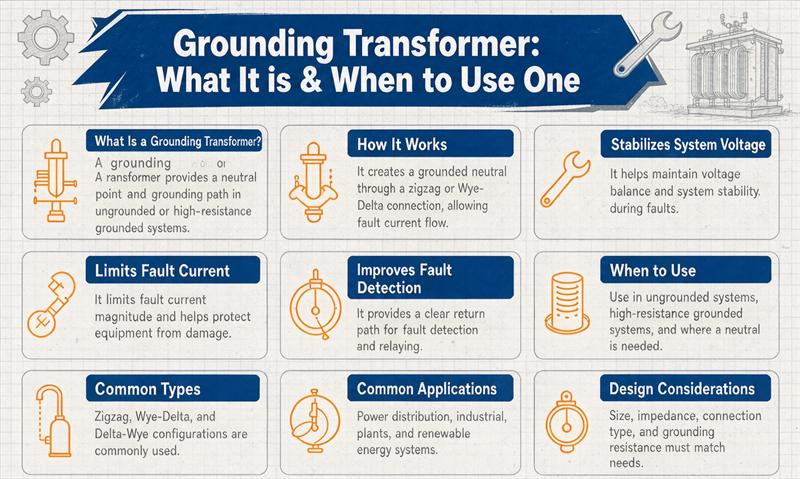
A grounding transformer (earthing transformer) is a three-phase auxiliary transformer that creates an artificial neutral point on a delta-connected or ungrounded power system, giving protective relays a path to detect and clear line-to-ground faults; you need one whenever your medium-voltage bus has no accessible neutral and you must limit fault current.
If that sentence already answered your question, you are set. If you are here to decide whether your project actually needs one, and how to specify it without over-buying or under-buying, keep reading. We will skip the textbook tone and give you the straight version.
The whole thing in one glance:
- What it is: an auxiliary transformer, not a power transformer. It sits nearly idle until a ground fault happens.
- When you need it: your MV source is delta-connected, ungrounded, or islanded, and you still want relays to see and clear ground faults.
- Two builds: zigzag (most common, compact) and wye-delta (can also feed station auxiliaries).
- How it is sized: by short-time fault duty (usually a 10-second rating), target fault current, and system voltage, not by continuous kVA.
- Standards in play: IEEE C62.92, IEEE Std 32, IEEE 3003.1, and IEC 60076-1.
What a grounding transformer actually does
Picture a three-phase medium-voltage bus with no neutral. That happens all the time: a delta-connected substation transformer, an ungrounded feeder, or an inverter-fed solar or battery system. With no neutral, a single line-to-ground fault does not trip the breaker right away. The two healthy phases float up toward line-to-line voltage, and you get dangerous transient overvoltages that can punch through insulation.
A grounding transformer fixes that by manufacturing a neutral where none exists. Under normal balanced load it carries almost no current, just a little excitation and imbalance. The moment a line-to-ground fault occurs, it opens a low-impedance path for the zero-sequence (fault) current to return through. Two things happen: the neutral stays near earth potential, and the protective relay finally sees a real fault current it can act on.
One detail that trips up first-time specifiers: the transformer is almost always connected to earth through a neutral grounding resistor (NGR) or a reactor. The grounding transformer makes the neutral; the resistor or reactor decides how much fault current is allowed to flow. Solid grounding (no resistor) gives a stiff, high fault current. Resistance grounding keeps that current bounded, which is what most industrial and renewable sites want.
The two types, side by side
There are really only two configurations you will be offered. Both do the same job; they differ in how much extra they can do.
| Parameter | Zigzag | Wye-Delta |
|---|---|---|
| Winding layout | Single zigzag winding, no secondary needed | Wye primary + delta secondary |
| Station auxiliary load | No | Yes, it can feed auxiliaries |
| Physical size & cost | Smaller, usually cheaper | Larger, more material |
| Zero-sequence impedance | Low, purpose-built for grounding | Depends on the design |
| Harmonics | Good zero-sequence cancellation | Delta traps triplen harmonics |
| Best fit | Pure grounding duty | Grounding plus auxiliary power |
For the large majority of projects, zigzag is the right call. Reach for wye-delta only when you genuinely need that secondary winding to run station service loads. You can see how a unit like this sits inside our specialty transformer range.
So when do you actually need one?
This is the part most vendor pages gloss over. Use this quick flow instead of guessing.
Step 1: Does your source already give you an accessible neutral?
If your power transformer or generator has a grounded wye neutral with the insulation and current capacity to use it, you may only need a neutral grounding resistor. If there is no neutral to connect to (delta bus, ungrounded network, inverter-fed BESS or microgrid), you need a grounding transformer first to build one.
Step 2: Do you need to control the fault current?
Pair the new neutral with an NGR or reactor. Solid grounding gives high fault current and fast clearing but more arc-flash energy. High-resistance or low-resistance grounding bounds the current, limits damage, and still lets the relay see the fault.
Step 3: Do you also need station auxiliary power?
If yes, the wye-delta build earns its extra cost. If not, zigzag wins on price and footprint.
Step 4: Will the system ever island?
When a plant separates from the grid, any delta bus loses its ground reference. Keep a dedicated grounding source on the islanded bus, or the protective scheme that depended on the utility neutral stops working. This is exactly why islanding studies (even at 138 kV) call for a grounding bank.
When you do not need one
Two cases where buyers waste money:
- You already have an accessible neutral. A neutral grounding resistor alone is enough. Adding a grounding transformer on top of an existing neutral is redundant.
- Very small ungrounded systems. Some legacy networks run ungrounded on purpose, but the transient overvoltage risk climbs with cable capacitance. Most utilities will not accept ungrounded MV today, so this is a shrinking exception, not a strategy.
The takeaway: a grounding transformer is a fix for a missing neutral, not a default add-on. If you are not sure which camp you are in, send your single-line diagram to a supplier and let them confirm.
How big, and what specs actually matter
A grounding transformer is rated for short-time fault duty, most often a 10-second rating, not continuous operation. It spends its life idle, so its continuous kVA is small. The numbers that drive the design are:
- System voltage: typically 6.6, 11, 13.8, 22, or 33 kV line-to-line.
- Target ground-fault current: commonly 200 to 1,200 A, set by the resistor or reactor you pair with it.
- Fault duration: 10 seconds is the standard thermal rating; 30- and 60-second ratings are available when the protection scheme needs more time.
- Zero-sequence impedance: kept low (a few percent up to roughly 10 to 15 percent) so the relay sees enough current to trip.
As a feel for scale: on an 11 kV bus where you want roughly 400 A of ground-fault current, the supplier sizes the unit on that short-time duty, and the continuous load it carries day to day is tiny. Do not judge it by power-transformer kVA rules.
The standards buyers get asked about
If you are an EPC or utility buyer, someone will ask which standard your unit is built and tested to. The short list:
- IEEE C62.92 — the guide for grounding of AC power systems above 1 kV.
- IEEE Std 32 — requirements and tests for neutral grounding devices (covers the resistor side too).
- IEEE 3003.1-2019 — recommended practice for system grounding of industrial and commercial power systems.
- IEC 60076-1 — the power-transformer standard that covers earthing transformers for IEC-markets.
Always confirm the edition your governing code actually cites, because that is what the authority having jurisdiction will check. If your project splits across markets, our IEC vs ANSI/IEEE guide walks through the differences that matter for export units.
Where they actually show up
Grounding transformers are quiet workhorses in places where a neutral does not exist by default:
- Solar PV plants on 6.6 to 33 kV collector systems, where inverters give no neutral. See how this plays out in a 50 MW solar PV case study.
- Wind farms on collector feeders and substations.
- Battery storage and microgrids, which are inverter-isolated and have no natural neutral reference.
- Industrial MV networks in factories, mines, refineries, and chemical plants.
- Utility delta feeders where no natural neutral is available.
- Generator islanding applications that must keep a ground reference off-grid.
Many of these are dry-type by installation, so our dry-type transformer guide is a useful companion if your site is indoor or space-constrained.
How to specify one (the part that gets you a real quote)
If you want an accurate quote instead of a vague brochure number, send your supplier these items. The more you provide, the tighter the price and lead time:
- Your single-line diagram (SLD).
- System line-to-line voltage and frequency.
- Target ground-fault current and the fault duration rating you need (10/30/60 s).
- The grounding method: solid, high-resistance, low-resistance, or resonant.
- Any auxiliary load, if you are leaning wye-delta.
- Indoor or outdoor, and the ambient and altitude.
- The standard edition your project specifies.
- Your needed incoterm, destination, and delivery window.
Hand that list to a manufacturer and you will skip the back-and-forth that drags lead times out. Our full transformer catalog and technical resource library cover the surrounding equipment if your scope is wider than the grounding unit itself.
Bottom line
A grounding transformer is a small, idle-most-of-the-time device that solves one specific problem: no neutral, no ground-fault detection. If your MV bus has no accessible neutral and you care about relay operation, transient overvoltages, and arc-flash energy, you need one. Pick zigzag unless you also need auxiliary power, size it on short-time fault duty rather than continuous kVA, and pair it with a resistor or reactor to set the fault current. Get the standards and the single-line diagram right, and specifying becomes straightforward.
Frequently asked questions
What is a grounding transformer in simple terms?
It is a three-phase auxiliary transformer that builds an artificial neutral point on a delta-connected or ungrounded system so protective relays can detect and clear line-to-ground faults.
When do you need a grounding transformer?
When your medium-voltage source has no accessible neutral: a delta-connected bus, an ungrounded network, an inverter-fed BESS or microgrid, or a system that islands from the grid.
Zigzag or wye-delta: which should I pick?
Pick zigzag for pure grounding duty: smaller, cheaper, built for low zero-sequence impedance. Pick wye-delta only if you also need to feed station auxiliary loads from the same unit.
What size grounding transformer do I need?
It is rated for short-time fault duty, normally a 10-second rating, not continuous kVA. Sizing follows system voltage (6.6 to 35 kV typical), target ground-fault current (200 to 1,200 A typical), and fault duration.
Do I need a grounding transformer or just a neutral grounding resistor?
If your source already has an accessible neutral, a neutral grounding resistor alone is enough. If there is no neutral to connect to, you need the grounding transformer first, then add the resistor to set the fault current.
Which standards apply to grounding transformers?
IEEE C62.92 (grounding of AC systems over 1 kV), IEEE Std 32 (neutral grounding devices), IEEE 3003.1-2019 (system grounding practice), and IEC 60076-1 (power transformers, covers earthing transformers). Confirm the edition cited in your governing code.
How fast does a grounding transformer clear a ground fault?
The transformer itself does not trip; it creates the neutral so the relay sees the fault. With resistance grounding the fault current is bounded and the breaker clears it in normal protection time, typically well under 10 seconds.