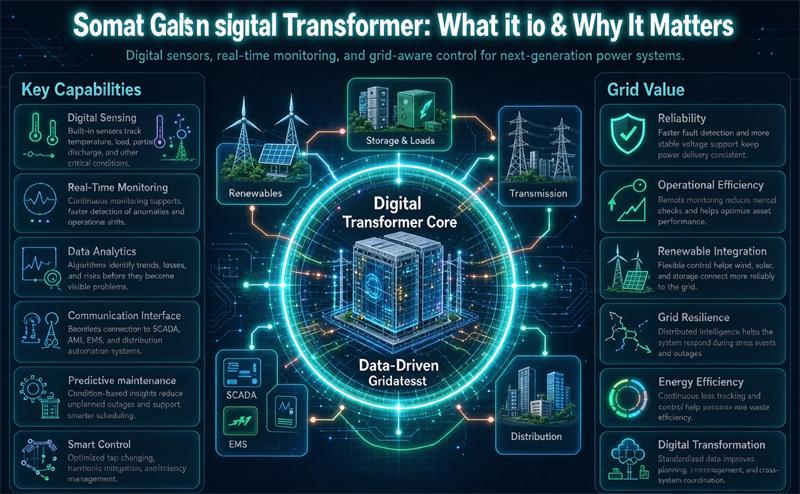
A smart grid digital transformer is a conventional transformer upgraded with online sensors, intelligent electronic devices (IEDs), and secure communication links so it can report its own temperature, load, and insulation health in real time. It matters because it lets grid operators catch faults before they cause outages instead of finding out after one, and it turns a unit you used to “set and forget” into an asset you actually manage.
We at TransNine Electric build conventional and monitored units across utility, renewable, and industrial jobs, so this is written for the person placing the order, not for an IEEE textbook. Below is the plain version: what these things are, why they are showing up in every grid spec now, and what to ask a supplier before you buy.
At a glance
- What it is: a transformer plus a sensing, intelligence, and communication layer.
- Core parts: smart sensors, an IED (the brain), a communication module, cybersecurity, and edge or cloud processing.
- Main protocols: IEC 61850 (MMS, GOOSE), Modbus, DNP3, IEC 60870-5-104.
- Why buyers care: earlier fault warning, condition-based maintenance, lower unplanned downtime.
- Headline numbers (vendor and industry-reported): smart grid investment projected above $400 billion by 2030 per the IEA; vendor case studies cite 30 to 50 percent operations-and-maintenance cost reduction and downtime cuts of roughly 40 to 60 percent. Treat those as site-specific and verify against your own reliability data.
What a digital transformer actually is
A digital transformer still does the one job it always did: step voltage up or down. The difference is that it also measures itself. Where a traditional unit is a sealed black box between two inspections, a digital unit streams data on what is happening inside, sends it to a control room or cloud, and in many cases acts on it locally without waiting for a human.
Think of it as the same engine with a full telemetry kit bolted on. The iron and copper do the power work. The sensors, IED, and links do the talking.
Why it matters right now
Three things changed at once, and that is why “digital” stopped being a nice-to-have:
1. Grids got unpredictable. Solar and wind swing output by the minute, EVs add load spikes, and two-way power flow is now normal. A unit sized for a steady one-direction load is running in a world it was not designed for.
2. Labor got expensive and scarce. Sending a technician to do a periodic inspection on hundreds of assets does not scale. Remote monitoring does.
3. Outages got costly. For a data center, a hospital, or a utility feeder, one unexpected transformer failure can mean six-figure downtime. Knowing a fault is forming weeks ahead is worth real money.
That is the “why it matters” in one line: a digital transformer converts an unmanaged liability into a managed, predictable asset.
How it works, layer by layer
The sensing layer
This is the eyes and ears. Typical sensors watch winding and oil temperature, dissolved gas in the oil (DGA), partial discharge, vibration, moisture, and load on every phase. Fiber-optic temperature probes can read winding hotspots to within a tenth of a degree in vendor-specified installations. The point is continuous measurement, not a snapshot every six months.
The intelligence layer
The IED is the brain. It takes the raw sensor feed, runs fault and trend logic, and raises an alert or triggers an action before a problem becomes a failure. Good IEDs also manage tap changers and load to keep voltage inside tolerance.
The communication layer
The unit needs to talk. Most digital transformers use IEC 61850 for substation integration, with Modbus, DNP3, or IEC 60870-5-104 for SCADA and control-room links. GOOSE messaging handles millisecond-level fault signaling between devices.
The edge and cloud layer
Some decisions happen on the unit (edge) to avoid cloud latency, like trimming cooling during a load peak. The rest goes to a platform where fleets of transformers are compared, trended, and turned into maintenance work orders.
Key components at a glance
| Component | What it does | What to ask the supplier |
|---|---|---|
| Smart sensors | Measure temp, DGA, PD, vibration, moisture, load | Which parameters, what accuracy, calibration interval |
| IED | Analyzes data, detects faults, manages load/taps | Which logic runs locally, alarm thresholds |
| Communication module | Sends data to control room or cloud | Protocols supported (IEC 61850, Modbus, DNP3) |
| Cybersecurity | Encrypts data, controls access | AES-256, role-based access, certs |
| Edge or cloud | Processes and stores data, runs trends | Where data lives, latency, retention |
What you actually get out of it
The benefits are real, but the numbers float around depending on who is quoting them. Here is the honest version:
Earlier fault warning. Continuous monitoring spots a developing issue weeks or months before it fails, versus a periodic inspection that might miss it.
Condition-based maintenance. You service on evidence, not on a calendar. Vendor-reported programs cite fewer annual interventions (some around a two-thirds reduction) and longer asset life.
Less unplanned downtime. Industry and vendor case studies cite downtime reductions in the 40 to 60 percent range and operations-and-maintenance cost cuts of 30 to 50 percent. Verify against your own reliability history before you bank on a specific figure.
Better efficiency visibility. Real-time load and loss data let you balance the fleet and trim technical losses.
None of those are guarantees. They are the upper band vendors report, and they depend on how good your data practice is after the hardware ships.
Where digital transformers fit
Utility grids: the original use case. Substation and feeder units that report health and support automation.
Renewable plants: solar and wind sites where output swings and remote location make remote monitoring worth every cent. Our 50 MW solar PV case study shows how step-up units sit at the collection point.
Data centers: stable voltage plus overload protection plus tracking, which matters when uptime is the product.
Industrial sites: reduced downtime on process lines that cannot afford a surprise stop.
EV charging hubs: managing volatile, fast-ramping loads.
Standards you will be asked about
This is where North American and European buyers diverge, and where a lot of RFQs go wrong.
IEC 61850 (especially -7-420 for distributed energy and grid devices) is the substation communication backbone, dominant in Europe and common globally.
IEEE C57.91 covers loading and dynamic thermal management, the North American anchor for loading practice.
IEC 62443 is the industrial cybersecurity standard for the communication side.
NERC CIP applies to bulk electric system assets in North America.
EU NIS2 Directive is the European cyber-resilience requirement landing on grid suppliers.
Frequency also splits: 60 Hz in North America, 50 Hz across most of Europe. Always confirm the exact edition your jurisdiction’s authority cites before you order. Our IEC vs ANSI/IEEE standards guide walks through the split in detail.
Digital built-in vs a retrofit sensor kit
You do not always need a unit born digital. Two paths:
Built-in digital: sensors and IED designed in from the factory. Cleaner integration, full warranty coverage, best for new builds.
Retrofit kit: add sensors and a gateway to an existing transformer. Cheaper, faster to deploy, and a smart move when the transformer is healthy but unmonitored.
If your asset is sound and you just want eyes on it, a retrofit kit often beats replacing the whole unit. If you are buying new and the spec calls for IEC 61850 out of the box, build it in.
When you honestly do not need a full digital unit
Say it plainly: not every job needs this. If the transformer sits in a small, stable, easily inspected installation with low consequence of failure, a conventional unit with basic gauges is fine. Digital monitoring pays for itself where failure is expensive, remote, or frequent, not where a site visit is a ten-minute drive and a trip to the hardware store.
What to ask your supplier
This is the part that turns a reader into an inquiry. Before you issue an RFQ, pin down:
1. Which parameters are monitored (temp, DGA, PD, vibration, moisture, load).
2. Which communication protocols (IEC 61850, Modbus, DNP3, IEC 60870-5-104).
3. Where the data lives (edge, private cloud, your SCADA).
4. Cybersecurity posture (encryption, access control, certs, IEC 62443 alignment).
5. Which standards and editions apply (IEEE C57.91, IEC 61850, NERC CIP, NIS2).
6. Frequency and voltage rating (60 Hz vs 50 Hz, your system voltage).
7. Alarm thresholds and who sets them.
8. Integration with your existing DMS or EMS.
9. Warranty and calibration expectations for the sensing hardware.
Our cast-resin dry-type units are a natural fit for indoor monitored applications, and you can browse the full transformer catalog to see what sits behind the monitoring layer.
FAQ
What is a smart grid digital transformer?
It is a conventional transformer fitted with sensors, an intelligent electronic device (IED), and secure communication so it reports its temperature, load, and insulation health in real time and supports predictive maintenance.
What sensors are inside a digital transformer?
Typically winding and oil temperature probes, dissolved-gas-in-oil (DGA) sensors, partial-discharge sensors, vibration sensors, moisture sensors, and per-phase load measurement.
What communication protocols do digital transformers use?
Most use IEC 61850 for substation integration, with Modbus, DNP3, or IEC 60870-5-104 for SCADA. GOOSE messaging handles millisecond-level fault signaling between devices.
How much can predictive maintenance save?
Vendor and industry case studies cite operations-and-maintenance cost reductions of 30 to 50 percent and unplanned downtime cuts of roughly 40 to 60 percent. These are site-specific upper bands, so verify against your own reliability data.
Do digital transformers meet North American versus European standards?
They can. North American practice leans on IEEE C57.91 and NERC CIP; European and global work leans on IEC 61850 and IEC 62443, with EU NIS2 for cybersecurity. Frequency is 60 Hz in North America and 50 Hz in most of Europe. Confirm the exact edition your authority cites.
Can I retrofit my existing transformer instead of buying a new digital unit?
Yes. A retrofit sensor and gateway kit adds monitoring to a healthy existing transformer and is often cheaper and faster than full replacement, especially for remote or low-consequence sites.
What should I specify in an RFQ for a digital transformer?
List the monitored parameters, supported protocols, data destination, cybersecurity requirements, applicable standards and editions, frequency and voltage, alarm thresholds, integration needs, and sensor warranty or calibration terms.