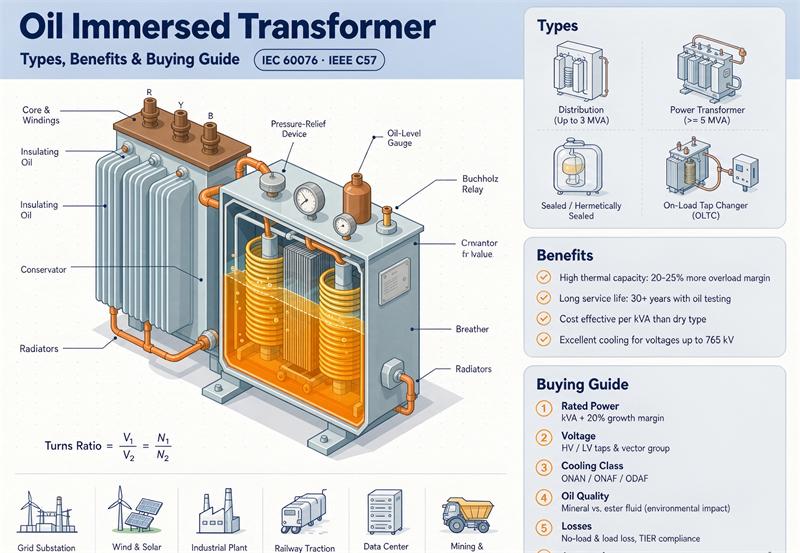
an oil immersed transformer puts the core and windings in a sealed steel tank and fills the space with insulating fluid that does two jobs at once — it insulates, and it carries heat out to the tank wall and radiators. That combination is why oil-filled units beat dry-type on overload capacity, physical size, and cost per kVA. It’s also why they come with obligations a dry-type unit never has: fire separation, spill containment, and oil testing.
Most guides on this keyword stop at “oil cools better and lasts longer.” The decision that actually costs money is different. It’s four questions: how the tank is sealed, what fluid goes in it, whether code and EPA let you put it where you planned to, and what the oil testing program will cost you for the next thirty years. This guide works through those in order.
TransNine Electric builds and exports oil-immersed units from 30 kVA distribution sizes up to 31,500 kVA, so the examples below come off real spec sheets rather than a brochure.
Key numbers
| Item | Value | Why it matters |
|---|---|---|
| DOE coverage, liquid-immersed | Input ≤34.5 kV, output ≤600 V, 60 Hz, 10–5,000 kVA | 10 CFR 431.192 |
| DOE compliance trigger | Manufactured or imported on or after April 23, 2029 | 89 FR 29834; your PO date is irrelevant |
| Min efficiency, 1,000 kVA liquid | 99.43% → 99.46% at 50% load (pre/post-2029) | 10 CFR 431.196 |
| IEEE C57.12.00 temperature rise | Top oil 65 °C, average winding 65 °C, hottest spot 80 °C | The numbers your heat-run test report has to beat |
| IEC 60076-2 temperature rise | Top oil 60 K, average winding 65 K, hot spot 78 K | Not the same as IEEE — matters on cross-standard projects |
| Normal service conditions | 40 °C max ambient, 30 °C 24-hour average, ≤1,000 m altitude | IEEE C57.12.00 |
| Less-flammable fluid line | Fire point not less than 300 °C | NEC 450.23 |
| Mineral oil flash point | Above 140 °C; in-service breakdown typically above 28 kV | IEEE; ester fluids run above 300 °C |
| Moisture warning level | Above 50 ppm water accelerates partial discharge | IEEE |
| SPCC threshold | Aggregate aboveground oil >1,320 gal; only containers ≥55 gal count | 40 CFR 112; transformers are oil-filled equipment |
| SPCC self-certification (Tier I) | ≤10,000 gal aggregate, no single container >5,000 gal, clean spill history | EPA; otherwise a PE must certify the plan |
| Vault fire resistance | 3 hours; 1 hour with automatic sprinklers (≤5 stories above grade) | NEC 450.42 |
| Vault ventilation | ≥3 in² per kVA for natural ventilation | NEC 450.45 |
| Vault door sill | ≥4 in high, to confine the oil | NEC 450.43 |
| 1 kW of no-load loss | 8,760 kWh per year | Core loss runs 24/7, loaded or not |
What “oil immersed” actually means
Core and coils go into a welded steel tank, and the tank gets filled with dielectric fluid under vacuum. The fluid does three things air can’t. It insulates at far higher electrical stress. It carries heat from the windings out to the tank wall by convection. And it keeps oxygen and moisture away from the paper insulation, for as long as the tank stays sealed.
That last clause is doing a lot of work. Oil doesn’t make a transformer maintenance-free, or automatically safer, or fit for any location you happen to have in mind. Every advantage on the standard list has a cost somewhere else in the budget, and the four decisions below are where those costs sit.
One boundary worth stating up front: this guide covers liquid-immersed designs. The oil-immersed vs dry-type decision is a separate call, made before most of what follows. If you haven’t settled it yet, start there.
Decision one: how the tank is sealed
This is the choice that decides your maintenance burden for the next three decades, and it’s usually the last thing anyone specifies.
Conservator (expansion tank) with a breather. A drum mounted above the main tank holds the oil that expands and contracts with temperature. The air that moves in and out passes through a silica-gel breather that dries it. You get a visible oil level, room for expansion, and a place for a Buchholz relay to catch gas from internal faults. You also get a maintenance item: the silica gel changes color as it saturates and has to be replaced or regenerated, and every gasket on the conservator line is a potential leak path.
Hermetically sealed, no conservator. The tank is completely filled and welded shut, with the expansion taken up by corrugated fin walls or by a nitrogen cushion above the oil. No breathing, so no moisture ingress and no oxidation. No silica gel to service, no topping up, no oil-level gauge to misread. The trade-off is that a sealed tank has less margin for error in filling and sealing, and you lose the visual oil level.
For humid, dusty, coastal, and chemically aggressive sites, sealed wins almost every time. Our S20 series is built that way: fully sealed, no conservator, no breather, rated IP44 on the enclosure, covering 30 kVA to 31,500 kVA at 6, 10, 20, and 35 kV.
Corrugated or fin-wall tanks. The tank wall itself is formed into fins that give both cooling surface and the flexibility to absorb oil expansion. This is the standard approach for sealed distribution-class units up to a few thousand kVA. Above that, you’re into radiator banks welded to a rigid tank, or into a conservator.
The whole oil-immersed range, from small distribution units to substation mains, sits under the oil-immersed transformers category, and the products page shows where each family stops and starts.
Decision two: cooling class, and what the letters mean
The four-letter code on the nameplate reads left to right: internal coolant, internal circulation, external coolant, external circulation.
- First letter — O for mineral oil or a synthetic liquid with a fire point at or below 300 °C, K for a liquid with a fire point above 300 °C, L for one with no measurable fire point
- Second letter — N for natural thermosiphon flow, F for forced circulation through cooling equipment, D for forced and directed into the windings
- Third letter — A for air, W for water
- Fourth letter — N for natural convection, F for forced (fans or pumps)
So ONAN is oil natural, air natural: plain convection, no fans, the baseline rating. ONAF keeps natural oil flow but blows air across the radiators. OFAF pumps oil and forces air. OFWF uses water as the external medium. KNAN is the same as ONAN but tells you the fluid is less-flammable.
The part that gets bought wrong is the staged rating. A unit rated “20/26.6 MVA ONAN/ONAF” carries 20 MVA with no fans and 26.6 MVA with them running, roughly a 33% step. That step is cheap at the factory and expensive to retrofit, because retrofitting means new radiators, fan control wiring, protection settings, and an outage. If there’s any chance your load grows past the base rating, buy the second stage at the specification stage.
Full letter-by-letter coverage of the codes, including the dry-type AN and AF pair, is in the cooling classes reference.
Two temperature facts to hold onto while you’re reading a quote. IEEE C57.12.00 caps top-oil rise at 65 °C, average winding rise at 65 °C, and the hottest-spot allowance at 80 °C, on the assumption of a 40 °C maximum ambient, a 30 °C 24-hour average, and altitude no higher than 1,000 m. IEC 60076-2 sets top oil at 60 K, windings at 65 K, and hot spot at 78 K. The difference looks cosmetic until a unit built to one standard gets submitted under the other. Ask for the measured heat-run values in the test report, not a statement of compliance.
Decision three: the fluid
Mineral oil. Naphthenic mineral oil, specified to IEC 60296 internationally or ASTM D3487 in North America. It’s cheap, well understood, and has a flash point above 140 °C. In service it typically holds a breakdown voltage above 28 kV when tested per IEC 60156 or ASTM D1816. It’s also combustible, which is what drives the code discussion below.
Natural ester. Made from seed oils, specified to IEC 62770 (ASTM D6871 in the US). Fire point lands above 300 °C, it’s readily biodegradable and non-toxic, and it tolerates far more moisture than mineral oil before its dielectric strength collapses. The catch is that it behaves differently with paper insulation — it pulls moisture out of the cellulose and holds it in the fluid — so the winding has to be processed drier than a mineral-oil design. Retrofilling an ester into a mineral-oil unit is a real engineering exercise, not a drain-and-fill.
Synthetic ester. IEC 61099. Higher fire performance and better low-temperature behavior than natural ester, at a higher price. Common on wind turbines and traction duty.
Silicone. IEC 60836, thermally stable to about 200 °C. Used where fire performance matters more than cost, and harder to dispose of than ester.
Where the fluid choice becomes a code choice: NEC 450.23 sets the less-flammable line at a fire point of not less than 300 °C. Cross it and the rules for where the unit can sit change completely. Cross it with a listed fluid and you may avoid a vault that would otherwise cost more than the transformer.
Decision four: where it goes, per code
Oil-filled equipment indoors is a fire problem before it’s an electrical one, and NEC Article 450 Part II draws the lines:
- 450.26 — an oil-insulated transformer installed indoors has to be in a vault. Six exceptions follow, mostly for small ratings and special cases, but the default is a vault.
- 450.23 — less-flammable liquid-insulated transformers (the 300 °C fire point line) can go indoors if the listed conditions are met: liquid confinement area, no combustible storage, and in the heavier path an automatic fire-extinguishing system.
- 450.27 — outdoors, the requirement is to keep a fire originating in the transformer from reaching buildings, fire escapes, and door and window openings. Space separation, fire barriers, suppression, or oil-confining enclosures are all recognized ways to do it.
If you end up in a vault, the construction numbers are specific. Walls, floor, ceiling, and roof need a three-hour fire rating, reducible to one hour where automatic sprinklers protect the vault and the unit sits no more than five stories above grade. The door carries the same rating, swings outward, needs panic hardware, and needs a sill or curb at least 4 inches high sized to confine the oil from the largest unit in the room. Natural ventilation needs at least 3 square inches per kVA, split between low and high openings. Vaults holding transformers above 100 kVA need a way to carry oil and water off to an oil/water separator.
That four-inch curb and the ventilation arithmetic are the two details most often missed on a first drawing set, and both are cheaper to draw than to fix.
The line item nobody prices: EPA SPCC
Here’s the one that surprises people. Buying a large oil-filled transformer can put your facility into a federal spill-prevention program.
Under EPA’s Spill Prevention, Control, and Countermeasure rule at 40 CFR Part 112, a non-transportation-related facility is covered when its aggregate aboveground oil storage capacity exceeds 1,320 gallons and a discharge could reasonably reach navigable waters or adjoining shorelines. Two details matter for transformer buyers:
- Only containers holding 55 gallons or more count toward the threshold.
- That 55-gallon floor applies to oil-filled operating equipment, including transformers. EPA has said so directly, citing 40 CFR 112.1(d)(2)(ii).
So a single 2,000 kVA oil-filled transformer can carry several hundred gallons on its own, and once you add hydraulic reservoirs, lube oil, and generator day tanks across the site, the 1,320-gallon total is easier to cross than most people assume.
What follows is a written SPCC plan with secondary containment sized for the largest single container, inspections, and spill response procedures. Above the Tier I qualified-facility threshold (10,000 gallons or less aggregate, no single container above 5,000 gallons, and a clean spill history), the plan has to be certified by a licensed Professional Engineer.
None of this is a reason to avoid an oil-filled unit. It’s a reason to price it before you buy rather than after the inspector asks.
Efficiency: the DOE coverage test, and the “sealed” trap
Federal efficiency rules apply to the transformer, not to the installation. Under 10 CFR 431.192, a liquid-immersed distribution transformer is one with an input of 34.5 kV or less, an output of 600 V or less, rated for 60 Hz, and sized 10 kVA to 5,000 kVA.
Answer yes to all four and the minimum efficiency table in 10 CFR 431.196 applies. Per DOE’s April 2024 final rule (89 FR 29834), the amended levels apply to units manufactured or imported on or after April 23, 2029. The trigger is the build or import date, not your PO and not your delivery.
Now the trap. The definition’s exclusion list includes something called a “sealed transformer,” and it’s tempting to read that as “my hermetically sealed oil unit is out of scope.” It isn’t. The same section defines a sealed transformer as a dry-type transformer designed to remain hermetically sealed. Sealed oil-filled units stay in scope.
Two more things worth knowing before you compare quotes. The 2029 curve is not monotonic: a 300 kVA unit is held to 99.42% while a 500 kVA unit is held to only 99.38%, so “meets DOE 2029” is meaningless without the kVA attached. And coverage widens in 2029: ratings above 2,500 kVA weren’t federally covered before, and they will be.
Sizing: where the losses actually come from
Get the kVA right first: connected load, demand and diversity factors, divided by power factor, rounded up to a standard rating, plus deliberate headroom.
Then do the loss math, because on a unit that runs for thirty years the losses are usually worth more than the purchase price difference between two bids.
No-load (core) loss is constant. It’s billed every hour of every year whether you’re drawing power or not. Load (winding) loss scales with the square of the load.
Take an illustrative 2,000 kVA unit with 2.3 kW of no-load loss and 13 kW of load loss at full load:
| Load factor | Load loss | Total loss | Core’s share | Annual kWh | At 13.9 ¢/kWh |
|---|---|---|---|---|---|
| 30% | 13 × 0.09 = 1.17 kW | 3.47 kW | 66% | 30,397 | ~$4,225 |
| 75% | 13 × 0.56 = 7.31 kW | 9.61 kW | 24% | 84,184 | ~$11,702 |
Read across that table and the buying rule falls out of it. A lightly loaded unit is mostly paying for its core, so buy the better core steel. A heavily loaded unit is mostly paying for its windings, so buy copper and heavier conductor. Ordering a copper upgrade on a unit that sits at 30% all day is paying for capacity you’ll never use.
And the size of the prize: 0.5 kW of no-load loss is 4,380 kWh a year, about $609 at an illustrative 13.9 ¢/kWh, roughly $15,200 over 25 years undiscounted. That’s real money sitting inside a line item most RFQs don’t even ask for. Ask for certified no-load and load loss values at your exact rating and run them against your own tariff.
Keeping the oil honest
The fluid is the only part of a transformer you can sample while it runs, which is why oil testing is the cheapest condition monitoring available on this equipment. The standards around it matter more than the schedule you invent yourself.
Dissolved gas analysis reads the gases the oil and paper give off under stress. Different gases point at different faults: hydrogen and methane toward partial discharge, ethylene toward hot metal, acetylene toward arcing, carbon monoxide and carbon dioxide toward paper degradation. Two frameworks turn those ppm values into a decision: IEEE C57.104 for mineral oil and IEC 60599, both of which lean on ratio methods and the Duval triangle. What matters more than any single reading is the rate of change — a stable elevated number is usually fine, a number that doubles in six months is not.
Oil condition testing covers dielectric breakdown, water content, acidity, interfacial tension, and power factor. IEEE C57.106 is the North American guide for mineral oil; IEC 60422 is its international counterpart; IEEE C57.147 covers natural ester. Water above about 50 ppm is where partial discharge starts to accelerate, and breakdown voltage drifting below the typical 28 kV range is when you start asking why.
When the numbers drift, there are three ways out. Reconditioning filters, vacuum-dehydrates and degasses the oil; it removes water and particles but leaves the acids alone. Reclamation treats the oil chemically and pulls the acids and polar contaminants out. Replacement is the answer once sludge has started settling on the windings, or when reclamation costs approach the cost of new oil. Knowing which of the three you’re looking at is the whole point of keeping a consistent test history.
The resources library has more on what each routine test proves before a unit ships.
Where oil-immersed earns its keep
Utility distribution, industrial plant mains, renewable interconnection, and anything much above 35 kV: those are the applications where the choice is settled before anyone argues about it. Outdoor duty with a high load factor is the sweet spot, because the thermal mass of the oil smooths out daily cycling in a way air can’t.
The step-up units on a 50 MW solar PV plant show why. Sitting outdoors, working hard through the middle of every day, taking the same thermal cycle thousands of times. That duty is what liquid cooling and paper-in-oil insulation were built for.
Where it doesn’t earn its keep is indoors in an occupied building, where the vault, the ventilation, the sill, and the containment cost more than the transformer does. That’s a dry-type job, and no amount of efficiency argument changes the arithmetic.
The RFQ block
Copy this into your inquiry.
1.  Standard basis: IEC 60076 series or IEEE C57.12.00 / .10 / .90 — state which, with edition
2.  Rated power, kVA or MVA, and number of phases
3.  Primary and secondary voltage, with BIL
4.  Frequency: 60 Hz (state it)
5.  Winding material: copper / aluminum
6.  Insulating fluid: mineral oil / natural ester / synthetic ester / silicone, with the spec standard
7.  Tank: hermetically sealed / conservator; corrugated fin / radiator bank
8.  Cooling class: ONAN / ONAF / OFAF, with staged ratings (e.g. 20/26.6 MVA)
9.  Temperature rise limits, and whether measured heat-run values are in the test report
10. Certified no-load loss and load loss, W, at rated tap
11. Efficiency tier: DOE pre-2029 / DOE post-2029 / not in scope — with the kVA attached
12. Impedance, %, with tolerance
13. Vector group and neutral arrangement
14. Tap changer: off-circuit / on-load, range and steps
15. Site ambient: maximum, 24-hour average, annual average
16. Altitude, m
17. Protection devices: Buchholz relay, pressure relief, winding temperature indicator, oil level
18. Enclosure degree of protection (IP code) for tank and terminal box
19. Finish and corrosion class
20. Routine tests and type tests supplied; witness testing available
21. Shipping mass, oil volume in litres, and lifting arrangement
Frequently asked questions
What is an oil immersed transformer?
A transformer whose core and windings sit inside a welded steel tank filled with dielectric fluid. The fluid insulates the windings and carries heat to the tank surface and radiators, which is why oil-filled units handle overload better and cost less per kVA than dry-type units of the same rating.
What are the main types of oil immersed transformer?
By duty: distribution transformers, power and substation transformers, generator and solar step-up units, furnace transformers, and rectifier transformers. By tank: conservator (breather) type, hermetically sealed, and corrugated fin-wall. By cooling: ONAN, ONAF, OFAF, OFWF, and the K-coded equivalents using less-flammable fluid.
How long does an oil immersed transformer last?
Thirty to forty years is the usual figure for a well-maintained unit, and the figure depends far more on operating temperature than on calendar time. Insulation aging accelerates with hottest-spot temperature. IEEE C57.91 is the loading guide that models it, and the common rule of thumb is that aging roughly doubles for every 6–8 °C of hottest-spot rise.
Can an oil immersed transformer be installed indoors?
Yes, but it usually costs you a vault. NEC 450.26 requires an oil-insulated transformer installed indoors to be in a vault built to Part III of Article 450, with a three-hour fire rating, a 4-inch door sill, and ventilation of at least 3 square inches per kVA. Switch to a listed less-flammable fluid with a fire point of 300 °C or higher and NEC 450.23 opens up a path without a full vault.
What is the difference between ONAN and ONAF?
ONAN is oil natural, air natural: convection only, and it sets the base rating. ONAF keeps natural oil circulation but adds fans forcing air over the radiators, which typically lifts the continuous rating by about a third. Buying that second stage at specification time is cheap; adding fans after commissioning is not.
Does an oil filled transformer trigger EPA SPCC requirements?
It can. The SPCC rule applies to non-transportation-related facilities with more than 1,320 gallons of aggregate aboveground oil storage where a discharge could reach navigable waters. Only containers of 55 gallons or more count, and EPA has stated that the 55-gallon floor applies to oil-filled operating equipment including transformers. A single large transformer plus site lube and hydraulic oil can cross that threshold.
Which fluid should I specify?
Mineral oil (IEC 60296 or ASTM D3487) is the default on cost and familiarity. Natural ester (IEC 62770) costs more but brings a fire point above 300 °C and biodegradability, which can change the code path and the containment conversation. Synthetic ester (IEC 61099) suits cold and high-fire-performance duty; silicone (IEC 60836) is a niche choice for extreme temperatures.
Is a sealed transformer exempt from DOE efficiency rules?
No. The “sealed transformer” exclusion in 10 CFR 431.192 is defined as a dry-type transformer designed to remain hermetically sealed. A hermetically sealed oil-filled unit stays inside the federal definition and has to meet the efficiency table.
How often should transformer oil be tested?
Intervals follow the equipment’s criticality and the guidance you adopt: IEEE C57.106 for mineral oil, IEC 60422 internationally, IEEE C57.147 for ester. Dissolved gas analysis is typically annual on important units and more often once a trend starts moving; the interpretation framework is IEEE C57.104 or IEC 60599. What matters more than the calendar is consistency, because the trend is the signal.
What does an oil immersed transformer cost?
Less per kVA than a dry-type unit at the same rating, and more than the price difference suggests once you add the pad, containment, fire separation, and the oil testing program. Compare bids on purchase price plus capitalized losses: ask for certified no-load and load loss at your rating and run them over your planning horizon at your tariff.