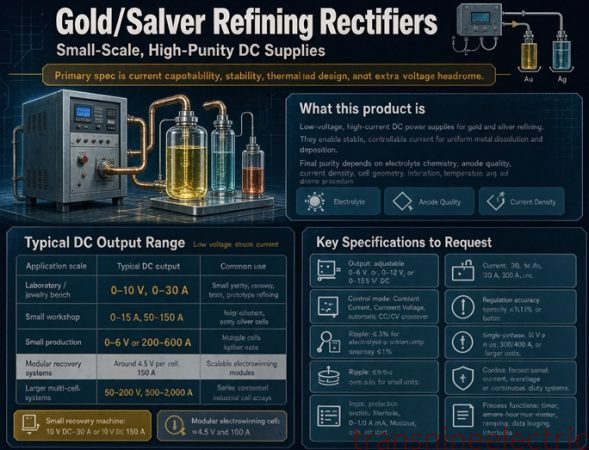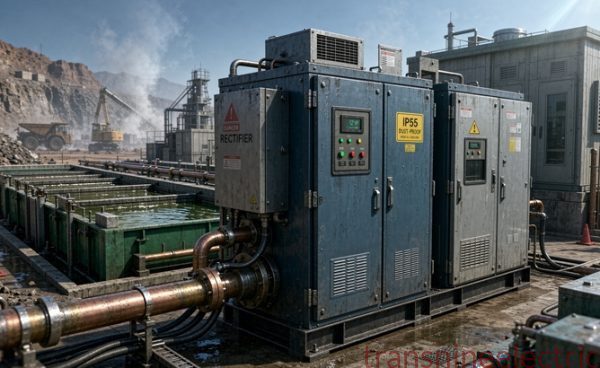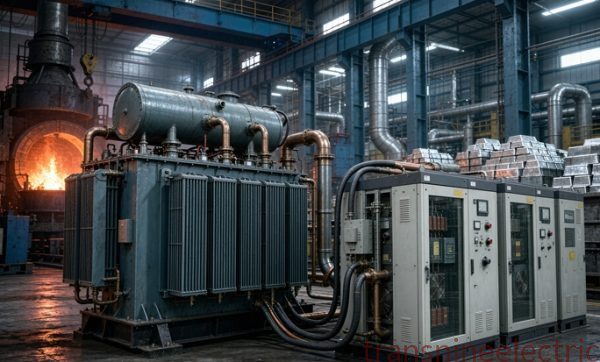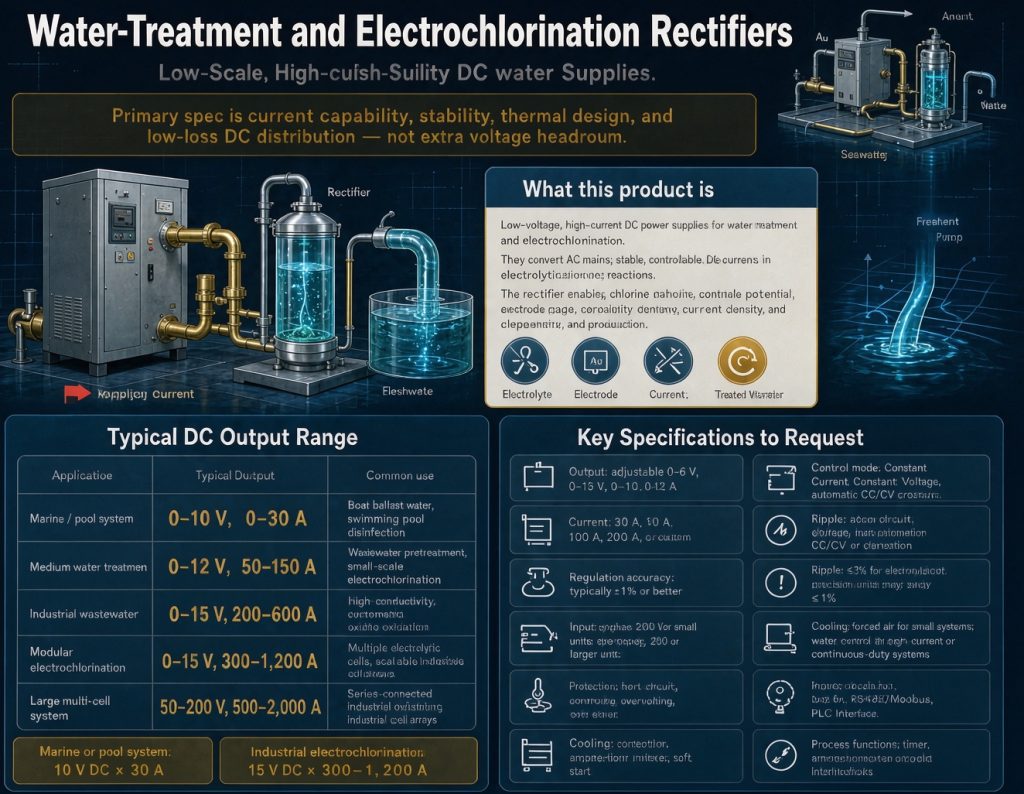
Chlorine output is set by current, not voltage. Faraday’s law gives 1.3228 g of Cl₂ per ampere-hour at 100% efficiency, so 10 kg/h of available chlorine needs about 8,400 A at 90% current efficiency whatever the cell voltage; the voltage only follows how many cells you stack and how much resistance they carry at end of life.
If you are sourcing a rectifier for a hypochlorite generator, a seawater electrochlorination skid, or a ballast water treatment system, that sentence is the whole game. Get the current right and the plant makes its dose. Get the voltage wrong and you either cannot reach the required cell stack at the end of the electrode life, or you buy a machine with a voltage range you will never use. Most supplier pages list twenty models and never say this. We will.
Start with the law, not the model number
Faraday’s law in one line
Every electrochlorination plant runs on the same reaction. Pass direct current through seawater or brine, chloride oxidises at the anode, hydrogen evolves at the cathode, and the chlorine combines with hydroxide to form sodium hypochlorite:
2 NaCl + H₂O → NaOCl + H₂ + NaCl
The mass of available chlorine you make is fixed by the charge you push through the cells. The working form is:
m = M · I · t · η / (z · F)
where M is the molar mass of Cl₂ (70.906 g/mol), I is cell current in amperes, t is time in seconds, η is current efficiency, z is electrons per mole (2), and F is the Faraday constant (96,485 C/mol).
Collapse that into a number you can use on a phone call: one ampere-hour delivers 1.3228 g of Cl₂ at 100% efficiency. At a realistic 90% current efficiency it delivers 1.1905 g. One kilogram of chlorine therefore costs 756 Ah in theory, or 840 Ah in practice.
This is why the first question in any serious RFQ is not “what voltage do you need.” It is “how many kilograms of available chlorine per hour, at what efficiency, and how many cells in series.”
Worked example: 10 kg/h of available chlorine
Take a municipal plant that needs 10 kg/h of equivalent chlorine for a 5,000 m³/h stream at a 2 mg/L dose.
- Mass rate: 10,000 g/h
- Theoretical current: 10,000 / 1.3228 = 7,560 A
- At 90% current efficiency: 7,560 / 0.90 = 8,400 A
- At a specific energy of 4.5 kWh/kg: 10 × 4.5 = 45 kW DC
- With a cell stack near 5 V: 8,400 A × 5 V = 42 kW, which lands in the same band
The same 10 kg/h co-produces 0.284 kg/h of hydrogen, about 3.16 m³/h at ambient conditions. Diluting that to 1% in air takes roughly 316 m³/h of ventilation. Hold that number; we come back to it in the safety section.
Why the same 8,400 A can mean 84 kW or 336 kW
Here is the part suppliers skip. Current sets production. Voltage is the product of cell count and the resistance of each cell. The same 8,400 A can be delivered at completely different powers:
| Cells in series | Cell stack voltage | DC current | DC power | Available chlorine |
|---|---|---|---|---|
| 2 | 10 V | 8,400 A | 84 kW | 10 kg/h |
| 4 | 20 V | 8,400 A | 168 kW | 10 kg/h |
| 8 | 40 V | 8,400 A | 336 kW | 10 kg/h |
The chemistry is identical. Only the electrical and physical arrangement changed. This is why a 6–24 V on-site generator, a 0–100 V seawater rectifier, and a 100–700 V chlor-alkali supply can all be “chlorination rectifiers” while being completely different machines.
The practical consequence for buyers: ask the electrolyser supplier for the cell curve first: unit operating voltage, maximum voltage at end of life, unit current, cell count, and series/parallel connection. If all you have is a production figure, you can size the power class, but you cannot pick the DC voltage range.
Three different jobs hide under one keyword
The phrase “water treatment and electrochlorination rectifiers” pulls up product pages that lump together three applications with almost nothing in common electrically. Sorting them out early saves a wrong specification.
On-site sodium hypochlorite from brine
This is the classic low-concentration brine generator used for drinking water, wastewater, pools, hospitals, and small cooling towers. Brine sits around 2.5–5% NaCl. The cell is diaphragm-less, the product is a dilute 0.7–1.0% solution, and the whole point is avoiding chlorine gas delivery.
- Typical DC output: 6–24 V, 100–10,000 A
- Control: constant current as the main mode, constant voltage for commissioning
- Current density often quoted around 600 A/m² of active anode area
- Cells run in series to add voltage, in parallel to add current
A 12 V / 2,000 A unit and a 200 A / 18 V unit are both legitimate here. They are not interchangeable. One is a bank of cells in parallel, the other a shorter stack.
Seawater electrochlorination for intakes and ballast water
Here the feed is seawater itself, typically 15 PSU or higher salinity, and the system either treats the full intake stream or treats a small side stream at high concentration and injects it back. Ballast water management systems use the same chemistry with tighter discharge limits.
- Typical DC output: 0–100 V high-frequency units, or SCR units up to 150–170 V for larger cell stacks
- Currents commonly 2,000–13,000 A
- Water temperature below 10°C cuts chlorine formation and raises energy use sharply
- Discharge limit at de-ballasting is often 0.2 mg/L TRO as Cl₂ (MADC), with dosing up to about 9 mg/L during ballasting
A side-stream system treating 1% of the ballast flow can use a much smaller electrolyser than a mainstream design, but the rectifier still sees the same current demand per kilogram of chlorine.
Chlor-alkali: a different animal entirely
Chlor-alkali membrane or diaphragm cells make three saleable products: chlorine gas, caustic soda, and hydrogen. They use ion-exchange membranes, separated compartments, and a completely different safety case.
- Typical DC output: 100–700 V, 20–60 kA per unit, individual units above 70 MVA
- Pulse counts of 24, 36, or 48 are common, often with active power filters to push THD below 3%
- Regulation accuracy of 0.5% or better, sometimes ±0.1%, because membrane balance depends on it
- Reverse-current protection with high-speed DC breakers is standard. Cell back-EMF during a grid disturbance can destroy a membrane
Buying a 15 V / 12 kA chlor-alkali rectifier for a brine hypochlorite generator is like buying a locomotive to deliver a parcel. The voltage range, protection scheme, and cooling are all wrong for the job.
Side-by-side
| Item | On-site NaClO (brine) | Seawater electrochlorination | Chlor-alkali |
|---|---|---|---|
| Feed | 2.5–5% NaCl brine | Seawater, ~15–35 PSU | Purified saturated brine |
| Product | 0.7–1.0% NaOCl | Dilute NaOCl at the intake | Cl₂ gas, NaOH, H₂ |
| Separator | Diaphragm-less | Diaphragm-less | Membrane or diaphragm |
| DC voltage | 6–24 V | 0–100 V (up to ~170 V) | 100–700 V |
| DC current | 100–10,000 A | 2,000–13,000 A | 20–60 kA |
| Typical pulse | 6 or 12 | 6 or 12 | 24 / 36 / 48 |
| Reverse-current protection | Optional | Recommended | Mandatory |
| Main control goal | Hold dose | Hold TRO at the sensor | Hold membrane balance |
Rectifier topology: what the acronyms actually buy you
SCR / thyristor
The workhorse for high current. A three-phase bridge with thyristors handles 6-pulse or 12-pulse operation and can be built to 100 kA. It is robust, serviceable, and comfortable at the currents chlor-alkali and large seawater plants need. The trade-offs are a lower power factor at partial load, more harmonic content, and a larger physical footprint. Water cooling is normal above roughly 15 kA.
High-frequency IGBT
The default for compact on-site generators and EDI systems. Switching frequencies push the ripple down, the transformer shrinks, and current control gets genuinely tight. Output ranges of 10–100 V suit most brine cells. EDI modules sit higher, around 50–300 V, and need voltage precision rather than brute current.
What the numbers actually mean
Two specifications get printed on every datasheet and rarely explained:
- Regulation accuracy. ±0.5% is normal for process work; ±0.1% is the chlor-alkali grade. At 8,400 A, 0.5% is 42 A, enough to move your dose. Ask whether the figure is at rated output or across the full range.
- Efficiency. 90% for a compact water-cooled IGBT unit, 92% for a mid-size SCR system, and above 98% for a large chlor-alkali installation with 36 or 48 pulses. On a continuous-duty generator, the difference between 90% and 94% is 4% of your electricity bill, forever.
Ripple is not a single number
What the percentage hides
A datasheet that says “ripple < 3%” without a voltage reference is not telling you much. Ripple is an absolute voltage swing riding on the DC:
- 3% on a 5 V cell stack is 0.15 V peak-to-peak, usually harmless to the electrodes
- 3% on a 150 V chlor-alkali bus is 4.5 V, enough to disturb cell balance
What to specify instead
For electrochlorination, low ripple matters less than steady current. The chemistry integrates charge over time; a small AC component mostly becomes heat. For chlor-alkali and EDI, ripple and dynamic response move into the foreground because membranes and membranes-like separators respond to instantaneous conditions.
A reasonable asking set: below 3% for brine and seawater cells, below 1% where the electrolyser supplier requires it, and a documented ripple measurement point. Do not accept a percentage alone.
Harmonics and pulse count
More pulses cost more but clean up the grid side. Ideal characteristic-harmonic distortion for a p-pulse converter follows:
THD = sqrt( (π² / p²) · csc²(π / p) − 1 )
| Pulses | Phase shift | Ideal THD |
|---|---|---|
| 6 | 60° | 31.084% |
| 12 | 30° | 15.219% |
| 24 | 15° | 7.570% |
| 36 | 10° | 5.042% |
| 48 | 7.5° | 3.780% |
What the table does not tell you
A few honest notes:
- These are ideal figures. Real THD depends on transformer balance, firing-angle symmetry, and load level. A 12-pulse unit at 30% load rarely looks like the table.
- IEEE 519 limits apply at the point of common coupling, not on the rectifier nameplate. Your supplier cannot certify compliance from the transformer data sheet alone.
- For a 1 MW on-site generator on a weak coastal grid, 12-pulse with a tuned filter is often cheaper than 24-pulse. For a 70 MVA chlor-alkali line, 36 or 48 pulses pay for themselves in avoided filter and utility penalties.
- Doubling the pulse count cuts THD by about half, not exactly half. Going from 31.084% to 15.219% is a 51.0% reduction.
The hydrogen problem is an electrical problem
This is the part most rectifier pages treat as someone else’s job. It is not. The hydrogen rate is set by your current, so the rectifier selection fixes the size of the safety system.
How much hydrogen
One mole of H₂ is co-produced per mole of available chlorine. At 10 kg/h of chlorine that is 0.284 kg/h, or 3.16 m³/h of gas. At 13,000 A on a large side-stream system it is more than four times that.
Hydrogen has a lower explosive limit of 4% in air. Good practice dilutes to well below that, commonly below 1% (25% of LEL), before discharge.
Ventilation math
For the 10 kg/h case, diluting 3.16 m³/h of hydrogen to 1% needs roughly 316 m³/h of air. That is why marine electrochlorination packages specify two 100% dilution blowers, a hydrogen detector at the vent, and an automatic shutdown at 4% LEL or at loss of dilution air.
A single failing blower turns a non-hazardous vent into a Zone 1 space. The rectifier interlocks belong in the same design review as the ducting.
Grounding and stray current
On ships, the DC bus is often run ungrounded. Grounded DC gives leakage current a path through hull and nearby structures, and stray-current corrosion follows. IEEE 463 and NEC Article 668 support the ungrounded approach for this class of equipment. Ask explicitly whether the rectifier output is floating and how insulation monitoring is handled.
If the system is installed in a dedicated space aboard a vessel, IEC 60092-502 may classify it as Zone 1, requiring non-sparking ventilation with around 30 air changes per hour and interlocks tied to the electrochlorination unit.
Temperature, salinity and the headroom nobody quotes
Electrolysis is easier in warm, salty water. Cold or brackish feed pushes the other way:
- Below 10°C, chlorine formation drops and specific energy rises steeply. Alfa Laval’s ballast-water guidance puts the normal low end around 10–17°C and calls for preheating below that.
- Low salinity reduces conductivity and chlorine output at the same current. Side-stream designs avoid this by treating only about 1% of the flow and adding salt where needed.
- Electrode coatings age. Cell voltage at end of life is commonly 10–20% above the commissioning value as scale builds and coating activity falls.
Electrode aging and voltage headroom
That last point is where rectifiers get underspecified. If the fresh stack runs at 5 V and your supply tops out at 6 V, you have almost no room left for scaling and coating loss. Ask for the maximum simultaneous operating point (maximum voltage at maximum current) and add the margin there. A 0–24 V unit on a 12 V stack is not waste; it is insurance.
Worked example 2: a 15 kg/h ballast-water side stream
A ship needs 15 kg/h of equivalent chlorine from seawater at 85% current efficiency.
- Current: 15,000 / (1.3228 × 0.85) = 13,341 A
- With 10 cells in series at 4.5 V: 45 V, 600 kW DC
- With 34 cells at 4.5 V: 153 V, 2.04 MW DC. This is where a 170 V SCR unit earns its keep
- Transformer apparent power at 0.95 power factor and 92% efficiency: roughly 690 kVA for the 45 V case
- Hydrogen: 0.43 kg/h, about 4.8 m³/h, needing around 480 m³/h of dilution air for a 1% target
Notice that the current did not change with cell count. Only voltage and power did. This is the whole selection logic in one example.
For a practical sense of scale, 10 kg/h of chlorine at a 2 mg/L dose treats 5,000 m³/h of water. As a delivered chemical it is only 80 litres of 12.5% bleach; as on-site 0.8% hypochlorite it is 1,250 litres. That concentration difference is why on-site generation trades a truck-delivery problem for a power-and-ventilation problem.
Standards and approvals you will actually be asked for
| Area | Reference | Why the buyer cares |
|---|---|---|
| Semiconductor converters | IEC 60146-1-1 | Thyristor converter performance and test basis |
| Transformers | IEC 60076 series / IEEE C57.12.00 | Insulation, temperature rise, short-circuit withstand |
| Harmonic limits | IEEE 519-2022 | Evaluated at the PCC, not at the rectifier |
| Marine electrical | IEC 60092-502 | Hazardous-area classification for ECU spaces |
| Shipboard equipment | Relevant class rules (ABS, DNV, LR) | Type approval for ballast water systems |
| Drinking water additives | NSF/ANSI/CAN 60 | Needed where the product contacts potable water |
| Hydrogen safety | IEC 60079 / ATEX where applicable | Ventilation, detection, Ex-rated equipment |
| System performance | IMO BWM Convention, USCG rules | Discharge limits and type approval |
Confirm the current edition of each standard before you write it into a tender. A specification that cites a withdrawn edition is a red flag in an international bid.
What to put in your RFQ
A good enquiry gets a calculated answer in days instead of a clarification loop in weeks. Send:
- Target available-chlorine output in kg/h, product concentration, and daily operating hours
- Feedwater source and salinity, temperature range, hardness, and bromide level
- Electrolyser make and model, cell count, series/parallel connection, operating voltage, maximum voltage at end of life, and normal current
- Current efficiency curve or the supplier’s guaranteed figure
- Required control mode: constant current, constant voltage, ampere-hour dosing, or polarity reversal, and whether reversal is a standard or a project option
- Ripple limit, regulation accuracy, and harmonic limits at the PCC
- Cooling medium available on site and ambient conditions
- Hydrogen dilution and detection scheme, including blower redundancy and interlocks
- Grounding preference and insulation monitoring requirements
- Communication protocol: RS485, Modbus RTU, Profibus, Profinet, or hardwired 4–20 mA
- Applicable standards, class approvals, and test witness points
One honest note: the rectifier alone does not guarantee a production rate or a disinfectant concentration. Salt quality, water temperature, electrode condition, flow, residence time, and dosing all move the result. A supplier who promises a concentration from the rectifier data sheet alone is overselling.
Where to go from here
If you have the cell curve and the production duty, we can return a DC rating with the assumptions written down, a pulse-count recommendation tied to your grid, and a ventilation interface list. If you only have a dose and a flow rate, we will tell you which figures to get from the electrolyser supplier before anyone quotes a rectifier.
FAQ
How do you calculate the DC current for a sodium hypochlorite generator?
Use Faraday’s law: I = m · z · F / (M · t · η). For 10 kg/h of available chlorine at 90% current efficiency, that is 10,000 × 2 × 96,485 / (70.906 × 3,600 × 0.90) = about 8,400 A. The shortcut is 1.3228 g of Cl₂ per ampere-hour at 100% efficiency, divided by your efficiency.
Does a higher voltage mean more chlorine production?
No. Current sets production; voltage follows cell count and cell resistance. The same 8,400 A produces 10 kg/h whether the stack is 10 V or 40 V. Higher voltage means more cells in series and more power, not more chlorine per ampere.
What voltage range should a brine hypochlorite rectifier have?
Most on-site brine generators use 6–24 V DC with currents from 100 A to 10,000 A. Size the upper end from the electrolyser’s maximum voltage at end of life, not from the fresh-cell voltage. A 12 V stack that rises to 15 V needs a supply with real headroom.
Is a chlor-alkali rectifier the same as a water treatment rectifier?
No. Chlor-alkali units run 100–700 V at 20–60 kA, often above 70 MVA, with 24/36/48 pulses, reverse-current protection, and 0.5% or better regulation. On-site hypochlorite generators run 6–24 V with diaphragm-less cells and no membrane balance to protect.
Why is current efficiency less than 100%?
Real cells lose charge to side reactions, oxygen evolution, and chlorate formation. Values from 76% to 95% are quoted, with 85–90% typical for brine and seawater cells. Electrolyte composition, electrode material, temperature, and current density all move the number.
How much hydrogen does electrochlorination produce?
One mole of H₂ per mole of available chlorine. At 10 kg/h of chlorine that is 0.284 kg/h, or roughly 3.16 m³/h of gas. Diluting it to 1% in air takes about 316 m³/h of ventilation flow.
What does the 4% hydrogen limit mean?
4% by volume in air is the lower explosive limit of hydrogen. Systems are designed to stay well below it, commonly under 1% (25% of LEL), with gas detection and automatic shutdown at the alarm setpoint.
How many pulses do I need for an electrochlorination rectifier?
Six or twelve pulses cover most brine and seawater generators. Six-pulse ideal THD is 31.084%, twelve-pulse is 15.219%. Chlor-alkali plants often use 24, 36, or 48 pulses, giving 7.570%, 5.042%, and 3.780% ideal THD. The final choice depends on limits at the point of common coupling.
Should I choose constant current or constant voltage?
Constant current is the normal mode because chlorine production tracks charge. Constant voltage helps during commissioning and for certain control strategies. Ask whether the supply can switch modes without a manual restart and whether ampere-hour dosing is included or a paid option.
How much regulation accuracy do I need?
±0.5% suits most process duties; ±0.1% is chlor-alkali grade. At 8,400 A, 0.5% is 42 A. Confirm whether the stated accuracy applies at rated output only or across the whole operating range.
Why does cold seawater need more power?
Below about 10°C, chlorine formation falls and specific energy rises. Salinity below roughly 15 PSU has a similar effect. Both push the rectifier to deliver more current or more voltage for the same dose, and both argue for headroom in the DC range.
What information does a supplier need to quote a rectifier?
Available-chlorine output, cell model and connection, normal and maximum cell voltage, current, current efficiency, brine salinity and temperature, duty cycle, cooling available, ripple and harmonic limits, hydrogen ventilation scheme, and required communications. Without the cell curve, no one can pick the final DC voltage.