Choosing between a US and a Chinese pad mounted transformer manufacturer comes down to six variables, not a flag: landed cost, lead time measured the same way, UL verification, the DOE 2029 date, whether your utility’s approved list is open to you, and who eats the warranty risk. On a 500 kVA three-phase unit, a Chinese FOB quote of about $22,000 lands at roughly $40,600 at your site once duties stack up — against 38,000–56,000 delivered from a US distributor. The headline “20–30% cheaper” is an EXW number, and it mostly disappears by the time the container clears customs.
Here’s the thing nobody on page one of Google will tell you: the country question is almost always the wrong first question. A US-made unit that shows up 30 weeks late costs more than a Chinese unit that shows up on time, and a Chinese unit that your utility won’t accept costs more than either. This guide is written for the person who has to sign the PO — with the tariff arithmetic shown line by line, because that’s where most comparisons quietly break.
If you haven’t locked the rating yet, start with pad mounted transformer sizing, dimensions and price ranges first. This article assumes you know your kVA and assumes you’re now deciding who builds it.
Key numbers
| Number | What it means |
| $40,603 | Modeled landed cost of a 500 kVA three-phase unit imported from China at $22,000 FOB |
38,000–56,000 | Same unit delivered to site by a US distributor, aluminum windings, mineral oil |
| 50% | Illustrative stacked duty rate on a Chinese-origin liquid-filled transformer (301 at 25% + 232 steel derivative at 25%) |
| 8–12 units | Roughly how many 300–500 kVA units fit a 40-ft high-cube before the payload limit binds |
| April 23, 2029 | The date DOE’s amended efficiency levels start applying — keyed to manufacture or import |
| 12–65 weeks | Spread of published 2026 pad-mount lead times, depending on whose number you read |
| 6 | Decision variables that actually matter (country is not one of them) |
| 12 | Due-diligence checks to run before you release a PO offshore |
Why “USA or China?” is the wrong first question
The country is a proxy. The six things you’re really buying are: total landed cost, a delivery date you can plan around, verifiable compliance, acceptance by whoever owns the service, enforceable warranty, and a spec that survives 2029. Two suppliers on the same continent can differ more on those six than two suppliers on opposite sides of the Pacific.
Put differently: a Chinese factory with an active UL file, a 10-week slot and a track record on US utility programs is a safer buy than a domestic broker with a 52-week queue and no drawing package. And a US distributor holding stock is a safer buy than an offshore factory quoting 30 days if your substation is down right now.
What the country does change, genuinely, is four things:
- The duty stack. 40–50% on Chinese-origin liquid-filled transformers as of late 2026, versus zero for domestic.
- The clock. Factory production in Asia is genuinely faster; getting it across the water is not.
- The service radius. A warranty claim in Ohio is a truck ride from Ohio. From Guangdong it’s an email.
- The acceptance path. Whether your utility’s approved-equipment list has a lane for it.
Everything else — winding metal, impedance, BIL, paint, loss values — is a spec question, and it’s answerable either way.
The two supply chains, honestly described
US and North America
Domestic supply is a mix of large OEM brands with US plants, specialist pad-mount builders, and a deep stock/surplus market. What you’re paying for is schedule certainty, utility familiarity, and somebody who can drive to the site.
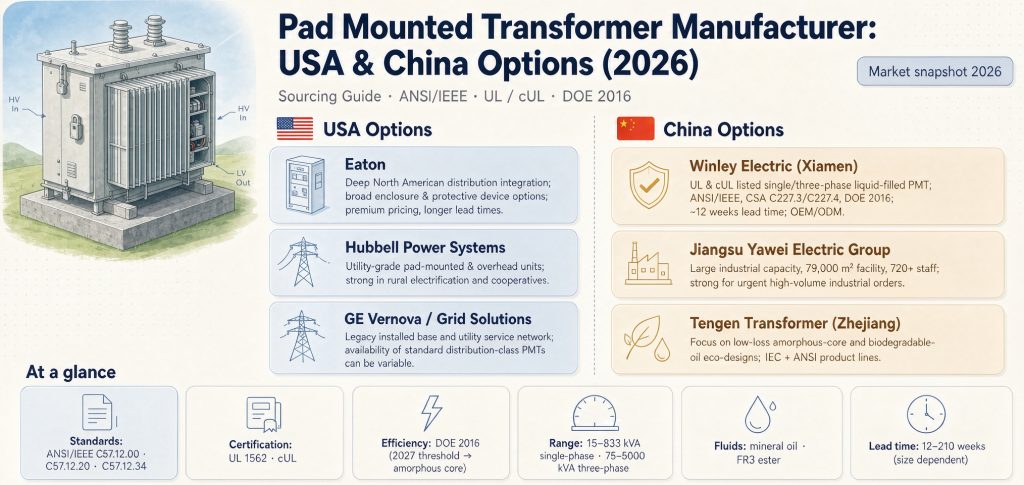
The big names — Eaton’s Cooper Power line, Hitachi Energy, Siemens Energy, Prolec GE, WEG’s Missouri plant — carry utility references and broad catalogs, and they’re the default on investor-owned utility work. The specialists are where a lot of commercial and industrial buyers actually land: VanTran in Waco, MGM Transformers, Maddox, Virginia Transformer, Giga Energy in Houston, ERMCO, Central Moloney. Several of them publish live inventory, which is worth more than a brochure when your schedule is broken.
The honest downsides: catalog lead times are long, and pricing sits at the top of the band. Published 2026 distributor pricing for a 500 kVA three-phase unit with aluminum windings and mineral oil runs 38,000–56,000, and that’s before installation. On top of that, domestic capacity is being bid up hard by data-center demand — WEG committed roughly $77 million to expand its Missouri plant in September 2025 targeting a 50% capacity increase, which tells you how tight the market is.
We break down how the major North American suppliers stack up separately, including where each one actually wins.
China
Chinese pad-mount capacity is real, certified, and fast — the constraint isn’t capability, it’s the duty stack and the acceptance path. The serious exporters hold UL and cUL files on liquid-filled pad-mounts, build to IEEE C57.12.34 and C57.12.38, and quote production cycles in weeks rather than quarters.
What they’re genuinely good at:
- Speed to build. Production cycles of 4–12 weeks for standard ratings are commonly quoted, against 16–65 weeks for domestic catalog or build-to-order.
- Custom configurations. Odd voltage combinations, non-standard bushings, specific accessory brands — a domestic catalog won’t bend for one project and an OEM program will.
- Multi-unit programs. If you need 40 identical units on a subdivision, this is where the economics get interesting.
- Small-unit economics. A 75 kVA single-phase pad-mount is dramatically cheaper per unit when ten of them share one container.
What they’re genuinely weaker at:
- Landed cost after duties. See the next section — this is the big one.
- Field service. Remote support is excellent; a technician at your pad on Tuesday is not.
- Utility acceptance. Often the binding constraint, and rarely about the transformer itself.
- Change risk. Tariff rates on this lane moved more than once during 2026 alone. Your budget needs a contingency line.
If you’re heading down this path, read what to check before you import from China — it covers factory audit, Incoterms and document packages in more depth than fits here.
Third countries and hybrid sourcing
Vietnam, Mexico, India, Brazil and Korea all appear in this supply chain, and some of it is genuine diversification. Some of it isn’t. Country of origin for US customs purposes isn’t determined by the port it ships from; it turns on where the article was substantially transformed. Re-boxing or final assembly in a third country doesn’t automatically move origin, and CBP has been clear on that.
Mexico deserves a specific mention: Prolec GE builds in Monterrey, and Mexican-origin units don’t face Section 301. For a North American program that wants offshore economics without the China duty stack, that’s frequently the cleanest answer — and it’s the option most comparison articles skip entirely.
Price: the only comparison that matters is landed cost
A factory quote is not a price. It’s a fraction of a price. On Chinese-origin liquid-filled transformers the missing fraction is currently around 40–50% in duties, and that single line item is the reason “20–30% cheaper” rarely survives contact with a customs entry.
Here’s the worked model. One 500 kVA three-phase pad-mount, mineral oil, aluminum windings, DOE 2016 compliant, destination a US job site.
| Line | China-sourced | US-distributed |
| Factory price, FOB | $22,000 | — |
| Distributor price, delivered to site | — | 38,000–56,000 |
| Ocean freight + marine insurance | $5,500 | — |
| Inland drayage to site | $1,500 | included |
| Section 301 (China origin), 25% | $5,500 | — |
| Section 232 steel derivative, 25% | $5,500 | — |
| MPF 0.3464% + HMF 0.125% | $103 | — |
| Customs broker, ISF, bond | $500 | — |
| Landed at site | $40,603 | 38,000–56,000 |
Two things jump out. First, duties are $11,000 on a $22,000 transformer — that’s half the factory price again, and it’s the line most “China vs USA” articles simply omit. Second, the landed number lands inside the domestic band, near its floor. Not above it, but not dramatically below it either.
The duty mechanics, briefly: Section 301 applies by country of origin, at 25% on many HTS 8504 lines. Section 232 applies by metal content — and since April 6, 2026, the steel-derivative duties apply to the full customs value of the article rather than just the steel content, which is what pushed this lane up. One tariff calculator shows the effective rate on HTS 8504.22.00.80 moving from 57.5% to 50% between February and July 2026 alone. Treat every number in this section as illustrative and have your broker confirm your specific 10-digit HTS before you commit a budget. The rate is not stable, and it’s not the same across subheadings.
Check the current China list against the USITC Section 301 tariff file, and read the amended DOE rule in 89 FR 29834 if efficiency is in your spec.
Where the offshore advantage actually survives
Chinese sourcing wins on landed cost when you can spread freight and fixed import costs across many units, and loses when you can’t. Container utilization is the variable nobody publishes.
| Program shape | Freight per unit | Verdict |
| 10 × 75 kVA single-phase in one 40-ft HC | ~$700–900 | Strong win. Duty base is small, freight nearly vanishes. |
| 8–12 × 300–500 kVA three-phase, one container | ~$700–1,200 | Win, but thinner. Duties scale with value. |
| 1 × 500 kVA, part container | ~$5,500 | Marginal. Roughly at the domestic floor. |
| 1 × 2,500 kVA (19,540 lb) | ~$9,000–14,000, likely flat-rack | Usually loses. One unit fills the box. |
A 40-ft high-cube carries roughly 8–12 units in the 300–500 kVA class before you hit the payload limit. A single 2,500 kVA unit at 19,540 lb fills it by itself and probably needs special equipment. So: consolidate or don’t bother. One-off large units are the worst possible use of an offshore factory.
Six variables that explain a 5–10× quote spread
| Variable | Impact |
| Winding metal | Copper +15–25% over aluminum |
| Voltage class | 34.5 kV +10–20% over 13.8 kV |
| Fluid | FR3 / natural ester +8–15%; silicone +20–30% |
| Efficiency tier | DOE 2016 added ~15–20% industry-wide |
| Accessories | Loop switch, Bay-O-Net + CLF, arresters, gauges |
| Commercial scope | EXW vs FOB vs DDP vs installed — the single biggest confuser |
Never compare a number to a number. Compare a scope to a scope.
Lead time: why the two sides quote different things
Published 2026 pad-mount lead times span 12 to 65 weeks — a factor of five — because every source is measuring a different thing. “Faster” is meaningless until you ask faster from what trigger.
| Source | Figure | What it actually measures |
| US distributor | 16–24 weeks | Catalog-configured units |
| US market analyst | 12–28 weeks | Domestic supply, split at 500 kVA |
| Procurement tracker | 26–40 weeks | Standard catalog, worsening into 2026–27 |
| Contractor slot data | 40–65 weeks | Build-to-order, 0–5 MVA |
| Export manufacturer | 8–14 months | Project-spec, build-to-order |
| Asian OEM (own claim) | 4–12 weeks | Production cycle only — excludes ocean transit |
That last row is where people get hurt. A 6-week production cycle plus 5–6 weeks on the water plus a week of customs is 12–13 weeks door-to-door — genuinely better than 40–65, but not the 6 weeks the quote implied. Always ask: “Is that production cycle or delivery to my site, and what’s the transit assumption?”
Three ways to actually go faster, either direction:
- Freeze the spec early. A change resets your place in the queue.
- Write performance specs, not brand names. Naming one bushing make means inheriting that make’s queue.
- Reserve a production slot instead of waiting for a finalized PO.
Plan 12–18 months from spec freeze to energization on anything custom, regardless of origin.
Compliance: UL, the 2029 date, and country of origin
How to verify a UL file in five minutes
An active UL listing is the single hardest thing to fake and the easiest thing to check. Do it yourself — it takes five minutes and it’s the highest-value five minutes in the whole sourcing exercise.
- Go to UL Product iQ and search the manufacturer’s UL file number (it looks like
E536138). - Check the status is Active and the file is under the legal entity you’re actually contracting with — not a trading company with a similar name.
- Read the category description. For pad mounts you want language covering liquid-filled, pad-mounted distribution transformers. A file that covers dry-type general-purpose transformers does not cover the oil-filled unit you’re buying.
- Check the rating limits. Files carry maximum kVA and maximum primary voltage. A file capped at 2,500 kVA doesn’t cover your 3,750 kVA unit.
- Check the manufacturing location. Multiple production sites is normal; an unlisted site is not.
Red flags: a certificate PDF with no file number, a file number that resolves to a different company, a listing marked “Voluntarily Withdrawn,” or a supplier who can’t tell you which factory address the file covers.
Standard set you should see referenced: IEEE C57.12.34 (three-phase, up to 10 MVA, ≤34.5 kV), C57.12.38 (single-phase to 250 kVA), C57.12.28 (enclosure integrity), C57.12.29 (coastal), C57.12.39 (tank pressure coordination), C57.12.90 (testing), IEEE 386 (separable connectors), NEMA 260, CSA C227.3 / C88 for Canada.
The DOE 2029 date — and why importers get hit harder
DOE’s amended efficiency levels apply to units manufactured or imported on or after April 23, 2029. If you’re importing, your compliance date is set by a ship’s arrival, not by your PO — which is a risk domestic buyers don’t have.
Three consequences:
- The trigger is manufacture or import, not PO date and not delivery date. A unit built in late 2028 and imported in 2029 is judged on the new table.
- Coverage expands to 5,000 kVA in 2029; above 2,500 kVA was previously outside federal scope entirely.
- Importers carry schedule risk on top of design risk. A vessel delayed from March to May 2029 can change which table applies.
Practical move: if you’re importing a unit that will be judged against the 2029 table, require the manufacturer to complete manufacture and document it well before Q4 2028, and build the date into the contract. Current minimum efficiencies sit in 10 CFR 431.196.
And one trap worth repeating: “Meets DOE 2029” means nothing without the kVA attached. The curve isn’t monotonic — a 300 kVA unit is held to 99.42% while a 500 kVA unit is held to only 99.38%. Ask for certified no-load and load loss values at your rating.
Also confirm you’re even in scope. The federal definition requires input ≤34.5 kV, output ≤600 V, 60 Hz, 10–2,500 kVA liquid-immersed. A 4,160 V secondary, a step-up solar collector unit, or a tap range of 20% or more all fall outside it.
“Assembled in Vietnam” doesn’t automatically work
Country of origin turns on substantial transformation, not on the last port of call. If the core, coils and tank are made in China and a third country bolts on accessories, CBP can still call it Chinese-origin — and Section 301 follows. CBP publishes guidance on origin and marking, and you can request a binding ruling through its eRulings process. If you’re building a diversification story into your sourcing plan, get that ruling before you rely on it, not after.
The utility approved list — the gate nobody writes about
If the transformer will be owned or maintained by a utility, the approved-equipment list decides your supplier pool before price does. And the reason offshore manufacturers struggle to get on it usually isn’t technical.
Three things actually keep a manufacturer off a utility list:
- Framework agreements. Utilities buy on multi-year contracts with qualified bidders. Getting added requires going through a bid cycle, not sending a cut sheet.
- First-article qualification. New suppliers typically go through a trial period on non-critical positions before they’re trusted with feeder positions.
- Service radius. When a unit fails at 2 a.m., the utility wants a truck, not a time-zone difference.
Ways in, in order of realism:
- Start on the customer-owned side of the meter. Developer-owned commercial and industrial pads usually aren’t bound by the utility’s list. This is where offshore sourcing legitimately wins most often.
- Enter as an OEM behind a listed brand. Some listed manufacturers source from qualified factories.
- Target engineering-driven utilities and municipal systems, which are often more willing to qualify on documented test evidence than on tenure.
- Lead with the test package. The routine tests every unit should pass — ratio, winding resistance, insulation resistance, applied and induced voltage, plus certified loss values — is the evidence a qualification reviewer actually reads.
Either way: pull the utility’s material standard before you draw anything. It governs at the service position and it will differ from any catalog you’ve been looking at.
Risk, warranty, and commercial terms
A warranty is only worth what it costs to enforce. A 24-month warranty from a factory 8,000 miles away is a different instrument from the same sentence issued by a supplier with a warehouse in-state — and the difference should show up in your price negotiation.
Nail these down before the PO:
| Term | Domestic norm | Offshore — what to insist on |
| Warranty | 12–24 months, service call | 24 months from bill of lading or from energization — get the trigger defined, plus a spare-parts kit shipped with the order |
| Claims | Field service | Written claims window, photo-evidence process, and a defined replacement-part shipping commitment |
| Testing | Routine, witnessed on request | Routine per C57.12.90 plus the option to witness FAT remotely — see our utility EPC compact substation programme for how witnessed FAT runs |
| Payment | Net 30, credit terms | LC or staged TT; fix the exchange rate or price the currency risk |
| Incoterms | Delivered | DDP if you want one accountable party; FOB if you have a broker you trust |
| Damage | Carrier claim | Export packing spec in writing — crating, VCI, shock indicators, and desiccant |
Two clauses worth the negotiation: a defined remedy for a failed FAT (who pays for re-test and re-shipment), and a documented production slot with a named date rather than a “we’ll fit you in.”
Decision matrix: which option wins for your project
| Your situation | Usually wins | Why |
| Emergency replacement, unit down now | US stock or new surplus | Days beat weeks. Freight transit alone kills the offshore option. |
| Utility-owned URD subdivision | Domestic or pre-qualified | Approved list governs. Price is the third or fourth variable. |
| Developer-owned commercial pad, 1–5 units | Either — run the landed math | No utility list constraint; compare landed to delivered, not FOB to delivered. |
| Multi-unit program, 20+ identical units | Offshore, consolidated | Freight and fixed import costs spread; this is the strongest offshore case. |
| Data center / hospital, downtime critical | Domestic or pre-qualified offshore | Loop feed, ester fluid, low no-load core, and a service radius that matters. |
| Solar / BESS collector, odd voltages | Offshore custom | Often outside DOE scope; catalogs won’t have 1,500 kVA at your ratio. |
| 2,500 kVA+ single unit | Domestic | One unit fills a container; freight and rigging erode the gap. |
| Coastal / marine exposure | Either — check the coating QA | IEEE C57.12.29 applies regardless of origin; audit the paint process, not the brochure. |
Two edge cases worth flagging. Federally funded projects may carry domestic-content requirements — check Build America, Buy America applicability before you shortlist anyone. And if the site is indoor or the clearances don’t work, a pad-mount may be the wrong product class entirely; our dry-type alternative covers that branch, and our oil-immersed transformer range covers IEC-market distribution and power classes where a North American pad-mount spec doesn’t apply.
Twelve checks before you release an offshore PO
Run all twelve. A supplier who clears ten of them is usually fine; one who stalls on the UL file number or the factory address is telling you something.
- UL file number verified in UL Product iQ — active, correct category, correct rating limits, correct factory address.
- Factory audit, not a showroom tour. Ask for the core-cutting line, the winding machines, the vacuum drying oven and the oil filtration setup, on video.
- QMS certificates current — ISO 9001, 14001, 45001, with scope that covers transformer manufacture.
- Test equipment list. Can they do induced voltage, impulse if specified, and certified loss measurement in-house?
- Certified loss values at your exact kVA, not a compliance sentence.
- Certified outline drawing with filled weight, base footprint, and oil volume — before you design the pad.
- Third-party type test reports if your spec calls for them, with dates and lab names.
- Export packing specification in writing, including crate type and shock indicators.
- Two or three reference projects in your market, with contacts you can call.
- Witnessed FAT option, including remote witnessing procedure.
- Documented production slot with a date, plus a stated transit assumption.
- Written warranty, claims process, and spare-parts list.
For a deeper version of this, including how to read a supplier’s claims critically, see how to vet a transformer supplier’s claims.