
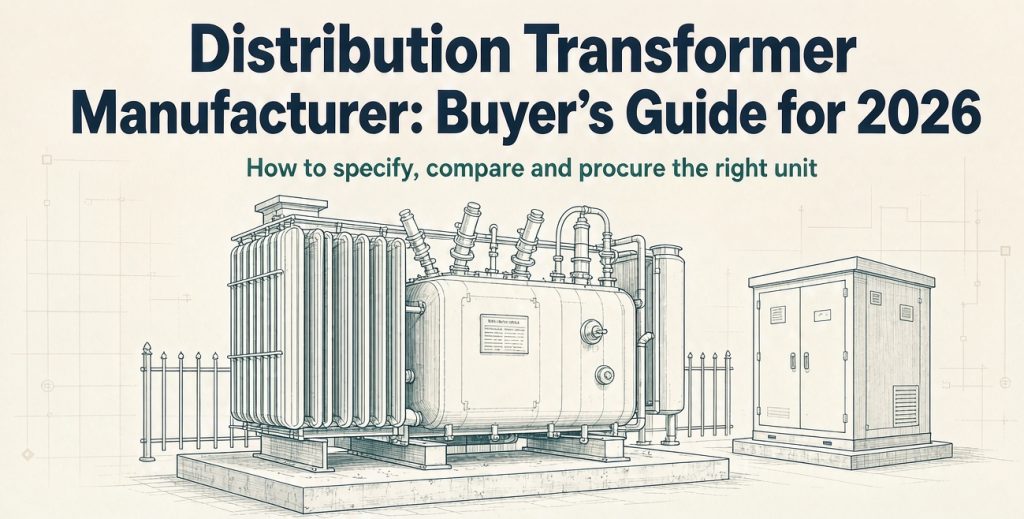
If you typed “distribution transformer manufacturer” into Google today, you got roughly one of three things: a list of names, a checklist of adjectives, or a thin blog post that ends in a contact form. None of those tell you what actually goes wrong between the day you send an RFQ and the day a 4-ton box shows up at your site.
This guide is the missing middle. It’s written for buyers who already know they need a distribution transformer and now have to not get burned buying one. Ten steps, real numbers, sourced where numbers can be sourced, and honest where they can’t.
Here’s the uncomfortable part up front: on a unit that will sit energized for 25 to 30 years, the purchase price is usually the smallest number you’ll pay. Everything else — the losses, the outage, the re-order because the BIL was wrong — shows up later, on someone else’s budget line, long after you’ve moved on.
The 60-second version
Twelve things. If you only skim, skim this.
- Distribution transformer, for DOE purposes, means input voltage ≤ 34.5 kV, output ≤ 600 V, 60 Hz (10 CFR 431.192). Anything outside that may be exempt from efficiency rules entirely — including sealed, special-impedance, UPS, and tap-range ≥20% units.
- The efficiency floor moves April 23, 2029. DOE’s final rule (89 FR 29834) requires compliance for units manufactured or imported on or after that date.
- Units made before April 23, 2029 can still be sold and installed after it. That single sentence is worth real money to anyone ordering in 2026–2028.
- One kilowatt of continuous loss costs about
1,218 a year** at 13.97¢/kWh — the US commercial average for January–July 2026 (EIA Electric Power Monthly, Table 5.3). Over 25 years, that's **30,441 per kilowatt. - Going from the 2016 efficiency floor to the 2029 floor on a 1,000 kVA three-phase low-voltage dry-type cuts losses by 1.42 kW — roughly $43,200 over 25 years at that same rate.
- Send 18 fields in your RFQ, not three. Missing fields are why you get three quotes you can’t compare.
- Three quotes are never comparable out of the box. Build a compliance matrix before you read the prices.
- Pad-mounted and pole-mounted units quoted 12–30 weeks as of Q1 2025. Units above 10 MVA have run 80–120 weeks in some quarters.
- The standard choice (IEC 60076 vs ANSI/IEEE C57.12) is a design decision, not a paperwork decision. Get it wrong and you’re rewiring bus bars on site.
- Nobody was ever happy about a transformer price after adding freight, insurance, duty, and the cost of waiting. Quote landed cost.
- Ask for the test reports before you pay the balance, not after.
- Check the nameplate against your PO at the dock, not at energization.
What a distribution transformer manufacturer actually sells you
Here’s the thing most guides don’t say plainly: you are not buying a transformer. You are buying four things, and only one of them is the box.
| You’re buying | Why it costs money | Typical failure mode |
| A design | Core grade, winding conductor, impedance, cooling class decide your losses for 30 years | You bought on price, got a commodity core, and pay for it every hour for three decades |
| A verification trail | Routine tests, type tests, witnessed FAT, certifications | You discover at energization that no one actually measured anything |
| A delivery date | In a market with multi-year backlogs, schedule certainty is a product | “Eight weeks” becomes fourteen, and the GC bills you for standby time |
| A 25-year relationship | Spare bushings, oil handling, warranty claims, troubleshooting | Manufacturer is unreachable 4 years in when you actually need them |
If you’re comparing suppliers and all four boxes look identical on paper, you’re not comparing suppliers — you’re comparing their marketing departments.
Step 1: Lock the spec before you ask for price
The most expensive sentence in transformer procurement is “just quote me a 1,500 kVA.” It guarantees you’ll get three quotes that mean three different things.
Send these 18 fields on every RFQ:
| # | Field | Why it changes the price |
| 1 | kVA rating | Sets the whole bill of materials |
| 2 | Phase (single / three) | Single-phase units are a different production line |
| 3 | Frequency (50 / 60 Hz) | Cross-frequency operation is a compromise, not a feature |
| 4 | Primary voltage + class | Drives BIL and bushing cost |
| 5 | Secondary voltage | Sets winding turns and conductor cross-section |
| 6 | BIL requirements | Directly priced |
| 7 | Impedance (Z%) | Custom impedance often means a custom design |
| 8 | Vector group / connection | Affects parallel operation |
| 9 | Tap configuration | Tap changers add real cost |
| 10 | Cooling class (ONAN / ONAF / AN / AF) | Fans and pumps are line items |
| 11 | Temperature rise | 65 °C vs 80 °C rise is a material decision |
| 12 | Insulation class | Long-term thermal aging |
| 13 | Winding material (copper / aluminum) | Usually the single biggest price lever |
| 14 | Applicable standard + edition | IEEE C57.12.xx vs IEC 60076 changes the design |
| 15 | Required certifications and their scope | UL listing covers specific models, not a company |
| 16 | Enclosure / mounting (pad, pole, vault, skid) | Site-driven |
| 17 | Altitude, ambient temp, seismic, coastal exposure | Derating and coating cost real money |
| 18 | Quantity, destination, Incoterm, requested date | Determines freight, duty, and whether anyone will expedite |
Cost of skipping this: one buyer we’ve all met sends a three-line RFQ, gets three wildly different numbers, spends two weeks clarifying, and discovers the “cheap” quote assumed aluminum windings and no witness test. That’s three weeks of schedule, gone, to save ten minutes of typing.
Step 2: Pick the type — because this locks everything else
Four configurations cover nearly all distribution purchases. Pick wrong here and every later step gets more expensive.
| Type | Typical range | Where it goes | Strengths | Watch out for |
| Pole-mounted | 10–167 kVA | Overhead rural and light residential | Cheapest per unit, minimal ground footprint | Tampering risk, storm exposure, limited capacity |
| Single-phase pad-mounted | 25–167 kVA | Residential neighborhoods, light commercial | Dead-front safety, tamper resistant | Requires a poured pad and clearances |
| Three-phase pad-mounted | 75–5,000 kVA | Commercial, industrial, utilities | High capacity at grade level | Bigger footprint, heavier logistics |
| Dry-type (cast resin / VPI) | 15–5,000+ kVA | Indoor, hospitals, data centers, high-rises | No oil, no fire vault, low maintenance | Ventilation requirements; higher cost per kVA in some ratings |
The oil-versus-dry question deserves more than a table row — it drives fire code compliance, maintenance budget, and indoor air handling. Our dedicated oil-immersed vs dry-type decision guide walks through it by environment, fire safety, and total cost.
INTERNAL LINK 1/8 ✅
Step 3: Get the standard right — this is a design decision
This is where projects quietly lose six weeks.
ANSI/IEEE C57.12 is the North American family. IEC 60076 is the global family used across Europe, most of Asia, Africa, the Middle East, and Latin America. If your spec was written by an EPC working under IEC, expect references to IEC 60076-1, -2, -3, and -5. If it’s a North American utility, expect IEEE C57.12 series plus NEMA enclosure requirements.
Why this isn’t paperwork: the two families differ in bushing configuration, terminal placement, cooling notation conventions, nameplate markings, and low-voltage terminal connections. Dropping an IEC-designed unit into an ANSI station usually means bus bar adapters and protection rewiring. Dropping an ANSI unit into an IEC station means… the same problem, in reverse.
The detailed comparison — including which family to specify when you’re exporting — lives in our IEC 60076 vs ANSI/IEEE guide.
INTERNAL LINK 2/8 ✅
Step 4: Read the efficiency number as money
This is the step almost every buyer skips, and it’s the one that costs the most.
An efficiency figure like “99.28%” tells you almost nothing about money. A watt tells you money. Here’s how to convert.
The capitalization table
A distribution transformer is energized roughly 8,760 hours a year, every year, whether anyone is drawing load or not. Core loss runs continuously. So one kilowatt of loss is a recurring bill:
| Electricity price | Cost per kW-year | Cost over 25 years |
| $0.06/kWh | $526 | $13,140 |
| $0.08/kWh | $701 | $17,520 |
| $0.10/kWh | $876 | $21,900 |
| $0.139/kWh — US commercial avg, Jan–Jul 2026 (EIA) | $1,218 | $30,441 |
| $0.20/kWh | $1,752 | $43,800 |
Math: 1 kW × 8,760 h × price. Undiscounted. Source for the highlighted rate: US Energy Information Administration, Electric Power Monthly, Table 5.3 (commercial sector, January–July 2026 year-to-date). EIA reports 13.41¢/kWh for full-year 2025.
The DOE tables — 2016 floor vs 2029 floor
DOE’s amended standards (89 FR 29834) cut allowable losses by roughly 30% for single-phase and 20% for three-phase low-voltage dry-type units versus the 2016 levels. Here’s what that looks like for three-phase units, with losses derived from the DOE minimum efficiency figures:
| kVA | Efficiency 2016 floor | Efficiency 2029 floor | Loss 2016 (kW) | Loss 2029 (kW) | Loss cut |
| 75 | 98.60% | 98.88% | 1.07 | 0.85 | 0.22 kW |
| 150 | 98.83% | 99.06% | 1.78 | 1.42 | 0.35 kW |
| 300 | 99.02% | 99.22% | 2.97 | 2.36 | 0.61 kW |
| 500 | 99.14% | 99.31% | 4.34 | 3.47 | 0.86 kW |
| 1,000 | 99.28% | 99.42% | 7.25 | 5.83 | 1.42 kW |
Sources: efficiency floors per DOE final rule, 89 FR 29834 (Apr. 22, 2024), as compiled by Rex Power Magnetics. Loss kW calculated from those efficiency values at rated output for illustration — always confirm against the manufacturer’s actual no-load and load-loss figures in watts, which are what your utility will evaluate.
The worked example
Take the 1,000 kVA row. Upgrading from the 2016 floor to the 2029 floor removes 1.42 kW of loss.
1.42 kW ×
1,218 per kW-year = **1,730 per year**1,730 × 25 years = **43,250 over the service life**
That’s the number nobody put in a blog post. Ask yourself: would you rather save $14,000 on the invoice, or save $43,000 over the next 25 years? Now do the same math at your actual utility rate — the industrial US average is 9.03¢/kWh for Jan–Jul 2026 (EIA), which lowers the annual figure; if you’re in California or the Northeast, it goes up substantially.
DOE projects the amended standards will save consumers more than $14 billion in energy costs over 30 years across covered categories. That’s the whole point of the rule — and the reason it’s shaping regional supply chains in 2026.
Step 5: The 2029 DOE deadline — the question nobody answers
Here’s the part almost every guide gets wrong by omission, so let’s be precise.
The timeline
| Date | What happens |
| Jan 1, 2016 | Current efficiency standards took effect |
| Apr 22, 2024 | DOE publishes final rule amending the standards (89 FR 29834) |
| Jul 8, 2024 | Rule becomes effective |
| Apr 23, 2029 | Compliance required — every covered unit manufactured in, or imported into, the US on or after this date must meet the new levels |
The question buyers actually ask
“If I install a transformer in 2032, does it need to meet the 2029 levels?”
Not necessarily. Compliance is determined at the point of manufacture or import, not installation. A unit manufactured before April 23, 2029 can still be sold and installed after that date. That creates a transition window where pre-compliance inventory moves through the channel.
Three consequences buyers should plan around:
- If your project energizes after 2029, ask your supplier which date they’re certifying to. A unit built in 2028 sits in a different regulatory bucket than one built in Q3 2029, even if both energize in 2030.
- If you’re buying for a utility, ask the utility. Many are writing their own forward-looking specs that exceed DOE minimums. The federal floor is not always your compliance boundary.
- If you’re stocking spares for post-2029 replacement, buy deliberately. Whether you want a pre-standard or post-standard unit depends entirely on your future replacement policy.
Check your unit is even covered
The rule covers distribution transformers as DOE defines them: input ≤ 34.5 kV, output ≤ 600 V, 60 Hz (10 CFR 431.192). Several categories are explicitly excluded — including autotransformers, drive (isolation) transformers, grounding transformers, machine-tool (control) transformers, nonventilated transformers, rectifier transformers, regulating transformers, sealed transformers, special-impedance transformers, testing transformers, transformers with a tap range of 20% or more, UPS transformers, and welding transformers.
If your unit falls into one of those categories, the DOE efficiency tables simply don’t apply to it. That’s not a loophole to exploit; it’s just scope. Know which one you’re in.
And the rules are still moving
In June 2026, DOE issued a Request for Information (docket EERE-2026-BT-STD-0133, comments accepted through July 15, 2026) examining how these standards affect national security, domestic manufacturing capacity, supply chain resilience, and material availability. It follows a Presidential Determination issued April 20, 2026 that found grid infrastructure supply chains — including distribution transformers and electrical core steel — essential to national defense.
Translation for a buyer: the 2029 date is firm today, and the policy environment around it is active. Don’t build a 2028 procurement strategy on the assumption nothing changes.
Step 6: Make three quotes comparable
You will not get three comparable quotes. You will get three different scopes and three PDFs that look similar.
Build this matrix and send it to every supplier. Then — and only then — read the price.
| Line item | Supplier A | Supplier B | Supplier C |
| Winding material offered | |||
| No-load loss (W) @ rated | |||
| Load loss (W) @ rated | |||
| Impedance (%) offered | |||
| Standard + edition quoted to | |||
| Certificates included (scope listed) | |||
| Routine tests included | |||
| Type-test reports submitted | |||
| Witnessed FAT: included or priced extra | |||
| Spare parts included | |||
| Warranty start date trigger | |||
| Incoterm + named place | |||
| Packaging included | |||
| Normalized landed cost |
The row people forget is no-load loss in watts. It’s the one number that will follow you for 25 years, and half of all quotes leave it off. If it’s missing from a quote, you haven’t got a quote — you’ve got an advertisement.
Once you have watts, run Step 4’s math on each one. We’ve watched a supplier win on price and lose on TCO by more than $40,000.
Step 7: Verify the factory, not the brochure
A certificate scan in an email proves nothing except that someone owns a scanner. Here’s what to actually check.
Ask these six questions before a factory visit or video audit:
- Is testing done in-house, or outsourced? Outsourced usually means longer lead times and fuzzier accountability when something fails.
- What’s the monthly unit capacity at my rating, not total across the plant?
- What percentage of output currently goes to my voltage class?
- When can I schedule a witnessed FAT, and is it priced separately?
- Can you share three project references at my rating — with contacts?
- What’s the spare parts lead time for bushings and tap changers, in writing?
Then ask to see the floor. Winding tension control, core stacking, vacuum drying, vacuum oil filling, and the test lab tell you more in twenty minutes than any datasheet. Our own plant runs winding, vacuum casting, vacuum oil filling, and a full routine-test lab — and yes, we’d rather you came and looked than took our word for it.
INTERNAL LINK 3/8 ✅
Step 8: Test before you pay
The balance payment is your only real leverage. Use it.
Every unit should clear a routine test set before it ships: winding resistance, turns ratio, polarity/vector group, insulation resistance, applied and induced voltage tests, plus no-load and load loss measurement. Insist on the actual reports with the unit’s serial number — not a generic “conforms to standard” letter.
The full breakdown of what every unit should pass before shipment is worth ten minutes if you’ve never read a test report closely before.
INTERNAL LINK 4/8 ✅
Two practical rules:
- Witness the FAT on anything above ~1,000 kVA or anything project-critical. A plane ticket is cheaper than a failed energization.
- Get reports before the balance payment clears. After that, you’re asking for a favor.
Step 9: Understand landed cost
The quoted unit price is the least informative number in your inbox. Here’s what actually lands on your budget:
| Cost layer | Where it bites |
| Unit price | Usually the smallest lever over 25 years |
| Export packing | Wooden crating, desiccant, shock indicators |
| Inland freight to port | Often quoted separately |
| Ocean / air freight | Rates move; get validity dates in writing |
| Marine insurance | Your risk allocation decision |
| Customs duty + HS classification | Distribution transformers typically fall in HS heading 8504 — confirm classification with your broker |
| Section 301 tariffs (China-origin) | Applicable to many Chinese-origin goods. Confirm current rate with a licensed customs broker — do not budget off a number you read in a blog post |
| Port handling, drayage, permits | Usually the buyer’s side |
| Rigging and setting | Cranes don’t work cheap |
| Cost of waiting | Often the largest unbudgeted line |
On Incoterms: FOB puts risk and onward freight on you. CIF covers carriage and insurance to your named port, but risk still transfers at loading. Neither covers the last mile. Know which of the Incoterms 2020 rules you’ve agreed to, and name the place, not just the rule.
And on tariffs — if you’re importing China-origin equipment into the US, Section 301 duties apply. Get the current rate from your broker in writing before you sign, because a 25% surprise is a very expensive difference between supplier A and supplier B.
Step 10: Accept at the dock
Whatever arrives is not necessarily what you ordered. Check before it goes on the pad.
Bring your PO and read the nameplate line by line: kVA, primary and secondary voltage, phase, frequency, impedance, vector group, cooling class, temperature rise, insulation class, serial number, year of manufacture. Every one of these is a field you specified. Every one of them has been wrong on somebody’s delivery.
INTERNAL LINK 5/8 ✅
Then collect the document package — twelve items:
- Routine test reports with matching serial number
- Type test reports (where applicable)
- Certificate(s) of conformity listing the model scope
- Dimensional drawing with actual as-built dimensions
- Weight and center of gravity
- Installation and commissioning manual
- Oil handling and sampling guidance (liquid-filled units)
- Spare parts list with lead times
- Warranty document stating the start trigger
- Packing list
- Bills of lading / airway bills
- Any inspection release or third-party witness report
Rule of thumb: no documents, no acceptance. It’s much easier to get papers from a supplier who still wants to be paid.
Where our catalog fits
We build IEC-family distribution equipment, factory-direct, across two core lines:
- Oil-immersed distribution transformers — the S11 through S22 series, 15–31,500 kVA at 6/11/20 kV, including the S20 series with low-loss sealed construction for rural grid, utility, and industrial distribution.
- Cast resin dry-type transformers — SCB13, SCB14 and SCB18-series units, plus amorphous alloy variants for hospitals, data centers, commercial buildings, and anywhere fire code rules out oil.
INTERNAL LINK 6/8 ✅ · INTERNAL LINK 7/8 ✅
Plant capacity, 20+ years of continuous production, a full IEC 60076 routine-test lab on site, shipments to 40+ countries. If you’re in Step 1 right now, send the 18 fields and we’ll come back inside 24 hours.
Six questions before you sign the PO
Six questions, asked in this order, catch most bad deals:
- “Is my unit inside or outside the DOE distribution transformer definition?” — changes everything downstream.
- “Which efficiency standard year are you certifying to — and what’s the manufacture date?” — determines your 2029 exposure.
- “Give me no-load loss and load loss in watts, not efficiency.” — the only number you can actually price.
- “Is testing in-house, and can I witness it?” — tells you where accountability sits.
- “What’s your results rate on schedule delivery for my rating?” — not what you promise, what you hit.
- “Name three projects like mine.” — and then look at whether those exist. We publish ours — including shipped projects with published specs across hospitals, metros, data centers, steel plants, and utility EPC programs. Ask your other suppliers for the same.