A reliable transformer supplier isn’t the one with the best website — it’s the one whose claims survive contact with a public database. Practically, that means four things: they can name the standard your inspector actually enforces, they hand over serial-number-level test evidence without a fight, they quote a production slot instead of a lead-time range, and they’ll still be in business when your unit needs warranty work. Below is how to check all four in about two weeks — starting from zero candidates.
Most articles on this topic hand you five adjectives — experience, quality, capacity, service, stability — and stop. Useful, sort of. But they don’t tell you where to find fifteen candidates in the first place, and “reputable” doesn’t help you write a purchase order.
So we’re going to do this differently. Instead of adjectives, you’ll get eight numbers you can demand and what a passing score looks like. Instead of “check their certifications,” you’ll get a 30-minute desk screen you run before you ever talk to a salesperson. And instead of trusting their word, you’ll get an evidence ladder that tells you exactly how much proof to require for how much money.
Reviewed October 2026. Every market figure below is sourced and dated at the bottom. Single-source estimates are labeled as such.
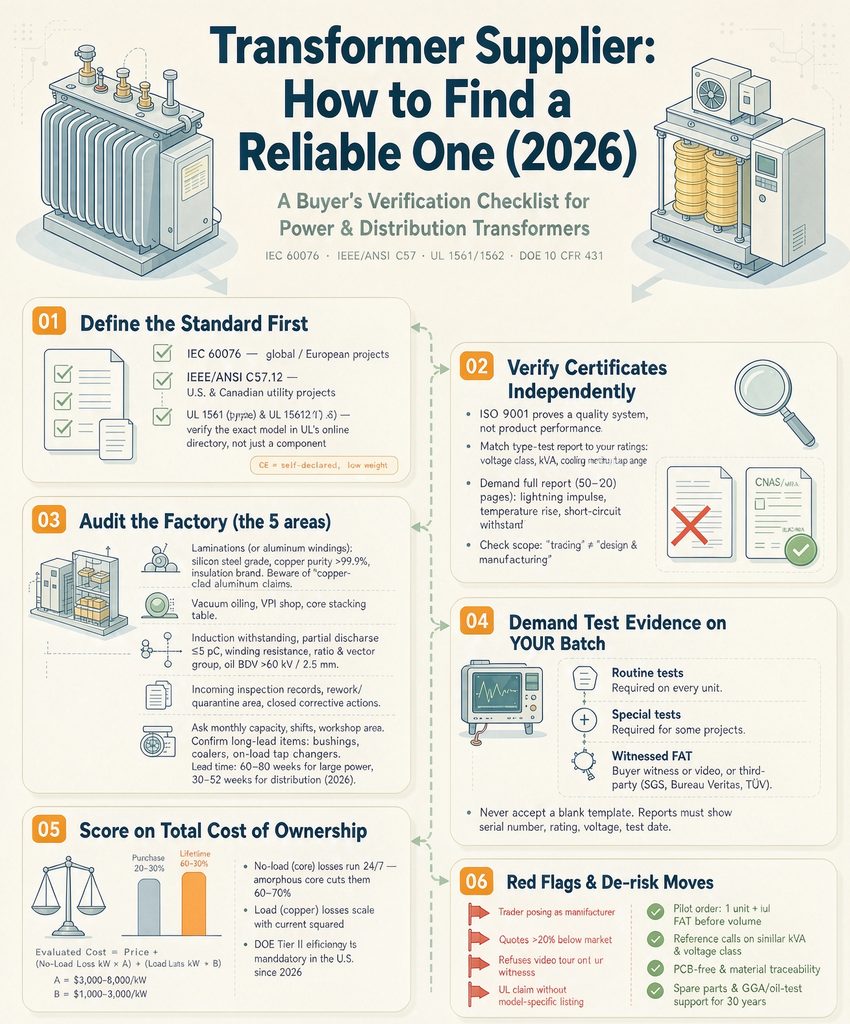
The 60-second version
If you read nothing else, take these ten.
- Decide who you’re contracting with before you decide who to call. OEM direct, stocking distributor, rep-plus-factory, reconditioner, or export manufacturer. They solve different problems, and mixing them up is why buyers compare quotes that aren’t comparable.
- Turn “reliable” into numbers you can put in an RFQ. Eight of them — on-time-in-full rate, warranty claim rate, FAT first-pass rate, and five more. Full table below.
- Run the 30-minute desk screen before you talk to anyone. About half the candidates fail on public records alone. You’ll save weeks.
- Demand a production slot, not a lead-time range. “16–65 weeks” isn’t a schedule. A named slot with a delay penalty is.
- Know your numbers for 2026 before you judge a quote. Distribution transformers are up roughly 78–95% since 2019, and three-phase pad-mount availability is expected to keep getting worse through 2027 (Wood Mackenzie via trade press; DistroForge).
- If a quote is more than ~15% below the median of the pack, assume it’s a different machine until the supplier proves otherwise in writing. Aluminum vs. copper and guaranteed vs. typical losses make up that gap easily.
- Test everything before you ship anything. A third-party pre-shipment inspection runs about **$800–2,500** on orders above $50,000 (indicative, supplier-sourced). That’s cheap insurance on a six-figure asset.
- Earn your way in. One pilot unit, then three, then a frame agreement. Reliability is demonstrated over time, not claimed in a brochure.
- Get every test tied to your serial number. Generic type-test reports prove somebody built something once. They don’t prove what you’re buying.
- Write the response time into the contract. “We’re responsive” is marketing. “One business day to a technical question, penalty attached” is a commitment.
Who this is for
This is written for people buying three-phase transformers from roughly 75 kVA up to about 50 MVA — plant engineers replacing a failed unit, facilities teams feeding a new line, developers building solar or data center capacity, and EPC procurement people who got handed a spec and a deadline.
The advice leans toward US and Canadian buyers, because that’s where the compliance tripwires are sharpest in 2026. But the screening logic works anywhere.
If you already have a shortlist and you’re trying to rank it, you want the scoring layer, not this page — our supplier scorecard guide walks through weighted evaluation and total-cost math. This guide sits one step earlier: how to build the list, and how to decide who deserves to be on it.
Part 1: “Reliable” is not a feeling. It’s eight numbers you can ask for.
Here’s the thing about the word reliable. Every supplier claims it. It costs nothing to say. So it’s useless as a question — and genuinely useful as a set of measurable behaviors.
None of the benchmarks below are “industry averages.” They’re pass bars you set and put in your RFQ, which is a different and much more defensible thing. Frame them that way when you send them: “These are our qualification thresholds. Please confirm you meet them, and tell us how you measure each.”
| # | KPI | What it actually tells you | Suggested pass bar | How to verify it |
| 1 | On-time in-full (OTIF) | Whether their schedule promises mean anything | ≥ 95% over trailing 12 months | Ask for the last 12 months’ shipment record with customer names redacted. Vague refusal usually means the number is bad |
| 2 | Quote turnaround | Whether they’re staffed or drowning | ≤ 5 business days for a standard spec | Send identical RFQs to three suppliers the same morning. Time-stamp the replies |
| 3 | Technical response time | Whether engineers are reachable, ever | ≤ 1 business day to a real technical question | Ask a hard one before you buy anything — something like no-load vs. load loss capitalization at your load factor |
| 4 | Drawing approval cycle | Where most schedules actually slip | ≤ 10 business days PO → approved drawings | Put it in the PO as a milestone with a hold point |
| 5 | FAT first-pass rate | Whether units pass testing the first time | ≥ 95% | Ask for a summary of their own nonconformance log. A supplier who tracks failures is a supplier who knows their numbers |
| 6 | Warranty claim rate | Field quality, in one ratio | < 1.5% of units shipped per year | Ask for claims ÷ shipments for the last 24 months |
| 7 | Field failure rate | How often units actually die | Express it per 100 unit-years | Ask for installed base and failure count. Compare to your own operating history |
| 8 | Spare parts availability | Whether the unit is repairable in year 12 | Stocked parts in ≤ 10 business days; availability committed for 10 years after the last unit ships | Get it in writing with a named parts list, not a general assurance |
Three things you’ll notice when you actually send this table out:
Serious suppliers argue about the numbers. They’ll say “we measure that differently, here’s our definition.” That’s good — it means they measure it. The ones who just say “yes, we meet all of them” without comment have read it as a formality, and it was.
Ask for denominators. A “99% quality rate” means nothing without knowing 99% of what. One failure out of a hundred units is a different company from one failure out of eight.
Small suppliers can pass this too. Some of the best-performing numbers come from specialty shops doing a narrow range extremely well. Size is genuinely not the point. Repeatability is.
Part 2: Before you search, decide which kind of supplier you need
This step is skipped constantly, and it’s expensive. Buyers send the same RFQ to a domestic OEM, a stocking distributor, and an export factory — then “compare” three quotes that have nothing in common. Different lead times, different Incoterms, different warranty starting points, different drawings burden.
Pick the contract counterparty type first. The candidates follow from that.
| Type | Use it when | Avoid it when | 2026 lead-time reality | What it costs you |
| Domestic OEM direct | You need cutsheet compliance, an NRTL listing, and a deep warranty; schedule is flexible | You need a unit in under 20 weeks | Months, unfortunately — see Part 7 | Premium price, lowest coordination risk |
| Stocking distributor | You need a standard catalog unit now and specs are flexible | Your voltage or kVA is unusual | Days to weeks if it’s on the floor | Higher unit price, lowest schedule risk |
| Rep + factory (agency model) | You want one accountable contact plus factory engineering | You want to negotiate design details with the actual builder | Varies with factory | Small agency margin, much better communication |
| Reconditioned / secondary market | Emergency replacement, budget-constrained, standard ratings only | Any application where you can’t independently test before energizing | Often weeks | Substantial discount, highest variability — bring an independent test agent |
| Export factory (direct) | Large unit counts, known repeat specs, you can manage Inspection and freight | Single emergency unit, or you’ve never done an import before | 18–36 months typical on many classes, plus transit | Lowest unit price, highest coordination and compliance burden |
A practical note on the last row: importing is very workable, but it moves work from your supplier to you. You own the freight, the customs classification, the receiving inspection, and the code-acceptance argument with your AHJ. Sometimes that’s the right trade. Just make it deliberately.
And a note on product type, which often settles the supplier question for you. Indoor, fire-sensitive, or noise-sensitive sites generally point to cast resin dry-type; outdoor pad or substation duty generally points to oil-immersed. If your shortlist can’t show you a real, currently-built range in the technology you need — say a mature cast resin dry-type transformer line with published ratings and enclosure options — then you’re their experiment, not their customer. Browse the full product range to see what “a real range” looks like before you start grading anybody.
Part 3: Nine places to actually find candidates
This is the section every other article skips. Building a decent long list — say 12 to 20 names — takes a couple of days if you know where to look. Here they are, ranked roughly by how much signal you get per hour of effort.
| # | Channel | Expected yield | Effort | Watch out for |
| 1 | Your utility’s approved vendor list | 3–8 qualified names | Low | Pre-qualified by someone else’s criteria — check that those criteria match yours |
| 2 | The consulting engineers who specify this work | 2–4 honest names | One phone call each | They’ve seen which ones failed. This is the highest-trust source available and almost nobody uses it |
| 3 | UL Product iQ, searched by category code | 5–15 names | Low | Confirms a listing exists. It does not confirm it covers your rating |
| 4 | NEMA member directory | Broad list | Low | Membership is not qualification. Treat as a starting pool |
| 5 | Trade shows — IEEE PES T&D, DistribuTECH, EPRI events | 5–10 real conversations | Medium | Booth polish correlates with marketing budget, not quality |
| 6 | Peers in adjacent industries | 1–3 strong names | Low | Reference bias — but they have nothing to sell you |
| 7 | National and regional electrical distributors | 2–5 | Low | Limited to catalog specs. Great for emergencies, poor for engineered units |
| 8 | Secondary market / reconditioners | 1–3 | Low | Always requires independent testing before you energize |
| 9 | Export manufacturers (direct) | 5–20 | High | Verification burden is real. Budget 2–4 weeks for document checks alone |
One of these deserves special mention. Channel 2 — asking the engineers who write specifications what they’ve seen fail — is free, takes maybe ninety minutes total, and returns names nobody publishes. Specification engineers watch units come back. They know which manufacturers answer the phone in year three. If you do exactly one thing from this list, do this one.
What to skip. Paid placements on B2B marketplaces mostly tell you who bought advertising. “Top 10 transformer suppliers” listicles are usually written by a company appearing on the list. Both are fine for generating names to then verify; neither is evidence of anything.
Part 4: The 30-minute desk screen
You have maybe fifteen names. Before you send a single email, spend thirty minutes per company (you’ll be shocked how many die here) and run these seven checks. All free. All public.
- Verify the entity exists and matches. Registered name, state/province registration, and the physical address on their site. If the address is an office park and they claim to run a winding floor, ask questions. (5 min)
- Check the listing, don’t read it. In UL Product iQ, pull the actual certificate file. Confirm the category code covers your construction — liquid-filled distribution units above 600 V sit in category XPLH, while UL 1562 scopes dry-type distribution units above 600 V. A listing in the wrong category is functionally no listing. (8 min)
- Verify ISO 9001 independently. Not their PDF — search the certificate in IAF CertSearch. Confirm the scope covers manufacture (not merely sale), the address matches, and the surveillance audits are current. (5 min)
- Confirm the standards regime. Are they quoting IEC 60076 or ANSI/IEEE C57 — and does it match where the unit will be installed? If you’re buying for North America from an overseas factory, read our breakdown of IEC 60076 vs ANSI/IEEE before you accept “compliant with international standards” as an answer. They are not interchangeable. (5 min)
- Search litigation and debarment. Federal exclusions lists, state court records, and — realistically — a plain web search for the company name plus “lawsuit,” “recall,” or “failure.” (3 min)
- Scan the address on satellite view. A transformer plant looks like a transformer plant: large buildings, rail or heavy-truck access, outdoor test bays, transformer-sized storage. (2 min)
- Check how long they’ve been at it under the current ownership. Longevity isn’t quality, but ownership changes correlate with engineering-team turnover. (2 min)
Roughly 30 to 50% of candidates fail something here, most often on #2 or #3. You’ve now spent maybe six hours and cut the list in half without a single sales call.
Part 5: The reliability evidence ladder
Here’s the framework we think is missing from every other guide on this topic. Not all evidence is the same kind of evidence, and treating a brochure like a witnessed test is how people get hurt.
| Level | Type of evidence | Example | What it’s actually worth |
| 0 | Claimed | “We’re ISO certified.” “Industry-leading quality.” | Nothing. Everyone says these things |
| 1 | Documented (self-issued) | Their own test sheet, their own certificate PDF | Weak. It proves they can make a document |
| 2 | Independently verified | IAF CertSearch entry, third-party lab report, UL listing file | Real. This is your minimum bar for anything you care about |
| 3 | Personally observed | You witness the FAT, or your agent audits the floor | Strong. You saw your serial number run |
| 4 | Demonstrated in service | Reference units with documented run-hours you can visit | Strongest. It’s the only proof nobody can argue with |
Then attach money to it:
| Order value | Minimum evidence level | What that means in practice |
| < $25,000 | Level 2 | Verified certificates + routine test reports tied to serial number |
| $25,000 – $100,000 | Level 2 + partial 3 | Add a third-party pre-shipment inspection (~$800–2,500, indicative) |
| $100,000 – $500,000 | Level 3 | You or your agent witness the FAT. Non-negotiable |
| > $500,000 | Level 3 + 4 | Witnessed FAT plus site visits to comparable operating units |
Two things worth being blunt about.
Most buyers stop at Level 1 and don’t realize it. They collect a stack of PDFs, feel diligence has occurred, and ship blind. Any document the supplier can generate without anyone else’s involvement is Level 1.
Level 4 is more available than people think. Ask a candidate for two reference installations at least three years old in a similar environment, pick one, and ask if you can visit for thirty minutes. Facility managers talk. A supplier confident in their installed base will arrange it; one who stalls is telling you something.
Case references are the practical route in — review how an 11 kV/33 kV compact substation programme ran for an overseas utility EPC and what got witnessed versus what got promised, then ask your shortlist for the equivalent. Browse more delivered project case studies to calibrate what a substantive reference actually contains.
Part 6: Test evidence — ask for these by name
You don’t need to be a test engineer. You need to know which words to use, because specific words get specific responses.
Every unit should pass routine tests before it leaves the factory: turns ratio, winding resistance, insulation resistance, no-load loss and excitation current, load loss and impedance, dielectric tests, and — for liquid-filled units — pressure and leak checks. Our walkthrough of routine testing every unit should pass lists them with the acceptance logic behind each.
Type tests are different. Those cover a design — temperature rise, lightning impulse, short-circuit withstand — and are performed once per design, not per unit.
Which is exactly why the trap exists. A supplier hands you an impressive full type-test report for “the SCB13-2000/10 design” and you relax. But that report may describe a different rating, a different tapping range, or a unit from three years ago. Ask directly: does routine test evidence exist for my serial number, and can I see it before shipment? A good answer is immediate and includes a document you can trace.
Two more asks that separate professionals from pretenders:
- Loss guarantees with penalties. “Typical losses” is a data point. “Guaranteed no-load loss of X watts, with a financial penalty if exceeded” is a commitment. Buy losses in watts, always.
- Material traceability. Core steel grade, winding conductor (copper or aluminum — get it in writing), insulation system. The gap between a cheap quote and a real one usually lives in these three lines.
Part 7: Read this before you judge anyone’s 2026 quote
Reliability in 2026 has a specific meaning that it didn’t have in 2019: can this supplier hold a production slot for you while everyone else is also trying to?
The market backdrop, from published sources:
| What | The number | Source |
| Distribution transformer prices since 2019 | Up 78–95% | Wood Mackenzie via trade press, 2026 |
| Power transformer prices | Up ~77% | Same |
| Generator step-up prices | Up ~45% | Same |
| Grain-oriented electrical steel | Up ~100% since Jan 2020 | Same |
| US GOES production | One mill (Cleveland-Cliffs Butler Works), covering roughly 1/5 of domestic demand | Trade press, 2026 |
| US transformer workforce | ~15,000 people; would need roughly tripling to meet projected demand | Niskanen Center via trade press, 2026 |
| US distribution units in service | ~40 million, over half past expected service life | Ryan Transformers, 2026 |
| Standard catalog distribution lead time | 26–40 weeks | DistroForge, 2026 |
| Build-to-order dry-type | 50 weeks to over a year, plus 8–12 weeks for non-standard ratings or enclosures | DistroForge / Ryan Transformers, 2026 |
| Three-phase pad-mount | Analysts expect worsening availability through 2026 and 2027 | DistroForge, 2026 |
| Generator step-up units | Past 160 weeks in Q1 2026, against a 143-week average in 2024 | Wood Mackenzie via Reuters, July 2026 |
| Class-level bands | Distribution ≤5 MVA 8–14 months; medium power 5–50 MVA 18–28 months; power class 50–200 MVA 36–48 months | Nexus Power market observations, 2026 |
Four conclusions you should draw from that table:
A supplier promising 12 weeks on a build-to-order unit in 2026 isn’t competitive — they’re guessing. Which production slot, which week, with what consequence if they miss? Ask all three.
Availability is now a technical spec. In a shortage, “reliable” partly means “has allocation priority with core steel and bushing suppliers.” Ask about their material position explicitly.
Standardize where you can. Cutting one custom requirement often buys more schedule than any negotiation. Ask what changes if you accept their standard tapping range or enclosure.
“We’ll figure out the date later” is disqualifying. With multi-year queues, the date is the deliverable.
Part 8: Earn your way in — start with a pilot
The single riskiest thing a buyer does is hand a brand-new supplier a million-dollar first order. Don’t. Buy reliability information in small increments instead.
| Stage | What you order | What you’re really buying | What “pass” looks like |
| Day 0–30 | One standard unit, your most common spec | Data on quote accuracy, drawing turnaround, and shipping condition | Quote matched the final invoice; drawings came back inside 10 business days; unit arrived undamaged with complete documentation |
| Day 30–90 | Witness the FAT, or send an agent | Level 3 evidence on a real unit | Tests pass first time; they let you watch without negotiating |
| Day 90–365 | 2–5 units, maybe including one custom | Evidence of repeatability | Repeat units perform like the first; deviations disclosed proactively, before you find them |
| Year 1+ | Frame agreement with reviewed SLAs | A supply relationship | Quarterly review of OTIF, claim rate, and response time — with real numbers attached |
Notice what that sequence buys you. Every stage generates verifiable evidence, and every stage is small enough that being wrong is survivable. By month twelve you’re not hoping they’re reliable — you have twelve months of their own performance data saying whether they are.
Put the review in the contract up front. Something as simple as: quarterly review of on-time-in-full delivery, warranty claims, and technical response time, with corrective action required below threshold. Suppliers who accept that have nothing to hide.
Part 9: Eleven red flags — with the line that ends it
Generic warning lists don’t help because “poor communication” isn’t decidable in the moment. So each flag below has a concrete trip line.
| # | Red flag | What it sounds like | Walk away / escalate when |
| 1 | Price far below the pack | “We are 30% cheaper than everyone” | Quote is more than ~15% below the median and they can’t explain it in engineering terms (conductor material, loss guarantees, core steel grade) |
| 2 | Can’t produce routine test data | “We will send reports after payment” | They won’t release serial-number-tied routine test results before shipment |
| 3 | Vague schedule | “Around 20 weeks or so” | No named production slot within 5 business days of your request |
| 4 | Wrong certification for the market | “CE certified, so it’s fine for the US” | They don’t understand that your AHJ wants an NRTL listing. This one is disqualifying in North America |
| 5 | Slow technical answers | Two-day replies to engineering questions | No substantive answer to a technical question within 48 hours, twice |
| 6 | No customer references | “We cannot disclose customer names” | They can’t offer two verifiable references at least three years old — even anonymized by sector |
| 7 | Can’t explain their own process | Deflects on winding, drying, or testing | The person quoting you can’t describe what they do in-house vs. outsource |
| 8 | Deposits demanded early, terms shift | “Standard is 100% advance this month” | Payment terms change between quote and contract, or the entity name changes |
| 9 | Loss figures are “typical” | Weasel words around no-load and load loss | They refuse guaranteed maximum losses with penalties |
| 10 | No warranty start point defined | Warranty is “12 months” with no anchor | They won’t state whether the clock starts at shipment, commissioning, or acceptance |
| 11 | Everything is yes | Agrees to everything instantly | They accepted every one of your unusual requirements without a single technical question. That’s not flexibility — nobody read your spec |
That last one is sneakier than it looks. Good suppliers push back. They tell you your impedance is odd for the application, or that your enclosure choice will hurt cooling. Pushback is evidence that an engineer read your documents.
Part 10: The 18-question supplier questionnaire
Copy this into an email. Send it to everyone. Differences in the answers are your real comparison.
Entity and capability
- What is your registered legal entity name, and is it the same entity that will sign the contract?
- Do you manufacture in-house, or do you act as agent or distributor? For which products?
- Which processes do you perform in-house — core cutting, winding, drying, tank fabrication, testing?
- How many units of this class did you ship in the last 12 months?
Compliance 5. Which standard does this unit comply with — IEC 60076, ANSI/IEEE C57, or both? 6. Provide your listing certificate file and category code. 7. Provide ISO 9001 certificate number and issuing body so we can verify independently. 8. Which NRTL listing applies, and what does its scope cover?
Performance numbers 9. What was your on-time-in-full delivery rate over the last 12 months? How do you define it? 10. What was your warranty claim rate over the last 24 months? 11. What percentage of units pass factory acceptance testing on the first attempt? 12. What guaranteed maximum no-load and load losses will you commit to, with what penalty?
Schedule 13. What production slot can you name for this order, and what happens if you miss it? 14. How many business days from purchase order to approved drawings? 15. What is your current position on core steel and bushing supply?
Support 16. What are your committed response times for technical questions, before and after sale? 17. What is the warranty period, and when does the clock start? 18. How long do you commit to supplying spare parts after the last unit ships?
Send identical packages on the same day. Same specs, same quantities, same deadlines. Identical inputs are the only way you’ll ever get a comparable output — change one variable between suppliers and you’ve invalidated the comparison.