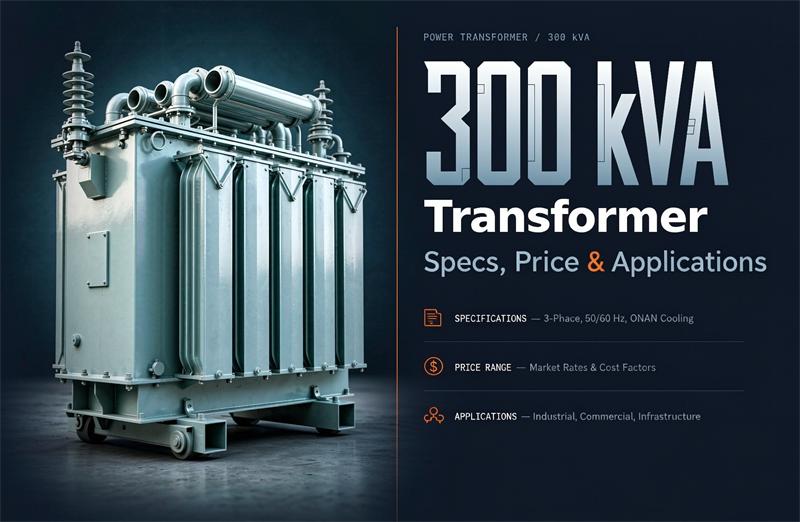
300 kVA three-phase is a stocked, standard size that appears by name in the federal efficiency tables. It pulls 361 A at 480 V and 833 A at 208Y/120 V, and that second number is where a lot of buyers get surprised. At 208 V you are buying a 1,200 A switchboard and two parallel sets of secondary conductors, and that downstream gear often costs more than the transformer feeding it.
Here is the rest of it in one place:
- Full-load amps, three-phase: 361 A at 480Y/277 V, 833 A at 208Y/120 V, 289 A at 600Y/347 V, 722 A at 240 V delta.
- DOE minimum efficiency, three-phase liquid: 99.27% today, 99.42% from April 23, 2029.
- DOE minimum efficiency, three-phase dry type: 99.02% today, 99.22% from April 23, 2029.
- Real listed prices we found on October 11, 2026: $3,999.99 for a used dry unit up to $42,502.70 for a new copper-wound one. That is a 10.6x spread on the same four words.
- Weight: about 1,550 lb for a dry unit in a NEMA 1 enclosure, about 3,437 lb for a liquid-filled pad-mount.
- Lead time: 12 to 16 weeks built to order at a US supplier that publishes it, one to two weeks if somebody has one sitting in the yard.
Key numbers
| Question | Answer |
| Is 300 kVA three-phase standard? | Yes. 300 = 3 x 100, and 100 is an industry preferred single-phase rating. |
| Is 300 kVA single-phase standard? | No. The single-phase ladder jumps from 250 to 333. |
| Does 300 kVA appear in the DOE efficiency tables? | Three-phase yes, in all three tables. Single-phase no. |
| What changes on April 23, 2029? | Minimum efficiency rises. Liquid three-phase 99.27% to 99.42%, dry three-phase 99.02% to 99.22%. |
| Amps at 480 V three-phase | 361 A |
| Amps at 208 V three-phase | 833 A |
| Real power at 0.9 power factor | 270 kW |
| Real price range found | $4,000 to $42,503 (five listings, October 11, 2026) |
| Typical weight | 1,550 lb dry, 3,437 lb liquid-filled |
| Typical lead time | 12 to 16 weeks built to order |
What you are actually buying at 300 kVA
300 kVA means 300,000 volt-amps. At a 0.9 power factor that is 270 kW of real power, and at 0.8 it is 240 kW. That is the number to hold in your head when someone hands you a load list. If your connected load adds to 270 kW you are at 100% with no headroom, and most engineers land a 300 kVA unit on a load somewhere between 180 kW and 240 kW.
In current terms you get 361 A at 480Y/277 V or 833 A at 208Y/120 V. Those two numbers drive everything downstream: conductor size, switchgear frame size, pad dimensions, and how many people need to sign off before you energize.
300 kVA is roughly the line where a transformer stops being a piece of equipment and becomes a small substation. Below about 150 kVA you can often set the unit, terminate it, and go home. At 300 kVA you are pouring a pad or framing a room, pulling a permit, coordinating a utility service point, getting a one-line diagram stamped, and in a lot of jurisdictions getting an arc-flash study done before anyone will throw the switch. Budget the project, not just the box.
The decision that costs the most money and gets the least attention is the secondary voltage. A 480 V service gives you 361 A, which fits one set of conductors and a 500 A device. A 208 V service gives you 833 A, which does not fit one set of conductors in any common 75 °C copper size and pushes you to a 1,200 A device. Same transformer, same kVA, wildly different downstream bill. Pick the voltage your equipment actually wants, because the secondary winding is built into the machine and you are not changing it after delivery.
If you are still deciding between 300 kVA and a different rung, the pad-mounted size and price guide walks the whole ladder, and our three-phase transformer guide covers the phase-level decisions that sit underneath this one.
Is 300 kVA a standard size? Do the division
There is a three-second test for this, and it works on any three-phase rating you will ever see. Divide by three. If the answer sits on the single-phase rating ladder, the three-phase size is standard.
300 divided by 3 is 100, and 100 is a rung on the ladder. So 300 kVA three-phase is a preferred rating: it is stocked, it is listed by name in the federal efficiency tables, and you can get a quote in days rather than a build slot in months.
The same test run the other way gives you a different answer. The single-phase ladder runs 10, 15, 25, 37.5, 50, 75, 100, 167, 250, 333, 500, 667, 833. There is no 300 on it. A 300 kVA single-phase unit is a custom build, and it will cost you lead time and money for no performance benefit. If your load is single-phase and lands near 300, spec 333.
The ladder itself is published by the Department of Energy in the Federal Register at 63 FR 63360 (November 12, 1998), Tables 2 and 3, under the heading “Preferred Standard kVA Ratings.” You do not have to take a manufacturer’s word for what is standard.
This matters more at 300 kVA than at smaller sizes because it decides whether the efficiency table applies to you directly or by interpolation. Three-phase 300 kVA is a printed row. Single-phase 300 kVA is not, and the regulation spells out what to do about that: minimum efficiency is set by linear interpolation between the ratings immediately above and below. We did that arithmetic and flagged it as ours, not the regulation’s, in the efficiency section below.
Full-load amps by voltage
Rated current comes straight from the rating. Three-phase is kVA x 1,000 divided by (1.732 x volts). Single-phase is kVA x 1,000 divided by volts. Every number below is that formula, rounded.
Three-phase secondary
| Secondary voltage | Full-load current |
| 600Y/347 | 289 A |
| 480Y/277 or 480 delta | 361 A |
| 415Y/240 | 417 A |
| 240 delta | 722 A |
| 208Y/120 | 833 A |
Three-phase primary
| Primary voltage | Full-load current |
| 2,400 delta | 72 A |
| 4,160 | 42 A |
| 4,800 delta | 36 A |
| 7,200 delta | 24 A |
| 12,470Y/7,200 | 14 A |
| 13,200 | 13 A |
| 13,800 | 13 A |
| 22,900Y/13,200 | 7.6 A |
| 24,940Y/14,400 | 6.9 A |
| 34,500 | 5.0 A |
Single-phase, if you end up there
| Voltage | Full-load current |
| 120/240 | 1,250 A |
| 480 | 625 A |
| 2,400 | 125 A |
| 7,200 | 42 A |
| 12,470 | 24 A |
| 14,400 | 21 A |
| 19,920 | 15 A |
We cross-checked the three-phase table against a published full-load current table from a US pad-mount supplier and against two used units listed with their nameplate data. Every figure matched: 289 A, 361 A, 417 A, 722 A, 833 A on the secondary, and 14 A at 12,470 V, 6.9 A at 24,940 V, 5.0 A at 34,500 V on the primary. When two independent sources land on the same digits, you can size conductors off them without a second thought.
Voltage class and BIL: why BIL moves your efficiency number
BIL stands for basic impulse insulation level, and it is the rating that says how much lightning-scale voltage spike the windings can take without punching through. It is set by where the transformer sits on the system, not by how much power it handles.
At 300 kVA you will see three common primary classes, and each one carries its own BIL:
| Primary class | Typical BIL |
| 15 kV | 95 kV |
| 25 kV | 125 kV |
| 35 kV | 150 kV |
Here is the part that catches people. For medium-voltage dry-type units, the federal efficiency table does not give you one efficiency per kVA. It gives you three, one per BIL group, and they are not the same number. For a 300 kVA three-phase medium-voltage dry-type unit, the current minimums are 98.93%, 98.81%, and 98.69% across the three BIL groups, rising to 99.04%, 98.93%, and 98.82% from April 23, 2029. Higher BIL means more insulation, more insulation means a bulkier coil, and a bulkier coil costs you a little efficiency.
So when you ask for a price, give both voltages and the BIL. A quote that says “300 kVA, 15 kV primary” is missing the piece that decides which column of the table you land in, and the supplier will fill in the blank with whatever is cheapest to build.
DOE minimum efficiency: now versus April 23, 2029
Federal efficiency standards for distribution transformers live in 10 CFR 431.196. Scope is set in 10 CFR 431.192, and a 300 kVA unit falls inside it if four things hold: input line voltage of 34.5 kV or less, output line voltage of 600 V or less, rated for 60 Hz, and a capacity between 10 kVA and 5,000 kVA for liquid-immersed units or 15 kVA to 5,000 kVA for dry-type. There are thirteen exclusions, including autotransformers, drive isolation transformers, grounding transformers, and anything with a tap range of 20% or more. A stock 300 kVA distribution transformer is not one of them.
Three-phase 300 kVA, printed table values
| Type | Today | From April 23, 2029 | Change | Measured at |
| Liquid-immersed | 99.27% | 99.42% | +0.15 | 50% load |
| Low-voltage dry-type | 99.02% | 99.22% | +0.20 | 35% load |
| Medium-voltage dry-type, lowest BIL group | 98.93% | 99.04% | +0.11 | 50% load |
| Medium-voltage dry-type, highest BIL group | 98.69% | 98.82% | +0.13 | 50% load |
Two things worth noticing. First, the two percentages are not measured at the same load. Liquid and medium-voltage dry numbers sit at 50% load, low-voltage dry numbers sit at 35% load. Comparing a dry unit’s 99.02% against a liquid unit’s 99.27% and concluding the liquid one is more efficient is a category error. They are different tests.
Second, the step in 2029 is small at this size. It is 0.15 points on liquid and 0.20 points on dry. We priced what that is actually worth further down, and the answer is a rounding error against the total lifetime losses.
Single-phase 300 kVA, interpolated
| Type | Today | From April 23, 2029 |
| Low-voltage dry-type | 98.86% | 99.20% |
| Liquid-immersed | 99.41% | 99.53% |
These four numbers are ours, not the regulation’s. The regulation tells you to interpolate between 250 kVA and 333 kVA, and that is what we did. If a supplier quotes you a single-phase 300 kVA efficiency figure, ask where it came from, because there is no printed row to read it off.
One caveat on the date. The April 23, 2029 compliance date is what the efficiency tables say as published today, and this section of the Code of Federal Regulations has been amended more than once. Pull the current text before you write it into a specification that has to hold for three years.
What a 300 kVA unit weighs and measures
Nobody publishes dimensions for this keyword. We went and collected them, because they decide whether you can get the thing through a door.
| Unit | Dimensions | Weight |
| Dry type, NEMA 1, copper, 480 to 208Y/120 | 35.5″ L x 39.5″ W x 45.6″ H | 1,550 lb |
| Dry type, NEMA 3R, aluminum, marine duty | 52″ H x 35″ W x 37″ D | 1,755 lb |
| Used dry type, 480 to 208Y/120 | 48″ W x 30″ D x 48″ H | 2,125 lb |
| Used dry type, K-rated | 48″ W x 33″ D x 61″ H | 2,500 lb |
| Liquid-filled pad-mount, 12,470 to 480Y/277 | 58″ W x 54″ D x 65″ H | 3,437 lb |
| Liquid-filled pad-mount, alternate listing | not published | 3,637 lb |
The spread on the dry units is real, not noise. The 1,550 lb unit is a 150 °C rise machine with copper windings. The 2,500 lb unit is a K-rated unit built to handle harmonic heating from nonlinear loads. Same kVA, 950 lb apart.
Two practical consequences. A dry unit at 1,550 lb needs a rigging plan and a floor rated for it, and if you are putting it on anything above grade you need to check the slab. A liquid-filled pad-mount at 3,437 lb needs a crane or a big forklift, and it is wide enough at 58 inches that you should confirm gate clearances before delivery day. Every year someone discovers this on the morning of.
What 300 kVA transformers actually cost
We pulled real listed prices on October 11, 2026. None of these are TransNine prices, and none of them are comparable to each other, because none of them are the same product.
| Source | Price | What it is |
| Larson Electronics MT-DOE16-3P-480D-300KVA-208Y.120-N1-CU-M3 | $42,502.70 | New dry type, copper windings, NEMA 1, 150 °C rise, 220 °C insulation, 1,550 lb |
| Larson Electronics MT-DOE16-3P-480D-300KVA-208Y.120-N3R | $34,692.11 | New dry type isolation, aluminum windings, NEMA 3R, marine duty, 1,755 lb |
| Bear Power Solutions BPS-3PH-PAD-300K | $22,641.15 to $37,235.00 | New liquid pad-mount, aluminum windings, mineral oil, ONAN, 12 to 16 weeks |
| Surplus Record, Sorgel 300T3H | $4,995 | Used dry type, 480 to 208Y/120, 4.0% impedance, 2,125 lb |
| Surplus Record, Siemens 3F3Y300K13TP1 | $3,999.99 | Used dry type, K13 rated, 2,500 lb |
That is $3,999.99 to $42,502.70, a 10.6x spread. Several Chinese supplier pages quote much wider bands, one of them from $2,207 to $10,300, another from $5,000 to $7,000 for oil and $6,000 to $8,000 for dry. Those bands are too wide to be useful and none of them are attached to a configuration you can buy. Treat them as marketing, not pricing.
Here is the honest read. The kVA rating tells you almost nothing about the price. What sets the price is winding material, insulation system, enclosure, voltage class, efficiency tier, and whether the unit is sitting in a yard or has to be built. Copper against aluminum alone can move a 300 kVA quote by 20% to 30%. A K-rating moves it again. So does NEMA 3R against NEMA 1.
What you should take away is this: when two quotes on “300 kVA” differ by more than about 20%, you are not looking at two prices for one product. You are looking at two different products, and the gap is hidden in the specification, not in the margin.
Losses: the money you keep paying
The purchase price is a one-time number. The losses run every hour for thirty years, and at 300 kVA they add up to roughly the purchase price again.
Take a liquid-immersed unit running a 50% load factor with a published loss pair of 480 W no-load and 3,650 W at full load. At 50% load the load loss scales with the square of the load, so 3,650 x 0.25 = 912.5 W, plus 480 W of no-load loss that runs around the clock. Total is 1,392.5 W.
Over a year that is 1,392.5 W x 8,760 hours = 12,198 kWh. At $0.12 per kWh that is about $1,464 a year. Capitalized over 30 years at a 7% discount rate, the annuity factor is 12.409, so the present value of those losses is about $18,164.
Now price the 2029 step separately. The federal minimum for a three-phase liquid unit goes from 99.27% to 99.42%. In loss terms at 50% load, where output is 150 kW, 99.27% permits 1,103 W of loss and 99.42% permits 875 W. The difference is 228 W. That is 1,997 kWh a year, about 240 a year, and a present value of about **2,974**.
The dry-type step is the same story. Going from 99.02% to 99.22% at 35% load, where output is 105 kW, is 1,039 W down to 825 W, a difference of 214 W, worth about $2,790 in present value.
Put those side by side and the buying rule falls out on its own. Total lifetime losses are about $18,000. The difference between today’s tier and the 2029 tier is about $3,000. Paying an extra $3,000 for a genuinely lower-loss unit is a fine trade. Paying an extra $10,000 for the word “efficient” on a brochure is not.
Ask for the measured no-load and load loss in watts, on the actual unit, at the reference temperature the standard uses. Then do this arithmetic yourself. It takes ten minutes and it is the single highest-value thing you can do with a transformer quote.
How to check a published loss pair against the DOE minimum
Here is a tool you can reuse on any quote, and it is worth running because published data at this size does not always survive the check.
The regulation gives you a minimum efficiency. Turn that into a maximum permitted loss at the test load with this: permitted loss equals output times (divided by efficiency, minus one).
For a three-phase liquid unit at 50% load, output is 150 kW and the current minimum is 99.27%:
150,000 W x (1 / 0.9927 – 1) = 1,103 W permitted
Now take the published pair from a 300 kVA liquid pad-mount listing: 480 W no-load and 3,650 W load loss. At 50% load:
480 + 3,650 x 0.25 = 1,392.5 W, which is 289 W over the permitted figure, giving a computed efficiency of 99.08% against a 99.27% floor.
That looks like a problem, and it may well be one. Before you say so out loud, run three checks on yourself:
- Reference temperature. The DOE test procedure corrects losses to a 75 °C reference. A manufacturer quoting at 85 °C will show higher winding resistance and higher load loss. The error is real but it is tens of watts, not 289.
- This unit or the family table? A lot of published loss figures are the worst case across a whole family of ratings, not the tested value for the unit in front of you.
- What does the tolerance mean? That same listing prints the no-load loss as “±500 W” against a stated value of 480 W. A tolerance larger than the number itself tells you the figure is not a test result.
If all three come back clean, you have found something worth raising. And regardless of how they come back, the action is the same: ask for the routine test report. No-load loss, load loss, impedance, test voltages, and the serial number of the unit you are buying. Any manufacturer who does routine testing has this, and a supplier who will not hand it over is telling you something.
Protection, fault current, and the 1,200 A wall
For a transformer with primary and secondary at or below 600 V, NEC 450.3(B) sets the protection at 125% of rated current when rated current is over 9 A, and lets you step up to the next standard size when 125% does not land on one.
Run it for a 480 V primary and a 208Y/120 V secondary:
| Position | Calculation | Device |
| Primary, primary-only protection | 361 A x 125% = 451 A | 500 A |
| Primary, with secondary protection | 361 A x 250% = 902 A | 1,000 A |
| Secondary, where required | 833 A x 125% = 1,041 A | 1,200 A |
The usual reason to go to the 250% primary figure is inrush. A 300 kVA core pulling magnetizing current on energization will occasionally take out a 125% device that is otherwise correctly sized, and the standard fix is to add secondary protection and step the primary up. Confirm the arrangement with your authority having jurisdiction and the edition in force.
Also worth knowing: a 208Y/120 V secondary is a four-wire wye, and Table 450.3(B) does not require a secondary device for that arrangement. Primary protection alone is acceptable. You need secondary protection on a two-wire secondary or a delta-delta three-wire secondary.
The 1,200 A wall. Look at that 833 A again. Typical 75 °C copper ampacity tables put 500 kcmil at 380 A and 600 kcmil at 420 A, before any derating. One set of 600 kcmil gives you 420 A, and you need 833. You are into two parallel sets, and two sets of 600 kcmil at 840 A combined is the usual landing point. At 480 V the same transformer gives you 361 A, which one set of 500 kcmil handles.
That is the whole argument for 480Y/277 over 208Y/120 at this size, and it is not a small argument. Two parallel conductor sets, a 1,200 A switchboard instead of a 500 A panelboard, bigger conduit, more terminations, more labor. On a lot of 300 kVA jobs the downstream package costs more than the transformer. Confirm conductor sizes against the NEC edition in force and with your AHJ before you buy copper.
Fault current is the other half of the gear specification. Available secondary fault current, treating the source as infinite, is full-load current divided by impedance:
| Impedance | At 480 V | At 208 V |
| 6.5% | 5,551 A | 12,811 A |
| 5.75% | 6,276 A | 14,482 A |
| 4.5% | 8,019 A | 18,505 A |
| 4.0% | 9,021 A | 20,818 A |
| 3.0% | 12,028 A | 27,757 A |
These are our calculations from the formula, not standard-mandated values. Get the tested impedance for your unit from the manufacturer, then add whatever the utility contributes upstream. NEC 110.9 and 110.10 require equipment to be rated for the current that can actually show up, so a unit landing at 18.5 kA on the 208 V side means your gear needs to be specified above that, and you want the utility’s available fault current in writing before you order switchgear.
If your primary is above 600 V, and on a 300 kVA pad-mount it almost always is, you are in NEC 450.3(A) with a different table and different percentages. Pad-mount units normally ship with the primary protection built in as bayonet fuses or a fused switch inside the tank, sized by the manufacturer as a listed assembly. Have your engineer confirm the upstream device against the nameplate, and remember that utilities write their own service requirements on top of the code.
Oil or dry at 300 kVA
Both work at this size, and the choice is usually made by location rather than by electrical preference.
Liquid-immersed is what you want outdoors. It is cheaper per kVA, it handles overload better, it runs quieter, and a sealed pad-mount tank needs almost nothing from you for decades. It weighs around 3,437 lb at this size, it contains oil, and that brings containment and environmental review with it. If you are setting it near a storm drain or a waterway, expect questions.
Dry type is what you want indoors. No oil, no containment, no spill plan, and it can go in an electrical room next to the switchgear. You pay for it: dry units at 300 kVA run roughly $34,700 to $42,500 new against $22,600 to $37,200 for a comparable liquid pad-mount, though those are different products and the comparison is rough. Dry units need ventilation, they are louder, and they do not forgive sustained overload the way oil does.
There is a third option that people forget at this size. If the job needs switchgear, metering, and protection all in one enclosure, a compact substation gets you there in one procurement instead of three. At 300 kVA it is often overkill, but on a greenfield site with no electrical room it can be the cheapest way to finish.
Pad-mount, dry type, or a compact substation
The mechanical form follows the site:
- Pad-mount, liquid-filled, outdoor, dead-front, tamper-resistant. The default for utility service, retail pads, schools, and anything fed underground at 12.47 kV or 13.2 kV. Expect 58″ x 54″ x 65″ and around 3,437 lb.
- Dry type indoors, NEMA 1 in an electrical room, or NEMA 3R if it has to live outside. The default for 480 V to 208Y/120 V step-down inside a building.
- MV dry type indoors when the primary is 4,160 V or 13.8 kV and you cannot use oil inside. Remember that BIL changes your efficiency column here.
- Compact substation when you need primary switching, protection, and the transformer in one box.
One thing to settle early: radial feed or loop feed. A loop-feed pad-mount has two sets of primary bushings so the utility can feed through to the next customer. It costs more and it is a decision the utility usually makes for you. Ask before you order, because it is not a field modification.
Where 300 kVA gets used
300 kVA lands in a particular band of the market, and it is a band that has grown fast in the last few years.
- Retail and restaurant service entrances, usually 208Y/120, usually with a real kitchen load and rooftop units
- Light manufacturing and machine shops, usually 480 V, where 361 A covers a shop floor with room to add a machine
- Small EV charging sites. At 0.9 power factor a 300 kVA unit delivers about 270 kW, which covers a handful of DC fast chargers once you apply diversity. Sites that need more should look at the 500 kVA EV charging transformer instead of trying to stretch this one.
- Solar and storage step-up, where 300 kVA is a common inverter block size
- Municipal and school facilities, clinics, office buildings, and light commercial
- Utility distribution in newer underground subdivisions, usually as a three-phase pad-mount
The project pages show what this looks like once it is installed, including hospital and metro work where noise and fire performance drove the specification rather than price.
How to read a 300 kVA spec sheet
A complete specification has eight items. If a quote is missing any of them, you do not have a price yet, you have a guess.
- kVA and number of phases
- Primary voltage, with class and BIL
- Secondary voltage, with BIL
- Frequency
- Winding material, copper or aluminum
- Cooling class and temperature rise
- Efficiency target, expressed as measured losses in watts if you can get them
- Destination, including altitude and ambient temperature
Altitude and ambient matter more than people expect. Standard ratings assume 40 °C ambient and up to 1,000 m. A rooftop in Phoenix or a site at 2,500 m changes the rating, and derating is cheaper to plan than to discover.
Our nameplate guide walks through each field and what a wrong one looks like, and the rest of our technical resource library covers the standards and testing side in more depth.
Two red flags specific to this size. First, an impedance range so wide it tells you nothing. We saw one 300 kVA pad-mount page print “1.2 to 6.0 percent” in one place and “5.0 to 7.5 percent” in another, on the same page. Second, a noise figure quoted without a distance or a standard behind it. NEMA ST-20 sets sound levels by kVA class, and 55 dB is a common figure at 300 kVA, but it means nothing without the test method.
Where to buy: stock, build slots, and what to ask
Three channels, and they behave differently.
Stock. Somebody has the unit, you get it in one to two weeks. At 300 kVA three-phase you have a real chance of this, because it is a preferred rating and distributors carry it. Used units show up too: we found a 300 kVA dry unit at $3,999.99 and another at $4,995, both tested. For a budget-constrained job with a tolerant schedule, this is the best value on the market.
Build slot. 12 to 16 weeks is the published figure at one US supplier for a built-to-order three-phase pad-mount. Same site advertises “as little as 10 weeks” elsewhere, so get it in writing. Custom voltages, copper windings, or ester fluid push it out.
Import. Cheapest per kVA, longest lead time, and you own the compliance question. If the unit is going into US service, the DOE standards apply at the point of manufacture or import, and you want the certification and test documentation in hand before it ships.
Whichever channel you use, start by checking whether your configuration is a stocked build or a custom one. The product range shows what is standard against what has to be wound to order, and TransNine will quote either with the test data attached.
Questions to put in the RFQ, in this order:
- Tested no-load loss and load loss in watts, at 75 °C reference, for this unit
- Tested impedance in percent, with the test report
- Winding material, and the price difference for the other one
- Temperature rise and insulation system class
- Sound level, with the standard it was measured to
- Lead time in writing, and what happens if it slips
- Whether a routine test report ships with the unit
- Warranty terms in years, and what “pro rated” means on a 32-year warranty
That last one is not a joke. We saw a 300 kVA listing advertise a 32-year pro rated warranty. Read what it actually covers.
Seven things that go wrong on a 300 kVA order
- Secondary voltage chosen by default. 208Y/120 gets specified because the building had it before, and nobody prices the 1,200 A switchboard and the parallel conductors that come with it.
- Impedance left blank. It decides your fault current, which decides your gear rating, which you have already ordered.
- BIL left blank. The supplier fills in the cheapest one, and your efficiency quietly drops a column.
- Losses accepted as a percentage instead of watts. 99.1% sounds fine and hides 289 W.
- No test report in the RFQ. You find out at commissioning.
- Delivery access not checked. 58 inches wide and 3,437 lb does not fit every gate.
- Utility requirements discovered late. Loop feed, dead-front construction, and the upstream device are all things the utility has opinions about, and they are not in the NEC.
Frequently asked questions
How many amps is a 300 kVA transformer?
Three-phase: 361 A at 480Y/277 V, 833 A at 208Y/120 V, 289 A at 600Y/347 V, 417 A at 415Y/240 V, and 722 A at 240 V delta. Single-phase it would be 1,250 A at 120/240 V. Formula is kVA x 1,000 divided by (1.732 x volts) for three-phase.
Is 300 kVA a standard transformer size?
Three-phase, yes. Divide by three and you get 100, which is a preferred single-phase rating, so 300 kVA three-phase is stocked and listed by name in the DOE efficiency tables. Single-phase, no. The ladder jumps from 250 to 333, so a 300 kVA single-phase unit is a custom build. Spec 333 instead.
What is the minimum efficiency for a 300 kVA transformer?
Three-phase liquid-immersed is 99.27% today and 99.42% from April 23, 2029, measured at 50% load. Three-phase low-voltage dry-type is 99.02% today and 99.22% from 2029, measured at 35% load. Medium-voltage dry-type runs 98.93% down to 98.69% today depending on BIL group.
How much does a 300 kVA transformer cost?
Real listed prices found on October 11, 2026 ran from $3,999.99 for a used dry unit to $42,502.70 for a new copper-wound dry unit, with new liquid pad-mounts at $22,641.15 to $37,235.00. The spread is 10.6x because winding material, enclosure, voltage class and efficiency tier move the price far more than kVA does.
How much does a 300 kVA transformer weigh?
About 1,550 lb for a dry unit in a NEMA 1 enclosure, 1,755 lb for a NEMA 3R dry unit, and around 3,437 lb for a liquid-filled three-phase pad-mount. Dimensions run roughly 35.5″ x 39.5″ x 45.6″ for the NEMA 1 dry unit and 58″ x 54″ x 65″ for the pad-mount.
What size breaker do I need for a 300 kVA transformer?
For a 480 V primary with primary-only protection, 361 A x 125% = 451 A, so a 500 A device. For a 208Y/120 V secondary, 833 A x 125% = 1,041 A, so a 1,200 A device. A four-wire wye secondary does not require secondary protection, so primary-only is often acceptable. Confirm with your AHJ.
Can I get a 300 kVA single-phase transformer?
Yes, but you should not. 300 is not a preferred single-phase rating, so it becomes a custom build with a longer lead time, a higher price, and no printed row in the efficiency tables. The standard rung above 250 is 333 kVA, and that is what to specify.
How much load can a 300 kVA transformer carry?
300 kVA is 270 kW at 0.9 power factor and 240 kW at 0.8. Most engineers land it on a load between 180 kW and 240 kW so there is headroom for starting currents and future additions.
What is the lead time on a 300 kVA transformer?
12 to 16 weeks built to order at a US supplier that publishes it, and one site also advertises “as little as 10 weeks,” so get it in writing. One to two weeks if you find one in stock. Custom voltages, copper windings, or natural ester fluid add time.
Does a 300 kVA transformer have to meet DOE efficiency standards?
If it is a distribution transformer as defined in 10 CFR 431.192, yes: input 34.5 kV or less, output 600 V or less, 60 Hz, and 10 to 5,000 kVA liquid or 15 to 5,000 kVA dry. There are thirteen exclusions, including autotransformers, drive isolation transformers, and units with a tap range of 20% or more. A stock 300 kVA distribution unit is covered.