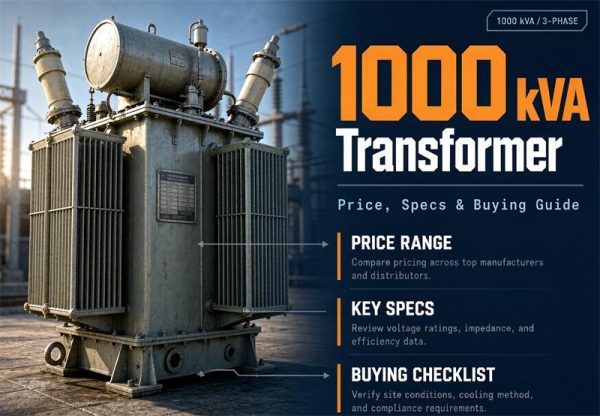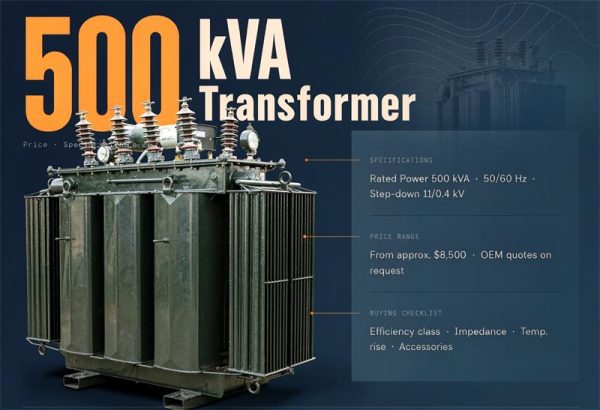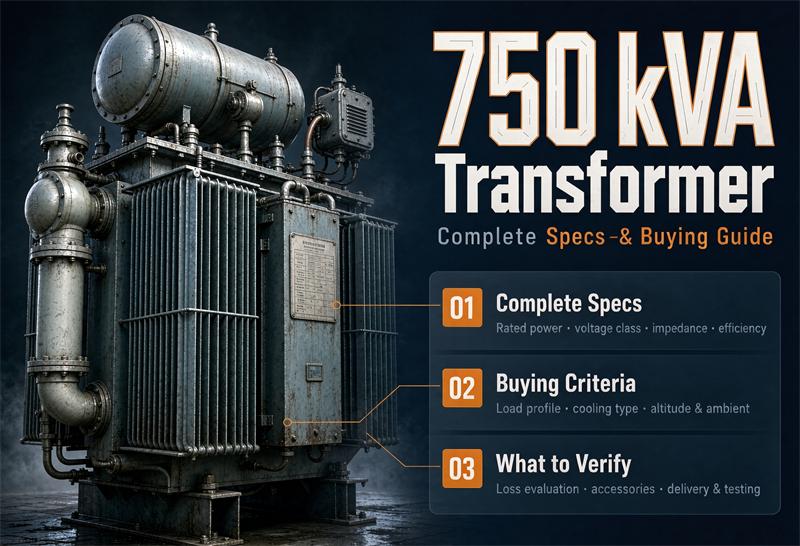
750 kVA is a fully standard three-phase rating, and it does not exist as a single-phase unit on either federal list. Three-phase, it pulls 902 A at 480Y/277 V and 2,082 A at 208Y/120 V. That difference is the whole story. At 480 V this is a routine 1,200 A service. At 208 V it is a 3,000 A device, busway instead of cable, and switchgear rated 42 kA or more. Same transformer, two completely different projects.
One more thing up front, because it runs against most of what you will read on this keyword: the 2029 federal efficiency update is barely worth anything at 750 kVA on the liquid side. For a non-submersible pad-mount the floor moves from 99.40% to 99.43%, which is 113.8 watts at the test load, worth about $1,480 over thirty years. For a submersible unit it does not move at all. The dry-type numbers are a different matter and we get to those below.
This page is about 750 kVA as a rating: whether it is standard, what current it draws, what the federal floor is, what happens downstream, what it weighs, and what it costs. If you are sizing for a DC fast charging site, jump to our 800 kVA and 1,000 kVA charging transformer page instead, because that is where charging loads actually land. Everything here applies to any 750 kVA job.
The numbers up front:
- Full-load amps, three-phase: 902 A at 480Y/277 V, 2,082 A at 208Y/120 V, 1,804 A at 240 V delta, 1,043 A at 415Y/240 V, 722 A at 600Y/347 V.
- Full-load amps, primary: 35 A at 12470Y/7200, 60 A at 7200 V delta, 104 A at 4160Y/2400, 180 A at 2400 V delta, 13 A at 34500Y/19920.
- Federal efficiency floor, liquid three-phase, today: 99.40% at 50% load, which permits 2,263.6 W of total loss.
- Federal efficiency floor, liquid three-phase, from April 23, 2029: 99.43% non-submersible, 99.40% submersible.
- Federal efficiency floor, low-voltage dry-type three-phase: 99.23% today, 99.38% from April 23, 2029, both at 35% load.
- Weight: about 5,600 to 6,500 lb including oil, depending on winding material and voltage class.
- Oil: about 290 gallons of mineral oil on a 750 kVA pad-mount.
- Second-year price reality: one US supplier lists this rating at $29,453.37 to $56,870.00. Two others list figures over $180,000. The spread is 7.2x and almost none of it is the kVA.
Is 750 kVA a standard transformer size?
Yes for three-phase, and it is one of the cleanest cases on the whole ladder.
North American distribution transformers follow a preferred rating ladder that the Department of Energy published in the Federal Register at 63 FR 63360, dated November 12, 1998, in Tables 2 and 3 under the heading “Preferred Standard kVA Ratings.” You do not have to take a manufacturer’s word for which sizes are standard, and you should not.
The three-phase liquid-immersed ladder runs: 15, 30, 45, 75, 112.5, 150, 225, 300, 500, 750, 1000, 1500, 2000, 2500.
The single-phase ladder runs: 10, 15, 25, 37.5, 50, 75, 100, 167, 250, 333, 500, 667, 833.
There is a shortcut that holds for most of the range: a three-phase rating is standard if dividing it by 3 lands you on a single-phase rung. It works because three identical single-phase units are one three-phase bank, so the ladder is built by multiplying. At 750 kVA the shortcut is exact: 750 ÷ 3 = 250, and 250 is on the single-phase list.
That matters more than it sounds, because the shortcut stops being exact once you go past this size. 1,000 ÷ 3 is 333.33 and the ladder says 333. 2,000 ÷ 3 is 666.67 and the ladder says 667. 2,500 ÷ 3 is 833.33 and the ladder says 833. 750 and 1,500 are the only common three-phase ratings above 300 kVA where the arithmetic comes out even.
Practical consequence: a 750 kVA three-phase unit is a stocked, catalogued product with a table row in every efficiency table that applies to it. You are not buying a custom design, and you should not be quoted custom lead times or custom engineering charges for it.
There is no such thing as a 750 kVA single-phase transformer
This trips people up, so here it is plainly.
750 does not appear in the single-phase column of the preferred rating ladder. The single-phase list jumps from 667 to 833. It also does not appear in the single-phase column of any efficiency table in 10 CFR 431.196. The liquid-immersed single-phase column runs 10, 15, 25, 37.5, 50, 75, 100, 167, 250, 333, 500, 667, 833. The low-voltage dry-type single-phase column stops at 333 kVA entirely.
So a 750 kVA single-phase unit is neither a preferred rating nor a table row. If a supplier quotes you one, you are buying a build-to-order design with no published efficiency floor to hold them to, and the interpolation rule has no upper anchor to work from either, because 833 is the next rung and 750 sits below it.
If you need roughly 750 kVA on single-phase service, ask for 833 kVA. That is the standard rating, it has a table row, and it will be cheaper than a custom 750.
How many amps does a 750 kVA transformer draw?
For three-phase, the formula is kVA × 1,000 ÷ (volts × √3). For single-phase it is kVA × 1,000 ÷ volts. Here is the whole table at 750 kVA, three-phase:
| Secondary voltage | Full-load amps |
| 208Y/120 | 2,082 A |
| 240 delta | 1,804 A |
| 415Y/240 | 1,043 A |
| 480 delta | 902 A |
| 480Y/277 | 902 A |
| 600Y/347 | 722 A |
| Primary voltage | Full-load amps |
| 2400 delta | 180 A |
| 4160 delta | 104 A |
| 4160Y/2400 | 104 A |
| 4800 delta | 90 A |
| 7200 delta | 60 A |
| 12000 delta | 36 A |
| 12470Y/7200 | 35 A |
| 13200 delta | 33 A |
| 13200Y/7620 | 33 A |
| 13800 delta | 31 A |
| 13800Y/7970 | 31 A |
| 22900Y/13200 | 19 A |
| 24940Y/14400 | 17 A |
| 34500 delta | 13 A |
| 34500Y/19920 | 13 A |
These are the same figures Bear Power Solutions publishes on its 750 kVA three-phase pad-mount listing, and every one of them matches the formula. That is worth saying because it means the arithmetic convention is shared: line-to-line volts, no power factor applied, rounded to the amp for the secondary and to the amp for the primary.
If you need single-phase figures for reference, 750 kVA would be 3,125 A at 240 V and 1,563 A at 480 V. Those numbers are arithmetic, not a product, because as we just covered the size does not exist.
Pick 480 V before you ask for a price
Here is the part of a 750 kVA project that decides the budget, and it has nothing to do with the transformer.
On a 208Y/120 secondary, 2,082 A of full-load current runs into two hard limits at once.
First, NEC 450.3(B) sizes the secondary overcurrent device at 125% of rated secondary current, rounded up to the next standard rating in 240.6(A). That is 2,602 A, and the standard ratings go 2,000, 2,500, 3,000, 4,000. There is no 2,600. You are on a 3,000 A device.
Second, 240.4(C) says that above 800 A the device rating cannot exceed the conductor ampacity, with no round-up allowance. A 3,000 A device needs 3,000 A of conductor. At 750 kcmil copper and 75 °C terminations that is 475 A per conductor, so seven parallel runs per phase, which is 3,325 A. Nobody pulls seven sets of 750 kcmil. You go to busway, and busway at 3,000 A is a designed item with its own lead time.
On a 480Y/277 secondary, the same transformer draws 902 A. The device is 1,128 A, which rounds to 1,200 A, a standard and readily stocked rating. Conductors are three runs of 350 kcmil copper at 310 A each, or 930 A, which covers it. Three sets of 350 kcmil is ordinary work for any crew.
| Secondary | Full-load amps | OCPD at 125% | Standard device | Copper conductors at 75 °C |
| 208Y/120 | 2,082 A | 2,602 A | 3,000 A | 7 × 750 kcmil, or busway |
| 240 delta | 1,804 A | 2,255 A | 2,500 A | 6 × 500 kcmil (2,280 A) |
| 480Y/277 | 902 A | 1,128 A | 1,200 A | 3 × 350 kcmil (930 A) |
| 600Y/347 | 722 A | 902 A | 1,000 A | 2 × 500 kcmil (760 A) |
If the load can be served at 480 V and distributed locally with small dry-type transformers, do that. If it genuinely needs 208Y/120 at full 750 kVA, price busway and a 3,000 A switchboard before you sign anything, because that package frequently costs more than the transformer feeding it.
Fault current: 208 V pushes you into 42 kA gear
Available fault current at the secondary terminals is roughly full-load amps divided by impedance, expressed as a decimal. The impedance is on the nameplate and on the spec sheet, and it is a number you get to choose within the standard band.
At 750 kVA:
| Impedance | 208Y/120 (2,082 A) | 480Y/277 (902 A) | 600Y/347 (722 A) |
| 4.5% | 46,264 A | 20,047 A | 16,038 A |
| 5.25% | 39,655 A | 17,183 A | 13,747 A |
| 5.75% | 36,207 A | 15,689 A | 12,551 A |
Standard distribution gear commonly carries a 22 kA short-circuit current rating, and 42 kA and 65 kA ratings cost more and take longer.
Look at what that means. At 208 V, every impedance in the normal band puts you above 22 kA. To stay under it you would need 9.46% impedance, and transformer impedance is not offered that high at this rating. You are buying 42 kA equipment, or 65 kA if the available fault contribution from the utility is high. At 480 V, 4.1% impedance is already enough to stay under 22 kA, so a normal 5.25% or 5.75% unit sits comfortably inside standard gear.
Specify the impedance on purpose and specify it early. It is a free choice at the RFQ stage and an expensive change after the switchboard is ordered.
DOE minimum efficiency: today versus April 23, 2029
Federal efficiency standards for distribution transformers live in 10 CFR 431.196. Scope is set in 10 CFR 431.192, and a 750 kVA unit is covered if four things hold:
- Input line voltage is 34.5 kV or less
- Output line voltage is 600 V or less
- Frequency is 60 Hz
- Rating is 10 to 5,000 kVA for liquid-immersed, or 15 to 5,000 kVA for dry-type
There are thirteen exclusions in 431.192, including autotransformers, drive isolation transformers, grounding transformers, machine tool control transformers, non-ventilated transformers, rectifier transformers, regulating transformers, sealed transformers, transformers with special impedance characteristics, testing transformers, transformers with a tap range of 20% or more, UPS transformers, and welding transformers. A stock 750 kVA pad-mount is not in any of them.
Here is what applies to 750 kVA three-phase, straight from the tables. All of these are table rows, not interpolations:
| Construction | Load point | Now through April 22, 2029 | From April 23, 2029 | Change |
| Liquid-immersed, non-submersible | 50% | 99.40% | 99.43% | +0.03 |
| Liquid-immersed, submersible | 50% | 99.40% | 99.40% | zero |
| Low-voltage dry-type | 35% | 99.23% | 99.38% | +0.15 |
| Medium-voltage dry-type, BIL 20 to 45 kV | 50% | 99.21% | 99.29% | +0.08 |
| Medium-voltage dry-type, BIL 46 to 95 kV | 50% | 99.12% | 99.21% | +0.09 |
| Medium-voltage dry-type, BIL 96 kV and up | 50% | 99.02% | 99.12% | +0.10 |
The 2029 rule is nearly free at this size on the liquid side
Run the arithmetic and the point lands hard.
At 50% load on a 750 kVA unit, output is 375 kW. Permitted total loss is output × (1 ÷ efficiency − 1).
- At 99.40%, permitted loss is 2,263.6 W
- At 99.43%, permitted loss is 2,149.8 W
- The difference is 113.8 W
113.8 watts running 8,760 hours a year is 997 kWh, which is about $120 a year at $0.12 per kWh. Capitalized over 30 years at a 7% discount rate, the annuity factor is 12.409, so the present value is about $1,480.
That is the entire value of moving from the current tier to the 2029 tier on a 750 kVA liquid pad-mount. Compare it to the total lifetime loss bill on the same unit, which we work out below at roughly $30,000 to $39,000 in present value depending on whose numbers you use. The tier step is under 5% of the loss cost.
Submersible units get no change at all
This one is worth reading twice.
Section 431.196(b)(2) covers liquid-immersed units, including submersible ones, from January 1, 2016 through April 22, 2029. Section (b)(4) covers submersible units from April 23, 2029. At 750 kVA three-phase, both tables say 99.40%.
Same number, same load point, same permitted loss of 2,263.6 W. A submersible 750 kVA transformer that meets today’s standard meets the 2029 standard. There is nothing to buy, nothing to upgrade, and no reason to pay a premium for a “2029-ready” label on that product.
We checked the whole 750 kVA row across both tables to be sure this was not a transcription error on our part. It is what the regulation prints.
Low-voltage dry-type is a genuinely different story
Same exercise on the dry-type side, where the test load is 35% of nameplate rather than 50%:
- Output at 35% is 262.5 kW
- At 99.23%, permitted loss is 2,036.9 W
- At 99.38%, permitted loss is 1,637.7 W
- The difference is 399.3 W
That is 3,498 kWh a year, about 420 a year, and a present value of about **5,209** over 30 years. Still not enormous, but three and a half times the liquid-side step.
And note the BIL dependency on medium-voltage dry-type: the same 750 kVA rating has three different efficiency values depending on the basic impulse insulation level, and the higher the BIL, the lower the required efficiency. A quote that says “15 kV primary” without a BIL is not a complete quote, because the number that applies changes with it.
What 750 kVA actually serves
At 0.9 power factor, 750 kVA delivers 675 kW. At 0.8, it is 600 kW. Most engineers size to run a transformer somewhere between 70% and 85% loaded at peak, which puts a 750 kVA unit on a demand band of roughly 525 to 638 kVA.
Typical applications that land here:
- Mid-size manufacturing plants with mixed motor and process load
- Apartment and mixed-use developments with central plant
- Data center mechanical and support loads, which is to say cooling and UPS support rather than the IT busway
- Cold storage and food processing, where the load factor is high and steady
- Mid-size commercial buildings on a medium-voltage service
- Campus or industrial park distribution at a secondary unit substation
We have shipped this class of unit into hospital, metro traction, steel plant, data centre and solar projects, and the project pages show how the specification changes with the application. A hospital wants low sound. A metro auxiliary wants seismic qualification. A solar step-up wants a particular vector group and a particular impedance to keep the inverter stable. Say which one you are doing in the RFQ.
A worked sizing example
Say you have a plant with a connected load of 780 kVA and a measured diversified peak of 560 kVA at 0.88 power factor.
560 ÷ 750 puts you at 74.7% loading, which is inside the normal band. That is a reasonable fit. kW delivered at peak is 560 × 0.88 = 493 kW.
Now check the alternate. A 500 kVA unit would run at 112% of rating, which is overload. A 1,000 kVA unit would run at 56%, which is wasteful on no-load loss and costs more to buy. 750 kVA is the right rung.
Then check the secondary. If that plant runs 480 V distribution, you are at 902 A and a 1,200 A service. If the plant engineer insists on 208Y/120 throughout, you are at 2,082 A and a 3,000 A service with busway. That is the decision that moves the money.
Price the losses in watts
A transformer is one of the few things you buy where the operating cost over the life is the same order of magnitude as the purchase price. At 750 kVA it is larger than the purchase price on some quotes.
Using the three published loss pairs we could find, at 50% load, 8,760 hours a year, $0.12 per kWh, 7% discount rate, 30 years:
| Loss pair source | Total loss at 50% | kWh per year | Cost per year | Present value, 30 years |
| transformer4u (1,200 W / 7,200 W) | 3,000 W | 26,280 | $3,154 | $39,133 |
| Winley (980 W / 7,500 W) | 2,855 W | 25,010 | $3,001 | $37,242 |
| Larson (1,000 W / 6,500 W) | 2,625 W | 22,995 | $2,759 | $34,242 |
| At the federal floor (2,263.6 W) | 2,264 W | 19,829 | $2,379 | $29,527 |
Read that against the 2029 tier step of $1,480 and the conclusion writes itself. **Buy the measured watts, not the tier label.** The gap between the best and worst published unit here is over $4,800 in present value, which is three times what moving to the 2029 tier buys you.
Three published loss pairs that miss the floor
Now the uncomfortable part, and we went through it carefully because naming numbers is a serious thing to do.
The federal floor for a 750 kVA three-phase liquid-immersed unit, non-submersible, at 50% load, is 99.40%. Permitted total loss: 2,263.6 W. Here is what three suppliers publish, and each of them states on the same page that the unit meets DOE 2016:
| Source | No-load loss | Load loss at 100% | Total at 50% | Implied efficiency | Over the floor |
| transformer4u 750 kVA padmount | 1,200 W | 7,200 W | 3,000 W | 99.21% | 736 W |
| Winley 750 kVA copper | ±980 W | ±7,500 W | 2,855 W | 99.24% | 591 W |
| Larson 750 kVA copper pad-mount | ±1,000 W | ±6,500 W | 2,625 W | 99.31% | 361 W |
Before you conclude anything, run the three checks that a fair reading requires.
Check one, reference temperature. DOE test procedure corrects load loss to 75 °C. Two of these pages state losses at an 85 °C reference. Copper resistance scales with (234.5 + T), so correcting 85 °C down to 75 °C lowers the I²R portion by about 3%. Taking 85% of load loss as I²R and correcting, the 50% load figures come down by roughly 50 W each. The three totals become about 2,952 W, 2,805 W and 2,582 W. Still over the floor by 689 W, 542 W and 318 W.
Check two, this unit or the family table. Two of the three present a product-family table where the row is a type rating, not a measured value on the unit you would receive. That is a real distinction and it goes both ways: a family table is usually a conservative ceiling, but it is not a test result.
Check three, the tolerance notation. Winley and Larson both print “±” in front of the loss figures with no number after it. On the same Winley page, the 300 kVA row carries a ±500 W tolerance on a 480 W no-load figure, which means the tolerance is larger than the value. A tolerance you cannot read is not a tolerance you can hold anyone to.
All three checks done, the gap does not close. There is also one internal contradiction worth flagging. The Larson page states “Efficiency 99.20%, based on transformer operating at 50% of nameplate base kVA” and separately states “Total Load Loss at 50%: ±2,567 W.” A 2,567 W total implies 99.32%. Adding their published no-load of 1,000 W to 25% of their published full-load loss gives 2,625 W, which implies 99.31%. Neither produces 99.20%.
None of this means the equipment is bad. It means the published numbers cannot be used to verify compliance, which is a different and more actionable problem.
The fix is always the same one: ask for the routine test report. No-load loss, load loss, impedance, test voltage, and the serial number of the unit you are actually getting. Our resource library covers what a complete test package looks like and which readings should be on it.
Weight, oil, pad, rigging and the 1,320 gallon line
At 750 kVA you are handling a 3-ton object, not a piece of electrical equipment you move with a pallet jack.
Weight. Published figures range from 5,600 lb with oil on one 750 kVA pad-mount listing to 6,500 lb on a dry-type 12,470 V unit. A copper-wound liquid unit is listed at 6,400 lb in one place and 2,755 kg (6,074 lb) in the specification table on the same page. Plan for 3 tons and a crane, and confirm the actual number on the drawing before you order the crane.
Dimensions. One listing gives 54 in high by 82 in wide by 62 in deep for a liquid pad-mount. Another gives 88 in wide by 56 in deep by 63 in high in the body text, while the spec table on that same page gives 2,030 mm high by 1,300 mm deep by 2,030 mm wide, which is 79.9 in by 51.2 in by 79.9 in. Those do not agree, and they do not even agree on which axis is which. Get a dimension drawing with the quote. It is the single most common cause of a pad being poured the wrong size.
Pad. Published guidance for this rating is a 108 in by 108 in pad, which is 81 square feet, four to six inches thick, 3,000 psi reinforced concrete, level within 1/4 in per foot, fully cured for 28 days before setting, with conduit entry per the utility’s specification. Check the utility’s own standard, because it overrides any of this.
Clearance. Ten feet from buildings is the figure commonly published for this size. Local fire code and the utility both get a vote.
Oil. About 290 gallons of mineral oil. That matters for one reason most people do not check. The federal Spill Prevention, Control, and Countermeasure rule at 40 CFR part 112 applies to facilities with more than 1,320 gallons of aggregate aboveground oil storage capacity, where a discharge into navigable waters could reasonably occur, and oil-filled electrical equipment counts toward that total.
One 750 kVA unit at 290 gallons is nowhere near it. Four units are 1,160 gallons and still under. Five units on one site is 1,450 gallons, and that crosses the threshold. If you are planning a multi transformer site, count the oil before you count the transformers.
Cooling. Standard construction at this rating is ONAN, which is oil natural, air natural, meaning no fans and no pumps. Some listings at this size use KNAN, which denotes a high-fire-point insulating fluid rather than mineral oil, with the same natural circulation. The letters are not cosmetic. Our cooling class guide walks through what each position means and when the second letter changes to F for forced circulation.
What a 750 kVA transformer costs
We are not going to print a price table for our own units, because a table without a configuration is a number nobody can use. What we can do is show you real, retrieved, third-party list prices and explain what drives the spread.
| Source | Listed price | What that money buys |
| Bear Power Solutions, BPS-3PH-PAD-750K | $29,453.37 to $56,870.00 | Aluminum windings, mineral oil, ONAN, 65 °C rise, BIL 95/125/150 kV, radial feed dead front, 12 to 16 weeks |
| Larson Electronics, liquid pad-mount | $187,398.18 | Copper windings, 12,470 V delta primary, KNAN fluid, dead front with surge arresters, five-position tap changer, bayonet and current-limiting fusing |
| Larson Electronics, dry-type | $211,720.14 | Reconditioned dry type, 12,470 V delta to 480Y/277, NEMA 3R, 150 °C rise, 6,500 lb |
All retrieved October 11, 2026. These are not comparable to each other and none of them is a TransNine quotation.
The low end to the high end is 7.2x. Here is what is actually inside that spread, and note that none of it is the kVA:
- Winding material. Aluminum versus copper is the single biggest driver, and it is also a loss driver, so it shows up twice: once in the price and once in the thirty-year power bill.
- Primary voltage class. 15 kV, 25 kV and 35 kV are different BIL levels, different bushings, different clearances. The 35 kV option costs more and, on medium-voltage dry-type, carries a lower required efficiency because of it.
- Fluid. Mineral oil is standard. Natural ester and high-fire-point fluids cost more and change the cooling class letters.
- Feed and protection. Radial feed, loop feed, dead front, live front, bayonet fuses, current-limiting fuses, surge arresters. Each is a line item.
- Copper versus aluminum on the secondary spades, tamper-proof hardware, and finish.
A price that is 7x another price on the same kVA is not a market with a wide range. It is two different products being described with the same three digits.
The product range page shows which of these configurations we build as standard and which are quoted.
A 750 kVA specification that is actually complete
Nine fields. Missing any one of them is how you end up comparing four different products and calling them quotes for the same thing.
- kVA and phase. 750 kVA, three-phase. If someone offers you single-phase 750 kVA, go back to the ladder section.
- Primary voltage and BIL. Name the class and the impulse level. “15 kV” is not enough, and on medium-voltage dry-type the BIL changes the efficiency requirement.
- Secondary voltage and connection. 480Y/277, 208Y/120, 600Y/347, and wye or delta.
- Impedance. Pick it on purpose. At 208 V you need to know whether the resulting fault current fits your gear.
- Temperature rise. 65 °C is standard for liquid pad-mount. Dry-type units are commonly 80, 115 or 150 °C, and 150 °C rise buys overloading capability.
- Winding material. Aluminum or copper, stated explicitly, because it moves both price and losses.
- Efficiency basis and the standard it is certified against. State the tier, the load point, and ask for the test report.
- Loss values with a stated tolerance. A number with no tolerance is not a commitment.
- Cooling class, enclosure, and finish. ONAN or KNAN, NEMA 3R, and the color.
What to put in the RFQ
Beyond the nine fields, four questions decide whether the quote you get back is worth reading:
- What is the lead time, in writing, to my configuration? Stock and build-to-order are different products at this size.
- What is the test report going to contain? No-load loss, load loss, impedance, applied and induced voltage tests, and the serial number.
- Which edition of which standard is it built to? ANSI/IEEE C57.12 series for pad-mounts, and UL listing if the authority having jurisdiction requires it.
- What does the freight and setting allowance assume? At 3 tons the rigging is a line item, and “delivered” means different things to different vendors.
When 750 kVA is the wrong answer
Three cases where the right move is a different product.
You need 208Y/120 at full rating and the gear is not in the budget. Split it. Two 375 kVA units on 480 V and local dry-type transformers, or one 750 kVA at 480 V feeding a 208 V sub-feed, will usually beat one 750 kVA at 208 V on total installed cost. The 3,000 A device and the busway are the cost, and they go away.
You need switchgear, metering and protection in the same package. At 750 kVA with a medium-voltage primary and multiple secondary feeders, a compact substation can land as one procurement instead of three, with the interlocking and the type testing already resolved between the parts.
Your load is going to grow past 750 kVA within a few years. Once you are above this rating you are into substation transformer territory, with different standards, different protection philosophy, and different lead times. If the five-year plan says 1,500 kVA, price that now rather than paying for two transformers.
Frequently asked questions
How many amps is a 750 kVA transformer?
Three-phase: 902 A at 480Y/277 V, 2,082 A at 208Y/120 V, 1,804 A at 240 V delta, 1,043 A at 415Y/240 V, and 722 A at 600Y/347 V. On the primary side it is 35 A at 12470Y/7200 and 180 A at 2400 V delta. The formula is kVA times 1,000 divided by volts times the square root of 3.
Is 750 kVA a standard transformer size?
Yes, for three-phase. It appears on the federal preferred rating ladder at 63 FR 63360, and 750 divided by 3 is 250, which is on the single-phase ladder. It also has its own row in every efficiency table that applies, so no interpolation is needed.
Can I get 750 kVA in single phase?
No, not as a standard product. 750 does not appear in the single-phase column of the preferred rating ladder, which goes from 667 to 833, and it does not appear in the single-phase column of any efficiency table in 10 CFR 431.196. Ask for 833 kVA.
What size breaker do I need for a 750 kVA transformer?
On the secondary, NEC 450.3(B) puts the device at 125% of rated current rounded up to the next standard rating. At 480Y/277 V that is 1,128 A, so 1,200 A. At 208Y/120 V it is 2,602 A, so 3,000 A, and above 800 A the conductor has to carry the full device rating with no round-up. Primary protection is sized separately under the same table.
How much does a 750 kVA transformer weigh?
Roughly 5,600 to 6,500 lb including oil, depending on winding material, voltage class and construction. That is about 3 tons, which means crane setting rather than forklift setting, and a pad sized and cured before the crane shows up.
What does a 750 kVA transformer cost?
Third-party list prices retrieved on October 11, 2026 range from $29,453.37 to $211,720.14, a spread of 7.2x. Almost none of that spread is the rating. It is winding material, primary voltage class and BIL, fluid type, feed configuration and protection. Any price quoted without those five things is not a price for a product.
How many kW is 750 kVA?
At 0.8 power factor, 600 kW. At 0.9, 675 kW. At unity, 750 kW. Most engineers size for a peak load of 70% to 85% of rating, which puts a 750 kVA unit on a demand band of about 525 to 638 kVA.
Does a 750 kVA transformer have to meet DOE efficiency standards?
If it is 60 Hz, input 34.5 kV or below, output 600 V or below, and not on the thirteen-item exclusion list in 10 CFR 431.192, then yes. The current floor for a three-phase liquid-immersed unit is 99.40% at 50% load. From April 23, 2029 it is 99.43% for non-submersible and still 99.40% for submersible units.
Is the 2029 efficiency change worth paying extra for at 750 kVA?
On the liquid side, barely. The step from 99.40% to 99.43% is 113.8 W at the test load, worth about $1,480 in present value over 30 years at $0.12 per kWh and a 7% discount rate. For submersible units the floor does not change at all. On the low-voltage dry-type side the step is 399.3 W, worth about $5,209.
What should I ask the supplier for before I sign?
The routine test report, with no-load loss, load loss, impedance and test voltage tied to a serial number. Then the dimension drawing, so the pad gets poured to the right size. Then the lead time in writing. In that order, because the first one is the only way to check the other claims on the sheet.