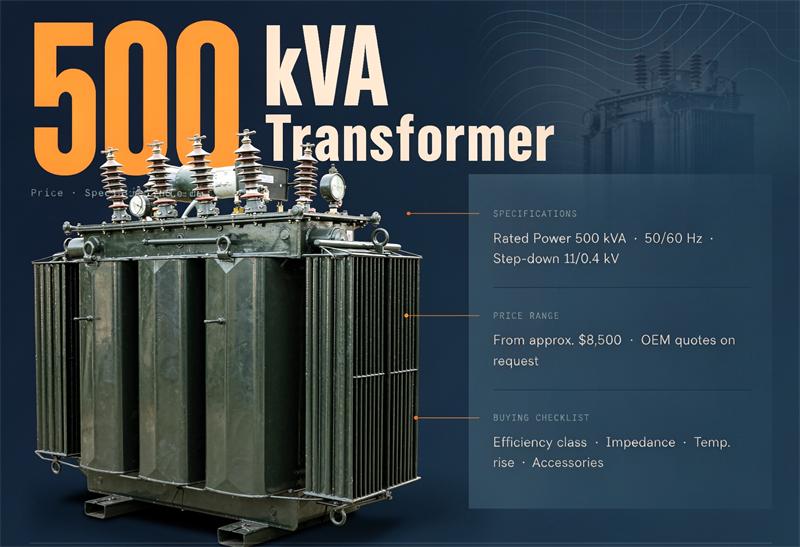
500 kVA is a stocked standard size, and it is one of the very few ratings that shows up in both the single-phase and three-phase columns of the federal preferred-rating tables. Three-phase, it pulls 601 A at 480Y/277 V and 1,388 A at 208Y/120 V. That second number is where budgets break. At 208 V you are buying a 2,000 A secondary device and three parallel sets of 750 kcmil copper, and the switchgear and cable on that side can easily cost more than the transformer feeding them.
This page is about 500 kVA as a rating: whether it is standard, what current it draws, what the federal efficiency floor is, what happens downstream, and what it costs. If you are sizing 500 kVA specifically for a DC fast charging site, our 500 kVA charging transformer page goes deeper on that one application. Everything here applies to any 500 kVA job.
The numbers up front:
- Full-load amps, three-phase: 601 A at 480Y/277 V, 1,388 A at 208Y/120 V, 1,203 A at 240 V delta, 481 A at 600Y/347 V.
- DOE minimum efficiency, three-phase liquid: 99.35% today, 99.38% from April 23, 2029 (99.35% if the unit is submersible).
- DOE minimum efficiency, three-phase low-voltage dry type: 99.14% today, 99.31% from April 23, 2029.
- Sensible continuous load: 350 to 425 kVA of demand.
- Realistic installed weight: roughly 4,200 to 4,650 lb for a three-phase pad-mount, plus a concrete pad about 96 by 96 inches.
Is 500 kVA a standard transformer size?
Yes, and it is unusual in a way that matters.
North American distribution transformers follow a preferred rating ladder that the Department of Energy published in the Federal Register at 63 FR 63360, dated November 12, 1998, in Tables 2 and 3 under the heading “Preferred Standard kVA Ratings.” You do not have to take a manufacturer’s word for which sizes are standard.
| Liquid-immersed | Dry-type | ||
| Single-phase | Three-phase | Single-phase | Three-phase |
| 10 | 15 | 15 | 15 |
| 15 | 30 | 25 | 30 |
| 25 | 45 | 37.5 | 45 |
| 37.5 | 75 | 50 | 75 |
| 50 | 112.5 | 75 | 112.5 |
| 75 | 150 | 100 | 150 |
| 100 | 225 | 167 | 225 |
| 167 | 300 | 250 | 300 |
| 250 | 500 | 333 | 500 |
| 333 | 750 | 500 | 750 |
| 500 | 1000 | 500 | 1000 |
| 667 | 1500 | 667 | 1500 |
| 833 | 2000 | 833 | 2000 |
| 2500 | 2500 |
Read across and you will spot the pattern people lean on: the three-phase column is roughly the single-phase column times three. It holds exactly up to 300 (100 × 3 = 300, 75 × 3 = 225, 50 × 3 = 150), and then it stops holding. At 167 × 3 you get 501, but the table says 500. At 333 × 3 you get 999, and the table says 1,000. At 833 × 3 you get 2,499, and the table says 2,500.
So the shortcut is fine for small units and wrong above 300 kVA. Read the table instead of doing arithmetic in your head.
The second thing worth noticing: 500 appears in all four columns. Most ratings appear on one side only. A 500 kVA single-phase unit is a real catalog item, not a custom build, and single-phase 500 kVA shows up on long rural laterals and on some charging sites that are fed from a single-phase tap.
One caveat that follows from this, and it catches people. The NEMA preferred-rating table lists 500 kVA single-phase for dry-type units, but the federal efficiency table for low-voltage dry-type transformers, 10 CFR 431.196, stops its single-phase column at 333 kVA. The regulation sets efficiency for unlisted ratings by linear interpolation between the rows immediately above and below. At 500 kVA single-phase there is no row above. If someone offers you a 500 kVA single-phase low-voltage dry-type unit and quotes you an efficiency figure sourced from that table, ask where the number came from. It did not come from a table row.
How many amps does a 500 kVA transformer draw?
Three-phase current is kVA × 1,000 divided by (volts × √3). Single-phase is kVA × 1,000 divided by volts. Here it is worked out for 500 kVA.
Three-phase secondary
| Secondary voltage | Full-load amps |
| 208Y/120 | 1,388 A |
| 240 delta | 1,203 A |
| 415Y/240 | 696 A |
| 480Y/277 or 480 delta | 601 A |
| 600Y/347 | 481 A |
These match the full-load current table published by Bear Power Solutions for its 500 kVA three-phase pad-mount, which lists 1,388 A at 208Y/120, 1,203 A at 240 delta, 696 A at 415Y/240, 601 A at 480 and 481 A at 600Y/347. Two independent sources arriving at the same numbers is a good sign that both the formula and the rounding convention are right.
Three-phase primary, at medium voltage
| Primary voltage | Full-load amps |
| 2,400 | 120 A |
| 4,160 | 69 A |
| 4,800 | 60 A |
| 7,200 | 40 A |
| 12,000 | 24 A |
| 12,470 | 23 A |
| 13,200 | 22 A |
| 13,800 | 21 A |
| 22,900 | 13 A |
| 24,940 | 12 A |
| 34,500 | 8.4 A |
Single-phase
| Voltage | Full-load amps |
| 240 | 2,083 A |
| 480 | 1,042 A |
| 2,400 | 208 A |
| 7,200 | 69 A |
| 12,470 | 40 A |
| 14,400 | 35 A |
| 19,920 | 25 A |
Look at the 240 V single-phase row. A 500 kVA single-phase unit at 240 V pulls 2,083 A. That is past the point where a single overcurrent device is a sensible answer, and it is why single-phase 500 kVA is almost always a medium-voltage primary unit serving a step-down at the far end, not a 240 V service transformer sitting behind a building.
The 2,000 A cliff on the 208 V side
This is the part that decides your budget, and almost nobody writes about it.
NEC Table 450.3(B) caps secondary overcurrent protection at 125% of rated secondary current when both primary and secondary protection are provided, and it lets you step up to the next standard rating when 125% does not land on one. NEC 240.6(A) lists the standard ratings, and above 800 A the list is 1,000, 1,200, 1,600, 2,000, 2,500, 3,000 and up. There is no 1,400 A and no 1,800 A.
| Secondary | Full-load amps | 125% | Standard device | Copper sets at 75 °C |
| 208Y/120 | 1,388 A | 1,735 A | 2,000 A | 3 × 750 kcmil (1,425 A) |
| 240 delta | 1,203 A | 1,504 A | 1,600 A | 3 × 600 kcmil (1,260 A) or 4 × 350 kcmil (1,240 A) |
| 415Y/240 | 696 A | 870 A | 1,000 A | 2 × 350 kcmil (620 A) is short, use 2 × 500 kcmil (760 A) |
| 480Y/277 | 601 A | 752 A | 800 A | 2 × 350 kcmil (620 A) |
| 600Y/347 | 481 A | 601 A | 601 A fuse or 700 A | 1 × 1,000 kcmil (545 A) |
Two things jump out.
The first is the step from 800 A to 2,000 A. On a 480 V secondary, a 500 kVA unit is an 800 A device with two runs of 350 kcmil. On a 208 V secondary the same transformer is a 2,000 A device with three runs of 750 kcmil. Same core and coil, completely different downstream bill. The 2,000 A frame, the parallel conductor terminations, and the labor on three large parallel pulls per phase is where the money goes.
The second is a curiosity that turns out to be useful. At 600Y/347 V, 125% of 481 A is 601 A, and 601 A is one of the five fuse-only standard ratings listed in 240.6(A) alongside 1, 3, 6 and 10 A. It exists precisely because several rules change at the 600 A break point. If your design lands there, a 601 A fuse is a real option rather than a 700 A compromise.
One more rule worth knowing before you size conductors. NEC 240.4(C) says that above 800 A the overcurrent device cannot exceed the conductor ampacity. The next-size-up allowance in 240.4(B) stops at 800 A. On the 208 V case that means your conductor assembly has to genuinely carry 1,388 A, and your device has to be sized to it, not rounded past it.
Short-circuit current: the 22 kA ceiling
Available secondary fault current is roughly full-load amps divided by per-unit impedance, assuming an infinite utility source. Real numbers come down once you add source impedance, but the number you spec against is the calculated one, so start here.
| Impedance | 208Y/120 | 480Y/277 | 600Y/347 |
| 6.5% | 21.4 kA | 9.3 kA | 7.4 kA |
| 5.75% | 24.1 kA | 10.5 kA | 8.4 kA |
| 5.0% | 27.8 kA | 12.0 kA | 9.6 kA |
| 4.5% | 30.8 kA | 13.4 kA | 10.7 kA |
| 4.0% | 34.7 kA | 15.0 kA | 12.0 kA |
A lot of panelboards and switchboards carry a 22 kA short-circuit current rating. On the 208 V side of a 500 kVA unit, 5.75% impedance puts you at 24.1 kA, which is over that line. You need impedance of about 6.31% or higher to stay under 22 kA, or you need gear rated for 42 kA.
That single row is worth more than most of the price negotiation. Specifying impedance deliberately, early, can save a switchboard upgrade. Specifying it late, after the gear is ordered, means you are buying new gear.
DOE minimum efficiency: today versus April 23, 2029
Federal efficiency standards for distribution transformers live in 10 CFR 431.196. Scope is set in 10 CFR 431.192, and a 500 kVA unit is covered if four things hold: input line voltage of 34.5 kV or less, output line voltage of 600 V or less, 60 Hz, and a rating inside 10 to 5,000 kVA for liquid-immersed or 15 to 5,000 kVA for dry-type. There are thirteen exclusions, including autotransformers, drive isolation transformers, and units with a tap range of 20% or more.
Here is what the tables require for 500 kVA three-phase. All values are minimum efficiency at the stated load point, and the load point differs by table, so compare within a row, not across rows.
| Type | Load point | Today (manufactured on or after Jan 1, 2016) | From April 23, 2029 |
| Liquid-immersed, three-phase | 50% | 99.35% | 99.38% (non-submersible) / 99.35% (submersible) |
| Low-voltage dry-type, three-phase | 35% | 99.14% | 99.31% |
| Medium-voltage dry-type, three-phase | 50% | 99.09 / 98.99 / 98.89% by BIL | 99.18 / 99.09 / 99.00% by BIL |
| Liquid-immersed, single-phase | 50% | 99.49% | 99.59% |
The medium-voltage dry-type row has three numbers because that table is indexed on basic impulse insulation level as well as kVA. For a 500 kVA three-phase unit today: 99.09% at BIL 20 to 45 kV, 98.99% at BIL 46 to 95 kV, and 98.89% at BIL 96 kV and above. From 2029: 99.18, 99.09 and 99.00%. Higher BIL, lower required efficiency, which makes sense once you remember that more insulation means more material between the winding and the tank and a bigger thermal penalty.
A request for quote that says “15 kV primary, dry type, 500 kVA” is incomplete. The BIL moves the number you are required to hit.
The 2029 rule splits by submersible, and nobody mentions it
Here is a detail that does not show up anywhere on this keyword’s search results.
Paragraph (b)(3) of 431.196 covers liquid-immersed units that are not submersible, manufactured on or after April 23, 2029, and sets 500 kVA three-phase at 99.38%. Paragraph (b)(4) covers submersible units on the same date and sets the same rating at 99.35%, which is where it sits today.
Same box, same kVA, same date, two different floors. If your specification says “submersible-capable” because the site floods or the vault is below grade, you are on the lower number. If it does not, you are on the higher one. Worth knowing before someone tells you a unit is “2029 ready” without saying which paragraph they mean.
One oddity in the published table, reported as published
The 2029 non-submersible liquid table is not monotonic at this size. It asks 99.42% of a 300 kVA three-phase unit and 99.38% of a 500 kVA unit, then goes back up to 99.43% at 750 kVA. The 500 row is 0.04 points below the 300 row.
That is what the table says. We are reporting it rather than smoothing it, because if you are checking a vendor’s efficiency claim against the regulation you want to be reading the same numbers they are.
What 500 kVA actually serves
At a 0.8 power factor, 500 kVA is 400 kW. At 0.9 it is 450 kW. At unity it is 500 kW.
The sizing habit that keeps units out of trouble is to land calculated demand at 70% to 85% of nameplate, which for 500 kVA means serving 350 to 425 kVA of demand. That headroom covers motor starting, a few years of growth, and the fact that nameplate assumes a specific ambient and a specific load profile.
Typical fits at this rating:
- Mid-size commercial buildings and mixed-use developments on a 480 V service
- Manufacturing plants with a mix of motor and process load
- Apartment complexes with central plant loads
- Data center mechanical and support loads, where the transformer feeds cooling rather than IT
- Cold storage and food processing
- Solar sites where 500 kVA is the step-up for a single inverter block, and DC fast charging sites in the 180 to 360 kW band
The two ends of that list want different things. A building service wants low sound and a small footprint. A solar step-up wants a specific vector group and a specific impedance to keep the inverter happy. Say which one you are doing in the RFQ.
A worked sizing example
Say you have a manufacturing plant with 225 kVA of motor load, 150 kVA of process equipment and 75 kVA of building services. That is 450 kVA of connected load, and it is tempting to call it a 500 kVA job. Do the demand math first.
Motors rarely all run at once, and the ones that do are not all at full load. Apply a demand factor of 0.7 to the motor group, 0.8 to process and 0.6 to building services, and you get 158 plus 120 plus 45, which is 323 kVA of demand. Add 20% for growth over five years and you are at 388 kVA. That sits inside the 350 to 425 kVA band, so 500 kVA is the right call.
Now do the same thing at 480 V and at 208 V. At 480Y/277 the unit delivers 601 A, and 388 kVA of demand is 467 A, which is 78% of nameplate. Comfortable. If you run the plant switchgear at 208Y/120 instead, full load is 1,388 A and your 388 kVA of demand is 1,077 A, which is still 78% of nameplate but it is 1,077 A you have to protect, switch and terminate. The transformer does not care. Your switchboard bill does.
The mistake this example is built to avoid is sizing in connected kVA rather than demand kVA. Connected load on that plant is 450 kVA, which reads like a 500 kVA unit with no margin at all. Demand says you have 22% headroom.
Price the losses in watts
A 500 kVA unit that runs around the clock costs more in lost energy over 30 years than it does to buy. Here is how to work it out, using $0.12 per kWh, 8,760 hours a year, a 7% discount rate and a 30-year life. The annuity factor at those settings is 12.409.
Step one: convert the efficiency floor into watts. Permitted loss equals output times (1 divided by efficiency, minus 1). At 50% load on a 500 kVA three-phase liquid unit, output is 250 kW.
| Standard | Efficiency | Permitted loss at 50% load |
| Today, liquid three-phase | 99.35% | 1,636 W |
| 2029, liquid three-phase, non-submersible | 99.38% | 1,560 W |
| Today, low-voltage dry three-phase (at 35%, 175 kW out) | 99.14% | 1,518 W |
| 2029, low-voltage dry three-phase (at 35%) | 99.31% | 1,216 W |
Step two: capitalize the difference. The liquid step from today’s tier to the 2029 tier is 76 W. Over a year that is 663 kWh, or about 80. Present value over 30 years at 7% is **988**. The dry-type step is 302 W, which is 2,648 kWh a year, about 318, and a present value of **3,943**.
Step three: do the same for total losses. Take a published pair of 698 W no-load and 4,985 W full-load. At 50% load that is 698 plus 4,985 × 0.25, which is 1,944 W. Over a year: 17,032 kWh, or 2,044. Present value: **25,362**.
So the honest framing is this. Total lifetime losses run something like $25,000 in present value. The 2029 tier step is worth under $1,000 of that on the liquid side. Pay for measured watts, not for the word “efficient,” and remember that after April 23, 2029, the higher tier is not an upgrade option. It is the floor, and you will not be able to buy below it.
Published loss numbers that do not add up
Two publicly posted 500 kVA loss pairs, run through the same arithmetic. Both are our calculations from the numbers those pages print, not values from a regulation.
| Source | No-load loss | Full-load loss | Loss at 50% | Implied efficiency | Over the 99.35% floor by |
| Winley Electric, 500 kVA three-phase pad-mount, copper, 12,470GrdY/7200 to 480Y/277 | ±698 W | ±4,985 W at 100% | 1,944 W | 99.23% | 309 W |
| Winley Electric, specification table, 500 kVA | 680 W | 5,100 W | 1,955 W | 99.22% | 319 W |
| transformer4u.com, 500 kVA three-phase pad-mount | 900 W | 5,200 W at 100% | 2,200 W | 99.13% | 564 W |
The third row is the interesting one. That page prints 900 W no-load, 5,200 W load loss, 5.0% impedance, an efficiency of 99.1%, and the words “DOE 2016 compliant” in the same table. Its own numbers give 99.13% at 50% load, and the 2016 floor for a 500 kVA three-phase liquid unit is 99.35%. By our arithmetic it misses by 564 W.
Before you accuse anyone, run the three checks we run.
- Reference temperature. That page’s load loss is stated at an 85 °C reference, and the DOE test procedure works from a different reference temperature. Correcting roughly 85% of a 5,200 W load loss from 85 °C to 75 °C moves it by about 140 W at full load, which is about 35 W at 50% load. Real, but it does not close a 564 W gap.
- This unit or the family? A lot of published tables are a family table, not a test result for the unit in front of you.
- What does the tolerance mean? The first row prints “±” in front of both loss figures with no number after it. A tolerance you cannot read is not a value you can hold anyone to. On a related 300 kVA listing from the same supplier the tolerance was printed as ±500 W, which is larger than the no-load loss itself.
Once those three are done and the numbers still do not work, the ask is always the same: the routine test report. No-load loss, load loss, impedance, test voltage, and the serial number of the unit you are actually buying.
Size, weight, pad and clearance
Real published figures for three-phase 500 kVA pad-mounts, from two different suppliers. They are not comparable to each other, because they are different designs and the two pages even order their dimensions differently.
| transformer4u.com | Winley Electric | |
| Weight | 4,200 lb (1,905 kg) | 4,650 lb |
| Oil volume | 225 gal (850 L), mineral oil | not stated |
| Dimensions | 48 in H × 74 in W × 56 in D | 89 in W × 53 in D × 50 in H |
| Cooling | ONAN | ONAN |
| Sound level | not stated | 56 dBA |
| Impedance | 5.0% | not stated |
| BIL | 150 kV | not stated |
At roughly 4,200 to 4,650 lb, this is a crane or a big forklift, not a couple of people and a pallet jack. Get the delivery access sorted before the truck is scheduled.
Pad and clearance guidance published alongside the first listing:
- Minimum pad size 96 × 96 in, allowing 6 in of overhang on all sides
- Thickness 4 to 6 in, reinforced concrete, 3,000 psi minimum
- Level within 1/4 in per foot, with slight slope away from buildings
- Cure 28 days before setting the unit
- Minimum 10 ft clearance from buildings, per NEC and local fire codes, with conduit entry per utility specs
Note that the 28-day cure sits on the critical path. If your schedule is tight, that is a constraint you find out about in week one, not in week ten.
What a 500 kVA transformer costs
One US supplier publishes a live price on this rating. Bear Power Solutions lists its 500 kVA three-phase pad-mount, SKU BPS-3PH-PAD-500K, at $25,963.62 to $47,190.00, retrieved October 11, 2026. That build is aluminum windings, mineral oil, ONAN cooling, 15, 25 or 35 kV primary, 240 to 600 V secondary, BIL 95/125/150 kV, 65 °C rise, taps of plus or minus 2 × 2.5% at full capacity, built to ANSI/IEEE C57.12 and DOE 2016 efficiency, with a 12 to 16 week lead time. Copper windings and natural ester fluid are available on request.
That is a 1.82× spread on one product page, and it comes entirely from voltage configuration and options. Which is the point: kVA does not set the price. A 500 kVA unit and a 300 kVA unit can be within a few thousand dollars of each other, or a factor of two apart, depending on what is inside the tank and what is bolted to it.
The wider market adds more spread. Chinese supplier listings for 500 kVA three-phase pad-mounts advertise ranges from about $5,000 up to $150,000 depending on configuration, which is not a useful number for budgeting because it spans everything from a bare unit to a full utility-spec build.
Installation is a second number and often a bigger one. Published guidance for a 1 MVA pad-mount puts install at $22,000 to $40,000 covering the pad, primary and secondary cable, terminations, grounding, crane, electrical labor, civil work, permits and commissioning. Expect 500 kVA to land in the same order of magnitude. A quote that covers only the transformer is not a project quote.
If you want the broader picture on what drives transformer pricing across ratings, our transformer price guide breaks it down. And if 500 kVA turns out to be one size small, the 1000 kVA pad-mounted guide covers the next rung up with the same arithmetic.
A 500 kVA specification that is actually complete
Here is the same nine items filled in for one real job, a mid-size commercial building on a 480Y/277 V service with a 12,470 V utility feed. Use it as a template and change the parts that do not match your site.
| Line | Value | Why it is there |
| Rating | 500 kVA, three-phase, 60 Hz, 65 °C rise | Rise changes the rating. Same core, different number |
| Primary | 12,470GrdY/7200, BIL 95 kV | BIL sets the efficiency column on dry-type units |
| Taps | ±2 × 2.5% at full capacity | Below-capacity taps limit how you can run it |
| Secondary | 480Y/277, 601 A | This is the number your gear is built around |
| Impedance | 5.75% ±7.5% | Chosen against the fault study, not defaulted |
| Windings | Copper | Aluminum is cheaper and physically larger |
| Losses | No-load and load loss in watts, at 75 °C | The only efficiency figure you can verify |
| Cooling and fluid | ONAN, mineral oil | Sets the footprint and the containment rules |
| Sound | 56 dBA or lower at rated load | Matters once it is near occupied space |
| Documentation | Routine test report with serial number | The whole point of the previous nine lines |
Notice that “500 kVA” is one of ten lines. A request for quote that stops at line one will come back with nine vendor assumptions, and the quotes will not be comparable.
What to put in the RFQ
Nine items. Missing any one of them is how you end up comparing four different products.
- kVA and phase, and whether the rating is at 55 °C or 65 °C rise
- Primary voltage and BIL, not just “15 kV”
- Secondary voltage and whether you need a neutral
- Impedance, with a target and a tolerance, chosen against your fault current study rather than defaulted
- Winding material, copper or aluminum, and the loss figures in watts at a stated reference temperature
- Fluid, mineral oil or natural ester, and whether the unit must be submersible
- Taps, including whether they are full-capacity
- Sound level in dBA if it sits near occupied space
- The routine test report, with no-load loss, load loss, impedance, test voltage and serial number
Deciding between the two families is its own question, and our oil-immersed versus dry-type comparison walks through where each one wins at this size. Oil is the default outdoors and the cheaper path at 500 kVA. Dry type wins indoors, in vaults under occupied space, and wherever oil containment rules make the installation expensive. Browse the full product range to see what is stocked at this rating.
When 500 kVA is the wrong answer
Two cases.
Split it. On a 208Y/120 service, one 500 kVA unit is 1,388 A, a 2,000 A device, and three runs of 750 kcmil per phase. Two 250 kVA units are 694 A each, and 125% of 694 A is 868 A, so each one lands on a 1,000 A device with two runs of 500 kcmil per phase.
| One 500 kVA | Two 250 kVA | |
| Secondary current | 1,388 A | 694 A each |
| Secondary device at 125% | 2,000 A | 1,000 A each |
| Copper per phase | 3 × 750 kcmil (1,425 A) | 2 × 500 kcmil (760 A) each |
| Fault current at 5.75% | 24.1 kA | 12.1 kA each |
Look at the last row, because it is the one nobody prices. Splitting the rating halves the available fault current on each feeder. One 500 kVA unit at 208 V pushes you past 22 kA and into 42 kA gear. Two 250 kVA units sit at 12.1 kA, safely inside standard ratings, and you avoid an upgrade that can cost more than the second transformer.
You do pay for two tanks and two pads. You save on switchgear frames, terminations and pulling labor, and you get redundancy, which on a building service is worth more than the arithmetic. If your load splits into two roughly equal halves, price it both ways before you decide.
Go up a rung. If your calculated demand is already past 425 kVA, or you expect to be past it inside three years, 500 kVA is the wrong landing spot. Oversizing costs twice, once in purchase price and once in no-load losses you pay for every hour of a 30-year life, so do not jump to 1,000 kVA out of caution. The step to 750 kVA is usually the right one, and the resources library has the adjacent sizes worked out with the same method.
If you want to see what this rating looks like in the field, the project case studies show 500 kVA-class units in hospital, metro, data center and solar installations.
Frequently asked questions
How many amps is a 500 kVA transformer?
Three-phase: 601 A at 480Y/277 V, 1,388 A at 208Y/120 V, 1,203 A at 240 V delta and 481 A at 600Y/347 V. Single-phase: 2,083 A at 240 V and 1,042 A at 480 V. These match the full-load current table published by Bear Power Solutions for its 500 kVA three-phase pad-mount.
Is 500 kVA a standard transformer size?
Yes, and unusually it appears in all four columns of the preferred rating tables published at 63 FR 63360: liquid single-phase, liquid three-phase, dry-type single-phase and dry-type three-phase. That means both a 500 kVA single-phase and a 500 kVA three-phase unit are catalog items rather than custom builds.
Can I get 500 kVA in single phase?
Yes for liquid-immersed and medium-voltage dry-type units. The federal efficiency tables list 500 kVA single-phase for liquid at 99.49% today and 99.59% from April 2029, and for medium-voltage dry-type by BIL. Be careful with low-voltage dry-type: the single-phase column in 10 CFR 431.196 stops at 333 kVA, so there is no table row for 500 kVA single-phase and the interpolation rule has no upper anchor.
What size breaker do I need for a 500 kVA transformer?
On the secondary, NEC Table 450.3(B) caps protection at 125% of rated current, stepped up to the next standard rating in 240.6(A). That gives 2,000 A at 208Y/120, 1,600 A at 240 V delta, 1,000 A at 415Y/240, 800 A at 480Y/277 and either a 601 A fuse or a 700 A device at 600Y/347. Above 800 A, NEC 240.4(C) does not let the device exceed conductor ampacity.
How much does a 500 kVA transformer weigh?
Published figures for three-phase pad-mounts run 4,200 lb to 4,650 lb, with about 225 gallons of mineral oil in the tank. Plan for a crane or a large forklift, a 96 by 96 inch reinforced pad, and 28 days of cure time before the unit is set.
What does a 500 kVA transformer cost?
One US supplier published $25,963.62 to $47,190.00 for a configured three-phase pad-mount on October 11, 2026, a 1.82× spread from options alone. Installation adds a second number in the tens of thousands. Treat published ranges as budget anchors, not quotes, and expect two quotes for “500 kVA” to differ by a wide margin if the specifications are not identical.
How many kW is 500 kVA?
400 kW at 0.8 power factor, 450 kW at 0.9, 475 kW at 0.95 and 500 kW at unity. For sizing, land calculated demand at 70% to 85% of nameplate, which is 350 to 425 kVA on a 500 kVA unit.
Does a 500 kVA transformer have to meet DOE efficiency standards?
If it is a distribution transformer as defined in 10 CFR 431.192, yes: input 34.5 kV or less, output 600 V or less, 60 Hz, and 10 to 5,000 kVA liquid or 15 to 5,000 kVA dry. There are thirteen exclusions, including autotransformers, drive isolation transformers, and units with a tap range of 20% or more.
Is 500 kVA enough for a DC fast charging site?
Commonly yes, for a site load band of roughly 180 to 360 kW, which is 6 to 8 chargers at 60 kW or 4 to 5 dual-gun units at 120 kW. The sizing question on charging sites is the diversity factor and the site’s peak coincidence, not the nameplate on the chargers. Our 500 kVA charging transformer page, linked earlier, works through those configurations.
What should I ask the supplier for before I sign?
The routine test report for the actual unit, with no-load loss, load loss, impedance, test voltage and serial number, plus the reference temperature the losses are corrected to. Then check those watts against the permitted loss for the standard that applies on your manufacture date.