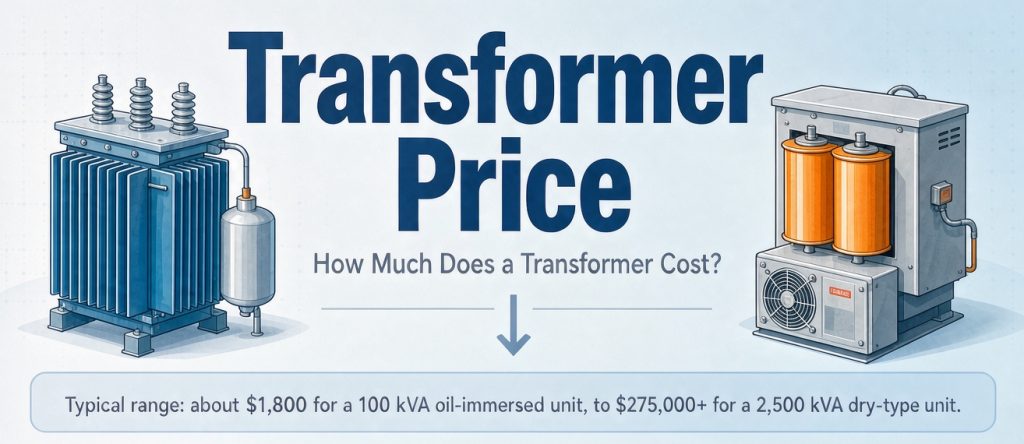
A transformer costs anywhere from about $8 for a small control transformer to over $15 million for a generator step-up unit. For the range most buyers actually shop in — 100 kVA to 2,500 kVA distribution equipment — published 2026 ranges run roughly $1,800 to $38,500 per unit, and the price per kVA falls from about 30/kVA at 100 kVA** to about **14/kVA at 2,500 kVA.
Here’s the part nobody tells you: the price tables you’ll find online disagree with each other by up to 5x. For a 1,000 kVA cast resin dry-type transformer with copper windings, published 2026 figures range from $12,100 to $62,000. That’s not a rounding difference. It’s a scope difference, and this page explains exactly which scope questions to ask before you believe any number — including ours.
If you typed “transformer price” into Google today, you probably got a price table. Maybe three of them. And if you compared them, you noticed they don’t agree.
That’s not because somebody is lying. It’s because a transformer quote is not a price — it’s a scope, and most published tables don’t tell you what’s inside theirs. This page does two things the others don’t: it gives you the numbers, and it gives you the scope questions that make the numbers mean something.
We’re a factory, so we’ll be straight with you up front: any price on this page is an indicative range, not a quote. Copper and grain-oriented electrical steel move too fast for anyone to publish a firm number. What we can give you is a defensible budget band and the ability to tell whether a quote you’re holding is reasonable.
The 60-second version
Ten things. If you only skim, skim this.
- The range is absurdly wide. $8 for a 10 VA control transformer. $15 million-plus for a GSU unit. Anyone quoting “transformer price” as one number is selling something.
- Price per kVA falls as size rises. Roughly $30/kVA at 100 kVA, $14/kVA at 2,500 kVA, $8–15/kVA above 1 MVA. Bigger units are cheaper per kVA and more expensive in absolute terms.
- Dry-type costs about 40–80% more than oil-immersed at the same kVA. You buy that back indoors through eliminated fire-rated construction and oil containment.
- Aluminum windings cut first cost by roughly 15–40% versus copper. You pay it back in higher load losses over 25 years.
- Stepping from 11 kV to 33/35 kV adds roughly 8–25% to the equipment price, because clearances, bushings and testing all get harder.
- Published 2026 tables disagree by up to 5.1x at 1,000 kVA cast resin copper. Scope, market and year explain most of it.
- US transformer producer prices rose 8.7% in the year to July 2026 (BLS PPI), and copper wire and cable rose 17.9% over the same period. Budget for movement, not for a fixed number.
- The equipment price is typically the smallest number you’ll pay. Freight, duty, rigging, commissioning and the cost of waiting routinely add 20–40% on an import.
- **At 13.97¢/kWh (EIA commercial average, Jan–Jul 2026), one kilowatt of continuous loss costs about $1,220 a year.** A $3,000 low-loss premium that removes 0.65 kW of no-load loss pays back in about 3.2 years.
- Transformer quotes now expire in 15–30 days, not 90. If your budget cycle takes two months, you’re budgeting off a dead number.
Why every transformer price list you find disagrees by 5x
Let’s put the problem on the table before we give you any numbers of our own.
Below are four published 2026 figures for the same nominal product — a 1,000 kVA cast resin dry-type transformer, copper windings, 10–11 kV primary:
| Source | Published 2026 range | Implied $/kVA |
| Ruistelectric (cast resin copper) | $12,100 – $16,800 | $12 – $17 |
| Unita Electric (SCB10/SCB13 series) | $15,800 – $18,000 | $16 – $18 |
| Toptransformer (2026 guide) | $22,000 – $31,500 | $22 – $32 |
| ZTELEC (cast resin copper) | $32,000 – $62,000 | $32 – $62 |
Spread: $12,100 to $62,000. That’s 5.1x. And that’s before freight, duty, or a single accessory.
Here’s why. Five variables, and every published table makes a different set of assumptions about all five:
| Variable | What it changes | Typical impact |
| Market | Ex-works China vs. delivered US/EU vs. a US OEM’s list price | 2–4x |
| Scope | Transformer only, or transformer + enclosure + bushings + tap changer + temperature controller + routine tests + witnessed FAT | 15–40% |
| Winding material | Aluminum vs. copper | 15–50% |
| Loss tier | Standard vs. low-loss vs. amorphous core | 10–45% |
| Certification | IEC/GB baseline vs. UL / CSA / KEMA / DOE-compliant | 8–20% |
There’s a second problem worth knowing about. Two of the “independent” price tables on page one of Google are byte-identical — the same ten kVA rows, the same numbers, published by two different factories. So when you feel like you’ve cross-checked a price against multiple sources, you may have checked one source twice. We’re not naming names; we’re telling you the cross-check is weaker than it looks.
The practical takeaway is the one that matters: a price without a scope is an advertisement. Before you compare two numbers, get both suppliers to answer the 14 scope questions in What your quote does not include. Half the time, the “expensive” quote is just the complete one.
Transformer price by type: the whole map
Four bands cover essentially everything you can buy. Prices below are published indicative ranges with their basis stated — ex-works or FOB, USD, 2026 — and they are the kind of numbers you use to build a budget, not to sign a PO.
Band 1 — Control, isolation and specialty small units (10 VA – 100 kVA)
| Type | Typical rating | Published range (USD) |
| Control / panel-mount | 10 VA – 5 kVA | $8 – $250 |
| Toroidal | 15 VA – 10 kVA | $20 – $900 |
| Isolation | 0.25 – 75 kVA | $80 – $6,500 |
| Autotransformer | 0.5 – 500 kVA | $60 – $15,000 |
These are catalog items. You can often ship one this week. The price is dominated by enclosure and certification, not by core steel.
Band 2 — Oil-immersed distribution (10–11 kV, S11/S13 class)
The workhorse band. Published FOB China ranges for standard three-phase designs:
| kVA | Published range (USD) | Implied $/kVA | Implied CNY |
| 100 | $1,800 – $2,200 | $18 – $22 | 12,800 – 15,600 |
| 250 | $2,800 – $3,400 | $11 – $14 | 20,000 – 24,000 |
| 400 | $3,800 – $4,500 | $10 – $11 | 27,000 – 32,000 |
| 500 | $4,500 – $5,200 | $9 – $10 | 32,000 – 37,000 |
| 630 | $5,500 – $6,300 | $9 – $10 | 39,000 – 45,000 |
| 800 | $6,800 – $7,800 | $9 – $10 | 48,000 – 55,000 |
| 1,000 | $8,200 – $9,500 | $8 – $10 | 58,000 – 67,000 |
| 1,600 | $12,500 – $14,500 | $8 – $9 | 89,000 – 103,000 |
| 2,000 | $15,500 – $17,800 | $8 – $9 | 110,000 – 127,000 |
| 2,500 | $18,500 – $21,000 | $7 – $8 | 131,000 – 150,000 |
Source: published 2026 China factory price guides (FOB). Apply +10–15% for S13 and higher-efficiency designs; deduct roughly 30–40% for aluminum windings. These are equipment figures — they exclude freight, duty, rigging and commissioning.
Band 3 — Dry-type / cast resin (10–11 kV, SCB10–SCB13)
Indoors, occupied buildings, data centers, hospitals, tunnels. Same capacity, higher price, and a different cost structure once you price the room it lives in.
| kVA | Published range (USD) | Implied $/kVA |
| 100 | $3,200 – $3,800 | $32 – $38 |
| 250 | $5,200 – $6,000 | $21 – $24 |
| 400 | $7,200 – $8,300 | $18 – $21 |
| 500 | $8,500 – $9,800 | $17 – $20 |
| 630 | $10,500 – $12,000 | $17 – $19 |
| 800 | $13,000 – $14,800 | $16 – $19 |
| 1,000 | $15,800 – $18,000 | $16 – $18 |
| 1,600 | $24,000 – $27,500 | $15 – $17 |
| 2,000 | $29,000 – $33,000 | $15 – $17 |
| 2,500 | $34,000 – $38,500 | $14 – $15 |
Source: published 2026 China factory price guides. Note this table sits near the low end of the spread shown earlier — higher figures of 22,000–62,000 at 1,000 kVA are also published, generally reflecting copper windings, higher voltage classes, UL/CSA compliance, or delivered rather than ex-works basis.
Within dry-type, construction and winding material split the number four ways. Published ex-works 2026 figures:
| kVA | VPI aluminum | VPI copper | Cast resin aluminum | Cast resin copper |
| 100 | $1,200 – $1,800 | $1,800 – $2,700 | $1,500 – $2,300 | $2,200 – $3,400 |
| 250 | $2,000 – $2,700 | $3,000 – $4,100 | $2,500 – $3,400 | $3,700 – $5,100 |
| 500 | $3,500 – $4,800 | $5,200 – $7,200 | $4,400 – $6,000 | $6,500 – $9,000 |
| 1,000 | $6,500 – $9,000 | $9,700 – $13,500 | $8,100 – $11,200 | $12,100 – $16,800 |
| 1,600 | $9,500 – $12,500 | $14,200 – $18,800 | $11,800 – $15,600 | $17,700 – $23,400 |
| 2,500 | $14,000 – $18,000 | $21,000 – $27,000 | $17,400 – $22,400 | $26,100 – $33,600 |
Two patterns jump out. Copper adds roughly 30–50% over aluminum. Cast resin adds roughly 15–30% over VPI. Which one you should buy depends on the room, not the price list — our dry type transformer guide walks through cast resin vs. VPI by environment, moisture and fire code.
Band 4 — Power transformers and GSU (above 5 MVA)
Above roughly 5 MVA the market stops behaving like a catalog. Everything is quoted, lead times dominate price, and the number depends more on your production slot than on your specification.
| Rating | Class | Published indicative range (USD) |
| 10 MVA | 33 kV power transformer | $90,000 – $160,000 |
| 60 MVA | 110 kV substation unit | $600,000 – $950,000 |
| 100–1,200 MVA | GSU / transmission | $150,000 – $15,000,000+ |
Wide bands are honest here, not lazy. At this level a single vector group or transport envelope constraint can move the price by more than the band. Selection logic is in our power transformer buying guide.
Price per kVA: the only number that scales
If you need one number for a back-of-envelope budget, use price per kVA. It’s the only figure that behaves predictably across ratings.
| Band | Published $/kVA benchmark (2026) | Cross-check from the tables above |
| Small distribution, 50–250 kVA | $18 – $30 | $11 – $22 (oil-immersed, China FOB) |
| Medium distribution, 315–1,000 kVA | $10 – $20 | $8 – $11 |
| Large, above 1 MVA or above 33 kV | $8 – $15 | — |
| Cast resin dry-type | $15 – $60 | $14 – $38 |
Read that cross-check column carefully, because it’s the whole point of this page: the published $/kVA benchmarks and the $/kVA you derive from the published price tables don’t reconcile. One widely cited 2026 source puts 50–250 kVA distribution units at $18–30/kVA, while its own table for the same range works out to $11–14/kVA. Neither is wrong; they’re measuring different scopes and different markets.
So use $/kVA the way it’s meant to be used — **as a sanity check, not as a price.** If a quote lands at $45/kVA for a 2,000 kVA oil-immersed unit, something in the scope is unusual and you should find out what. If it lands at $12/kVA, you’re in the normal band and should move on to checking losses.
One further caution. Geography moves this number by 2–4x. Published comparisons put North American and European supply around $38–50/kVA against roughly $28–35/kVA for Asian supply on comparable specifications, while China ex-works catalog pricing can land well below both. Same machine, different market, different number.
Two other anchors worth having:
- The US secondary market. Surplus dealers publicly post buying ranges of roughly
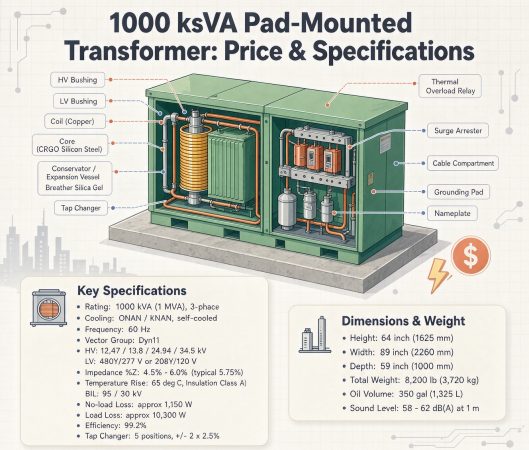
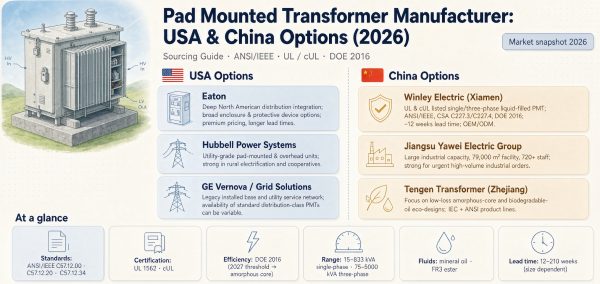
5–9/kVA for 75–300 kVA pad-mounts**, **7–14/kVA for 500–1,500 kVA, and $10–20+/kVA above 2,000 kVA. Read that carefully: those are what a dealer will pay you, not what you’d pay a dealer. Sell-side pricing runs higher. But it’s a useful floor on what the steel is worth. - The pad-mount exception. Pad-mounted units price differently from pole-mount and from indoor dry-type, because enclosure, dead-front construction and tamper rating are real line items. If that’s your product, use the dedicated pad-mounted transformer sizes, prices and buying guide instead of a general $/kVA band.
The seven things that move the quote
Ranked by how much they actually move the number, based on the percentage ranges published across 2026 supplier guides.
| Rank | Driver | Typical impact | Notes |
| 1 | kVA rating | Sets the whole bill of materials | Everything scales from here |
| 2 | Winding material (copper vs. aluminum) | Aluminum −15% to −40% | The single biggest discretionary lever |
| 3 | Oil-immersed vs. dry-type | Dry-type +40% to +80% on equipment | Often recovered indoors on installed cost |
| 4 | Voltage class | 20–24 kV +8% to +15%; 33–35 kV +15% to +25% | Clearances, bushings, testing |
| 5 | Loss tier / core material | +10% to +45% for low-loss or amorphous | Pays back through energy, see the TCO math below |
| 6 | Certification and testing scope | +8% to +20% for UL / CSA / KEMA; FAT and type tests priced separately | A UL listing covers specific models, not a company |
| 7 | Accessories and site conditions | Tap changer, temperature controller, enclosure, altitude, ambient, seismic, coastal coating | Each one is a line item, and each one is optional until it isn’t |
The type decision at rank 3 is the one that can’t be undone later, and it’s also the one most often made on price alone. Our oil-immersed vs. dry-type comparison breaks it down by environment, fire code and total installed cost rather than by sticker price.
One driver that doesn’t appear in most tables and should: who you’re buying from. A factory-direct price and a trading company price for the same unit can differ by 20–40%, because one of them is paying someone else’s margin. It’s a legitimate question to ask, and a legitimate question for a supplier to answer. We build, wind, vacuum-cast and routine-test in-house, and we’d rather you came and looked at the floor than took our word for it.
Why 2026 prices are where they are
If your last transformer purchase was in 2019 or 2020, throw that number away. Here’s what the data actually shows, with sources — and a warning about why the headlines disagree.
The three headline numbers, and why they don’t match:
| Claim | Figure | Source |
| “Transformer costs have soared” | more than 400% since 2020 | The Conference Board, report released September 11, 2026 |
| Distribution transformer price change | +78% to +95% since 2019 | Wood Mackenzie supply-deficit analysis, as reported in 2026 industry coverage |
| US producer price index, power and distribution transformers | +8.7% year to July 2026; +11.6% over two years | US Bureau of Labor Statistics PPI series, current to July 2026 |
Those three numbers are not reconcilable, and the reason is instructive. The 400% figure reflects emergency and spot procurement — storm replacement, expedited orders, single-unit buys into a sold-out market. The +78–95% figure tracks contracted utility programme pricing since 2019. The +8.7% figure is a single-year producer price index, which measures what manufacturers charge, not what a buyer in a queue pays.
Read all three, and the honest conclusion is: your price depends almost entirely on how much of a hurry you’re in.
What’s actually driving it:
- Copper. Published levels disagree by source and date — roughly
6.52/lb on 3 September 2026**, about **12.60/kg for the US in Q2 2026, and LME spot cited near $14,000/tonne in June 2026. Different contracts, different dates, different units. We’re not going to average them into a false precision. What’s consistent across every source is direction: up, materially, since 2020. Copper and aluminum together account for more than half of transformer material cost. - Grain-oriented electrical steel (GOES). The US has essentially one domestic producer, and domestic output covers roughly a fifth of demand. That’s a structural constraint, not a cycle.
- Tariffs. A presidential proclamation dated 2 April 2026, effective 6 April 2026, restructured the Section 232 steel, aluminum and copper actions into tiers — 50% on primary articles and close derivatives, 25% on downstream derivatives, and a temporary 15% combined rate on a defined list of metal-intensive industrial and electrical grid equipment, running through 31 December 2027, rising to 25% in 2028. Critically, the duties now apply to the full customs value of the imported article rather than to its metal content alone.
- We are not going to tell you which tier transformers fall into. The annex defining that list runs to dozens of tariff codes and we could not verify its contents from a primary source. Confirm your classification with a licensed customs broker against the annex text — not against a blog, including this one.
- Lead times. Large power transformers are widely reported at an average of about 128 weeks, GSU units at 144–210 weeks, and distribution transformers at 52–78 weeks. NERC flagged lead times above 120 weeks as early as 2024. Availability, not capital, is the gating factor on most 2026 projects.
- Demand concentration. Hyperscale data center buyers are securing factory capacity through long-term agreements, which tightens the spot market for everyone else.
What this means for your budget is simple and uncomfortable: a quote you received 60 days ago may no longer be honored, and a budget built on last year’s number is wrong before you start. Which brings us to the mechanics.
What your quote does not include
This is where budgets break. The equipment price is one line in a stack, and on an import it’s often the smallest one.
Landed cost, layer by layer:
| Layer | Notes |
| Ex-works / FOB unit price | The only number in most published tables |
| Export packing | Crating, desiccant, shock indicators |
| Inland freight to port | Frequently quoted separately |
| Ocean or air freight | Rates move; get validity dates in writing |
| Marine insurance | Your risk allocation decision |
| Customs duty + HS classification | Distribution transformers typically fall in HS heading 8504 — confirm with your broker |
| Section 232 (US imports) | Framework described above; confirm the applicable tier with a licensed broker |
| Port handling, drayage, permits | Usually buyer’s side |
| Rigging and setting | Cranes are not cheap |
| Cost of waiting | Usually the largest unbudgeted line |
A commonly used planning allowance is +10% to +30% above ex-works depending on destination and site requirements. On a US import with current tariff treatment and a tight schedule, 20–40% is more realistic.
Then there’s the scope question — 14 things to confirm in writing before you compare two prices:
| # | Ask | Why it matters |
| 1 | Winding material — copper or aluminum? | Same kVA, different losses, different price |
| 2 | Is oil included? | On liquid-filled units, sometimes it isn’t |
| 3 | Are radiators, bushings and the tap changer included? | Common exclusions |
| 4 | Is the enclosure included, and to which NEMA or IP rating? | Real money on outdoor units |
| 5 | Temperature controller and RTDs — included or extra? | Usually extra |
| 6 | Are routine tests included? | They should be, but ask |
| 7 | Is witnessed FAT included, or priced separately — and is travel included? | Separates two quotes by thousands |
| 8 | Are losses guaranteed with a tolerance and penalty, or “typical”? | “Typical” is not a commitment |
| 9 | Which standard and which edition? | IEC 60076 vs ANSI/IEEE C57.12 is a design difference |
| 10 | Which efficiency tier are you certifying to, and what’s the manufacture date? | Determines your DOE 2029 exposure |
| 11 | Incoterms — and the named place, not just the rule | EXW, FOB and CIF differ by a wide margin |
| 12 | Packaging included? | |
| 13 | Quote validity, in days | Now commonly 15–30 |
| 14 | Is there a copper or steel price-adjustment clause? | If yes, what index and what lag |
Number 13 deserves its own paragraph. Transformer quote validity has compressed from the historical 60–90 days down to 15–30 days in the current materials market, and it’s the most common way a carefully built budget silently goes wrong. If your approval cycle takes eight weeks, tell your supplier and negotiate a longer validity or a stated index formula — don’t just assume the number holds.
Price vs. cost: the TCO math
Here’s the arithmetic that turns a price comparison into a decision. It’s four lines and you can check every one of them.
The anchor: at the US commercial average electricity price of 13.97¢/kWh (EIA, Electric Power Monthly, Table 5.3, January–July 2026), a transformer energized 8,760 hours a year makes one kilowatt of continuous loss cost:
1 kW × 8,760 h × $0.1397 = **about $1,220 per kilowatt-year**
Worked example — 1,000 kVA oil-immersed distribution, two quotes, 35% load factor:
| Quote A (standard) | Quote B (low-loss) | |
| Purchase price | $9,000 | $12,000 |
| No-load loss | 1.80 kW | 1.15 kW |
| Load loss at full load | 9.50 kW | 8.60 kW |
| No-load energy (1.80/1.15 × 8,760) | 15,768 kWh/yr | 10,074 kWh/yr |
| Load energy (0.35² × kW × 8,760) | 10,194 kWh/yr | 9,229 kWh/yr |
| Total energy | 25,962 kWh/yr | 19,303 kWh/yr |
| Annual cost at 13.97¢/kWh | $3,627 | $2,697 |
Annual saving: $930. Premium: $3,000. Payback: about 3.2 years — on an asset with a 25-year design life.
Over 25 years that premium saves roughly $23,300 undiscounted. Every hour of every day, whether you’re drawing load or not.
Now the honest caveat, because this math cuts both ways: run it with your own load factor and your own utility rate. At a low load factor and cheap power, the payback stretches and the cheap unit can genuinely be the right buy. Generic “high efficiency saves money” claims are why procurement stops believing engineers.
And one regulatory clock to keep in view: US DOE efficiency standards tighten for covered distribution transformers manufactured in, or imported into, the US on or after April 23, 2029 (final rule 89 FR 29834, April 22, 2024; scope defined at 10 CFR 431.192). Compliance keys off the manufacture or import date, not your installation date. If you’re ordering in 2026 for a 2029+ energization, ask your supplier which date they’re certifying to.
How to get a number you can actually budget
Three steps. About an hour of work, and it’s the difference between a budget and a guess.
Step 1 — Send a real specification, not a rating. “Quote me a 1,000 kVA transformer” guarantees you’ll get three quotes that mean three different things. Send the full field set: kVA, phase, frequency, primary and secondary voltage, BIL, impedance, vector group, tap configuration, cooling class, temperature rise, insulation class, winding material, applicable standard and edition, certifications with scope, enclosure and mounting, altitude and ambient, quantity, Incoterm with named place, and your required date. We published the complete 18-field RFQ package in our distribution transformer manufacturer’s buyer’s guide — copy it verbatim and send it to every supplier you’re considering, including us.
Step 2 — Normalize before you compare. Put every quote on one sheet using the 14 scope questions above. Only then read the price column. The row people forget is no-load loss in watts — it’s the one number that follows you for 25 years, and half of all quotes leave it off.
Step 3 — Get the commercial terms in writing. Validity in days. Copper adjustment formula if there is one. Warranty start trigger — shipment, arrival or energization, because on a long transit those differ by months of coverage. Production slot, named by week if you can get it.
Where our catalog fits
We build IEC-family equipment, factory-direct, across two core lines:
- Oil-immersed transformers — S11 through S22 series, roughly 15–31,500 kVA at 6/11/20 kV, including low-loss sealed construction for rural grid, utility and industrial distribution. This is your Band 2 pricing.
- Cast resin dry-type transformers — SCB13, SCB14 and SCB18-series units plus amorphous alloy variants, for hospitals, data centers, commercial buildings and anywhere fire code rules out oil. This is your Band 3 pricing.
Twenty-plus years of continuous production, a full IEC 60076 routine-test lab on site, shipments to 40+ countries. Send the specification and we’ll come back inside 24 hours with a number that states its own scope.