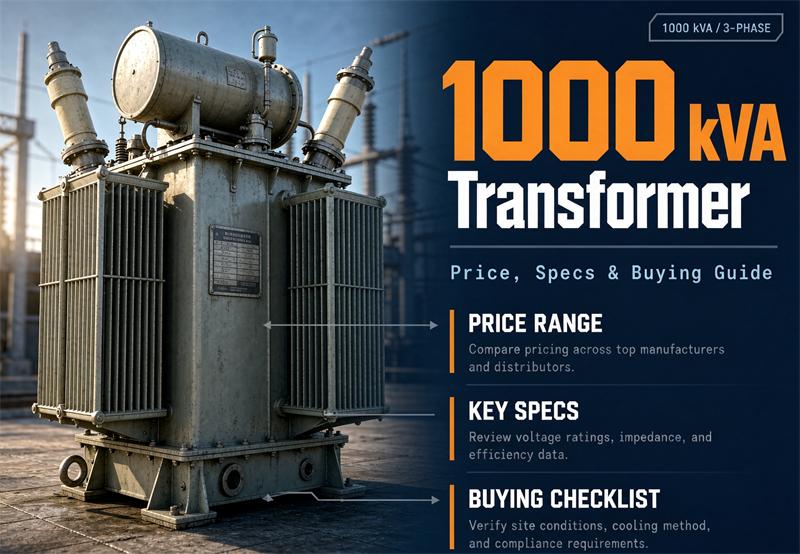
1000 kVA is the same thing as 1 MVA, and it is a fully standard three-phase rating on both the liquid and the dry-type ladders. Three-phase it draws 1,203 A at 480Y/277 V, 2,776 A at 208Y/120 V, and 962 A at 600Y/347 V. That spread is the whole buying decision. At 600 V this is a 1,000 A service. At 208 V it is a 3,000 A device with six 1000 kcmil copper conductors per phase, or a busway, and switchgear nobody stocks.
Here is the part most guides on this keyword get wrong. The 2029 federal efficiency update is close to worthless at 1000 kVA on the liquid side. The floor moves from 99.43% to 99.46% for a non-submersible unit, which is about 152 watts at the test load and roughly $1,650 in present value over thirty years. For a submersible unit it does not move at all. Dry-type is a different story and we get to it below.
Where this page fits: this is the capacity layer. It is about 1000 kVA as a rating, whether it is standard, what current it draws, what the federal floor is, what it does downstream, what it weighs, and what it costs. If you already know you want a pad-mount cabinet, our 1000 kVA pad-mounted transformer guide is the enclosure-level page and picks up where this one stops. If you are reading an IEC model code like S18-1000/10/0.4, the S18-1000 kVA model page decodes that separately. For DC fast charging sites the sizing logic is driven by dispenser count rather than by nameplate kVA, so that belongs on our charging transformer pages instead.
The numbers up front:
- Full-load amps, three-phase secondary: 2,776 A at 208Y/120, 2,406 A at 240 V delta, 1,203 A at 480Y/277, 962 A at 600Y/347.
- Full-load amps, primary: 139 A at 4,160 V, 80 A at 7,200 V, 46 A at 12,470 V, 42 A at 13,800 V, 17 A at 34,500 V.
- Federal efficiency floor, liquid three-phase, today: 99.43% at 50% load, which permits 2,866 W of total loss.
- Federal efficiency floor, liquid three-phase, from April 23, 2029: 99.46% non-submersible, 99.43% submersible.
- Federal efficiency floor, low-voltage dry-type three-phase: 99.28% today, 99.42% from 2029, both at 35% load.
- Weight: about 6,170 to 8,380 lb filled for a liquid unit, 6,610 to 9,260 lb for a cast resin dry unit.
- Oil: roughly 198 to 291 gallons, depending on radiator design.
- Price reality: published listings for this rating run from about $8,500 to just under $65,000. That is a 7.6x spread, and almost none of it comes from the kVA.
Is 1000 kVA a standard transformer size?
Yes for three-phase. It is on both ladders, liquid and dry, and it has a row in every efficiency table that applies to it.
The ladders come from the Department of Energy’s notice in the Federal Register at 63 FR 63360, dated November 12, 1998, in Tables 2 and 3 under “Preferred Standard kVA Ratings.” You do not have to take a manufacturer’s word for which sizes are standard, and you should not.
The three-phase liquid-immersed ladder runs: 15, 30, 45, 75, 112.5, 150, 225, 300, 500, 750, 1000, 1500, 2000, 2500.
The three-phase dry-type ladder is identical at this size: 15, 30, 45, 75, 112.5, 150, 225, 300, 500, 750, 1000, 1500, 2000, 2500.
The single-phase ladder runs: 10, 15, 25, 37.5, 50, 75, 100, 167, 250, 333, 500, 667, 833.
The divide-by-three shortcut breaks here, and 1000 is where you notice
There is a handy rule that holds across most of the range: a three-phase rating is standard if dividing it by 3 lands on a single-phase rung. The ladder was built by multiplying, because three identical single-phase units make one three-phase bank.
At 150 kVA the shortcut is exact: 150 ÷ 3 = 50. At 300 it is exact: 300 ÷ 3 = 100. At 750 it is exact: 750 ÷ 3 = 250. At 1500 it is exact: 1500 ÷ 3 = 500.
At 1000 it fails. 1000 ÷ 3 = 333.33, and the single-phase ladder says 333. Multiply back and you get 999, not 1000. The shortcut leaves you a third of a kVA short, and it does not resolve by rounding, because the next rung up is 500 and 500 × 3 is 1500.
This is not a technicality. It is the reason three of the four capacity guides you will find on this keyword quietly skip the question of whether 1000 is standard, or assert it without proof. The answer is yes, but the honest route to that answer is the published ladder, not the shortcut. If you want the full walkthrough of how phase count and rating interact, our three-phase transformer buyer’s guide covers the whole ladder.
Practical consequence: a 1000 kVA three-phase unit is a catalogued product with a table row at every level that applies. You are not buying a custom design, and you should not accept custom lead times or engineering charges for it.
There is no 1000 kVA single-phase transformer
1000 does not appear in the single-phase column of the preferred rating ladder. That column tops out at 833. It also does not appear in the single-phase column of any efficiency table in 10 CFR 431.196. The liquid-immersed single-phase column runs 10, 15, 25, 37.5, 50, 75, 100, 167, 250, 333, 500, 667, 833. The low-voltage dry-type single-phase column stops at 333 kVA entirely.
So a 1000 kVA single-phase unit is neither a preferred rating nor a table row. If someone quotes you one, you are buying a build-to-order design with no published efficiency floor to hold them to, and the interpolation rule has no anchor to work from because 833 is the last rung and 1000 sits above it.
If you need roughly 1000 kVA on single-phase service, expect to compromise. The standard rung below is 833 kVA, which is about 17% short of what you asked for. If your load genuinely needs 1000 kVA, single-phase is the wrong architecture and you should be looking at a three-phase service, not a bigger single-phase can.
1000 kVA means 1 MVA, and that changes the paperwork
At exactly this rating, spec sheets, utility interconnection agreements, and a lot of bid packages switch units from kVA to MVA. A 1000 kVA unit and a 1 MVA unit are the same piece of equipment. You will see both written on the same project, sometimes on the same drawing, and nobody is wrong.
What does change is the vocabulary around it. Below about 750 kVA, most engineers call it a distribution transformer. At 1000 kVA you start hearing “substation,” “unit substation,” and “secondary unit substation,” because at this size the transformer usually sits next to a switchboard section rather than feeding a panelboard. Utility tariff language often changes at 1 MVA too, which can shift who owns the transformer, who sets the protection, and what the metering requirements are.
Two things to confirm with the serving utility before design freeze:
- Which size is on their approved list. 1000 kVA is standard, but a specific utility may stock only 750 and 1500 and treat 1000 as a special order for replacement purposes.
- Whether the service is treated as distribution or substation class. That drives fault current study requirements, relay settings, and in some territories whether they will allow customer-owned gear at all.
None of this shows up in a price quote, and all of it shows up in your schedule.
How many amps does a 1000 kVA transformer draw?
For three-phase, the formula is kVA × 1,000 ÷ (volts × √3). Here is the whole table at 1000 kVA.
| Secondary voltage | Full-load amps |
| 208Y/120 | 2,776 A |
| 240 delta | 2,406 A |
| 480Y/277 | 1,203 A |
| 600Y/347 | 962 A |
| Primary voltage | Full-load amps |
| 4,160 V | 139 A |
| 7,200 V | 80 A |
| 12,470 V | 46 A |
| 13,200 V | 44 A |
| 13,800 V | 42 A |
| 34,500 V | 17 A |
One cross-check worth doing: a US supplier publishing a 1000 kVA pad-mount lists “2,776 A at its lowest available secondary voltage” and “962 A at its highest.” Both match the table. That same page also describes the secondary options as 240 V and 600 V in its summary text, but 2,776 A is the 208 V number. At 240 V you would see 2,406 A. Read the data table, not the marketing paragraph, and confirm which secondary you are actually being quoted.
What the secondary voltage does to your switchgear
This is where 1000 kVA stops being a transformer purchase and becomes a distribution purchase.
NEC 450.3(B) caps the secondary overcurrent device at 125% of rated secondary current. NEC 240.6(A) gives you the list of standard device ratings, and above 800 A the ladder goes 1000, 1200, 1600, 2000, 2500, 3000, 4000. There is no 1,250, no 1,400 and no 1,800.
NEC 240.4(C) is the part people miss. Above 800 A, the device rating cannot exceed the conductor ampacity. The next-size-up allowance that saves you on smaller circuits is gone.
| Secondary | FLA | 125% of FLA | Standard device | Conductors per phase (copper, 75 °C) |
| 208Y/120 | 2,776 A | 3,470 A | 3,000 A | 6 × 1000 kcmil (3,270 A) or busway |
| 240 delta | 2,406 A | 3,007 A | 2,500 A | 5 × 1000 kcmil (2,725 A) or busway |
| 480Y/277 | 1,203 A | 1,504 A | 1,600 A | 3 × 1000 kcmil (1,635 A) |
| 600Y/347 | 962 A | 1,203 A | 1,000 to 1,200 A | 2 × 1000 kcmil (1,090 A) or 3 × 600 kcmil (1,260 A) |
Two notes on that table.
At 480 V, 125% of 1,203 A is 1,504 A, which is not a standard frame. The next frame up is 1,600 A, which works out to 133% of full-load current. Confirm that next-higher-standard-rating allowance with your AHJ before you order the gear, because it is the difference between a compliant installation and a field change order.
At 208 V, six 1000 kcmil copper conductors per phase is not a cable job, it is a busway job. If your site has a 208 V legacy distribution system and you are adding 1000 kVA, price the busway before you price the transformer. The transformer is usually the cheaper half.
The rule of thumb that comes out of the table: at 1000 kVA, the secondary voltage choice moves more money than the transformer brand does. A 480 V service costs you 3 conductors per phase. A 208 V service costs you 6, plus a 3,000 A frame, plus busway, plus the labor to pull it.
Fault current: where 22 kA stops being enough
Available secondary fault current, before you add utility source impedance, is roughly full-load current divided by per-unit impedance. Here is what that looks like across the impedance range you will actually see quoted on a 1000 kVA unit.
| Impedance | 208 V | 240 V | 480 V | 600 V |
| 4.0% | 69.4 kA | 60.1 kA | 30.1 kA | 24.1 kA |
| 5.0% | 55.5 kA | 48.1 kA | 24.1 kA | 19.2 kA |
| 5.75% | 48.3 kA | 41.8 kA | 20.9 kA | 16.7 kA |
| 6.5% | 42.7 kA | 37.0 kA | 18.5 kA | 14.8 kA |
| 8.0% | 34.7 kA | 30.1 kA | 15.0 kA | 12.0 kA |
Read the 480 V column twice, because that is where most of these units land.
At 5.0% impedance you get 24.1 kA, which is over the 22 kA interrupting rating that most standard molded-case and insulated-case gear carries. At 5.75% you get 20.9 kA, which is under it. One line on the specification sheet, the impedance value, decides whether you buy 22 kA switchgear or step up to 42 kA. That is a five-figure swing on a project this size, and it is controlled by a number most buyers never read.
To stay under 22 kA at 480 V you need at least 5.47% impedance. At 208 V you would need 12.62%, which no manufacturer will build at this rating, so a 208 V 1000 kVA service is a 42 kA or 65 kA switchgear project no matter what.
Two caveats, both in your favor. Real available fault current is lower than these figures once you include utility source impedance and the impedance of the secondary conductors, and the transformer contribution is the part you control. Get a real short-circuit study rather than sizing gear off this table. But do bring this table to the study, because it tells you which impedance to ask for.
Federal efficiency: what the floor is now and what it becomes in 2029
The scope question comes first. DOE defines a distribution transformer in 10 CFR 431.192 as 60 Hz, input at or below 34.5 kV, output at or below 600 V, and 10 to 5,000 kVA for liquid-immersed or 15 to 5,000 kVA for dry-type. A 1000 kVA unit at 480 V secondary is squarely inside that on all four tests, so the federal floor applies.
The efficiency values live in 10 CFR 431.196. Compliance with the updated values starts April 23, 2029.
Liquid-immersed, three-phase, 1000 kVA
Tested at 50% of nameplate load, which is 500 kW of output at this rating.
| In force today (b)(2) | From April 23, 2029, non-submersible (b)(3) | From April 23, 2029, submersible (b)(4) | |
| Minimum efficiency | 99.43% | 99.46% | 99.43% |
| Allowed total loss at the test point | 2,866 W | 2,715 W | 2,866 W |
Note the third column. For a submersible unit the 2029 value is identical to today’s value. There is no increment at all. If you are buying submersible, the 2029 rule changes nothing for you at this rating.
Low-voltage dry-type, three-phase, 1000 kVA
Tested at 35% of nameplate load, which is 350 kW of output at this rating.
| In force today (a)(2) | From April 23, 2029 (a)(3) | |
| Minimum efficiency | 99.28% | 99.42% |
| Allowed total loss at the test point | 2,538 W | 2,042 W |
Medium-voltage dry-type, three-phase, 1000 kVA
This is the table nobody on this keyword publishes. Medium-voltage dry-type efficiency depends on basic impulse insulation level, and the higher the BIL the lower the required efficiency. Tested at 50% load.
| BIL | In force today (c)(2) | From April 23, 2029 (c)(3) | Allowed loss today | Allowed loss 2029 |
| 20 to 45 kV | 99.28% | 99.35% | 3,626 W | 3,271 W |
| 46 to 95 kV | 99.20% | 99.28% | 4,032 W | 3,626 W |
| 96 kV and above | 99.11% | 99.20% | 4,490 W | 4,032 W |
If you are buying a medium-voltage dry-type unit, three different efficiency numbers are legal for the same 1000 kVA rating, and which one applies depends on the BIL you specify. Ask which column the vendor certified against.
The 2029 dry-type increment gets smaller as the unit gets bigger
Worth seeing as a set, because it tells you where the rule is aimed.
| Rating | Low-voltage dry-type today | Low-voltage dry-type 2029 | Increment |
| 300 kVA | 99.02% | 99.22% | +0.20 points |
| 500 kVA | 99.14% | 99.31% | +0.17 points |
| 750 kVA | 99.23% | 99.38% | +0.15 points |
| 1000 kVA | 99.28% | 99.42% | +0.14 points |
The 2029 update leans hardest on small dry-type units and eases off as the rating climbs. By 1000 kVA the dry-type bump is down to 0.14 points.
What the 2029 rule is actually worth at 1000 kVA
Take the loss difference at the DOE test point, run it for 8,760 hours a year at $0.10 per kWh, and discount thirty years at 7%, which gives a present value factor of 12.409.
| Case | Loss reduction | Per year | Present value, 30 years |
| Liquid, non-submersible | 152 W | $133 | about $1,649 |
| Liquid, submersible | 0 W | $0 | $0 |
| Low-voltage dry-type | 496 W | $435 | about $5,396 |
| Medium-voltage dry-type, 20 to 45 kV BIL | 355 W | $311 | about $3,857 |
| Medium-voltage dry-type, 46 to 95 kV BIL | 406 W | $356 | about $4,415 |
| Medium-voltage dry-type, 96 kV and above BIL | 458 W | $401 | about $4,975 |
Say this out loud before you let anyone sell you on 2029 compliance at 1000 kVA: on the liquid side, the entire federal update is worth about the same as the crane pick to set the unit. It will not change your decision.
What will change your decision is where a given unit sits above the floor. The floor at 1000 kVA liquid is 99.43%, and real units on the market run anywhere from barely at the floor to 99.6% and better. That gap is worth far more than the 0.03 points the 2029 rule adds. Buy on measured losses, not on the compliance date.
How to check a loss pair in about ninety seconds
You do not need a laboratory. You need two numbers off the routine test report and one formula.
Total loss at any load = no-load loss + (load loss × load factor²).
Efficiency = output ÷ (output + total loss).
DOE allows 2,866 W of total loss at 50% load for a 1000 kVA liquid unit. So:
- Take the published no-load loss, call it P0.
- Take the published load loss at rated current, call it Pk.
- Total at 50% load = P0 + Pk × 0.25.
- Compare 500,000 ÷ (500,000 + total) against 99.43%.
Here is the arithmetic on a made-up pair, to show the shape of it. Say a vendor lists P0 = 1,600 W and Pk = 9,500 W. Total at 50% load is 1,600 + 2,375 = 3,975 W. Efficiency comes out at 99.21%, which is 1,109 W over the federal allowance. The unit does not meet the current floor, let alone the 2029 one.
Before you conclude the vendor is lying, run three checks.
- Reference temperature. DOE corrects load loss to 75 °C. If the published figure is at 85 °C, apply a correction factor of about 0.973 to the I²R portion. On that example pair it moves the total to 3,912 W. Still 1,046 W over. Temperature explains tens of watts, not hundreds.
- Is it this unit or the family table. Some published numbers are for a design family, not the exact kVA and voltage you are buying.
- What the column header actually says. “Loss,” “total loss,” and “load loss” get used loosely on cut sheets. Confirm which is which.
Then land on the one action that settles it: ask for the routine test report for the specific serial number, with no-load loss, load loss at rated current, impedance, and test voltage. If a supplier will not produce it, you have your answer about the quote. Our walkthrough of how to read a transformer nameplate and technical parameters covers every field on that report.
What a 1000 kVA transformer costs
We are not going to print a price table, because every price table on this keyword is unsourced and they contradict each other by a factor of four. Here is what is actually published, with the source and the date, and then the reason the spread exists.
| Source | What it lists | Figure | Retrieved |
| Bear Power Solutions | 1000 kVA three-phase pad-mount, aluminum windings, mineral oil, ONAN | $35,128.50 to $64,955.00 | 2026-10-11 |
| Energy Power Transformer | 1000 kVA oil-filled, EXW | $9,000 to $18,000 | 2026-10-11 |
| Energy Power Transformer | 1000 kVA cast resin dry-type, EXW | $12,000 to $25,000 | 2026-10-11 |
| Energy Power Transformer | 1000 kVA pad-mounted, EXW | $18,000 to $35,000 | 2026-10-11 |
| Electric-GS | 1000 kVA, 11 kV / 0.4 kV, FOB China | $8,500 to $13,000 | 2026-10-11 |
Low to high that is roughly $8,500 to $64,955, a 7.6x spread on the same three words. None of it is a TransNine quotation and none of these figures are comparable to each other. EXW means you collect at the factory gate. The US figure includes a distributor’s margin, catalog configuration, and a domestic warranty path.
What actually moves the number at 1000 kVA:
- Winding material. Copper versus aluminum is the single biggest swing, and it also changes weight, size and loss.
- Fluid. Mineral oil is the baseline. Natural ester and synthetic ester cost more and can change fire separation and containment requirements, sometimes favorably.
- Impedance. A non-standard impedance is a redesign. If you can live with the standard value on the platform, do.
- BIL. Higher BIL means more insulation, more clearance, and a lower efficiency floor on dry-type.
- Enclosure and accessories. On pad-mounts the cabinet, the taps, the fusing, and the finish are a large share of the delta between two “identical” quotes.
- Efficiency level above the floor. Amorphous core and high-grade designs cost more upfront and pay back on no-load loss, which runs 8,760 hours a year whether you draw load or not.
- Lead time. One US source quotes 12 to 16 weeks for this rating. Rush slots cost money, and a unit that is not on the shelf is a unit built to order.
Ask every vendor to quote the same written specification, then compare. If two quotes are more than about 20% apart on the same spec sheet, one of them is not quoting the same machine. Send the checklist at the bottom of this page to TransNine Electric and you will get a written figure for your configuration, with the loss and impedance numbers on it.
Weight, size, and getting it onto the pad
Manufacturer-published figures for this rating:
| Build | Weight | Typical dimensions (L × W × H) |
| Liquid-immersed, filled | 2,800 to 3,800 kg (6,170 to 8,380 lb) | about 1,950 × 1,250 × 1,650 mm |
| Cast resin dry-type, enclosed | 3,000 to 4,200 kg (6,610 to 9,260 lb) | about 2,000 × 1,350 × 2,100 mm |
| Core and coil only | 1,400 to 2,100 kg | not applicable |
Core and coil weight matters more than people expect. It is the number you need if you ever have to untank the unit inside a vault, and it is the number a rigging contractor will ask for first.
Two logistics points that bite on 1000 kVA jobs:
- Dry-type units are taller. Air clearance drives the height, so a 1000 kVA cast resin unit is often around 2,100 mm, roughly 83 inches. Measure the door, the corridor, and the elevator before you order. A unit that will not fit through the opening is a crane pick through a wall.
- At 6,000 lb and up you are planning a lift, not a shuffle. Whether it is a mobile crane or a heavy-capacity telehandler, the pick needs to be in the schedule before the transformer arrives, and the pad has to be cured and load-bearing by then.
Oil volume and the 1,320-gallon line
A 1000 kVA liquid unit holds about 750 to 1,100 liters of insulating oil, which is roughly 198 to 291 gallons. The wide band is radiator design, so take the figure off your own nameplate rather than a range like this one.
Why it matters: the federal Spill Prevention, Control, and Countermeasure rule at 40 CFR part 112 applies to facilities with above-ground oil storage over 1,320 gallons where a discharge could reach navigable water. Oil inside oil-filled electrical equipment counts toward that total.
Run the arithmetic:
| Oil per unit | Units on one site before you cross 1,320 gallons |
| 198 gallons (750 L) | 7 |
| 238 gallons (900 L) | 6 |
| 291 gallons (1,100 L) | 5 |
So a campus with five or more 1000 kVA oil-filled units in one location is plausibly over the federal threshold and needs an SPCC plan, with secondary containment sized accordingly. Two or three units usually are not.
Two things we will not do here: guess at state thresholds, which are often lower than the federal one, and guess at whether your equipment is counted. Confirm both with your environmental consultant and the AHJ. The arithmetic above is the part you can check yourself.
One 1000 kVA unit or two 500 kVA units?
A fair question at this size, and the answer is less obvious than it looks.
Fault current only improves if you keep the secondaries separate. Two 500 kVA units at 5.75% impedance each contribute about 10.5 kA. Land them on a common bus and the bus sees about 21 kA, which is the same as the single 1000 kVA unit. Land them on separate buses and each bus sees 10.5 kA, which fits 22 kA gear comfortably. If the reason you are splitting is fault current, the split has to be electrical, not just physical.
Efficiency favors the single unit. At the federal floor, one 1000 kVA unit at 50% load is allowed 2,866 W of total loss. Two 500 kVA units at 50% load each are allowed 3,271 W between them. Call it 405 W in favor of the single unit, which is about $355 a year at $0.10 per kWh. The gap widens if you load the pair harder.
Redundancy favors the pair. Lose one 500 kVA unit and you keep 500 kVA. Lose the 1000 kVA unit and you keep nothing.
Physical logistics favor the pair, sometimes. Two smaller units fit through openings a single large one will not, and they can be set with smaller equipment. You pay for it with two pads, two sets of terminations, and two protection schemes.
There is one case where the pair wins outright: a load with a deep overnight trough, where you can de-energize one unit entirely and stop paying its no-load loss for eight hours a day. No-load loss is charged 24/7, and it is the number that decides this comparison. Get the guaranteed watts for both configurations before you choose.
Specification checklist for an RFQ
Send all of this, in writing, to every vendor. Quotes that are not built on the same list are not comparable.
- Rating: 1000 kVA (1 MVA), three-phase, 60 Hz
- Primary voltage and BIL
- Secondary voltage and configuration (480Y/277, 208Y/120, 600Y/347)
- Winding material: copper or aluminum
- Impedance, in percent, at the reference temperature
- Efficiency standard to be certified against, and which column of 431.196 applies
- Guaranteed no-load loss and load loss in watts, with reference temperature and test standard
- Temperature rise and insulation class
- Cooling class
- Vector group
- Tap changer: range, positions, and whether taps are full capacity
- Sound level in dB(A) and the standard it is measured to
- Enclosure: NEMA or IP rating, finish, and cabinet construction standard
- Fluid: mineral oil or ester, and whether it is a sealed design
- Applicable standards: IEEE, ANSI, UL, CSA, IEC
- Seismic requirements, if the jurisdiction has them
- Required documentation: routine test reports, certified drawings, and the serial number list
- Delivery terms, lead time, and whether the unit is stocked or built to order
Frequently asked questions
Is 1000 kVA a standard transformer size?
Yes for three-phase, and it appears on both the liquid-immersed and the dry-type preferred rating ladders published by DOE at 63 FR 63360. It also has a row in every applicable table in 10 CFR 431.196. It is not a standard single-phase size, and the single-phase ladder tops out at 833 kVA.
How many amps is a 1000 kVA transformer?
Three-phase at 480Y/277 V it is 1,203 A. At 208Y/120 V it is 2,776 A. At 600Y/347 V it is 962 A. At 240 V delta it is 2,406 A. Multiply kVA by 1,000 and divide by volts times the square root of three.
Is there a 1000 kVA single-phase transformer?
Not as a standard rating. The single-phase preferred ladder jumps from 667 to 833 and stops there, and no single-phase column in the federal efficiency tables reaches 1000. The standard rung below is 833 kVA. If you truly need 1000 kVA, three-phase service is the right answer rather than a custom single-phase build.
What does a 1000 kVA transformer cost?
Published listings run from about $8,500 FOB China for a basic oil-filled unit to just under $65,000 for a catalog pad-mount from a US supplier. That is a 7.6x spread and most of it is winding material, fluid, enclosure, and terms, not capacity. Get quotes against one written specification or you are not comparing the same machine.
How much does a 1000 kVA transformer weigh?
About 6,170 to 8,380 lb filled for a liquid-immersed unit, and about 6,610 to 9,260 lb for an enclosed cast resin dry-type unit. Core and coil alone runs 1,400 to 2,100 kg. Dry-type units are taller, often near 2,100 mm, so check the door and corridor before ordering.
What is the DOE efficiency for a 1000 kVA transformer?
For liquid-immersed three-phase, 99.43% at 50% load today. For low-voltage dry-type three-phase, 99.28% at 35% load. For medium-voltage dry-type three-phase it depends on BIL: 99.28%, 99.20% or 99.11% depending on whether you specify 20 to 45 kV, 46 to 95 kV, or 96 kV and above.
Does the 2029 DOE rule change much at 1000 kVA?
Barely on the liquid side. The floor moves from 99.43% to 99.46% for non-submersible units, about 152 watts at the test point, worth roughly $1,650 in present value over thirty years. For submersible units it does not move at all. Dry-type moves more, about 496 watts and around $5,400 in present value.
What size breaker do I need for a 1000 kVA transformer?
NEC 450.3(B) caps the secondary device at 125% of rated secondary current. At 480Y/277 V that gives you a 1,600 A frame, with conductors rated 1,600 A or better. At 600Y/347 V it is 1,000 to 1,200 A. At 208Y/120 V it is a 3,000 A frame, and NEC 240.4(C) means the conductors have to match it, which usually means busway.
How much oil is in a 1000 kVA transformer, and does SPCC apply?
About 750 to 1,100 liters, which is 198 to 291 gallons, depending on radiator design. The federal SPCC threshold is 1,320 gallons of above-ground oil storage, and oil in electrical equipment counts toward it. Five to seven of these units at one site puts you over, depending on the actual oil volume. Confirm state thresholds separately.
Should I buy one 1000 kVA transformer or two 500 kVA units?
Split only helps fault current if the two secondaries feed separate buses. Otherwise the common bus sees about the same 21 kA either way. Splitting gives you redundancy and sometimes easier rigging. One unit is more efficient at the floor by about 405 watts and costs less in pads, terminations, and protection. If your load has a deep overnight trough, run the no-load loss numbers for both.