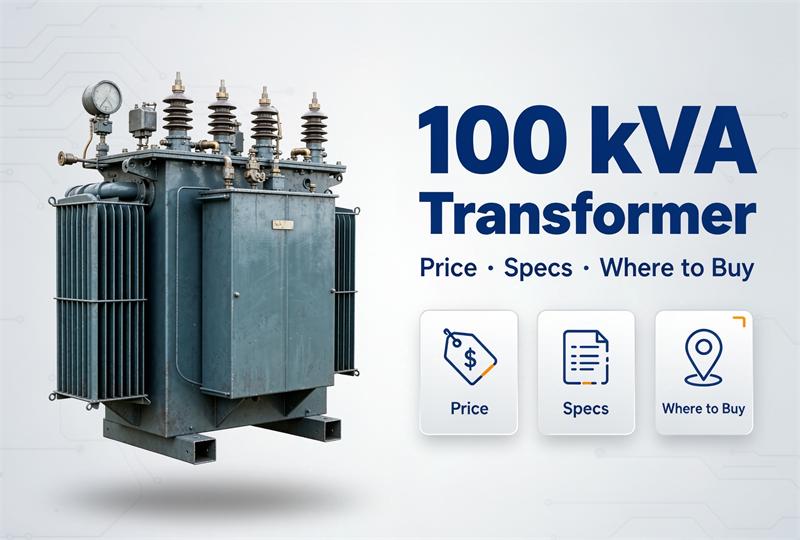
“100 kVA” is two different products, and the difference matters before you ask for a price. A 100 kVA single-phase transformer is a completely standard North American size: it’s stocked, it’s on the industry’s preferred-ratings list, and it has its own printed row in the federal efficiency table. A 100 kVA three-phase transformer is none of those things. The standard three-phase ladder goes 75, then 112.5. There is no 100 in the middle.
That single fact drives everything else in this guide: why one vendor quotes in days and another in months, why your federal minimum efficiency has to be calculated instead of looked up, and why the size one step up often costs less than the size you asked for.
The numbers you came for:
- 100 kVA three-phase, 480 V primary → 120.3 A; 208Y/120 V secondary → 277.6 A
- 100 kVA single-phase, 120/240 V secondary → 416.7 A on the 240 V winding
- DOE minimum efficiency, single-phase 100 kVA: 98.60% dry-type and 99.25% liquid today, rising to 99.02% and 99.29% on or after April 23, 2029
- DOE minimum efficiency, three-phase 100 kVA (interpolated): 98.69% dry-type and 99.08% liquid today, 98.98% and 99.27% from 2029
- Real published prices for a 100 kVA unit range from about
1,200** (FOB China, basic dry-type) to **30,813 (US-built three-phase isolation transformer in a 316 stainless NEMA 3R enclosure)
One hierarchy note before we start, so you don’t end up on the wrong page: this guide is about one capacity, 100 kVA, across every construction that gets built at that size. If what you actually need is the whole range of ground-mounted distribution sizes, the pad-mounted transformer size and price guide on the TransNine Electric site covers that separately. If you need to understand what the numbers on a nameplate mean once you have one in front of you, that’s a different page too.
Key numbers
| Item | Value | Note |
| Full-load current, 3-phase 480 V | 120.3 A | 100,000 ÷ (√3 × 480) |
| Full-load current, 3-phase 208 V | 277.6 A | 100,000 ÷ (√3 × 208) |
| Full-load current, 3-phase 240 V | 240.6 A | |
| Full-load current, 3-phase 600 V | 96.2 A | |
| Full-load current, 1-phase 240 V | 416.7 A | 100,000 ÷ 240 |
| Full-load current, 1-phase 480 V | 208.3 A | |
| DOE minimum, 1-phase 100 kVA dry-type | 98.60% → 99.02% | at 35% load; step lands 2029-04-23 |
| DOE minimum, 1-phase 100 kVA liquid | 99.25% → 99.29% | at 50% load |
| DOE minimum, 3-phase 100 kVA dry-type | 98.69% → 98.98% | interpolated, not a table row |
| DOE minimum, 3-phase 100 kVA liquid | 99.08% → 99.27% | interpolated, not a table row |
| Fault current at 208 V, Z = 4.5% | 6.2 kA | 277.6 ÷ 0.045 |
| Heat rejected at full load | ≈ 3,600 BTU/h | 1,060 W of total losses |
| Standard 3-phase size above 75 kVA | 112.5 kVA | not 100 kVA |
100 kVA is two different products
Walk into a supply house and ask for “a 100 kVA transformer” and the counter person’s first question should be “single or three phase?” That’s not pedantry. At this capacity the two answers lead to entirely different supply chains.
Single-phase 100 kVA is a utility distribution animal. It’s the top of the stocked single-phase range at most US distributors, and it’s the size that shows up in underground residential distribution loops, subdivision feeders, and small commercial services fed from a pad. The typical build is a sealed, dead-front cabinet on a concrete pad: aluminum windings, mineral oil, ONAN cooling, 65 °C rise, Munsell green finish, four-position no-load tap switch. One distributor lists 56 voltage configurations for it, with primary classes at 15, 25 and 35 kV and secondary options at 120/240, 240/480, 277 and 480 V. The full background on where single-phase units fit is in the single-phase guide in the resources library.
Three-phase 100 kVA is a commercial-building animal. It’s the 480 V to 208Y/120 V step-down that feeds lighting panels, receptacles, small HVAC and miscellaneous loads. Physically it’s a ventilated dry-type unit in an electrical room, not a green box on a pad. And here’s the part nobody says out loud: it isn’t a standard size.
The kVA ladder: why there is no 100 kVA three-phase
Transformer capacities aren’t arbitrary. The industry publishes preferred ratings, and the US Department of Energy reproduced NEMA’s list in a Federal Register notice back in 1998 (63 FR 218, November 12, 1998). Here it is, condensed:
| Single-phase | Three-phase | |
| Liquid-immersed | 10, 15, 25, 37.5, 50, 75, 100, 167, 250, 333, 500, 667, 833 | 15, 30, 45, 75, 112.5, 150, 225, 300, 500, 750, 1000, 1500, 2000, 2500 |
| Dry-type | 15, 25, 37.5, 50, 75, 100, 167, 250, 333, 500, 667, 833 | 15, 30, 45, 75, 112.5, 150, 225, 300, 500, 750, 1000, 1500, 2000, 2500 |
Look at the relationship between the two columns. Leaving aside the extra 15 kVA at the bottom of the three-phase list, every three-phase rating is exactly three times a single-phase rating:
- 30 = 3 × 10
- 45 = 3 × 15
- 75 = 3 × 25
- 112.5 = 3 × 37.5
- 150 = 3 × 50
- 225 = 3 × 75
- 300 = 3 × 100
- 500 = 3 × 167
- 750 = 3 × 250
- 1000 = 3 × 333
A three-phase transformer is three single-phase windings in one tank, so the ladder is built by tripling. Now do the arithmetic in reverse: 100 ÷ 3 = 33.3 kVA, and 33.3 is not a single-phase rating on that list. That’s why there’s no 100 kVA three-phase. It’s not an oversight. It’s arithmetic.
You can see the consequence in distributor stocking. One national transformer manufacturer states its stocked three-phase general-purpose range as 15, 30, 45, 75, 112.5, 150, 225, 300, 500 and 750 kVA, and its single-phase range as 10 kVA up to 100 kVA. 100 is the ceiling of one list and absent from the other.
And the cost of asking for an off-ladder size is not theoretical. A transformer retailer describes it plainly: request a non-standard rating and lead time moves from one to two weeks to sixteen to twenty weeks, and cost goes up 25 to 35 percent.
Here’s the most useful version of that. One sizing guide walks through a machine-tool panel drawing 85 kW at 0.87 power factor: 85 ÷ 0.87 = 97.7 kVA, and their stated next standard size is 112.5 kVA three-phase. If you are reading this page because your three-phase load calculation landed somewhere near 100, that example is your answer. Ask for 112.5.
Full-load amps at 100 kVA
Everything downstream of the transformer is sized off these numbers: feeder conductor, conduit fill, overcurrent device, panel rating.
| Configuration | Voltage | Full-load current |
| Three-phase | 208Y/120 V | 277.6 A |
| Three-phase | 240 V | 240.6 A |
| Three-phase | 480 V | 120.3 A |
| Three-phase | 600 V | 96.2 A |
| Single-phase | 120/240 V (at 240 V) | 416.7 A |
| Single-phase | 277 V | 361.0 A |
| Single-phase | 480 V | 208.3 A |
| Single-phase | 600 V | 166.7 A |
Two things people underestimate at this size.
The first is that 277.6 A is not a 277 A circuit. Under the NEC, continuous loads (anything running three hours or more) are calculated at 125%, so a fully loaded 100 kVA secondary feeding continuous load is a 347 A design problem. That’s a 350 A device and a feeder sized for it, not a 300 A panel you happened to have.
The second is the single-phase case. 416.7 A on a 240 V winding is a serious conductor. It’s the reason single-phase 100 kVA pad-mounts terminate in parallel lugs and why the secondary run to the service equipment is usually the most expensive part of that installation.
DOE minimum efficiency: the rows that exist and the ones that don’t
Federal efficiency rules for distribution transformers live in 10 CFR 431.196, and the section is organized as a set of tables keyed by kVA. For 100 kVA single-phase, your number is printed. For 100 kVA three-phase, it isn’t, because there’s no row.
Single-phase 100 kVA (table rows, values printed in the regulation):
| Type | 2010–2015 | 2016-01-01 to 2029-04-22 | On or after 2029-04-23 | Measured at |
| Low-voltage dry-type | — | 98.60% | 99.02% | 35% load |
| Liquid-immersed | 99.23% | 99.25% | 99.29% | 50% load |
Three-phase 100 kVA (no table row):
| Type | 2016-01-01 to 2029-04-22 | On or after 2029-04-23 | Measured at |
| Low-voltage dry-type | 98.69% | 98.98% | 35% load |
| Liquid-immersed | 99.08% | 99.27% | 50% load |
Those last four numbers are ours, not the regulation’s. The text of 431.196 says that ratings not appearing in the table get their minimum by linear interpolation of the kVA and efficiency values immediately above and below. For a three-phase 100 kVA low-voltage dry-type today, the neighbors are 75 kVA at 98.60% and 112.5 kVA at 98.74%:
98.60 + (100 − 75) ÷ (112.5 − 75) × (98.74 − 98.60) = 98.69%
Say plainly in your RFQ that this is an interpolated requirement. Two vendors may round differently, and the only thing that settles it is a certified test report.
Here’s a nice confirmation that the table is real and not theoretical. A Canadian supplier’s 100 kVA single-phase isolation transformer, 480 V to 208 V, copper, NEMA 3R, publishes an efficiency of 98.60% at 35% load, labelled “DOE 2016 / NRCan 2019.” That is exactly the Table 2 value for a single-phase 100 kVA low-voltage dry-type unit. When a catalog number matches the federal floor to two decimals, you’re looking at a real compliance calculation.
Is your unit covered at all? The definition in 10 CFR 431.192 requires: input voltage 34.5 kV or below, output voltage 600 V or below, 60 Hz, and a rating of 10–5,000 kVA if liquid-immersed or 15–5,000 kVA if dry-type. A 100 kVA pad-mount at 12.47 kV in and 120/240 V out is covered. A 100 kVA three-phase dry-type at 480 V in and 208Y/120 V out is covered. Move the secondary above 600 V, or specify a tap range of 20% or more, or buy a genuinely non-ventilated or hermetically sealed dry-type design, and you may be outside. The section lists thirteen exclusions; read it against your spec rather than assuming.
April 23, 2029, and why it hits a 100 kVA dry-type hardest
The next efficiency step lands on April 23, 2029, and the date that matters is the date the unit was manufactured or imported, not your purchase order date and not your delivery date. If a container lands in May 2029, the 2029 table applies to it.
What the step does at 100 kVA:
| Today | From 2029-04-23 | Change | |
| Single-phase dry-type | 98.60% | 99.02% | +0.42 points |
| Single-phase liquid | 99.25% | 99.29% | +0.04 points |
| Three-phase dry-type | 98.69% | 98.98% | +0.29 points |
| Three-phase liquid | 99.08% | 99.27% | +0.19 points |
The dry-type jump is roughly ten times the liquid jump at this size. Liquid-immersed units were already close to their practical ceiling; dry-type designs have room to move, and the rule moves them.
Practical reading: if you’re buying a 100 kVA single-phase dry-type unit with a service life measured in decades, the unit you install in 2028 and the unit you install in 2029 are held to materially different standards. If you’re buying liquid-filled, the step barely touches you.
One thing to be aware of when a supplier cites the rulebook at you. An editorial note in the eCFR records that DOE withdrew a December 2024 amendment to several paragraphs of Part 431 under the Congressional Review Act (90 FR 43371, September 9, 2025), which returned the affected paragraphs to their December 22, 2024 wording. The 2029 tables at issue here come from a separate final rule (89 FR 29834) and are not part of that withdrawal. If someone tells you the 2029 date was cancelled, ask which Federal Register citation they’re reading.
Voltage classes and BIL at 100 kVA
Single-phase pad-mounts are medium-voltage devices. A typical 100 kVA unit is offered at 15 kV, 25 kV and 35 kV primary classes, which map to basic impulse insulation levels of 95 kV, 125 kV and 150 kV respectively. Secondary options commonly include 120/240, 240/480, 277 and 480 V. Taps are usually plus and minus two 2.5% full-capacity positions.
Three-phase dry-types at 100 kVA are usually low-voltage: 480 V delta primary to 208Y/120 V wye secondary is the workhorse pairing, with 480Y/277, 240 and 600 V secondaries also common. Taps are typically two above and four below in 2.5% steps, or plus/minus two.
600 V is a double boundary line, and it’s worth knowing both halves:
- In the efficiency regulation, a “low-voltage dry-type distribution transformer” is one with an input of 600 V or less. Put a 100 kVA dry-type on a 13.8 kV primary and it’s a medium-voltage dry-type transformer under a different set of tables, where the minimum depends on both kVA and BIL. We’re deliberately not printing those numbers here, because getting a kVA-plus-BIL table wrong is worse than pointing you to it. Pull the current 431.196 and read the columns against your BIL.
- On the safety side, UL 1561 covers dry-type transformers at 600 V and below, and UL 1562 covers 601 V to 35 kV. Same physical machine, different standard, purely because of voltage. Specifying “cast coil plus UL 1562” on a 480 V unit is a mismatch that will cost you a re-quote.
Temperature rise, insulation, and what 115 °C actually buys
The stock default for a 100 kVA dry-type in North America is a 150 °C rise over a 40 °C ambient, on a 220 °C insulation system. It’s what distributors carry, and for a ventilated electrical room with a known load it’s fine.
Dropping the rise buys margin: cooler windings, slower insulation aging, and headroom if the room runs hot or the load grows. It costs money, and at this size you can see exactly how much. One supplier’s published option pricing for a 100 kVA single-phase isolation transformer puts it at +1,095.60 CAD for a 130 °C rise, +1,826.00 for 115 °C, and +$3,195.51 for 80 °C, against a 150 °C base. That’s roughly a 25 percent premium to go from 150 °C to 115 °C on that unit.
Whether it’s worth it comes down to two questions. Is the room hot, or poorly ventilated, or in a climate where summer ambients push past 40 °C? And do you expect the load to grow? If either answer is yes, buy the lower rise. If it’s a conditioned room with a load you’ve measured, 150 °C is the right answer and the money is better spent on impedance or a better enclosure.
Make it a decision you write down rather than whatever happens to be on the shelf.
Impedance, fault current, and the panel rating downstream
Impedance is the least-discussed number on a 100 kVA spec and one of the most consequential, because it sets the fault current everything downstream has to survive.
At the 208 V secondary of a three-phase unit, 277.6 A full-load current:
| Impedance | Available fault current |
| 2.5% | 11,104 A |
| 4.5% | 6,169 A |
| 5.75% | 4,828 A |
That’s a 2.3× spread from the same transformer. A panelboard with a 10 kA short-circuit current rating is fine behind a 5.75% unit and violates code behind a 2.5% unit. NEC 110.9 and 110.10 require equipment to be rated for the available fault current, and this is where projects get failed at inspection.
Most 100 kVA three-phase dry-types land in the 3% to 6% band. If you don’t specify it, you get whatever the factory’s standard design is, and you find out the fault current after the gear is bought. Name it in the RFQ.
Overcurrent protection: NEC 450.3(B) worked once
Take the most common 100 kVA three-phase configuration: 480 V primary, 208Y/120 V secondary. Primary full-load current is 120.3 A, secondary is 277.6 A.
Table 450.3(B) gives two ways to protect a transformer rated 600 V and below.
Primary protection only. Where the primary current is 9 A or more, the device may be set at up to 125%:
120.3 × 1.25 = 150.4 A → next standard rating up is 175 A
Primary and secondary protection. With protection on both sides, the primary device may go to 250% and the secondary to 125%:
Primary: 120.3 × 2.50 = 300.8 A, so a 300 A device sits inside the limit Secondary: 277.6 × 1.25 = 347.0 A → next standard rating up is 350 A
Two cautions. The percentages in the table are maximums, not targets. Picking 250% because it’s allowed will usually mean a device that doesn’t protect the transformer the way you want. And the “next standard rating up” step is permitted by 240.6, but both the step and the question of whether a four-wire wye secondary needs its own device are worth a conversation with your authority having jurisdiction before you order gear.
Size, weight, and the heat you have to get rid of
Published figures for real 100 kVA units, retrieved 2026-10-11:
| Unit | Weight | Dimensions |
| 3-phase isolation, NEMA 3R ventilated | 750 lb (860 lb shipping) | 26.88 × 31.9 × 35.47 in |
| Single-phase dry-type, 240 → 480 V, NEMA 3R | 1,200 lb | 39.5 × 32 × 41 in |
| 3-phase pole-mount, copper, mineral oil | 1,019 lb | 36 × 29 × 49 in |
| Single-phase isolation, copper, NEMA 3R | 711 lb | — |
For a three-phase dry-type, distributors’ published ladders list 75 kVA at 610 lb and 112.5 kVA at 840 lb, so a 100 kVA unit should land somewhere around 700 to 800 lb. Treat that as an estimate for rigging and floor-loading planning, and get the actual number from the cut sheet before you schedule the crane.
Heat is the part that gets forgotten. A 100 kVA copper pole-mount with published losses of 210 W no-load and 850 W at full load rejects 1,060 W at full load:
1,060 W × 3.412 = ≈ 3,600 BTU/h into the room
In a small electrical room with no ventilation, that’s a real air-conditioning load and a real derating risk in August. Ventilated enclosures also need clearance around them, and that clearance is a floor-plan number you need before the room is laid out, not after.
What a 100 kVA transformer actually costs
Here is what was publicly listed on 2026-10-11. Every figure is a third-party published price with its scope attached, and none of them are quotations from TransNine Electric.
| Source | What it is | Published price |
| Chinese factory-direct guide | 100 kVA dry-type, basic | ~$1,200 – $1,800 |
| Chinese manufacturer price guide | 100 kVA three-phase cast resin, 10 kV, copper, CE/IEC | $1,800 – $2,600 FOB Shanghai |
| Chinese supplier price table | SCB13-100/10/0.4, copper, Class F, Z = 4% | $2,676 – $3,141 FOB Qingdao |
| US distributor | 100 kVA single-phase pad-mount, aluminum, mineral oil, 15/25/35 kV | $9,800 – $10,850, 12–16 week lead time |
| US manufacturer | 100 kVA single-phase dry-type, 240 → 480 V, NEMA 3R, aluminum | $14,665.05 |
| US manufacturer | 100 kVA three-phase pole-mount, 480Δ → 208Y/120, copper | $15,795.32 |
| US manufacturer | 100 kVA three-phase isolation, 316 stainless NEMA 3R | $30,812.96 |
The spread from bottom to top is about 25×, and almost none of it is markup. It’s scope:
- Incoterms. FOB Shanghai excludes ocean freight, duties, and inland delivery. A landed cost can easily double the FOB number.
- Winding metal. Copper typically runs 30 to 50 percent over aluminum at the same rating.
- Enclosure. A distributor’s option list for one 100 kVA unit charges +
365 CAD for NEMA 3R outdoor, +3,195.51 for NEMA 12, +6,847.52 for NEMA 4 sealed, and +8,399.62 for NEMA 4 stainless. The enclosure can be half the price of the transformer. - Voltage class. A 10 kV or 15 kV unit is a different machine from a 480 V unit.
- Certification. UL listing, CE marking, seismic qualification and third-party test reports each add cost.
- Quantity. Bulk orders usually break at five units or more, worth roughly 5 to 15 percent.
One more thing to build into the budget: the equipment is typically only part of the check. For pad-mounted work, published guidance puts equipment at 55 to 65 percent of the installed figure, with the pad, terminations, setting and inspection making up the rest. We deliberately don’t publish our own price list. A price without a scope attached is a number you can’t compare, and the table above is exactly why.
Where to buy: four channels and which one fits
1. Local electrical distributor. Fastest path, but only for ladder sizes. Stocked three-phase general-purpose ranges run 15 through 750 kVA in the standard steps, so if you want 100 kVA three-phase you will not find it. If you want 112.5, you may have it tomorrow. Single-phase 100 kVA pad-mounts are a different story and are often stocked regionally.
2. National transformer specialists. Companies that do nothing but transformers carry both stock and custom. Stock ships in days; custom builds of off-ladder sizes run 12 to 16 weeks on the single-phase pad-mount side and longer on three-phase. This is where you go when you need a specific impedance, a 115 °C rise, or K-factor.
3. Factory direct or import. The FOB figures in the table above come from here, and they are genuinely lower. Budget for build time (typically 4 to 10 weeks), ocean transit (4 to 6 weeks), and the compliance work: UL listing for a US installation, the DOE efficiency floor applied at the import date rather than the order date, and duty classification handled by a licensed customs broker rather than guessed at. If you’re replacing a failed unit next week, this is not your channel.
4. Utility-spec or RUS work. If the unit has to meet a utility’s own material standard, the utility’s spec governs and lead times are the longest in the market. Published 2026 pad-mount lead times ranged from 16 weeks to 65 weeks depending on whose numbers you read.
If you’re sourcing at this capacity, start with the products catalog to see what’s built at 100 kVA and what’s built one size up, and check project references for installations at comparable capacity. If your application is a three-phase commercial step-down, the dry-type range is where to look first.
The 112.5 kVA question
If your three-phase load calculation landed anywhere between roughly 90 and 110 kVA, price 112.5 kVA alongside 100 kVA. Every time.
Here’s what you get: 12.5 percent more capacity, a rating that appears on the preferred list, a rating that appears in the efficiency table so your compliance number is printed instead of interpolated, a size distributors actually stock, and in many cases a lower price and a shorter wait than a made-to-order 100 kVA.
Here’s what you give up: possibly a slightly higher minimum efficiency (112.5 kVA three-phase is held to 98.74% today versus 98.69% interpolated for 100 kVA, because the curve rises with capacity), a bit more floor space and weight, and a slightly higher no-load loss.
When is 100 kVA three-phase still the right ask? When you’re replacing an existing 100 kVA unit in a tight space and need a drop-in. When your service or upstream gear is capped at 100 kVA. When a spec you don’t control says 100. Otherwise, quote both and let the numbers decide.
Ten specification mistakes that show up on the invoice
- Asking for 100 kVA three-phase without pricing 112.5. The single most expensive omission on this page.
- Accepting a catalog efficiency instead of a certified test report. One spec sheet publishes 180 W no-load and 750 W load loss and then states an efficiency of 98.9%. Those losses give 100 ÷ 100.93 = 99.08% at full load. The two numbers on the same page don’t agree. Ask for the report.
- Not naming the enclosure. NEMA 1, 2, 3R, 4, 4X. On one 100 kVA option list, the spread from NEMA 3R to NEMA 4 stainless was over $8,000 CAD.
- Not naming the winding metal. Aluminum or copper. It drives price, weight, losses and termination compatibility.
- Not naming temperature rise. 150 °C is the default you get if you say nothing.
- Not naming impedance. It sets the fault current your downstream panel has to be rated for.
- Forgetting taps. Plus/minus two 2.5% is standard; two above and four below is common on three-phase.
- Not asking for shipping mass and lifting points. A 1,200 lb unit needs a plan for getting it off the truck and onto the pad.
- Not asking for a sound level. Published values for 100 kVA units range from about 42 to 50 dB depending on design, and NEMA ST-20 sets the ceiling for the class. If the unit sits near occupied space, ask for a measured number.
- Not stating the standard basis. UL or IEC, and which one. “Built to IEC” is not an answer to an AHJ asking for a UL listing.
Here is the block to paste into an RFQ. Fill every line or explicitly mark it “manufacturer’s standard”:
Frequently asked questions
How many amps is a 100 kVA transformer?
Three-phase at 208Y/120 V it’s 277.6 A; at 480 V it’s 120.3 A; at 240 V it’s 240.6 A. Single-phase at 120/240 V it’s 416.7 A on the 240 V winding, and 208.3 A at 480 V. For three-phase, divide 100,000 by (√3 × volts); for single-phase, divide 100,000 by volts.
Is a 100 kVA transformer a standard size?
Single-phase, yes. It’s on NEMA’s preferred-ratings list and it’s the upper end of most distributors’ stocked single-phase range. Three-phase, no. The standard three-phase ladder goes 75 kVA and then jumps to 112.5 kVA. There is no 100 in between, because three-phase ratings are built by tripling single-phase ratings and 100 ÷ 3 = 33.3 is not a single-phase rating.
What is the minimum efficiency for a 100 kVA transformer?
For single-phase, the numbers are printed in 10 CFR 431.196: 98.60% for a low-voltage dry-type and 99.25% for liquid-immersed today, rising to 99.02% and 99.29% for units manufactured or imported on or after April 23, 2029. For three-phase, 100 kVA has no table row, so the minimum is interpolated between 75 and 112.5 kVA: 98.69% dry-type and 99.08% liquid today, 98.98% and 99.27% from 2029.
Why is there no 100 kVA row in the DOE three-phase efficiency table?
Because the three-phase ladder is three times the single-phase ladder. 30 = 3 × 10, 45 = 3 × 15, 75 = 3 × 25, 112.5 = 3 × 37.5, 150 = 3 × 50, 225 = 3 × 75, 300 = 3 × 100. Since 100 ÷ 3 = 33.3 and 33.3 is not a listed single-phase rating, there’s no 100 kVA three-phase row. The regulation tells you to interpolate between the rows immediately above and below.
Should I buy a 100 kVA or a 112.5 kVA three-phase transformer?
Quote both. 112.5 kVA is a standard, stocked, table-listed rating with 12.5 percent more capacity, and it’s often cheaper and faster than a custom 100 kVA. Buy 100 only if you’re dropping it into an existing 100 kVA installation, your upstream gear is capped at 100 kVA, or a spec you don’t control requires it.
How much does a 100 kVA transformer cost?
Publicly listed prices on 2026-10-11 ran from about 1,200** for a basic factory-direct dry-type to **30,813 for a US-built three-phase isolation unit in a 316 stainless NEMA 3R enclosure. A single-phase 100 kVA pad-mount with aluminum windings and mineral oil was listed at $9,800 to $10,850. The 25× spread is scope, not markup: incoterms, winding metal, enclosure, voltage class and certification. Always compare landed cost against identical scope.
How heavy is a 100 kVA transformer?
Published figures run from 711 lb for a copper single-phase isolation unit to 1,200 lb for a NEMA 3R single-phase dry-type. A three-phase dry-type should land around 700 to 800 lb, based on published ladder weights of 610 lb at 75 kVA and 840 lb at 112.5 kVA. Get the actual figure from the cut sheet before you plan rigging or floor loading.
What size breaker do I need for a 100 kVA transformer?
For a three-phase 480 V to 208Y/120 V unit, NEC Table 450.3(B) allows 125% of primary current with primary-only protection: 120.3 × 1.25 = 150.4 A, so a 175 A device. With protection on both sides, the primary may go to 250% (a 300 A device sits inside the 300.8 A limit) and the secondary to 125%: 277.6 × 1.25 = 347 A, so a 350 A device. These percentages are ceilings, not targets, and the next-standard-size-up step should be confirmed with your AHJ.
How much heat does a 100 kVA transformer put out?
At full load, a unit with 210 W no-load loss and 850 W load loss rejects 1,060 W, which is about 3,600 BTU/h. In a small, unventilated electrical room that’s a real cooling load and a real derating risk in summer. Ventilated enclosures also require clearance around the unit, so check the manufacturer’s clearance dimensions before the room is laid out.
Does a 100 kVA transformer have to meet DOE efficiency standards?
If it meets the definition in 10 CFR 431.192, yes: input 34.5 kV or below, output 600 V or below, 60 Hz, and 10–5,000 kVA liquid-immersed or 15–5,000 kVA dry-type. Both the 100 kVA single-phase pad-mount and the 480 V to 208Y/120 V three-phase dry-type are inside that definition. Secondary voltage above 600 V, a tap range of 20% or more, and a handful of other exclusions can put a unit outside it.