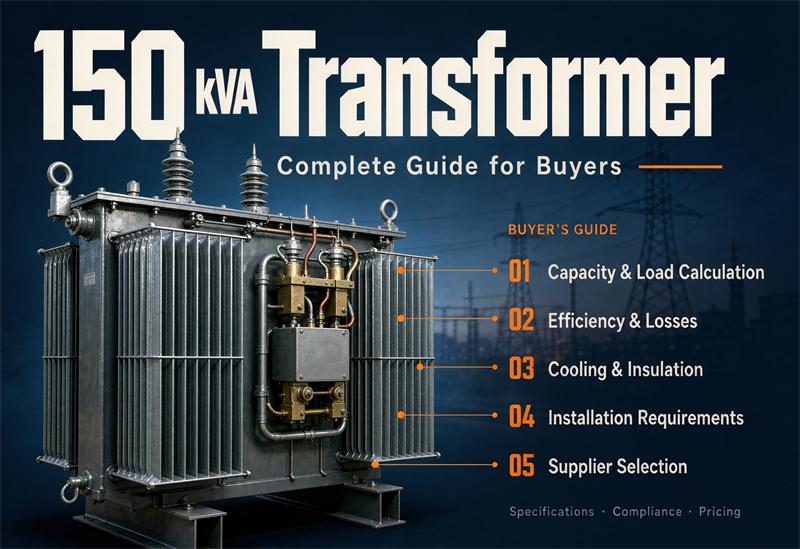
150 kVA is a standard three-phase size and a non-standard single-phase size. That one sentence decides your lead time, your price, and how much grief you get from the utility. A 150 kVA three-phase unit is stocked, listed by name in the federal efficiency tables, and quoted in days. A 150 kVA single-phase unit is neither.
Here is the rest of it in one place:
- Full-load amps, three-phase: 180 A at 480Y/277 V, 416 A at 208Y/120 V, 144 A at 600Y/347 V, 361 A at 240 V delta.
- DOE minimum efficiency, three-phase liquid: 99.16% today, 99.33% from April 23, 2029.
- DOE minimum efficiency, three-phase dry type: 98.83% today, 99.06% from April 23, 2029.
- Real listed prices we found on October 11, 2026: $12,546.88 to $48,420.25. That is a 3.9x spread on the same four words, “150 kVA transformer.”
- Lead time on a built-to-order three-phase pad-mount: 12 to 16 weeks at one US supplier that publishes it.
- Weight: roughly 785 lb for a dry unit in a NEMA 3R box, roughly 2,700 lb for a liquid-filled pad-mount.
Key numbers
| Question | Answer |
| Is 150 kVA three-phase standard? | Yes. 150 = 3 x 50, and 50 is an industry preferred single-phase rating. |
| Is 150 kVA single-phase standard? | No. The single-phase ladder jumps from 100 to 167. |
| Does 150 kVA appear in the DOE efficiency tables? | Three-phase yes, both liquid and dry. Single-phase no, on either one. |
| What changes on April 23, 2029? | Minimum efficiency goes up. Liquid three-phase 99.16% to 99.33%, dry three-phase 98.83% to 99.06%. |
| Amps at 480 V three-phase | 180 A |
| Amps at 208 V three-phase | 416 A |
| Typical building load served | Around 135 kW at 0.9 power factor |
| Real price range found | $12,547 to $48,420 (three listings, October 11, 2026) |
| Typical lead time | 12 to 16 weeks built to order, 1 to 2 weeks if someone has one sitting in the yard |
What you are actually buying at 150 kVA
150 kVA means 150,000 volt-amps. At a 0.9 power factor that is about 135 kW of real power, which is a useful way to sanity check whether you sized the thing right. If your connected load adds up to 135 kW, you are at 100% and you have no headroom at all. Most engineers land a 150 kVA unit on a load somewhere between 90 kW and 120 kW.
In current terms, what you get is 180 A at 480Y/277 V or 416 A at 208Y/120 V. Those two numbers drive everything downstream: the service conductors, the switchgear rating, the size of the concrete pad, and whether the utility needs to be involved at all.
150 kVA is also roughly the line where a transformer purchase stops being a purchase and starts being a small project. Below about 75 kVA you can often hang the unit on a wall or a pole and call it a day. At 150 kVA you are usually pouring a pad, pulling a permit, coordinating a utility service point, and getting a one-line diagram stamped. Budget the project, not just the box.
The things people actually put on a 150 kVA unit:
- Small retail and restaurant buildings with 208Y/120 service and a real kitchen load
- Light manufacturing and machine shops running 480 V equipment
- School wings, clinic buildings, and municipal facilities
- Small EV charging sites where the site load has been properly diversified
- Rural and suburban utility distribution, usually as a single-phase pole or pad unit
If you are still deciding between 150 kVA and something else, the guide to the rung below this one is worth ten minutes, and the pad-mounted size and price guide covers the whole ladder from 25 kVA up.
One more decision happens early and is expensive to change later: 480Y/277 or 208Y/120. A 480 V service gives you 180 A to work with, which means smaller conductors and smaller switchgear for the same load. A 208 V service gives you 416 A, which means bigger everything downstream. Most light industrial work wants 480. Most small commercial work with a lot of 120 V receptacles and rooftop units wants 208. Pick the one your equipment actually wants rather than the one the transformer happens to come in, because the secondary voltage is wound into the machine and you are not changing it after delivery.
Is 150 kVA a standard size? The three-second test
This is the part every guide on this keyword skips, and it is the part that costs you money.
North American distribution transformers follow a preferred rating ladder. The Department of Energy printed it in the Federal Register at 63 FR 63360 (November 12, 1998), Tables 2 and 3, under the heading “Preferred Standard kVA Ratings.” Here it is:
| Single-phase | Three-phase | |
| Liquid-immersed | 10, 15, 25, 37.5, 50, 75, 100, 167, 250, 333, 500, 667, 833 | 15, 30, 45, 75, 112.5, 150, 225, 300, 500, 750, 1000, 1500, 2000, 2500 |
| Dry-type | 15, 25, 37.5, 50, 75, 100, 167, 250, 333, 500, 667, 833 | 15, 30, 45, 75, 112.5, 150, 225, 300, 500, 750, 1000, 1500, 2000, 2500 |
Look at the structure and you will see the trick: the three-phase ladder is the single-phase ladder multiplied by three. 30 is 3 x 10. 112.5 is 3 x 37.5. And 150 is 3 x 50.
So the test is one division. Take your kVA, divide by 3, and ask whether the answer sits on the single-phase ladder.
150 divided by 3 is 50. Fifty is on the ladder. So 150 kVA three-phase is a standard rating. It is in every stock program, it has a row in the DOE efficiency tables, and you can get quotes from four vendors before lunch.
Now run it for single-phase. Is 150 on the single-phase ladder? No. The ladder goes 100, then 167. There is no 150. A 150 kVA single-phase transformer is a custom size.
This matters more than it sounds:
- Lead time. A stock 150 kVA three-phase pad-mount is 1 to 2 weeks if a distributor has one. A built-to-order single-phase 150 is a factory slot. The one supplier in our sample that publishes lead times on a 150 kVA three-phase pad-mount says 12 to 16 weeks.
- Price. Off-ladder sizes carry a premium because the core and coil are built once, to your drawing, with no repeat order to amortize the setup.
- Efficiency compliance. On-ladder sizes have a printed minimum. Off-ladder sizes have to be interpolated from the two rows on either side, which means nobody can tell you the exact number without doing arithmetic.
- Replacement. In fifteen years, a stock size is a phone call. A custom size is a project.
If a load calculation lands you near 150 kVA single-phase, the standard answer is 167 kVA. If it lands you near 150 kVA three-phase, you are already on a rung, and the question is just which enclosure and which voltage.
Worth noting how often this flips. Our 100 kVA guide reaches the opposite conclusion: 100 kVA single-phase is standard, 100 kVA three-phase is not. Same arithmetic, different answer, because 100 divided by 3 is 33.3 and that is not a rung. Do the division, do not assume.
Full-load amps by voltage
Every number below is straight arithmetic from I = kVA x 1000 / (sqrt(3) x V) for three-phase, and I = kVA x 1000 / V for single-phase. Use them for conductor and device sizing. Round up when you pick a breaker.
Three-phase, 150 kVA
| Secondary | Full-load amps | Common primary | Full-load amps |
| 208Y/120 | 416 | 4800 Delta | 18.0 |
| 240 Delta | 361 | 7200 Delta | 12.0 |
| 240/120 Delta | 361 | 12470Y/7200 | 6.9 |
| 415Y/240 | 209 | 13200 Delta | 6.6 |
| 480 Delta | 180 | 13200Y/7620 | 6.6 |
| 480Y/277 | 180 | 13800Y/7970 | 6.3 |
| 600Y/347 | 144 | 22900Y/13200 | 3.8 |
| 24940Y/14400 | 3.5 | ||
| 34500Y/19920 | 2.5 | ||
| 2400 Delta | 36.1 | ||
| 4160 Delta | 20.8 |
One US distributor publishes a full-load amp table for its 150 kVA three-phase pad-mount and lists 208Y/120 at 416 A, 240 Delta at 361 A, 415Y/240 at 209 A, 480 Delta at 180 A and 600Y/347 at 144 A. Our arithmetic matches on every one. That is a good sign the formula and the rounding convention agree.
Single-phase, 150 kVA (remember, this is the off-ladder size)
| Voltage | Full-load amps |
| 120/240 | 625 |
| 240 | 625 |
| 480 | 313 |
| 2400 | 62.5 |
| 7200 | 20.8 |
| 12470 | 12.0 |
| 14400 | 10.4 |
| 19920 | 7.5 |
Voltage class and BIL at 150 kVA
Primary voltage class does more than set the number on the nameplate. It sets the basic insulation level, the bushings, the internal clearances, and most of the weight difference between two units of identical kVA.
The standard North American classes and the BIL values published by one supplier for its 150 kVA three-phase pad-mount line up like this:
| Primary voltage class | Typical primary BIL |
| 15 kV (12470Y/7200, 13200, 13800) | 95 kV |
| 25 kV (22900Y/13200, 24940Y/14400) | 125 kV |
| 35 kV (34500Y/19920) | 150 kV |
On the secondary side, a 480Y/277 winding typically carries a 30 kV BIL. Do not assume the secondary BIL matters less than the primary one. It is what protects your low-voltage windings from a transient coming back the other way, and it is cheap to specify correctly at order time and impossible to fix afterwards.
Three more items to pin down while you are at it:
- Taps. The common configuration is two 2.5% taps above and two below nominal, sometimes five positions including nominal. Ask whether the taps are full capacity. A unit that can only hit its taps at reduced load is not the same product.
- Tap range and DOE scope. A tap range of 20% or more puts a unit outside the federal efficiency standard. That is not a loophole to hunt for, because it also means you have no efficiency floor to hold your vendor to.
- Vector group. A 23 kV unit published as Dyn1 will not parallel with a Yyn0 unit of the same rating. If you have an existing transformer on site and intend to parallel, match the vector group to what is already there.
DOE minimum efficiency: now versus April 23, 2029
Federal efficiency standards for distribution transformers live in 10 CFR 431.196. Scope is set in 10 CFR 431.192, and a 150 kVA unit falls inside it as long as four things hold: primary voltage at or below 34.5 kV, secondary at or below 600 V, 60 Hz, and capacity inside the covered band (10 to 5,000 kVA liquid, 15 to 5,000 kVA dry).
A 150 kVA three-phase pad-mount at 12470Y/7200 to 480Y/277 meets all four. So do most 150 kVA dry units. A 150 kVA unit with a 690 V secondary or a 50 Hz rating does not, and the standard does not apply to it.
Here is what the tables say for 150 kVA. Efficiency is measured at 35% load for dry types and 50% load for liquid types, which is why the two columns are not directly comparable.
Three-phase, 150 kVA
| Type | Manufactured on or after Jan 1, 2016 | Manufactured on or after Apr 23, 2029 | Change |
| Liquid-immersed (tested at 50% load) | 99.16% | 99.33% | +0.17 points |
| Low-voltage dry-type (tested at 35% load) | 98.83% | 99.06% | +0.23 points |
Both of those are printed rows. You can look them up, quote them in a spec, and hold a vendor to them.
Single-phase, 150 kVA, interpolated
150 is not a table row for single-phase, so the regulation tells you to interpolate between the rows immediately above and below: 100 and 167. These next four numbers are our arithmetic, not values printed in the rule:
| Type | Interpolated, 2016 tier | Interpolated, 2029 tier | Change |
| Liquid-immersed | 99.31% | 99.42% | +0.11 points |
| Low-voltage dry-type | 98.67% | 99.07% | +0.40 points |
If you write a single-phase 150 kVA spec, write the interpolated number down as a target and make the vendor confirm it in writing. Do not write “meets DOE” and leave it there, because there is no row to check against.
One trap worth flagging. A dry-type transformer with a primary above 1.2 kV is a “medium-voltage dry-type” unit, and its efficiency requirement is looked up from kVA and BIL together, not from kVA alone. A 150 kVA cast resin unit at 4160 V is a different table from a 150 kVA dry unit at 480 V. We are not printing a number for the medium-voltage case because there isn’t one number: it depends on the BIL you specify. Ask for it per BIL class.
What a 150 kVA unit weighs and measures
Weights and dimensions move with voltage class and enclosure, so treat everything below as a description of specific published units rather than a specification. All were retrieved on October 11, 2026.
| Unit | Weight | Dimensions |
| Dry type, 480 V to 220 V, NEMA 3R, aluminum | 785 lb | 38 in H x 29 in W x 29 in D |
| Liquid pad-mount, 4800 V delta to 240/120 V, copper | about 2,700 lb | 50 in x 68 in x 49 in |
| Liquid pad-mount, 12470Y/7200 to 480Y/277 | 2,700 lb | 74 in W x 49 in D x 50 in H |
| Liquid pad-mount, 23 kV to 480Y/277 | 2,100 kg (4,630 lb) | 1800 x 1500 x 1700 mm (70.9 x 59.1 x 66.9 in) |
Two things jump out. First, the dry unit is roughly a third of the weight of the liquid one, which is what decides whether you need a crane or a couple of guys and a pallet jack. Second, the 23 kV unit is nearly twice the weight of the 12.47 kV unit at the same kVA, almost entirely because of insulation clearances and tank size. Higher primary voltage costs you mass.
Plan the pad for the heaviest case, not the lightest. A 2,700 lb unit on a 6-inch reinforced slab is normal. Verify with your structural engineer, and check the local frost depth while you are at it.
What 150 kVA transformers actually cost
We are not going to print a price list of our own, and you should be skeptical of anyone who does. What we can do is show you three real, publicly listed prices for 150 kVA units, retrieved October 11, 2026, with enough detail that you can see why they differ.
| Listing | Price | What it is |
| Dry type, 480 V delta to 220 V delta with 110 V center tap, aluminum windings, NEMA 3R | $12,546.88 | Low-voltage indoor/outdoor dry unit, 785 lb |
| Three-phase pad-mount, 15/25/35 kV primary, aluminum windings, mineral oil, ONAN | $19,329.29 to $24,960.71 | Compartmental dead-front pad-mount, 12 to 16 week lead time |
| Three-phase pad-mount, 4800 V delta to 240/120 V, copper windings, biodegradable fluid | $48,420.25 | Liquid pad-mount with 125 gallon tank, about 2,700 lb |
$12,547 to $48,420. Same kVA, 3.9x apart. These are not comparable quotes and you should not treat them as a range to shop within. They are three different products that happen to share a number:
- The cheap one is dry, low-voltage, and aluminum.
- The middle one is a liquid pad-mount with aluminum windings and a published build slot.
- The expensive one is liquid, copper wound, and filled with biodegradable fluid instead of mineral oil.
The honest way to read this is: kVA tells you almost nothing about price. Winding material, primary voltage class, fluid type, enclosure, and the accessories list move the number far more than capacity does.
What actually drives the price on a 150 kVA order:
- Winding material. Copper costs more than aluminum up front, and the gap widens with copper prices.
- Primary voltage class. A 15 kV unit and a 35 kV unit at the same kVA are different machines inside.
- Fluid. Mineral oil is the baseline. Natural ester and other less-flammable fluids add cost and can reduce the fire separation you need.
- Efficiency target. Anything above the DOE minimum is more core steel and more copper.
- Accessories. Bayonet fuses, load break switches, surge arresters, pressure/vacuum gauges, and a four-position switch add up fast.
- Quantity and timing. One unit on a rush is a different price from six units on a schedule.
Losses: the money you keep paying after you buy it
A transformer is one of the few things you buy where the operating cost over the life can equal or beat the purchase price. Here is how to size that up, using two independent paths so you can check one against the other.
Path A: start from real published losses. One publicly listed 150 kVA liquid pad-mount publishes 280 W no-load loss and 2,200 W load loss. Assume it runs at 50% of nameplate, all 8,760 hours a year, at $0.12 per kWh.
- No-load loss runs around the clock: 280 W x 8,760 h = 2,453 kWh per year
- Load loss scales with the square of the load: 2,200 W x 0.5 squared x 8,760 h = 4,818 kWh per year
- Total: 7,271 kWh per year, or about $873 a year
Over 30 years at a 7% discount rate, the annuity factor is 12.409, so the present value of those losses is about $10,827.
Read that again. The electricity this thing wastes over its life is worth about as much as the unit costs to buy. That is why the loss numbers deserve a place on your specification.
Path B: work backwards from the DOE thresholds. This one needs no vendor data at all, so it is a useful cross-check.
For a three-phase liquid unit at 50% load, output is 75 kW:
- At 99.16% (the tier that applies today), allowed losses = 75,000 x (1/0.9916 – 1) = 635 W
- At 99.33% (the tier applying from April 23, 2029), allowed losses = 75,000 x (1/0.9933 – 1) = 506 W
- Difference: 129 W, or 1,134 kWh a year, or about
136 a year, or about **1,690** in present value over 30 years
For a three-phase dry unit at 35% load, output is 52.5 kW:
- At 98.83%, allowed losses = 622 W
- At 99.06%, allowed losses = 498 W
- Difference: 123 W, or about 1,080 kWh a year, or about
130 a year, or about **1,610** in present value
Both paths land in the same place. Total lifetime losses are on the order of $10,000, and the step from today’s efficiency tier to the 2029 tier is worth roughly $1,600 to $1,700 on a 150 kVA unit at $0.12 per kWh and 50% load.
That gives you a decision rule you can actually use: if a vendor wants more than about $1,700 extra to jump you from a 2016-tier unit to a 2029-tier unit, the energy savings do not pay for it. Push back, or ask for the real measured losses and rerun Path A with their numbers instead of the minimums. Your own electricity price and load factor will move the answer, so swap in yours before you commit.
Protection, fault current, and NEC 450.3
Overcurrent protection. For a transformer with primary and secondary at or below 600 V, NEC 450.3(B) sets both the primary and secondary device at 125% of rated current when the rated current is over 9 A, and lets you step up to the next standard size when 125% does not land on one.
Take a 150 kVA unit at 480 V primary and 208Y/120 V secondary:
- Primary full-load current is 180 A. 125% is 226 A. The next standard size up is 250 A.
- Secondary full-load current is 416 A. 125% is 521 A. The next standard size up is 600 A.
Do not reuse those percentages on a medium-voltage primary. A 12.47 kV primary is over 600 V, which puts you in NEC 450.3(A) with its own table and different percentages. Pad-mount units usually come with the primary protection built in as bayonet fuses or a fused switch inside the tank, sized by the manufacturer as a listed assembly. Have your engineer confirm the upstream device against the nameplate, and check with the authority having jurisdiction, because utilities write their own service requirements on top of the code.
Fault current. This is simple arithmetic that almost nobody publishes: available short-circuit current at the secondary is roughly the full-load current divided by the impedance in per unit. Using 180 A at 480 V and 416 A at 208 V:
| Impedance | At 480Y/277 (FLA 180 A) | At 208Y/120 (FLA 416 A) |
| 5.75% | 3,138 A | 7,241 A |
| 4.5% | 4,009 A | 9,252 A |
| 3.83% | 4,711 A | 10,871 A |
| 2.5% | 7,217 A | 16,655 A |
| 1.2% | 15,035 A | 34,697 A |
Read your own nameplate impedance and divide. Point being, a lower impedance unit gives you better voltage regulation and a dramatically higher fault current, and your downstream panel has to be rated for it. A 150 kVA unit at 1.2% impedance feeding a 208 V panel is asking that panel to interrupt nearly 35,000 A. Make sure it can.
Note this is the transformer’s own contribution. The total available fault current at the bus also includes whatever the source upstream can deliver, so the real number is higher.
Oil or dry at 150 kVA
At 150 kVA both are genuinely viable, and the choice is usually made by location rather than by engineering.
Go dry if the unit goes inside a building, in a basement electrical room, on a roof, or anywhere fire codes and occupancy make liquid-filled equipment a headache. Dry units weigh about a third as much, need no oil containment, and are the default for commercial interiors.
Go liquid if it goes outside on a pad, if it is a utility service, or if you want the longest life for the money. Liquid units handle overload better, run cooler, and are quieter at the same rating.
If your project is genuinely split, a cast resin dry unit in an outdoor-rated enclosure can sit outside and still avoid the oil question. Our oil-immersed transformer range covers the liquid side of that decision.
Do not decide on first cost alone. Factor in the fire separation, the containment, the ventilation, and how much room you have. The dry unit is often cheaper to install even when it is more expensive to buy.
How to read a 150 kVA spec sheet (and catch a bad one)
Here is a check worth running on every quote you get, and it takes about three minutes.
Take the published loss pair from that 150 kVA liquid pad-mount: 280 W no-load, 2,200 W load loss. Test it against the DOE table.
- At 50% load, output is 75 kW
- Losses at 50% load = 280 + (2,200 x 0.25) = 830 W
- Efficiency = 75,000 / 75,830 = 98.91%
- The 2016 tier for a three-phase liquid 150 kVA unit is 99.16%
So the published losses come up short of the tier the same sheet claims to meet. Before you conclude somebody is lying, check three things:
- Reference temperature. DOE corrects load loss to 75 °C. If the sheet states load loss at 85 °C, the number reads higher than it would at the reference. The correction moves it by tens of watts, not hundreds, so it does not close a 195 W gap, but it can close a small one.
- Is that loss figure for this exact unit? Lots of suppliers publish a family table that covers a dozen voltage classes. The number you are reading may belong to a different row.
- Are the columns what you think they are? “Loss” and “no-load loss” get used loosely on spec sheets.
Then do the thing that settles it: ask for the routine test report. A real report gives you measured no-load loss, measured load loss at a stated reference temperature, measured impedance, and the applied test voltages, with the unit’s serial number on it. If a supplier cannot produce that, the efficiency claim is a marketing number, not a test result. Our piece on what routine testing every transformer should pass lists the tests to expect and what each one proves.
Where to buy: stock, build slots, and what to ask
There are four channels, and they are not interchangeable.
Distributor stock. Fastest, usually 1 to 2 weeks, but you get what is on the ground. Fine for a standard 150 kVA three-phase pad-mount in a common voltage. Check that the unit is actually in the yard before you pay, because inventory moves and listings lag.
Build slot from a manufacturer. This is where the 12 to 16 week figure comes from, and it is the realistic answer for anything with an uncommon voltage, a special fluid, or a higher efficiency target. Order early and get the date in writing.
Direct import. Cheapest per unit on the right order, and it works well when you know exactly what you want and can wait for the vessel. Budget the freight, the duty, and the time for the paperwork. It is a poor fit for a single emergency replacement.
Utility. For a service transformer, the utility may supply and own it. Ask before you buy, because you may be about to buy something you are not allowed to install.
Either way, put these eight things in your RFQ. Missing any one of them is how quotes become non-comparable:
- kVA and phase (150 kVA three-phase, not just “150 kVA”)
- Primary voltage and BIL
- Secondary voltage and BIL
- Frequency (60 Hz, stated)
- Winding material (copper or aluminum, not “either”)
- Cooling class and temperature rise
- Efficiency target, and whether you want the test report with the unit
- Destination port or jobsite address, and Incoterms
If you are comparing vendors rather than units, our resources library has the longer buying guides, the product range shows what is actually built, and the project pages show how these units land in the field. Start from TransNine if you want the short version.
Six things that go wrong on a 150 kVA order
These show up on real purchase orders, and every one of them is avoidable with a sentence in the RFQ.
- “150 kVA” with no phase stated. A 150 kVA single-phase unit and a 150 kVA three-phase unit are not variations of each other. They are different machines, and only one of them is a stock size. Say “150 kVA three-phase” every single time.
- Frequency left blank. 60 Hz is the US default and everyone assumes it. On an export order, or on a unit destined for a site with 50 Hz equipment, an unstated frequency is a saturated core and a smoking transformer. Write it down.
- Winding material left to the vendor. Copper and aluminum are both legitimate, but they differ in size, weight, losses and price. If you do not specify, you will get aluminum, and then you will discover your conduit and lugs were sized for copper.
- No test report requested. Ask for the routine test report with the unit, not if you remember to ask six months later. It is the only document that turns an efficiency claim into a measured number.
- Pad designed from the dry weight. A 785 lb dry unit and a 2,700 lb liquid unit need different foundations. Size the slab for what you might install in ten years, not for the lightest thing you could buy today.
- Buying before asking the utility. If this is a service transformer, the utility may supply it, may own it, and may have written standards about it. Ten minutes on the phone at the start beats a rejected installation at the end.
Frequently asked questions
How many amps is a 150 kVA transformer?
It depends entirely on the secondary voltage. Three-phase: 416 A at 208Y/120 V, 361 A at 240 V delta, 180 A at 480Y/277 V, 144 A at 600Y/347 V. Single-phase: 625 A at 120/240 V and 313 A at 480 V. Divide kVA by voltage, and by the square root of three as well if it is three-phase.
Is a 150 kVA transformer a standard size?
Three-phase yes, single-phase no. The preferred rating ladder is built on single-phase steps multiplied by three, and 150 divided by 3 is 50, which is a ladder rung. The single-phase ladder jumps from 100 to 167, so there is no 150 rung there.
What is the minimum efficiency for a 150 kVA transformer?
For three-phase, the DOE tables list it directly: 99.16% for liquid-immersed and 98.83% for low-voltage dry-type today, rising to 99.33% and 99.06% for units made on or after April 23, 2029. For single-phase there is no table row, so you interpolate between the 100 and 167 kVA rows.
Why does the DOE table have no 150 kVA single-phase row?
Because it follows the industry preferred ratings, and 150 is not one of them for single-phase. The regulation says ratings that do not appear in the table get their minimum by linear interpolation from the rows immediately above and below.
Should I buy a 150 kVA or a 167 kVA single-phase transformer?
Buy 167 unless you have a specific reason not to. 167 is a preferred rating, so it is stocked, it has a printed efficiency row, and it will be replaceable in fifteen years. The extra 17 kVA usually costs less than the custom build does.
How much does a 150 kVA transformer cost?
Anywhere from about $12,500 to over $48,000 based on three real published listings we found on October 11, 2026. The spread is driven by winding material, primary voltage class, fluid type and enclosure, not by capacity. Get quotes against a full specification, because “150 kVA” alone is not a request anyone can price accurately.
How heavy is a 150 kVA transformer?
Around 785 lb for a dry unit in a NEMA 3R enclosure, and around 2,700 lb for a liquid-filled three-phase pad-mount at 12.47 or 4.8 kV. A 23 kV unit of the same rating can weigh closer to 4,600 lb because of the extra insulation clearances.
What size breaker do I need for a 150 kVA transformer?
For a 480 V primary and 208Y/120 V secondary under NEC 450.3(B), 125% of 180 A is 226 A, so a 250 A primary device, and 125% of 416 A is 521 A, so a 600 A secondary device. That applies at 600 V and below. Above 600 V on the primary, NEC 450.3(A) uses a different table.
Does a 150 kVA transformer have to meet DOE efficiency standards?
If it is 60 Hz, 34.5 kV or below on the primary, 600 V or below on the secondary, and inside the covered capacity band, yes. That describes most 150 kVA distribution units sold in the United States. Units outside those four conditions are not covered.
What is the lead time on a 150 kVA transformer?
One to two weeks for a stock three-phase pad-mount in a common voltage. Twelve to sixteen weeks for a built-to-order unit, which is the figure one US supplier publishes for its 150 kVA three-phase pad-mount. Longer for off-ladder configurations like a single-phase 150.