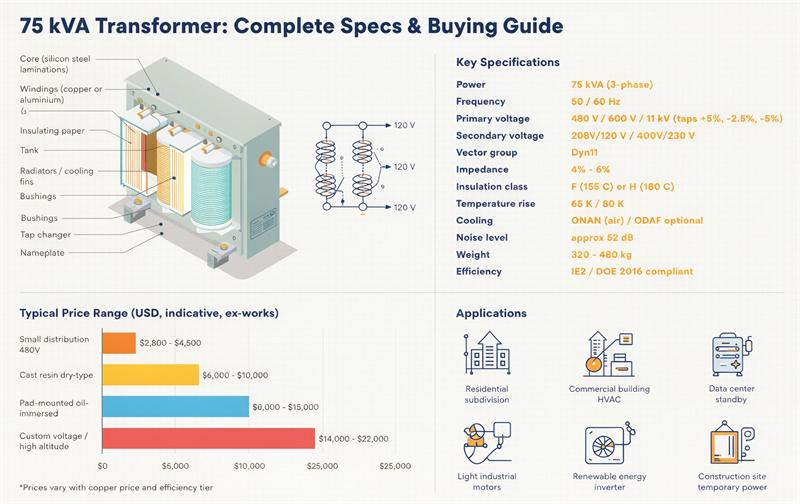
a 75 kVA three-phase transformer on a 480 V primary draws 90.2 A and delivers 208.2 A at 208Y/120 V. Federal minimum efficiency is 98.60% for a low-voltage dry-type unit and 99.03% for a liquid-immersed three-phase unit today, rising to 98.88% and 99.22% for anything manufactured or imported on or after April 23, 2029. Everything else — copper or aluminum, 150 °C or 115 °C rise, NEMA 1 or 3R, 125 A or 225 A primary breaker — is what this guide walks through.
75 kVA is the size people buy when a 45 kVA won’t carry the load and a 112.5 kVA is more copper than the job needs. It’s also the size where the rules get specific: it’s big enough to sit squarely inside federal efficiency scope, and small enough that the 2029 efficiency step lands harder on it than on almost anything else. Here’s what to get right.
Key numbers
| Item | Value | Note |
| Full-load current, 3-phase 480 V | 90.2 A | 75,000 ÷ (√3 × 480) |
| Full-load current, 3-phase 208 V | 208.2 A | 75,000 ÷ (√3 × 208) |
| Full-load current, 3-phase 240 V | 180.4 A | |
| Full-load current, 3-phase 600 V | 72.2 A | |
| Full-load current, 1-phase 240 V | 312.5 A | 75,000 ÷ 240 |
| DOE minimum, low-voltage dry-type 3-phase | 98.60% → 98.88% | 2016–2029 → on/after 2029-04-23; measured at 35% load |
| DOE minimum, liquid-immersed 3-phase | 99.03% → 99.22% | measured at 50% load |
| DOE minimum, medium-voltage dry-type 3-phase (2029) | 98.86% / 98.71% / 98.68% | by BIL: 20–45 / 46–95 / ≥96 kV |
| The 2029 step at 75 kVA | +0.28 points dry, +0.19 points liquid | vs +0.03 points at 500 kVA liquid |
| DOE coverage | Input ≤34.5 kV, output ≤600 V, 60 Hz | 10 CFR 431.192 |
| DOE compliance trigger | Manufactured or imported on/after April 23, 2029 | 89 FR 29834; not your PO date |
| Primary OCPD, primary-only protection | 90.2 A × 125% = 112.75 A → 125 A device | NEC 450.3(B) |
| Secondary OCPD, where required | 208.2 A × 125% = 260.25 A → 300 A device | NEC 450.3(B) |
| Primary OCPD with secondary protection | Up to 250% → 225 A device | Useful when inrush trips |
| Secondary fault current | 4.6 kA at 4.5% Z, 8.3 kA at 2.5% Z | Sets the SCCR you need downstream |
| 1 kW of no-load loss | 8,760 kWh per year | Core loss runs 24/7 |
| Published dry-type weights we found | 405–605 lb | Four catalogs, retrieved 2026-10-10 |
What a 75 kVA transformer is, and where it sits
The standard North American distribution ladder runs 15, 30, 45, 75, 112.5, 150, 225, 300, 500 kVA and up. 75 kVA is the first step that comfortably feeds a small commercial building, a machine shop, a school wing, or a decent-sized EV charging block, and it’s the last step you can usually buy off a distributor’s shelf without a long lead time.
Two things define it beyond the number: phase (three-phase for anything with motors; single-phase for rural and light commercial at 240 V) and primary voltage class (480 V is “low voltage” and gets you a cheap, commodity dry-type unit; 4,160 V or 13.8 kV is medium voltage and moves you into a different world of insulation, BIL, and price).
Most 75 kVA units sold in the US are dry-type, indoor or NEMA 3R outdoor, 480 V delta primary to 208Y/120 V secondary, air-cooled (AA or AN in the cooling notation), with a 150 °C temperature rise. That’s the default. Every deviation from it costs money or time, and some of them are worth paying for.
Here’s how it sits against its neighbours, at 208 V three-phase:
| Rating | Full-load current at 208 V | Typical fit |
| 45 kVA | 124.9 A | Small retail, one tenant space |
| 75 kVA | 208.2 A | Small commercial building, machine shop, school wing |
| 112.5 kVA | 312.4 A | Full floor, light industrial, small charging block |
| 150 kVA | 416.4 A | Larger commercial, mixed-use |
| 225 kVA | 624.6 A | Industrial, campus distribution |
The gap from 75 to 112.5 is a 50% jump in capacity and usually a bigger jump in price, footprint, and lead time. That asymmetry is why the sizing step below is worth doing carefully rather than rounding up “for safety.”
In practice a 75 kVA lands in one of four places: a commercial fit-out that needs 208Y/120 from a 480 V service, a machine shop or light industrial bay, an institutional wing (school, clinic, hospital auxiliary), or a charging block where the site service stops short of what the dispensers want. The first three want a quiet indoor dry-type. The fourth usually wants outdoor-rated gear and a K-factor. You can see the spread of where these actually end up in the project library.
TransNine Electric builds dry-type and liquid-immersed units across this range, and most of what follows comes from RFQs that came back wrong the first time.
The current math
For three-phase: I = kVA × 1,000 ÷ (√3 × V), where V is line-to-line. For single-phase: I = kVA × 1,000 ÷ V.
At 75 kVA:
| Voltage | Phase | Full-load current |
| 480 V | 3-phase | 90.2 A |
| 240 V | 3-phase | 180.4 A |
| 208 V | 3-phase | 208.2 A |
| 600 V | 3-phase | 72.2 A |
| 240 V | 1-phase | 312.5 A |
Two mistakes show up constantly. The first is using 120 V in the formula for a 208Y/120 V secondary — you use 208 V, the line-to-line value, for a balanced three-phase calculation. The second is adding the primary and secondary currents together. They’re the same power measured on two sides of one transformer. Don’t add them.
Note what the current numbers do to your wiring: 208 A on the secondary is a serious conductor. It’s not “a 75 kVA transformer and some wire”; it’s a 300 A-rated feeder with the copper to match.
Single-phase is a different animal. At 240 V, 75 kVA single-phase is 312.5 A, which is more than a 320 A service is rated to carry continuously. These units show up on farms, small commercial services, and rural distribution, usually as pole-mounted or pad-mounted oil-filled cans rather than anything dry-type. The sizing conversation is the same, but the equipment, the listing, and the installation are not, and most of what follows is written for the three-phase case.
Sizing: three numbers decide 75 vs 112.5
The nameplate is a candidate, not a decision. Work it in order.
Steady-state load. Build a schedule, convert kW to kVA at your actual power factor, then apply demand and diversity with a documented rule rather than a habit.
Worked example, small commercial fit-out:
- Connected load: 85 kW at 0.9 PF → 85 ÷ 0.9 = 94.4 kVA
- Documented diversity factor 0.65 → 61.4 kVA
- 15% growth allowance → 70.6 kVA
- Next standard rating above 70.6: 75 kVA
That’s how you land on 75 honestly. If the same arithmetic came out at 78 kVA, you’d be on 112.5. That jump is expensive, which is exactly why the diversity factor and the growth allowance deserve to be written down instead of guessed.
Starting and step loads. A transformer that’s fine at steady state can sag badly when a 30 hp motor starts across the line. Check the largest motor against the transformer’s impedance and the allowable voltage dip. If the dip is unacceptable, you either go up a size, use a soft starter or VFD, or accept it — but decide which, deliberately.
Harmonics. If a big share of the load is switch-mode (IT gear, LED drivers, VFDs, DC fast chargers), the fix is not more kVA. It’s a K-factor rating on the transformer, because harmonic current heats the windings in a way that extra capacity doesn’t solve. K-4 is the common minimum for mixed commercial; K-13 for heavy non-linear load.
If you get through all three and the number is still 75, buy 75.
Dry or liquid, and what the temperature rise actually means
Dry-type is the default indoors: no oil, no containment, no fire pump interface, and it can sit in an electrical room next to the panelboard it feeds. See the dry-type transformer range for what’s standard versus built to order. The trade-off is that it’s physically larger and more expensive per kVA than an oil unit, and it’s less tolerant of overload.
Liquid-immersed wins outdoors and on price at higher capacities. At 75 kVA you’ll mostly see it as a pad-mount or a pole-mount single-phase unit. It runs cooler under overload and costs less, but you now own fluid testing, containment, and — if the unit sits near a combustible wall — the fire provisions in NEC 450.23, which turn on the fluid’s fire point.
Then there’s the number almost nobody specifies: temperature rise.
A 75 kVA transformer rated at a 150 °C rise and one rated at 115 °C rise carry the same nameplate kVA, and they are not the same machine. The 150 °C unit is smaller, lighter, and cheaper, because it’s allowed to run hotter. The 115 °C unit has real thermal headroom — it will tolerate overload and high ambient better and will very likely outlive the 150 °C unit. Cast resin units often sit at 80 °C rise.
If your electrical room is hot, or you expect the load to grow, or you’d rather not think about this transformer again for thirty years, the lower rise is usually worth the money. If it’s a cool room with a known, stable load, 150 °C is fine and cheaper. Just make it a decision, not whatever the distributor had in stock. The dry-type selection guide goes through rise, insulation class, and enclosure together, because they interact.
The full range of constructions is on the products page, and the resources library has a dedicated dry-type versus oil-immersed comparison if you want to go deeper on that branch.
Efficiency: the 2029 rule hits 75 kVA harder than most sizes
Here’s the part every guide on this keyword skips. Federal minimum efficiency for a distribution transformer is set by kVA, by type, and by which side of April 23, 2029 the unit was built on.
Low-voltage dry-type, three-phase, at 75 kVA (input 600 V or less, per 10 CFR 431.196):
| Period | Minimum efficiency |
| Manufactured 2007–2015 | 98.0% |
| Manufactured 2016-01-01 to 2029-04-22 | 98.60% |
| Manufactured or imported on/after 2029-04-23 | 98.88% |
Liquid-immersed, three-phase, at 75 kVA:
| Period | Minimum efficiency |
| Manufactured 2010–2015 | 98.91% |
| Manufactured 2016-01-01 to 2029-04-22 | 99.03% |
| Manufactured or imported on/after 2029-04-23 | 99.22% |
Two things fall out of those tables that matter more than the numbers themselves.
One: you cannot compare the dry-type number with the liquid number. DOE measures low-voltage dry-type efficiency at 35% of nameplate load and liquid-immersed at 50% of nameplate load. They’re different tests. Saying “liquid is more efficient because 99.03 beats 98.60” is comparing two different measurements.
Two: the 2029 step is biggest at the small end. At 75 kVA the required efficiency rises 0.28 points (dry) and 0.19 points (liquid). At 500 kVA liquid it rises 0.03 points (99.35% → 99.38%). Small transformers get squeezed hardest, which means the specific unit you’d have bought in 2026 may not be importable in 2030, and “meets DOE” is a claim that means nothing without the kVA and the type attached.
The date that governs is the manufacturing or import date, not your purchase order date and not your delivery date. Per DOE’s April 2024 final rule (89 FR 29834), the amended levels apply to units manufactured or imported on or after April 23, 2029.
Is your 75 kVA even covered? Four ways out
Under 10 CFR 431.192, a “distribution transformer” has an input of 34.5 kV or less, an output of 600 V or less, is rated for 60 Hz, and falls between 10 and 5,000 kVA liquid-immersed or 15 and 5,000 kVA dry-type. A 75 kVA, 480 V to 208Y/120 V, 60 Hz unit checks every box. It’s covered.
Four ways a 75 kVA unit ends up outside the definition, and all four matter in practice:
- Nonventilated. The definition excludes a dry-type transformer “constructed so as to prevent external air circulation through the coils… while operating at zero gauge pressure.” Some encapsulated designs fall here.
- Sealed. Also excluded: a dry-type transformer “designed to remain hermetically sealed under specified conditions of temperature and pressure.”
- Tap range of 20% or more. Excluded. A wide-range tap unit isn’t covered.
- Drive (isolation) transformer — but read the fine print. The exclusion requires, among other things, that the transformer’s rated output voltage is neither “208Y/120” nor “480Y/277.” So a 75 kVA drive-isolation transformer feeding a 208Y/120 board stays in scope. Only a non-standard output gets it out.
Why this matters commercially: a supplier telling you “it’s exempt” should be able to tell you which exclusion applies. If they can’t, assume it’s covered and ask for certified loss values.
One more thing that surprises people: if your 75 kVA dry-type has a medium-voltage primary (4,160 V or 13.8 kV), it’s no longer a low-voltage dry-type for DOE purposes. It’s a medium-voltage dry-type, and its minimum efficiency depends on BIL — 98.86% / 98.71% / 98.68% for BIL 20–45 / 46–95 / ≥96 kV under the 2029 table. The same 600 V dividing line shows up on the safety side: UL 1561 covers dry-type transformers at 600 V and below, UL 1562 covers 601 V to 35 kV. So a commodity 480 V unit and a 13.8 kV unit of the same kVA are different listings, different insulation, and different money. See the UL-listed low-voltage dry-type units for what the 600 V-class side looks like.
Overcurrent protection: the 125 A breaker, and where it comes from
Transformer protection is set by NEC Table 450.3(B), and for a 75 kVA unit the arithmetic is short.
Primary-only protection. Where the primary current is 9 A or more, the primary device is sized at up to 125% of rated primary current:
- 90.2 A × 1.25 = 112.75 A → next standard rating: 125 A
Secondary protection, where it’s required. Same 125% principle:
- 208.2 A × 1.25 = 260.25 A → next standard rating: 300 A
The good news for this exact configuration: a 208Y/120 V secondary is a four-wire wye, and the table doesn’t require a secondary device for that arrangement. Primary protection alone is acceptable on a 480 V to 208Y/120 V transformer. Confirm it with your AHJ, but that’s the code position, and it’s why so many of these units have no main breaker on the secondary.
Primary and secondary both. If you provide secondary protection at 125%, the primary device can go as high as 250% of rated primary current, so 225.5 A → 225 A. That’s the lever you pull when inrush keeps tripping the primary breaker on energization. Transformer inrush on a 75 kVA unit is typically several times full-load current for a few cycles (commonly quoted as 8–12×), and the honest answer is that the actual value has to be measured or taken from the manufacturer, so don’t size protection off a rule of thumb.
And check the fault current. Available symmetrical fault current at the secondary is roughly full-load current divided by impedance:
- At 4.5% Z: 208.2 ÷ 0.045 = 4,627 A, call it 4.6 kA
- At 2.5% Z: 208.2 ÷ 0.025 = 8,328 A, call it 8.3 kA
Your downstream panelboard needs a short-circuit current rating above that. Low-impedance units are great for voltage regulation and brutal on fault duty — a 2.5% transformer and a 4.5% transformer are not interchangeable parts even though both say 75 kVA.
Physical reality: how big, how heavy, how loud
This is where projects get surprised, and it’s where the published guides are thinnest. Real catalog values for 75 kVA three-phase dry-type units, retrieved 2026-10-10:
| Source | Weight | Dimensions | Notes |
| Larson Electronics (MT-ATX-3P-480Y-75KVA-208Y.120-N3R) | 510 lb | 36.00″H × 28.30″W × 27.00″D | Aluminum, NEMA 3R, 150 °C rise, Class H, seismic Zone 4 |
| Jefferson Electric (via Equipt listing) | 605 lb | 27″W × 26″D × 32″T | Aluminum, NEMA 3R, Z = 4.6%, 10-yr warranty |
| Winley (SG-75KVA) | 405 lb | 24.50″W × 25.00″H × 19.25″D | Aluminum, NEMA 3R, 220 °C insulation |
A spread of 405 to 605 lb for the same nominal rating, driven mostly by winding material, temperature rise, and enclosure. Plan for the top of that range: you need a floor or pad that carries it, a doorway it fits through, and equipment to set it. A 75 kVA unit is a two-or-three-person lift with a pallet jack at minimum, and a 600 lb box on a raised floor should be looked at by somebody who signs drawings.
Sound. NEMA ST-20 sets sound levels for dry-type transformers by kVA, and published values we found for 75 kVA units run roughly 41 to 47 dB. That’s quiet enough for most occupied-adjacent locations, but if the unit is going into a hallway wall or an open office, ask for the tested value rather than “meets NEMA ST-20.”
Enclosure. NEMA 1 for a clean indoor room; NEMA 3R for outdoors or anywhere with dripping water. Ventilated enclosures need clearance. Check the manufacturer’s required clearance on all sides, not just what fits.
Seismic. If you’re in a seismic region, say so on the RFQ. The Larson unit above is listed to Seismic Zone 4; not every catalog unit is.
Site conditions that quietly change the rating
- Altitude. Standard ratings assume up to 1,000 m (3,300 ft). Above that, air is thinner, cooling is worse, and output has to be corrected. Denver and anything mountainous needs this stated.
- Ambient. Ratings assume a 40 °C maximum. A unit in a boiler room or a non-conditioned Southwest electrical closet doesn’t get that.
- Harmonics. Covered above — K-factor, not extra kVA.
- Ventilation. A dry-type transformer dumps its losses into the room as heat. A typical 75 kVA unit with around 880 W of total losses is rejecting roughly 3,000 BTU/h at full load. In a small, sealed electrical room that’s a real load on the HVAC in summer and a real derating risk. Tell the mechanical engineer.
- Clearances. Ventilated enclosures need air space on the vented sides, and the working space in front of the equipment is set by NEC 110.26, not by what fits. Verify both before the room is laid out. A unit that fits the floor plan but fails the clearance is a re-design.
If you want to read a nameplate properly before you compare two quotes, how to read a transformer nameplate and technical parameters walks through every field.
The RFQ block
Copy this into your inquiry. Every line is a blank that costs money if it’s filled in wrong.
Where the money goes
We’re not printing a price table. Published ranges for a 75 kVA transformer ranged from $1,200 to $4,000 on one site and $3,000 to $10,000 on another, and both were unsourced. Meanwhile, real catalog prices retrieved on 2026-10-10 were 4,195** for a Jefferson Electric 75 kVA dry-type and **22,015.83 for a Larson Electronics 75 kVA dry-type, nominally the same product, a factor of five apart.
That spread is the story, and it’s almost never about the transformer. It’s about:
- List price vs street price. Larson’s number is a published list price for a built-to-order unit. Distributors discount. Always ask what the number is.
- Copper vs aluminum. Aluminum is cheaper and lighter; copper is smaller for the same rating and holds up better thermally.
- Temperature rise and insulation. A 115 °C rise unit with a 220 °C insulation system costs more than a 150 °C / 180 °C unit.
- Listing and seismic. UL listing scope and seismic qualification both cost real money.
- Enclosure. NEMA 3R outdoors, stainless, or special finishes add up.
- Lead time. A catalog unit ships in days; a built-to-order unit with custom taps and a K-factor can run months. Time is money on a project schedule.
Should you pay more for efficiency? Do the math rather than the reflex. No-load loss runs 8,760 hours a year whether you load the unit or not, so 1 kW of core loss is 8,760 kWh — about $1,218 per kW per year at an illustrative 13.9 ¢/kWh.
Illustrative comparison (replace with certified values from your quotes): Quote A has 320 W no-load and 1,100 W load loss; Quote B has 210 W and 850 W. At 60% average load:
- A: 320 W × 8,760 h = 2,803 kWh, plus 1,100 W × 0.6² × 8,760 h = 3,469 kWh → 6,272 kWh/yr
- B: 210 W × 8,760 h = 1,840 kWh, plus 850 W × 0.6² × 8,760 h = 2,681 kWh → 4,521 kWh/yr
- Difference: 1,751 kWh/yr, about
243/yr**, roughly **6,100 over 25 years
So if Quote B is $1,500 more, it pays back in a little over six years on a 25-year asset — buy B. If it’s $5,000 more, it doesn’t. The point isn’t that the efficient unit always wins; it’s that at 75 kVA the answer is a two-minute calculation, not a slogan. Unlike a 1,000 kVA unit, where loss differences can dominate the purchase price, at 75 kVA they usually don’t, so don’t let anyone talk you into a premium on efficiency grounds alone.
Frequently asked questions
How many amps does a 75 kVA transformer draw?
At 480 V three-phase, 90.2 A. At 208 V three-phase, 208.2 A. At 240 V three-phase, 180.4 A. At 600 V three-phase, 72.2 A. Single-phase at 240 V, 312.5 A. Use I = kVA × 1,000 ÷ (√3 × V) for three-phase with line-to-line voltage.
Is 75 kVA three-phase or single-phase?
Either. Three-phase 75 kVA units are the commercial and industrial default. Single-phase 75 kVA units show up on rural distribution and light commercial services at 240 V, where they deliver 312.5 A. Which one you need depends entirely on the load, not the size.
What size breaker do I need for a 75 kVA transformer?
For primary-only protection on a 480 V primary, NEC Table 450.3(B) allows up to 125% of rated primary current: 90.2 A × 1.25 = 112.75 A, so a 125 A device. If secondary protection is also provided, the primary device can go to 250% — 225 A — which is the usual fix when inrush trips on energization. Confirm with your AHJ and the edition in force.
Does a 75 kVA transformer need secondary overcurrent protection?
Usually not, for the common configuration. A 208Y/120 V secondary is a four-wire wye, and Table 450.3(B) does not require a secondary device for that arrangement. Primary protection alone is acceptable. A two-wire secondary or a delta-delta three-wire secondary is the case where secondary protection is required.
What is the minimum efficiency for a 75 kVA transformer?
98.60% for a low-voltage dry-type three-phase unit and 99.03% for a liquid-immersed three-phase unit manufactured between January 1, 2016 and April 22, 2029. From April 23, 2029, 98.88% and 99.22% respectively. Dry-type values are measured at 35% of nameplate load, liquid-immersed at 50% — they aren’t directly comparable.
When does the 2029 efficiency rule apply?
To units manufactured or imported on or after April 23, 2029, per DOE’s April 2024 final rule (89 FR 29834). The trigger is the manufacturing or import date, not your purchase order date. A unit built in late 2028 and delivered in 2029 is judged on the pre-2029 table.
How much does a 75 kVA transformer weigh?
Published catalog values we found on 2026-10-10 ranged from 405 lb to 605 lb for three-phase dry-type units, depending on winding material, temperature rise, and enclosure. Liquid-filled units are heavier. Design to the certified drawing, not to a range.
Can I put a 75 kVA dry-type transformer outdoors?
Yes, in a NEMA 3R ventilated enclosure rated for rain and sleet. Verify the clearance requirements around ventilation openings, and check whether the manufacturer requires a rain hood or a canopy.
Do I need a K-factor transformer at 75 kVA?
Only if a meaningful share of the load is non-linear — IT equipment, LED drivers, VFDs, DC fast chargers, UPS systems. Harmonic current heats windings in a way that extra kVA doesn’t fix. K-4 is a common minimum for mixed commercial loads; K-13 for heavy non-linear content.
What’s the lead time for a 75 kVA transformer?
Catalog-configured units in common voltages can ship in days to a few weeks. Built-to-order units with custom voltages, taps, K-factor ratings, or seismic qualification run considerably longer and are frequently the critical path item on a project. Get the lead time in writing before you commit to a schedule.