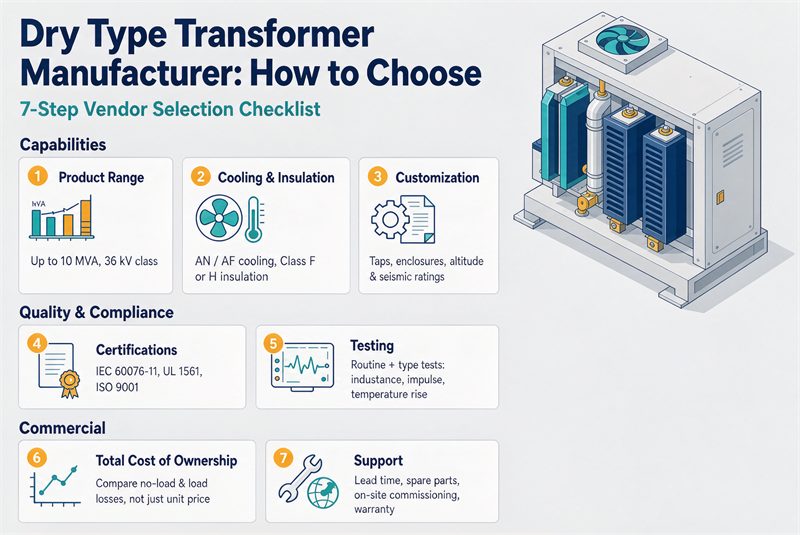
don’t start with the checklist everybody publishes: ISO, certificates, references, warranty. Start with whether you can verify any of it. A dry type transformer manufacturer worth buying from can hand you a UL file number you can look up yourself, a type test report whose accredited lab you can check, and the silicon steel grade with the mill certificate behind it. One that can’t will send a brochure with four logos on it.
There are two different decisions hiding behind this keyword, and mixing them up is why so many specs go sideways. Choosing the transformer is the equipment layer: capacity, voltage, insulation class, temperature rise, K-factor, enclosure, sound. Choosing the manufacturer is the supplier layer: can this company actually build what the spec says, prove it, and still answer the phone in year five. This guide is the second one. If you haven’t nailed the first, read what a dry type transformer is and how to choose one first, then come back — the two documents are meant to be used together, not instead of each other.
TransNine Electric builds cast resin and VPI dry-type units for export, so we see the RFQ packets that arrive with no way to check any claim in them. Everything below is the verification side that usually goes missing.
Key numbers
| Item | Value | Why it matters |
| UL 1561 scope | Dry-type general purpose and power transformers, 600 V and below | The standard for building distribution dry-types |
| UL 1562 scope | 601 V to 35,000 V, explicitly including solid cast and resin encapsulated | The standard for MV cast resin units |
| DOE dry-type coverage | 15 kVA to 5,000 kVA, input ≤34.5 kV, output ≤600 V, 60 Hz | 10 CFR 431.192 — most US building dry-types are in scope |
| DOE compliance trigger | Manufactured or imported on or after April 23, 2029 | 89 FR 29834; your PO date doesn’t count |
| IEC 60076-11 classes | C1/C2 (climatic), E0/E1/E2 (environmental), F0/F1 (fire) | Specified by the buyer, not defaulted by the maker |
| Temperature rise, 155 °C (F) system | 100 K average winding rise; 180 °C (H): 125 K | You can specify a lower rise than the maximum |
| 1 kW of no-load loss | 8,760 kWh per year | Core loss runs around the clock, loaded or not |
| 800 kVA worked example | 875 W vs 1,215 W no-load loss → 340 W ≈ 2,978 kWh/yr | Turns an efficiency grade into kilowatt-hours |
| Partial discharge | Ask for the value, the test voltage, and the standard edition | A pC number without its test voltage means nothing |
The two-minute filter
Before you get into documents, ask five questions. Each one eliminates a chunk of the field, and none of them require anything from the supplier except a straight answer.
1. What’s the standard basis, UL or IEC? If the unit is going into a US building, the answer has to include a UL standard, because that’s what your inspector looks for. “We build to IEC 60076-11” is a fine engineering answer and a bad compliance answer.
2. Which UL standard, specifically? This is where most quotations get vague, and it’s a voltage question, not a preference:
- UL 1561 — Dry-Type General Purpose and Power Transformers — covers air-cooled, dry, ventilated and non-ventilated types at 600 V and below. Your 480 V to 208Y/120 V building unit lives here.
- UL 1562 — Transformers, Distribution, Dry-Type – Over 600 Volts — covers single- or three-phase dry-type distribution transformers, including solid cast and resin encapsulated, rated from 601 V to 35,000 V. A 13.8 kV cast resin unit lives here.
- UL 5085 — the low-voltage small and control end (the small isolation and control transformers); UL 1446 covers insulation systems, which is not the same thing as a listed complete transformer.
Ask which file number covers your voltage class. “UL certified” without a number is a marketing sentence.
3. Is the transformer in DOE scope, and which tier are you quoting? Under 10 CFR 431.192, a covered distribution transformer has an input of 34.5 kV or less, an output of 600 V or less, is rated 60 Hz, and falls between 10 and 5,000 kVA (liquid-immersed) or 15 and 5,000 kVA (dry-type). A 480 V secondary dry-type in a commercial building is squarely inside that. The amended levels apply to units manufactured or imported on or after April 23, 2029 (89 FR 29834), and the trigger is the build or import date, not your contract date.
4. 60 Hz, in writing? IEC-designed units are built around 50 Hz. Losses, impedance, and thermal behavior all shift with frequency. If you’re buying for North America, it goes on the RFQ as its own line.
5. Cast resin or VPI, and do they actually do both? A manufacturer who only does VPI will tell you VPI is fine everywhere. One who only casts will tell you the opposite. What you want is a straight answer about which process fits your environment — more on that below.
The products range is worth a look here, because seeing what a given factory actually lists tells you more about its real capability than the capability statement in its profile does.
How to check every certificate they send you
This is the part no checklist on this keyword covers. Everyone says “verify certifications.” Nobody says how. Here’s how, by document type.
UL listing. Ask for the UL file number (it looks like E123456) and the product category. Then look it up yourself at UL Product iQ. It’s free, public, and needs no account. You’ll see the company name, the category, and whether the listing is active. Two things to watch: the file name on the listing must match the company invoicing you, and a listing for one construction doesn’t extend to another. A supplier with a UL file for ventilated dry-types can’t claim cast resin coverage under it.
ISO 9001. The certificate should show the issuing registrar, the certificate number, the site address, and an expiry date. Verify it with the registrar directly or through IAF CertSearch. The detail that matters is the site address: an ISO certificate covering a sales office doesn’t say anything about the plant winding your coils. If the address on the certificate isn’t where the transformer is built, ask why.
Type test reports. These are the documents that actually carry engineering weight, and they’re the easiest to fake by omission. Ask for three things: the testing laboratory’s name, its ISO/IEC 17025 accreditation number, and the accreditation scope. Accreditation registers are public — A2LA, UKAS, CNAS and the others all publish searchable scopes. If the lab isn’t accredited for the specific test, or the report is from an in-house lab with no accreditation, treat it as a data sheet, not as evidence.
CE marking. Worth saying plainly because it confuses a lot of buyers: CE is a manufacturer’s declaration of conformity with applicable EU directives, not a certificate issued by anybody. There’s no CE “certificate number” to look up. If a supplier offers a CE certificate from a testing firm, ask what it actually is — it may be a test report supporting the declaration, which is legitimate, or it may be a purchased logo.
Chinese energy-efficiency grades. If you’re quoted an SCB18 or a “Grade 1” unit, understand that the grade refers to GB 20052-2020, China’s minimum energy performance standard. It’s a real standard with real thresholds, and it does not transfer automatically to US or EU compliance. Your AHJ will ask for IEC 60076 losses, a DOE efficiency level, or an EU Ecodesign PEI value. Ask for all three on one sheet rather than assuming the Chinese grade maps across.
Type test, routine test, FAT: three different things
Buyers use these interchangeably and they aren’t interchangeable.
- Type tests are performed on a representative unit to prove the design meets the standard. For dry-types that typically includes temperature rise, lightning impulse, short-circuit withstand (IEC 60076-5), and for cast resin the climatic, environmental, and fire behavior classes in IEC 60076-11.
- Routine tests are performed on every unit: winding resistance, ratio and vector group, no-load and load loss, impedance, applied and induced voltage withstand, and a partial discharge measurement. The full walkthrough of what each one proves is in transformer routine testing: what every unit should pass.
- FAT is you, or your inspector, standing in the factory while the unit is tested.
The question nobody asks is the one that matters most: what’s in the design family? A type test certificate covers a range: a kVA band, a voltage class, an impedance range, a construction. A certificate for a 1,000 kVA, 13.8 kV unit does not cover your 2,500 kVA, 34.5 kV unit just because both are “cast resin.” Ask for the family definition in writing, and check that your rating sits inside it. If it doesn’t, you’re being sold a design that has never been tested at your rating.
Two more things worth pinning down. Short-circuit withstand is expensive and destructive, so it’s done once per design family and almost never repeated, which makes the family question doubly important. And partial discharge: published limits vary by source and by the test voltage used, so a bare “≤10 pC” or “≤5 pC” isn’t comparable between suppliers. Ask for the measured value, the voltage it was measured at, and the edition of the standard it was judged against. Then compare like with like.
Fire and environment classes deserve the same treatment. IEC 60076-11 defines C1/C2 for climatic performance (C2 covers thermal shock down to −25 °C), E0/E1/E2 for condensation and pollution, and F0/F1 for fire behavior (F1 = self-extinguishing). These are specified by the buyer. If your RFQ doesn’t name them, nobody is obliged to deliver them, and “flame retardant” in a brochure is not an F1 classification. Coastal, humid, or underground sites generally need E2 and C2; occupied buildings need F1.
Our low-noise cast resin units for a city hospital are a good reference to model yours on: SCB13 cast resin, IP23 enclosure with forced-air cooling so the unit carries full rating on natural cooling and has AF headroom when the building peaks, and a sound level that was measured rather than quoted from a catalog. A reference project should read like that — constraints, decisions, and verified numbers. If a supplier’s references are all photos and model numbers, they aren’t references.
Factory or trading company: how to tell
Roughly half the companies that present as manufacturers are sourcing from somebody else’s plant. That isn’t automatically disqualifying, but it changes who controls your quality, your schedule, and your technical questions, and you’re entitled to know which situation you’re in.
Signals that cost you nothing to check:
- Name on the type test report vs name on the quotation. If they differ, ask for the relationship in writing.
- ISO certificate site address vs the address you’d ship from.
- Depth of process answers. Ask what silicon steel grade they use and which mill it comes from, what the vacuum casting cycle time is, and what the curing oven schedule looks like. A factory engineer answers in specifics. A sales desk answers in adjectives.
- Video, not photos. Ask for a walk-through of the winding area, the casting station, and the test bench, in one continuous take. Stock footage of a coil is not evidence of a line.
If you do get on a plane, here’s a 90-minute route. Four stations tell you almost everything:
- Core cutting and stacking. Look for an automated cut-to-length line and step-lap stacking. Hand-stacked cores aren’t automatically bad, but they’re inconsistent, and inconsistency shows up as noise and no-load loss spread.
- Winding. Foil winding for LV, wire or foil for HV, with tension control you can see. Ask to see the conductor material certificate for the coil in progress.
- Vacuum casting and curing. This is the throughput bottleneck for cast resin, not winding. Ask how many molds and ovens they run, what the cycle time is, and what happens when a unit fails a PD test: is it scrapped, or repaired and retested? The answer tells you more about quality culture than any certificate.
- Test bench. Look for a calibrated loss measurement system, a PD measurement setup, and an impulse generator on site or a named partner lab. Ask for the calibration certificates on the instruments. A plant that can’t measure a 300 W difference on a 1,000 kVA unit cannot prove an efficiency claim, no matter what the brochure says.
Then ask about traceability: pick a finished unit on the floor and have them pull its records: core steel heat number, conductor batch, resin batch, test results. If that takes more than ten minutes, the system isn’t there.
What’s actually inside
Four material decisions drive most of the difference between two quotes that look identical on paper.
Core steel. Grain-oriented electrical steel, and the grade matters. Lower-loss grades cost more and buy you a permanently lower no-load loss. Ask for the grade designation and the mill certificate. Vague answers here are the single most common place quality quietly disappears.
Conductor. Copper or aluminum, and for cast resin, foil or wire on the LV winding. Aluminum isn’t cheating; it’s a legitimate choice with different loss and termination behavior. What isn’t legitimate is quoting copper and shipping aluminum, which is why the conductor material belongs in the RFQ and on the nameplate.
Insulation system and resin. Ask for the thermal class (155 °C / F is standard; 180 °C / H costs more) and the temperature rise you’re actually specifying. The standard caps average winding rise at roughly 100 K for an F system and 125 K for H, and you can specify a lower rise than the maximum — an 80 K rise on F insulation is a common way to buy insulation life. Also ask for the resin system and whether it’s the one that was fire-tested.
Cooling and enclosure. AN (natural air) or AF (forced air), and the enclosure IP rating. A unit that carries full rating on AN and has an AF rating in reserve is worth more than one that needs fans to hit nameplate. Be careful with IP here: a tighter enclosure holds out dust and water and also holds in heat, so a higher IP on the transformer itself can cost you loading capability.
The dry-type transformer range shows how these choices stack up across a catalog, and it’s worth comparing against whatever a supplier sends you.
Can they measure what they claim?
This separates a real factory from an assembler, and it’s the fastest question to answer.
Ask what the loss measurement system’s accuracy is, and whether it’s calibrated by an outside body. Then ask for the measured no-load and load loss for a unit at your rating, not the catalog value. Then ask three more:
- Do you measure partial discharge on every unit, or on request? For cast resin, PD is the quality indicator that correlates with long-term reliability. “On request” means the default is no.
- Where does impulse testing happen? In-house or at a named lab, and is that lab accredited for it?
- How do you measure sound? IEC 60076-10 defines the method. “Below 55 dB” without a measurement distance and load condition isn’t a specification.
A supplier who can answer all four with numbers and documents is a different animal from one who answers with assurances.
Delivery: the real bottleneck
Lead time quoted in an email is a forecast, not a commitment. What makes it real is structure.
For cast resin, the constraint is usually mold and curing oven capacity, not winding capacity. Ask how many units per week the casting line can actually run and what the current backlog is. A supplier quoting eight weeks while running three shifts of backlog is quoting you a hope.
Then put three things in the contract: a milestone schedule (drawing approval, material release, casting, test, shipment), a liquidated damages clause tied to the shipment date, and a witnessed FAT window with enough notice that you can actually book a flight. And ask what happens to your slot if a larger order lands — the answer to that question is genuinely informative.
Money: compare the right number
We’re not going to print a price table. Dry-type pricing moves with copper, core steel grade, loss tier, voltage class, enclosure, and freight, and any table you find without a date and a scope attached is fiction.
Compare on purchase price plus capitalized losses. Core loss runs 8,760 hours a year whether you load the unit or not, so 1 kW of no-load loss is 8,760 kWh annually. Our SCB18 page works a real example: at 800 kVA, 875 W of no-load loss against 1,215 W — a 340 W difference, about 2,978 kWh a year. At an illustrative 13.9 ¢/kWh that’s roughly $414 per year, or about $10,000 over a 25-year asset life, for what might be a small line-item premium at purchase. Plug in your own tariff; the point is that this arithmetic changes which quote is actually cheaper, and it takes fifteen minutes.
Two things to demand while you’re at it:
Warranty in sentences, not years. What’s covered: parts only, or parts and labor? Does it cover a technician on site, or do you ship the unit back? What voids it? A two-year warranty with real coverage beats a five-year one full of exclusions.
Spares. On a dry-type, the things that actually fail are the cooling fans, the PT100 sensors, and the temperature controller, not the windings. Ask whether those ship with the unit, whether they’re stocked for export, and what the lead time on a replacement fan is. A unit that waits eight weeks on a $200 fan has a bad availability record for a silly reason.
The efficiency end of this is where a grade-1 energy-efficiency cast resin unit earns its premium, and where you should insist on certified loss values rather than a grade label.
The email to send
Paste this into your inquiry. It’s short, it’s fair, and the suppliers who answer it completely are the ones worth shortlisting.
Frequently asked questions
How do I choose a dry type transformer manufacturer?
Work from evidence outward, not from a checklist inward. Filter first on the standard basis (UL or IEC), the specific UL standard for your voltage class, DOE scope, and 60 Hz. Then verify the documents yourself: UL file numbers at UL Product iQ, ISO certificates with the registrar or IAF CertSearch, and type test reports against the lab’s ISO/IEC 17025 accreditation scope. Then ask what the type test’s design family covers, because a certificate for one rating doesn’t extend to yours.
What is the difference between UL 1561 and UL 1562?
Voltage. UL 1561 covers dry-type general purpose and power transformers at 600 V and below, which is where your 480 V to 208Y/120 V building unit sits. UL 1562 covers dry-type distribution transformers, explicitly including solid cast and resin encapsulated types, rated from 601 V to 35,000 V. UL 1446 covers insulation systems and is not a listing for a complete transformer.
Do I need a UL listed dry type transformer in the US?
In most jurisdictions, yes, because the authority having jurisdiction looks for a listing mark on equipment being installed. Requirements vary by locality, so confirm with your AHJ before ordering. What’s worth being firm about: “UL certified” without a file number and a product category isn’t something you can check, and an IEC-only test report won’t satisfy an inspector looking for a listing.
How can I verify a manufacturer’s certificates?
UL file numbers are searchable free at UL Product iQ. ISO 9001 certificates can be checked with the issuing registrar or through IAF CertSearch; verify that the site address covers the plant, not a sales office. Type test reports should name an ISO/IEC 17025 accredited lab whose scope you can look up in the accreditation body’s public register. CE is a manufacturer’s declaration, not a certificate, so there’s no number to look up.
What is the difference between a type test and a routine test?
A type test proves a design meets the standard and is performed on a representative unit: temperature rise, impulse, short-circuit withstand, and for cast resin the C/E/F classes. A routine test is performed on every unit before shipment: winding resistance, ratio and vector group, losses, impedance, dielectric withstand, and partial discharge. The critical question is what range the type test’s design family covers.
Should I buy cast resin or VPI?
It depends on the environment. Cast resin encapsulates the windings in epoxy under vacuum, which handles condensation, humidity cycling, and polluted atmospheres well, and it’s the default for occupied buildings because F1 fire behavior is achievable. VPI (vacuum pressure impregnated) is lighter and often cheaper and works well in clean, dry, indoor rooms. Humid, coastal, underground, or fire-sensitive sites push you toward cast resin.
Do US efficiency regulations apply to dry type transformers?
Often yes. Under 10 CFR 431.192 a covered distribution transformer has an input of 34.5 kV or less, an output of 600 V or less, is rated 60 Hz, and falls between 15 and 5,000 kVA for dry-type. Most commercial building dry-types meet all four. The amended levels apply based on manufacturing or import date, on or after April 23, 2029.
How do I tell a factory from a trading company?
Check whether the name on the type test report matches the name on the quotation, and whether the ISO certificate’s site address is the plant. Then ask process questions that a sales desk can’t answer from a catalog: silicon steel grade and mill, vacuum casting cycle time, curing oven schedule, and whether a unit that fails PD is scrapped or repaired. If the answers stay general, you’re talking to a reseller.
What should the warranty and spares package include?
Warranty terms in sentences: what’s covered, whether labor is included, whether a technician comes on site or the unit ships back, and what voids it. On spares, ask for cooling fans, PT100 sensors, and a temperature controller, and those are the parts that actually fail on a dry-type — plus their export lead times.
What lead time should I expect, and how do I make it real?
It varies with rating, voltage class, and how booked the plant is, and for cast resin the binding constraint is usually casting mold and curing oven capacity rather than winding. Make it real by getting a milestone schedule, a liquidated damages clause tied to the shipment date, and a FAT window with enough notice to actually attend.