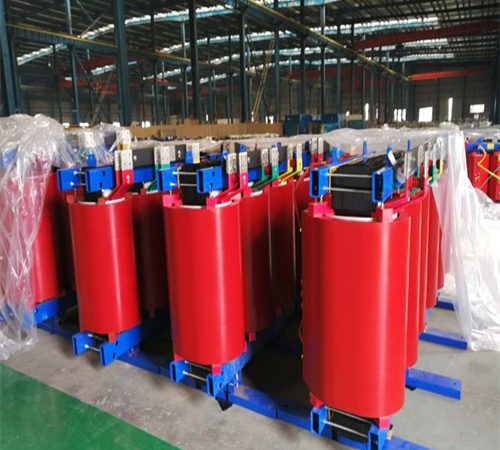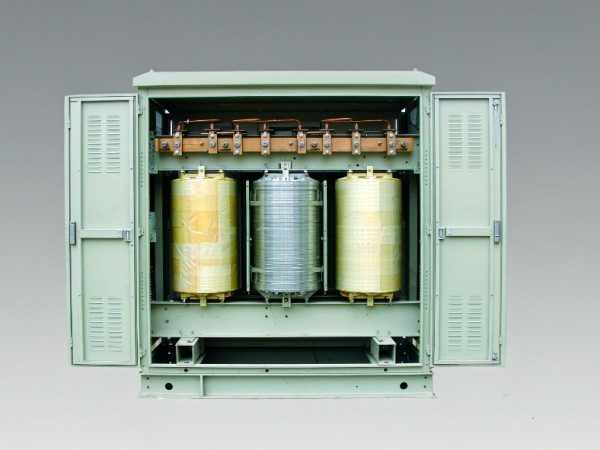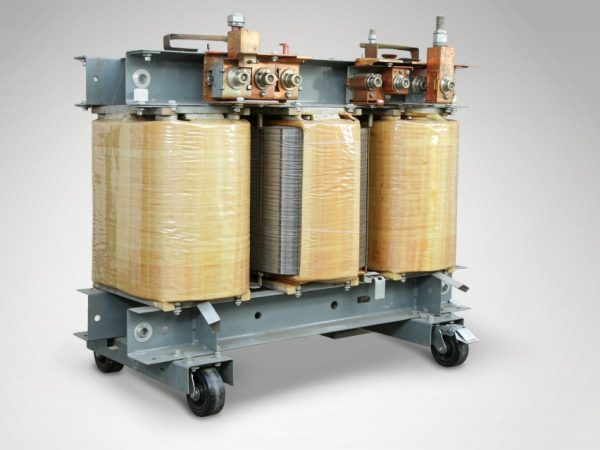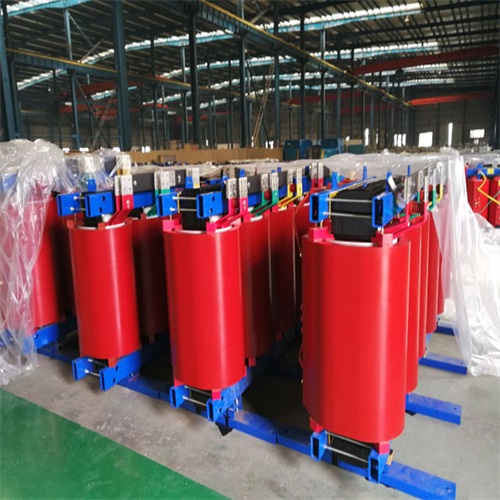
The SCB18 is China’s Grade-1 energy-efficiency cast resin dry-type transformer: a three-phase epoxy-encapsulated unit rated 30–5000 kVA, built on all-copper windings and high-permeability grain-oriented core steel, that cuts no-load loss by roughly 20–30% against an SCB14 and about 10% of load loss. Below: what that grade actually buys you in kilowatt-hours and dollars, the real price bands by capacity, the customization options worth paying for, and what a US buyer has to re-specify for 60 Hz.
Reference frame: GB 20052-2020 (China minimum energy performance standard, Grade 1), IEC 60076-11 (dry-type), IEC 60076-5 (short-circuit withstand), IEC 60076-10 (sound levels), IEEE C57.12.01 / C57.12.51, ISO 9001 / 14001 / 45001. UL 1561 listing, EU Ecodesign 2019/1783 (PEI) and DOE 10 CFR 430 coverage: confirm per target market — a China MEPS grade does not transfer automatically to US or EU compliance.
1. What “SCB18 Grade 1” actually means
1.1 Reading the model code
Chinese type codes pack a surprising amount of information into a few characters:
| Symbol | Meaning | International equivalent |
|---|---|---|
| S | Three-phase | three-phase |
| C | Solid, cast insulation (epoxy resin) | cast resin / epoxy encapsulated |
| B | Copper foil low-voltage winding | foil-wound LV |
| 18 | Loss / performance level code | confirm the exact code-to-grade mapping with the manufacturer — the numeric suffix is a performance code, not a literal percentage |
1.2 Translating the efficiency claim
“Grade 1” (一级能效) is the top band of GB 20052-2020. In practical terms, against the SCB14 series an SCB18 delivers about 20–30% lower no-load loss and roughly 10% lower load loss. The worked example the industry quotes is 800 kVA: 875 W no-load loss for the SCB18 against 1,215 W for an SCB12, a 340 W difference — confirm both figures against the type test report, not the brochure.
One thing to be clear about up front: GB 20052 is a Chinese regulation. Your utility, your insurer and your AHJ outside China will ask for IEC 60076 losses, an EU Ecodesign PEI value, or a DOE efficiency level instead. Ask for all of them on one sheet.
If the technology itself is new to you, start with what a dry type transformer is and how to choose one before you get into efficiency grades.
2. Technical specifications
| Parameter | SCB18 typical | Notes |
|---|---|---|
| Rated capacity | 30–5000 kVA | three practical bands, see Section 4 |
| Primary voltage | 6 / 10 / 20 / 35 kV | export equivalents: 12.47 / 13.8 / 34.5 kV |
| Secondary voltage | 0.4 kV | 480Y/277 V in the US, 600Y/347 V in Canada |
| Frequency | 50 Hz standard | 60 Hz must be specified at RFQ — see Section 9 |
| Phase / windings | Three-phase, two-winding | |
| Vector group | Dyn11 | confirm against your bus arrangement |
| Insulation class | F (155 °C) or H (180 °C) | Class H buys overload headroom |
| Cooling | AN / AF | natural air, forced air for the AF step |
| No-load loss, 800 kVA | 875 W | GB 20052 Grade 1; confirm per type test report |
| Load loss, 800 kVA | confirm per type test report | needed for a real payback calculation |
| Impedance | 4–6% typical | confirm against your fault level |
| Tap changer | Off-circuit (DETC), ±2 × 2.5% | regulation under load needs an OLTC, a different product family |
| Flammability | UL 94 V-0 | quoted as FV-0 in Chinese specifications |
| Ingress protection | IP20 standard, IP23 optional | see the IP warning in Section 6 |
| Partial discharge | ≤ 10 pC | confirm per type test report |
| Acoustics | ≤ 55 dB(A) for a low-noise build | confirm whether this is sound power LWA or sound pressure — see FAQ 7 |
3. Loss, payback, and where the money actually is
Annual energy is not a mystery — it is one formula:
E = P0 × 8760 + Pk × β² × 8760
where P0 is no-load loss in kW, Pk is load loss at rated current in kW, and β is the load factor. No-load loss is billed 24 hours a day whether or not you draw a single amp; load loss scales with the square of the load.
Run the verified part of it at 800 kVA:
- No-load delta: 1,215 W − 875 W = 340 W
- 0.340 kW × 8,760 h = 2,978 kWh per year
- At $0.12/kWh that is about $357 per year, or roughly $7,150 over 20 years undiscounted — and that is no-load only. Add the load-loss delta once you have the
Pknumbers off the test report and the real figure is higher.
| Build (800 kVA) | No-load loss | Grade under GB 20052 | Best for |
|---|---|---|---|
| SCB18 | 875 W | Grade 1 | 7×24 duty, low load factor, long hold periods |
| SCB14 | ~1,100 W | Grade 2 | the value default — full build breakdown on the SCB14 dry-type transformer page |
| SCB12 | 1,215 W | Grade 3 | capex-driven projects, short payback horizons |
| SCBH15 amorphous | materially lower | beyond Grade 1 | see caveat below |
The counter-intuitive part: because the SCB18 cuts no-load loss by 20–30% but load loss by only about 10%, it pays back fastest at low load factor. A commercial building or a data center hall that sits at β = 0.3 most of its life is exactly where the premium earns its keep. Push the same unit to β = 0.7 or above and load loss dominates the bill — at which point you are paying a premium for roughly 10%.
Two honest caveats. First, if no-load loss is genuinely the whole game, the SCBH15 amorphous alloy dry-type transformer cuts it by a further 40–50% — but it costs more and typically runs a few dB louder, which matters in the applications below. Second, do not confuse a Grade 1 label with a compliance certificate; see Section 9.
4. Capacity bands and where each one goes
Across the dry-type and oil-immersed transformer range, capacity splits into three practical bands:
- Small — 200, 250, 315 kVA. Commercial buildings, residential block distribution rooms, retail fit-outs.
- Medium — 630, 800, 1000 kVA. Industrial plants, data centers, hospital campuses.
- Large — 1600, 2000, 2500 kVA. Renewable generation, heavy industry, utility-side step-down.
Commercial buildings — 200–630 kVA. The binding constraint here is almost never capacity, it is noise and fire safety. Specify a low-noise build with ≤ 55 dB(A) at the boundary you care about and IP23 for plant rooms that get washed down. We delivered exactly this profile on low-noise cast resin dry-type transformers for a city hospital, where the switchroom sat directly under occupied wards.
Industrial and data centers — 1000–2500 kVA. Here the asks are short-circuit withstand (a well-built cast winding runs about 20% above a conventional build), continuous overload headroom, and thermal monitoring wired into the BMS. For harmonic-heavy halls, the relevant reference is K-factor rated dry-type transformers for a hyperscale data centre.
Renewables — custom large units. Solar and wind duty means harmonic-rich inverter output, wide ambient swings and often a step-up configuration. Say so at RFQ: inverter duty drives the winding arrangement and the K-factor or IEEE C57.110 derating, and it is expensive to retrofit.
You can see how these bands land in the field in our project case studies.
5. Construction: core, windings, insulation, cooling
Windings. All-copper. That is worth stating in the purchase order rather than assuming it, because an aluminum-wound unit will meet the same kVA and loss tables on paper while behaving very differently under fault and thermal cycling.
Core. High-permeability grain-oriented silicon steel — the mill grade quoted in Chinese specifications as 30QG120, roughly a 1.20 W/kg class at 1.7 T / 50 Hz. Confirm the actual grade against the mill certificate before sign-off; it is cheap to fake on a spec sheet and easy to see on the line.
Insulation. Epoxy resin vacuum cast, UL 94 V-0 flame class, with a conformal moisture/dust/corrosion coating. That coating is the difference between surviving a coastal or high-humidity switchroom and not.
Cooling. Rated AN/AF. If you are sizing a room around a noise limit, remember the fan is the loud part: an AN rating is genuinely quiet, and the acoustic picture changes the moment forced air kicks in.
Where cast resin stops being the answer. Above roughly 35 kV or 6 MVA, a cast resin unit loses its cost advantage to a liquid-filled design, and at that point the fire-safety argument has to be weighed against a materially higher purchase price. The trade-off is laid out in oil-immersed vs dry-type: how to choose.
6. Customization options
| Option | Choices | When to pick it | Cost impact |
|---|---|---|---|
| Voltage combination | 10/0.4 kV, 35/10 kV, non-standard | any site that does not match the national grid pattern | engineering + tooling |
| Ingress protection | IP20 (default), IP23, IP40 | IP23 for wash-down and sheltered outdoor plant rooms | modest |
| Enclosure | None, mild steel, stainless steel | stainless for coastal, chemical or food-processing sites | confirm per enclosure size |
| Thermal monitoring | PT100 sensors + controller, fan start/alarm/trip | any unattended or BMS-integrated site | modest |
| Communications | RS485, Modbus RTU | when the switchroom reports to a central SCADA or BMS | modest |
| Special duty | High altitude, high ambient, K-factor, inverter duty | renewables, data centers, sites above 1,000 m | derating or upsizing |
A correction worth flagging on IP ratings. IP40 is often described as “splash-proof.” It is not. The second digit is 0, which means no water-ingress rating at all — IP40 improves protection against solid objects while giving up the spray protection IP23 provides. If water is the risk, IP23 or a sealed IP54 enclosure is the answer. And note that a sealed enclosure restricts cooling: it forces either forced-air cooling or derating, and forced air raises noise. Those two decisions have to be made together.
7. Pricing: what these units actually cost
| Capacity (kVA) | Indicative China ex-works (CNY) | Approx. USD | Notes |
|---|---|---|---|
| 200 | ¥37,700 – ¥54,500 | $5,200 – $7,600 | most price-competitive band; several factories quote from the low end |
| 400 | ~¥85,000 | ~$11,800 | common commercial-building size |
| 630 | ¥93,000 – ¥104,000 | $12,900 – $14,400 | |
| 800 | ~¥95,000 – ¥104,000 | ~$13,200 – $14,400 | the size used in the loss example above |
| 1000 | ¥150,000 – ¥181,000 | $20,800 – $25,100 | |
| 1600 | ¥216,000 – ¥222,000 | $30,000 – $30,800 | |
| 2500 | from ¥300,000 | from ~$41,700 | quoted as custom; engineering-led |
Read these as China domestic ex-works, 50 Hz, copper-price sensitive, converted at roughly ¥7.2 to the dollar. An export order lands materially higher once you add 60 Hz design work, IEEE or UL compliance testing, export crating, ocean freight, insurance and duty — confirm the multiplier with your own landed-cost model rather than assuming a fixed ratio. Two other things move the number fast: the copper price on the day of quotation, and whether the unit is IEC or ANSI specified.
8. Suppliers and how to vet them
Representative China-market sources for this class of unit:
| Supplier | Location | Strength |
|---|---|---|
| Jiangsu Juli Electric Power Equipment Co., Ltd. | Xuzhou, Jiangsu | Full capacity coverage; claims ~12-day dispatch and supplies type test certificates. Verify both claims on your own order. |
| Henan Diteli Electric Co., Ltd. | Zhengzhou, Henan | Focused on large units; 2000–2500 kVA custom builds |
| Sute Electric (Jiangsu) | Xuzhou, Jiangsu | Strong value at the small end — 200 kVA from around ¥37,700 |
| Zhongdian Electric (China Electric) | China | Large-unit and utility-side work |
These are independent factories, listed for orientation. Verify each one yourself as you would any other supplier.
Procurement checklist:
- Type test report for the exact rating, plus routine test reports for the actual unit shipped — not a family certificate.
- Loss values on the test report, not the marketing sheet. This is the single number most worth challenging.
- ISO 9001 / 14001 / 45001. CE where it applies. UL listing: confirm per market — treat as available on request until you see the file number.
- Conductor material in writing. “All copper” belongs in the PO, not in an email.
- Freight insurance, explicitly, on anything above about 1600 kVA. Large cast resin units are heavy, brittle and awkward to claim on.
- Warranty and response in the contract — three years and a 48-hour response commitment is a reasonable ask.
Our transformer knowledge base and buying guides go considerably deeper on supplier due diligence.
9. Specifying an SCB18 for 60 Hz and North American markets
- Voltage mapping. 10 kV → 12.47 kV or 13.8 kV. 35 kV → 34.5 kV. 0.4 kV → 480Y/277 V (600Y/347 V in Canada). Give the actual system voltages, not the Chinese nominal.
- Frequency. 60 Hz changes core cross-section, flux density, impedance and loss. It has to be on the RFQ; it cannot be corrected after the core is cut.
- Code. NFPA 70 (NEC) Article 450 governs installation; clearances, ventilation and overcurrent protection are local.
- Standards family. IEC 60076 vs ANSI/IEEE: which standard your export transformer needs — read this before you accept a “compliant” claim, because the two families do not test or declare the same things.
- Efficiency regulation. US DOE 10 CFR 430 rules cover distribution transformers within a defined kVA and voltage scope; a large power transformer sits outside that scope and its efficiency is governed by contract specification instead. Confirm the exact scope with your compliance team before quoting a DOE level.
- Thermal setpoints. Chinese-market convention is fan start around 70 °C and trip at 130 °C. North American Class F practice is typically fan start near 80 °C, alarm around 130 °C, trip around 150 °C. Ask for the setpoints to be reconfigured rather than inheriting factory defaults.
10. FAQ
What does SCB18 mean, and how is it different from SCB14 or SCB13?
S is three-phase, C is cast resin insulation, B is a copper foil low-voltage winding, and 18 is the loss-level performance code. Against an SCB14 the SCB18 runs roughly 20–30% lower no-load loss and about 10% lower load loss; against an SCB13 the gap is wider still. Higher number, lower loss — but confirm the code mapping with the manufacturer, because the suffix is a performance code rather than a percentage.
Is “Grade 1 energy efficiency” recognized outside China?
Not as a compliance claim. Grade 1 is the top band of GB 20052-2020, a Chinese minimum energy performance standard. Outside China you will be asked for IEC 60076 loss values, an EU Ecodesign PEI figure under Regulation 2019/1783, or a DOE efficiency level under 10 CFR 430. Ask the factory to put all of them on one data sheet.
Will an SCB18 run on a US 60 Hz system?
Yes, but only if it is designed for it. 60 Hz changes the core cross-section, flux density, impedance and both loss figures. Declare 60 Hz and the actual primary and secondary voltages on the RFQ; a unit built for 50 Hz cannot be economically converted afterward.
How much money does the efficiency upgrade actually save?
At 800 kVA, the 340 W no-load delta between an SCB12 (1,215 W) and an SCB18 (875 W) works out to 2,978 kWh a year — about $357 a year at $0.12/kWh, roughly $7,150 over 20 years undiscounted, on no-load loss alone. Use E = P0 × 8760 + Pk × β² × 8760 with your own load factor and tariff for the full figure. The premium pays back fastest at low load factor, because no-load loss is the part that gets cut the most.
When should I not buy a cast resin dry-type transformer?
Above roughly 35 kV or 6 MVA, where a liquid-filled unit is usually the better value unless fire safety dominates. Also reconsider where noise is the binding constraint and an amorphous core is being proposed — amorphous saves more no-load loss but typically runs a few dB louder, so near patient rooms, classrooms or bedrooms a conventional build with vibration isolation often hits the limit more easily.
What IP rating do I need — IP20, IP23 or IP40?
IP20 for a clean, dry, indoor switchroom, which is the default. IP23 where there is spray exposure or wash-down. IP40 protects better against solid objects but carries no water-ingress rating at all, so it is not an upgrade over IP23 where water is the risk. A sealed enclosure cuts cooling capacity, which forces forced-air cooling or derating — and forced air raises noise.
How quiet is it, and how do I compare noise numbers honestly?
Ask whether the number is sound power (LWA, declared per IEC 60076-10) or sound pressure at a stated distance. In a free field, sound pressure at 1 m is roughly LWA minus 11 dB, and it drops a further 6 dB each time the distance doubles; hard-walled switchrooms reflect and push it back up. Also specify whether the rating is AN or AF, because the fans add several dB. Structure-borne transmission usually matters more than airborne — anti-vibration mounts are the cheapest decibel you will ever buy.
What do you need from me to quote an SCB18?
Six things: kVA rating; primary and secondary voltage; frequency (50 or 60 Hz); vector group and impedance; enclosure and IP rating; and the duty profile — load factor, ambient temperature, altitude, and whether the load is harmonic-rich or inverter-fed. Add the standards family (IEC or ANSI/IEEE) and any AHJ requirements, and you will get a quote you can actually compare.