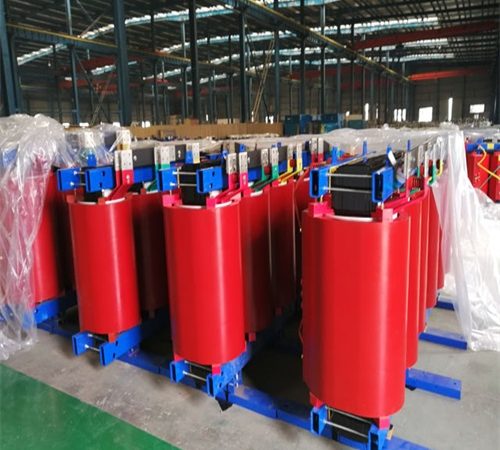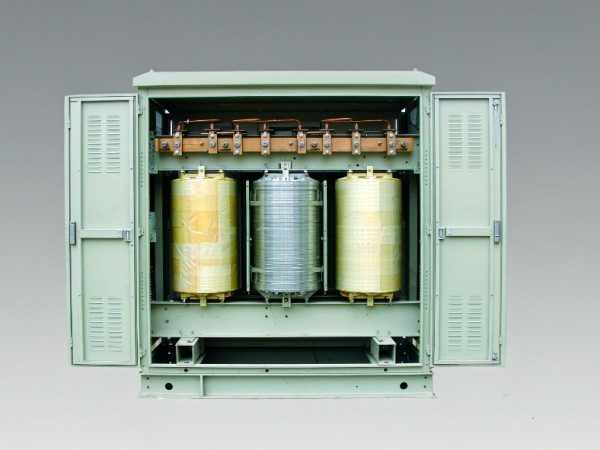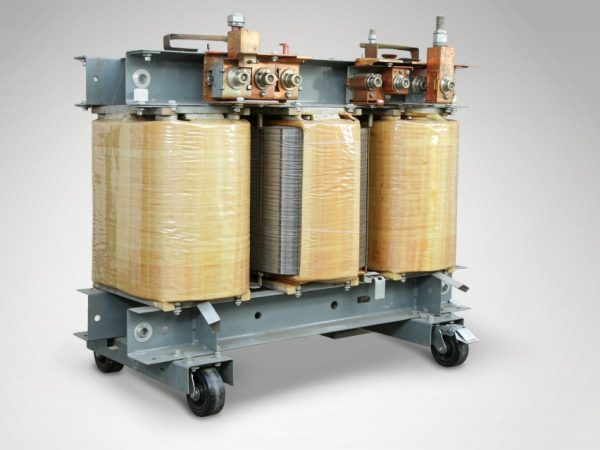
The SCB14 is China’s Grade-2 energy-efficiency epoxy resin cast dry-type transformer: a cast resin dry-type transformer built around lower-loss core steel, vacuum-cast windings and a Class F/H insulation system. This page breaks down how those numbers are actually achieved on the factory floor — core steel and step-lap geometry, foil versus wire windings, vacuum casting, what gets tested before shipment — and what an export buyer has to re-specify for 60 Hz, IEC or UL markets.
Reference frame: IEC 60076-11 (dry-type), IEC 60076-5 (short-circuit withstand), IEEE C57.12.01 / C57.12.51, ISO 9001 / 14001 / 45001. UL 1561 listing, EU Ecodesign PEI and DOE 10 CFR 430 coverage: confirm per target market — do not assume a China MEPS grade transfers.
1. Materials: core steel, windings and the insulation system
1.1 Core
- Electrical steel. High-permeability grain-oriented cold-rolled silicon steel — the mill grade quoted as “80” in Chinese specifications, roughly a 0.80 W/kg class at 1.7 T / 50 Hz. Confirm the actual grade against the mill certificate before you sign off.
- Joint geometry. Five-step fully mitred step-lap joints, which keep flux crossing the air gap at a shallow angle and cut the no-load loss by 30%+ versus a conventional SCB11-class build.
- Surface and clamping. Core surface sealed with epoxy; clamps and fasteners treated to suppress circulating current paths; core limbs bound with Class F weftless (unidirectional) glass tape, which drops the running noise by 10–15 dB against a conventional unit.
Two things worth pushing back on during a factory audit: the steel grade on the certificate, and whether the step-lap is genuinely five-step. Both are cheap to fake on a spec sheet and easy to see on the line.
1.2 Windings
- HV winding. Vacuum cast with silica-filled epoxy resin, partial discharge held to ≤ 5 pC, glass fiber mesh reinforcement on both the inner and outer wall. The mesh is what raises short-circuit withstand — roughly 50% better than an unreinforced cast winding.
- LV winding. Foil construction, which removes the axial helix angle problem you get with a wire-wound LV winding and therefore the ampere-turn imbalance behind it — ampere-turn balance improves by about 30%. Axial cooling ducts take heat out of the winding stack (+20% heat dissipation per the build sheet), and DMD epoxy prepreg between layers cures into a single solid block.
1.3 Insulation system
Class F (155 °C) or Class H (180 °C), with the winding hot spot held under 110 °C. That headroom is what lets the unit carry roughly 40% over rating for short periods. Windings get a conformal “three-proof” coating — moisture, dust, corrosion — which is the difference between surviving a coastal or high-humidity switchroom and not.
2. Key manufacturing steps
| Step | What is controlled | Target |
|---|---|---|
| Core cutting | Automatic cut-to-length line, 45° full mitre | Stacking factor ≥ 95%, limb height tolerance ≤ ±1 mm |
| Core assembly | Resin bonding between laminations instead of traditional banding | ≈ 2 dB lower noise; insulating board under top/bottom clamps to avoid a closed short-circuit loop |
| HV winding | Computer-controlled automatic winder | Tension fluctuation ≤ ±5% (keeps the coil from going slack or deforming) |
| LV foil winding | Auto edge-alignment + argon arc welding | Foil flatness ≤ ±0.5 mm, weld strength ≥ 90% of base metal |
| Pre-drying | 80–110 °C hot-air circulation | Coil moisture content below 0.5% |
| Vacuum casting | Vacuum ≤ 10 Pa | Full resin penetration into winding gaps; +30% mechanical strength after cure |
The two rows that most often get quietly skipped are pre-drying and the vacuum level. If the coil goes into the mold with moisture still in it, no amount of resin will save the partial discharge figure.
Cooling is rated AN/AF: natural air up to the base rating, forced air for the AF step. If you are sizing a room around a noise limit, remember the fan is the loud part — see transformer cooling classes for how AN and AF ratings change the acoustic picture.
3. Quality control and testing
Incoming materials. Silicon steel, epoxy resin and conductor all carry RoHS compliance; insulation materials are verified to the declared F/H temperature class; flame retardancy to UL 94 V-0.
In-process.
- Core: joint density checked after stacking, no-load loss within ±3%, three-phase no-load current spread ≤ 5%.
- Windings: DC resistance balance ≤ 2%, partial discharge ≤ 5 pC, temperature rise test per insulation class.
Type tests. Short-circuit withstand to IEC 60076-5 with winding deformation ≤ 1%; climatic cycling −40 °C to +70 °C with no insulation degradation.
Two honest corrections to the usual build sheet. First, “top-oil temperature rise ≤ 60 K” is a liquid-filled measurement — for a dry-type unit the number that matters is winding rise by resistance, and the declared limit should be confirmed to IEC 60076-11. Second, −40 °C in continuous service is outside what IEC 60076-11 climatic class C2 normally declares (−25 °C in service, −40 °C in transport and storage); confirm which class your unit is actually declared to.
4. Smart monitoring, customization and what each option costs
The standard monitoring package is six PT100 sensors on the windings feeding a controller that starts the cross-flow fans at 70 °C and trips at 130 °C. Under those setpoints and normal indoor duty the design life quoted is 30 years (design target — tied to the stated duty cycle and maintenance regime, not a warranty).
Note that 70 °C fan start and 130 °C trip are the Chinese-market convention. Class F units in North America are usually set for fan start around 80 °C, alarm ~130 °C, trip ~150 °C. Ask for the setpoints to be reconfigured rather than assuming the factory defaults.
| Variant | What changes | Indicative price uplift |
|---|---|---|
| High-altitude | Insulation coordination and cooling derated for > 4 000 m | +15–20% |
| Low-noise | Acoustic package, ≤ 55 dB(A) for hospitals and schools | +10–15% |
| Explosion-proof | Ex d IIB T4 construction | +25% and up |
For US projects, Ex d IIB T4 is an IEC/ATEX scheme marking; the local equivalent is a NEC Class I, Division 2 or Zone 1 listing, and that has to be confirmed with the authority having jurisdiction.
5. Where SCB14 earns its money
Rail and metro. Short-circuit impedance tailored to 4–8% to suit the rectifier and fault level. On one metro line in Nanjing the utility reported a 37% drop in failure rate after the swap (as reported in the project brief; ask for the underlying maintenance record).
Solar and storage. Cast resin handles 30–120% load swing without the thermal cycling penalty that a liquid-filled unit takes.
Data centers. This is the strongest SCB14 case: a lightly loaded, 7×24 site spends most of its life paying for no-load loss. See how we specified K-factor dry-type transformers for a hyperscale data centre.
Hospitals and schools. Low noise is the binding constraint, not efficiency. For a room next to a ward or a classroom, a low-noise cast resin unit plus anti-vibration mounts usually beats chasing a lower loss figure — structure-borne noise travels further than airborne noise.
High-rise and commercial. The brief quotes IP68; for a ventilated dry-type transformer that is not a normal rating and probably refers to a sealed enclosure variant. Confirm whether the IP claim applies to the winding assembly or only to the enclosure.
Run the saving yourself rather than taking a headline number. Annual loss energy in kWh is P0 × 8760 + Pk × β² × 8760, where:
P0= no-load loss in kW, billed every hour of the yearPk= load loss at rated load in kWβ= load factor (0.65 in the example below)
At 65% load factor and ¥0.8/kWh, the quoted saving is about ¥150,000 per year (≈ US$21,000). At US industrial rates that figure moves a lot, so re-run it with your own tariff before you write the business case.
One caveat: the lifecycle CO₂ figure of 45–575 tonnes per unit depends entirely on the grid mix you displace. Ask for the emission factor behind the number.
6. Specifying an SCB14 for North America and other export markets
| Chinese spec | North American equivalent | Notes |
|---|---|---|
| 10 kV | 12.47 kV / 13.8 kV | 13.8 kV is the common US primary for this size |
| 35 kV | 34.5 kV | Above this, cast resin stops being the default choice |
| 0.4 kV | 480Y/277 V (600Y/347 V in Canada) | Confirm the LV neutral and grounding scheme |
| 50 Hz | 60 Hz | Must be stated at RFQ stage — it cannot be changed afterward |
| GB 20052 Grade-2 | IEC 60076 / EU Ecodesign 2019/1783 (PEI) / DOE 10 CFR 430 | GB 20052 is a China MEPS; overseas buyers do not recognize it |
Where cast resin is the wrong answer. Above roughly 35 kV and 6–10 MVA, a cast resin dry-type transformer stops being cost-effective next to a liquid-filled unit — you pay for epoxy and cooling air that oil gets for free. And for US distribution work, DOE 10 CFR 430 covers distribution transformers and, in practice, liquid-filled units up to about 2500 kVA; large power transformers fall outside it, so efficiency has to be locked down in the contract rather than assumed from a standard. If you are comparing across that line, read oil-immersed vs dry-type: how to choose before you freeze the one-line diagram.
There is also a Grade-1/Grade-2 inconsistency in the source brief: SCB14 is normally positioned as Grade-2 under GB 20052, while the same brief cites GB 20052-2020 Grade-1. Confirm the current standard edition and the grade your unit is certified to. Regional purchase subsidies of up to 30% are a China domestic instrument and do not apply to export orders.
7. SCB14 vs SCB13 vs SCB11 vs SCBH15
| Model | Core material | No-load loss vs SCB11 | Best fit | Trade-off |
|---|---|---|---|---|
| SCB11 | Conventional GO steel | Baseline | Budget retrofit | Highest running cost |
| SCB13 | Improved GO steel | ≈ −20% | General duty | Balanced |
| SCB14 | High-grade GO steel, 5-step step-lap | ≈ −30% | 7×24 lightly loaded sites | Modest premium over SCB13 |
| SCBH15 | Amorphous alloy | ≈ −40 to −50% | Very light, long-hour duty | Higher cost, and usually a few dB louder |
The counter-intuitive one is SCBH15. Amorphous metal cuts no-load loss harder than SCB14, but the material is more magnetostrictive, so an amorphous unit next to a bedroom or a ward often needs more acoustic treatment than an SCB14 to hit the same dB limit. See the SCB13 series cast resin dry-type transformer and the SCBH15 amorphous alloy dry-type transformer for the full loss tables.
8. Buyer checklist: what to send with your RFQ
- kVA rating, primary and secondary voltage, and frequency (50 or 60 Hz).
- Vector group and whether you need an off-circuit or on-load tap changer.
- Site altitude, ambient range, indoor or outdoor, and IP/NEMA enclosure requirement.
- Noise limit in dB(A) and the distance and room conditions it applies to.
- Insulation class (F or H) and the temperature-rise limit you want declared.
- Standards the unit must be declared to — IEC 60076-11, IEEE/ANSI, UL, EU Ecodesign.
- Harmonic profile or K-factor requirement if the load is rectifier-heavy.
- Which routine and type tests you want witnessed, and by whom.
9. FAQ
What does “SCB14” actually mean?
A Chinese type designation: S for three-phase, C for cast resin (solid insulation), B for the foil or copper-wound low-voltage construction, and 14 for the loss/efficiency step in the national series. It is a platform designation, not a complete specification — voltage, frequency, impedance, IP rating and monitoring all still have to be stated.
Is SCB14 the same as a Grade-2 efficiency transformer?
SCB14 is normally positioned at Grade-2 under GB 20052, China’s minimum energy performance standard for transformers. That grade does not transfer to an export project — overseas buyers need IEC 60076 loss values, EU Ecodesign PEI, or DOE 10 CFR 430 compliance, quoted separately.
Can an SCB14 be built for 60 Hz and US voltages?
Yes, but it has to be on the order from the start. 60 Hz changes core flux, loss and impedance, and the LV winding is usually built for 480Y/277 V rather than 400 V. Retrofitting frequency after manufacture is not possible.
How loud is it, and what does dB(A) mean here?
The number to ask for is the sound power level LWA declared under IEC 60076-10, not a sound pressure reading taken at an arbitrary spot. In a free field, sound pressure at 1 m is roughly LWA − 11 dB, and it drops another 6 dB each time you double the distance — a hard-walled switchroom reflects sound back and pushes the real figure up.
For a 7×24 site, should I optimize no-load or load loss?
No-load loss. It is billed 8,760 hours a year regardless of what the load is doing; load loss scales with the square of the load factor. On a data center running at 30–40%, no-load loss dominates the lifetime cost by a wide margin.
Is cast resin always the safer choice over oil-immersed?
Not at high ratings. Cast resin wins on fire behavior and indoor siting, but above roughly 35 kV and 6–10 MVA the cost per kVA turns against it. A modern ester-filled unit (IEC 61099 synthetic ester or IEC 62770 natural ester) also carries a fire point above 300 °C, which closes much of the safety gap.
How much do the custom variants really add?
Indicative uplifts are 15–20% for high-altitude construction above 4 000 m, 10–15% for a low-noise package at ≤ 55 dB(A), and 25% or more for explosion-proof construction. Treat these as budget guidance and get a live quotation — resin and copper move.
What should I insist on before shipment?
Winding resistance and balance, ratio and vector group, no-load loss and current, load loss and impedance, partial discharge (≤ 5 pC), applied and induced voltage withstand, and a temperature-rise test if it was not already covered by a type test on the same design. Ask for the test report with the serial number on it.