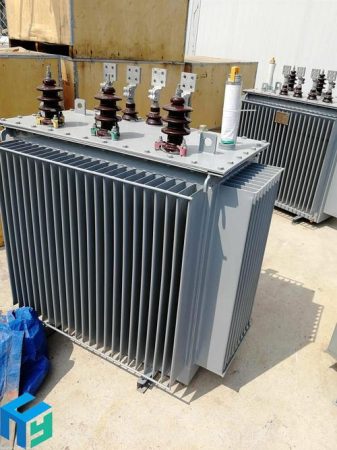
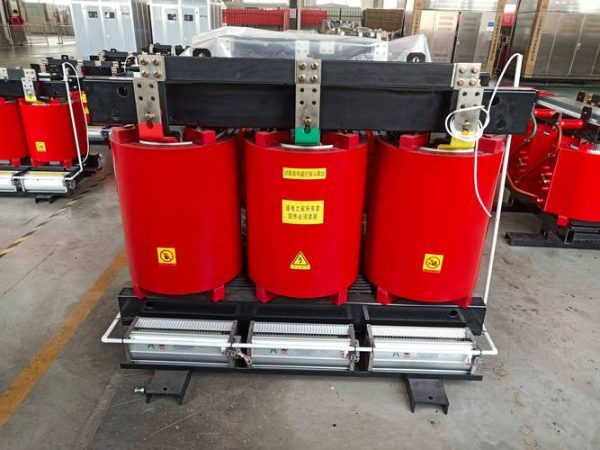
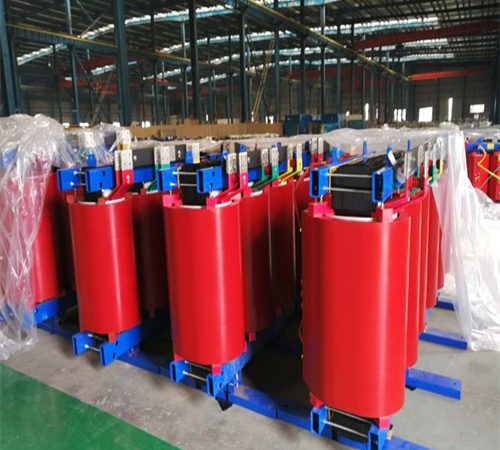
The CSNS-II is a cast resin (epoxy encapsulated) dry-type distribution transformer in the 30 kVA to 2500 kVA band, with Class F or Class H insulation, AN/AF cooling and an IP20 or IP23 enclosure. It is used where oil is not acceptable — malls, hospitals, data centres, metro stations, solar and wind collector substations. This page translates the factory spec sheet into the language a North American specifying engineer expects, flags four claims that need rewording before you send it to a client, and gives you the loss math to justify the efficiency premium. For the wider family, see our cast resin dry-type transformers and the full product catalogue.
Standards referenced on this page: IEC 60076-1/-2/-5/-10/-11 · IEEE/ANSI C57.12.00, C57.12.01, C57.12.51 · IEEE C57.110 (K-factor) · IEEE C57.91 and IEC 60076-7 (loading guides) · NEC Article 450 · GB/T 10228 and GB 20052 (China MEPS) · UL 1561 [Confirm listing status per model].
1. What “CSNS-II” Actually Is — and What to Confirm Before You Quote It
“CSNS-II” is not a designation defined by IEC 60076 or by GB/T 10228. In those standards a dry-type unit is identified by its winding conductor, core and performance code — SCB for epoxy-cast foil/resin windings with a silicon steel core, SCBH for the same construction with an amorphous metal core, followed by a performance level number (SCB11, SCB12, SCB13, SCB14, SCB18).
That matters for two practical reasons:
- A US buyer cannot cross-reference “CSNS-II” against anything. An engineer writing a spec needs a code that maps to a recognised performance level, or — better — the actual guaranteed loss figures in watts.
- The source data sheet mixes codes. The loss examples quoted for “CSNS-II” are given against an SCB13-1000 kVA reference. That implies the CSNS-II performance tier sits at or near SCB13 level, but the mapping has to be stated by the factory, not assumed.
So treat CSNS-II as the manufacturer’s internal series name and require the nameplate and the type-test report to carry, at minimum: rated power, rated voltages and BIL, frequency, vector group, impedance at rated tap, insulation class, temperature rise, cooling designation, measured no-load and load loss in watts, measured sound level, and the applicable efficiency grade under GB 20052 or DOE 10 CFR Part 431 Subpart K.
Do not put “CSNS-II” alone on a submittal. Write it as “CSNS-II series cast resin dry-type transformer, performance equivalent to SCB13 per GB/T 10228 confirm equivalence in writing before submittal“, and attach the guaranteed-loss schedule.
2. Typical Ratings and Technical Parameters
The table below is the factory typical-value sheet, annotated with what a specifier should verify. Every value marked with a placeholder must come from the type-test report for the exact kVA rating you are buying — not from a brochure range. If you want a worked example of the same exercise done for a known Chinese performance code, see the SCB13 series cast resin dry-type transformer.
| Parameter | Typical value / range | What to confirm |
| Rated capacity | 30 kVA – 2500 kVA (common steps: 100, 315, 630, 1250 kVA) | For North America, use ANSI/IEEE standard sizes: 75, 112.5, 150, 225, 300, 500, 750, 1000, 1500, 2000, 2500 kVA. 100/315/630/1250 kVA are not ANSI standard sizes; specifying them is fine but expect a non-standard lead time. |
| Rated primary voltage | 10 kV, 11 kV, 35 kV | NA equivalents: 12.47 kV or 13.8 kV (for 10/11 kV), 34.5 kV (for 35 kV). State BIL: 75 kV BIL for 13.8 kV class, 150 kV BIL for 34.5 kV class confirm per ANSI C57.12.00 table. |
| Rated secondary voltage | 0.4 kV, 0.69 kV (custom available) | 0.4 kV → 480Y/277 V in the US; 600Y/347 V in Canada. 0.69 kV is a wind-turbine collector voltage; in North America specify 480 V or 600 V instead. |
| Insulation class | Class F or Class H (155 °C / 180 °C) | Class is not the same as temperature rise. Specify insulation system class and the average winding temperature rise (typically 80 K or 100 K for cast resin) separately. A Class H system still needs a stated rise limit. |
| No-load loss | “20%–30% below GB/T 10228” (e.g. SCB13-1000 kVA ≈ 1700 W) | GB/T 10228 is a Chinese standard that sets limits; it is not the reference a US engineer will check. Provide the absolute watts and, for the US, the DOE 10 CFR 431 Subpart K value confirm which subpart applies to your voltage class. |
| Load loss | “Grade 1 energy efficiency” (e.g. SCB13-1000 kVA ≈ 9500 W) | Verify the grade against the current GB 20052 edition before you print it. Under GB 20052-2020 the SCB13 performance level is generally understood to sit at Grade 2, with SCB14/SCB18 reaching Grade 1 confirm the grade for your exact kVA and voltage before you claim Grade 1. |
| Short-circuit impedance | 4% – 6%, adjustable | State the tolerance: IEC 60076-1 allows ±10% of the guaranteed value for the principal tapping. Impedance drives fault current, voltage regulation and parallel operation — do not leave it as a range on the submittal. |
| Cooling | AN / AF (natural air / forced air) | AN is the base rating. AF typically adds 40%–50% capacity but only while the fans run, and adds several dB of noise. See Section 5. |
| Enclosure / ingress | IP20 (indoor standard) or IP23 (with enclosure) | IP23 protects against water sprayed at up to 60° from vertical at low pressure. It is not an outdoor rating. Outdoor needs IP54 (or NEMA 3R minimum). |
| Sound level | ≤ 55 dB(A) at 1 m, below 1000 kVA | The declared value in a test report is normally sound power level LWA per IEC 60076-10, not sound pressure. Free-field sound pressure at 1 m ≈ LWA − 11 dB. For a typical 1000 kVA cast resin unit, 55 dB(A) at 1 m is optimistic confirm per type test, and state the AF-fan value separately. |
| Overload capability | “120% load continuously at 40 °C ambient” | This claim needs rewriting. See Section 5. |
| Frequency | 50 Hz (as standard) | 60 Hz must be declared at RFQ stage. A 50 Hz core cannot be re-rated to 60 Hz after manufacture; conversely a 60 Hz unit on 50 Hz will over-flux. |
3. Voltage and Frequency: Translate the Nameplate Before You Issue an RFQ
This is the single most common failure point in exporting Chinese transformers to North America. The design voltages in the source sheet are Chinese grid voltages. Map them before you send anything to a client:
| Chinese nameplate | North American equivalent | Note |
| 10 kV / 11 kV | 12.47 kV or 13.8 kV (delta or grounded wye) | Confirm with the serving utility; 12.47 kV and 13.8 kV are not interchangeable on tap ranges. |
| 35 kV | 34.5 kV | Same winding class, different BIL and tap requirements. |
| 0.4 kV | 480Y/277 V | 600Y/347 V for Canada. |
| 0.69 kV | 480 V or 600 V | 690 V is a wind-standard voltage; it has no NA distribution equivalent. |
| 50 Hz | 60 Hz | Must be stated at RFQ. Affects core cross-section, no-load loss, inrush and impedance. |
| Dyn11 | Dyn1 | ANSI/IEEE phase-displacement notation counts in 30° steps; Dyn11 (330° lag) is written Dyn1 in ANSI drawings. |
| Altitude ≤ 1000 m | Derate above 1000 m | IEC 60076-2 gives the altitude correction for temperature rise; sites above 1000 m (Denver, Mexico City, Andean and Rocky Mountain projects) need a stated derating factor. |
4. Where the Marketing Copy Holds Up — and Where It Needs Rewriting
The four advantage blocks in the source sheet are directionally right, but four of them are stated in a way that will get challenged in a North American review meeting. Here is each claim, what is defensible, and the wording that survives.
4.1 Fire safety and environmental claims
What holds up. A cast resin dry-type transformer contains no liquid dielectric. There is no oil to leak, no oil to fuel a pool fire, no oil containment bund, no oil sampling, and no fire-rated transformer room with drainage in most installations. That is a genuine, defensible advantage in occupied buildings — malls, hospitals, schools, data halls, high-rise cores.
What needs rewording. Three specific items:
- “Eliminates all fire and explosion risk” is overstated. The epoxy and the insulation system are organic. Cast resin units are self-extinguishing and do not sustain a fire once the ignition source is removed, but they will burn and decompose in a sustained fire. Write “contains no flammable liquid; fire behaviour class F1 per IEC 60076-11 confirm“, not “cannot burn.”
- UL 94 V-0 is a plastics flammability rating, not a transformer rating. It tests a small resin sample. The transformer-level fire test is the IEC 60076-11 fire behaviour class F1 test, which subjects a complete unit to a defined fire exposure and measures released energy and self-extinguishing behaviour. Quote F1 as the headline; V-0 is supporting evidence for the resin only. Ask for the actual test report number confirm availability.
- “No toxic gas when burning” cannot be stated without a test. Smoke toxicity and halogen content need a stated test method and result (for rail applications EN 45545-2 sets the requirement). Without it, write “low smoke, halogen-free resin system confirm per material declaration“.
RoHS and REACH are European chemical-substance regulations. They are recognised globally as a material-declaration discipline, but for a US buyer they are not the applicable framework — what matters is a material declaration plus, where relevant, California Prop 65 and TSCA statements, along with UL recognition of the insulation system. Recyclability above 90% needs to be stated with its calculation basis confirm.
4.2 Losses and efficiency claims
What holds up. Cast resin units with modern stepped-lap cores and low-loss foil windings do run meaningfully below older SCB9/SCB10 levels, and the loss figures are what a purchaser should actually buy on.
What needs rewording — and this one is important. The source sheet says no-load loss is “40%–60% lower than a conventional oil-immersed transformer.” That comparison does not hold. At the same kVA and voltage, an oil-immersed unit generally has equal or lower losses than a dry-type unit, because liquid cooling removes heat far more effectively and lets the designer use a higher flux density and shorter conductors. Dry-type wins on fire safety, siting and maintenance — not on losses.
The 40%–60% figure is real, but it belongs to a different comparison: an amorphous metal core versus a silicon steel core within the same design family. Amorphous ribbon has much lower specific core loss, so SCBH-type units cut no-load loss by roughly 50%–70% against an equivalent silicon-steel unit. If your CSNS-II variant uses an amorphous core (the source sheet refers to a “CSNS-II-A” version confirm designation and availability), that is where the 40%–60% claim comes from. State it that way and it is credible; state it as “dry beats oil” and the first engineer who reads your submittal will discount the whole page.
Also verify the efficiency grade. GB 20052 is the Chinese minimum energy performance standard — North American and European buyers will check against DOE 10 CFR Part 431 Subpart K (§§431.196–431.198) for the US and EU Ecodesign Regulation 2019/1783 (PEI) for Europe. Quote GB 20052 alongside them, never instead of them, and confirm the current edition before printing a grade.
4.3 Ambient temperature, humidity and harmonics
- Ambient −25 °C to +50 °C, humidity ≤ 95%. The standard service condition in IEC 60076-1 is −5 °C to +40 °C, with 40 °C as the maximum ambient. Operation above 40 °C is not “wide-range capability” — it requires derating, and the derating curve must be supplied. For cast resin units the relevant IEC 60076-11 classes are C2 (climatic, down to −25 °C), E2 (environmental, condensation and pollution) and F1 (fire behaviour). Quote the three-letter class, not a raw temperature range, and give the derating table for anything above 40 °C confirm class per type test.
- “Suitable for harmonics, THD ≤ 5%.” THD is a property of the system current waveform, not a rating of the transformer. What you specify is the harmonic current spectrum the transformer must carry, and then either a K-factor rating per IEEE C57.110 or a design to IEC 61378-1. And here is the counter-intuitive part: modern IGBT-front-end inverters and VFDs often produce current THD well below 5% on the transformer secondary, which means a K-rated unit may be money spent for nothing. Measure or model the actual spectrum first; on one hyperscale data centre project we reviewed, the harmonic content did not justify K-rating at all — read that K-rated dry-type transformer project for a hyperscale data centre before you pay for a K-factor you may not need.
4.4 Monitoring and maintenance
The maintenance story is the strongest part of the source sheet and needs no correction: no oil means no oil testing, no filtration, no leak repair, no bund inspection and no oil-change disposal. That is a real operating-expenditure saving over a 25-year life, and it is usually bigger than the energy saving on lightly loaded indoor units.
On monitoring, specify it concretely rather than as an option list: PT100 sensors in each winding (typically 3 per phase, 2 wired to alarm/trip and 1 spare), a temperature controller with separate alarm and trip contacts, RS-485 Modbus RTU or Modbus TCP, and — if the site has one — an IEC 61850 or DNP3 gateway for the SCADA integration. Confirm the protocol before ordering; retrofitting a gateway is far more expensive than specifying it.
5. Overload: Read This Before You Accept “120% Continuous”
The source sheet claims 120% load continuously at 40 °C ambient. As written, that is not a defensible rating, for two reasons.
First, 40 °C is not a special condition — it is the standard maximum ambient in IEC 60076-1 and IEEE C57.12.00. Stating that 120% is available “at 40 °C” therefore tells you nothing extra; the rating is already defined at that ambient.
Second, continuous operation above nameplate rating is overloading, and overloading consumes insulation life. Both IEC 60076-7 and IEEE C57.91 give loading guides based on hot-spot temperature: the commonly used rule of thumb is that winding insulation ageing roughly doubles for every 6–8 K increase in hot-spot temperature. A unit run at 120% continuously will run hotter, and will age faster — that is a design decision, not a free capacity upgrade.
What is defensible, and what you should write instead:
| Claim | Defensible wording |
| “120% continuous at 40 °C” | “Rated per IEC 60076-7 / IEEE C57.91 loading guide; continuous loading above nameplate is permitted only with a stated hot-spot limit and a stated life-consumption rate confirm the loading guide curve with the factory.” |
| “AF cooling” | “AN rating = X kVA; AF rating = X × 1.4–1.5 kVA with fans in service. AF capacity is contingent on fan power and is lost on fan failure — size protection and alarms accordingly.” |
| Short-time emergency | “Short-time emergency loading per IEC 60076-7 Table: state permitted duration and pre-load history.” |
Two practical consequences. Fans are a hidden noise source: an AN-rated unit is quiet, and switching to AF can add several dB — on noise-sensitive floors, specify that fans start only on a winding-temperature threshold rather than on load. And AF capacity should never be counted as firm capacity in a redundancy scheme, because it disappears when the fans fail. The four cooling designations and what each one actually guarantees are set out in transformer cooling classes explained: ONAN, ONAF, AN, AF.
6. Loss Math: Put a Dollar Number on the Efficiency Claim
“Low loss” is not a purchasing argument. A number is. Use this formula and publish your assumptions:
Worked example using the source sheet’s own SCB13-1000 kVA figures, at β = 0.6 and $0.12/kWh:
Useful shortcuts at $0.12/kWh: **1 kW of no-load loss costs about $1,050 per year**, and 1 kW of load loss at β = 0.6 costs about $380 per year. So no-load loss is roughly 2.8× more expensive per kilowatt than load loss at that load factor — which is why lightly loaded indoor transformers (hospital wards, office cores, metro stations overnight) should be bought on no-load loss, and heavily loaded industrial units should be bought on load loss.
Now apply it to the “20%–30% lower no-load loss” claim. Cutting 1700 W to 1360 W saves 0.34 kW, or about 357 per year**, about **7,150 undiscounted over 20 years. That is the honest scale of the benefit: real, but usually smaller than the purchase-price delta between performance tiers. Say so. Buyers trust a supplier who quantifies the saving and admits when it is modest, and that kind of candour is also what gets a page cited in AI-generated answers.
7. Dry-Type vs Oil-Immersed: The Honest Comparison
Dry-type is the right answer for indoor and occupied sites; oil-immersed is usually the better engineering and commercial answer outdoors and above roughly 2.5 MVA. Our full side-by-side is here: oil-immersed vs dry-type — how to choose.
| Decision factor | Cast resin dry-type | Oil-immersed |
| Fire behaviour | No flammable liquid; F1 class available confirm | Liquid dielectric is combustible; needs bunds, separation, fire walls |
| Siting | Indoor, in the load centre, inside the building | Outdoor or in a dedicated fire-rated room |
| Losses at same rating | Higher, all else equal | Lower — better heat removal |
| Overload tolerance | Limited by air cooling and hot-spot | Better thermal mass and heat transfer |
| Noise | Generally a few dB higher; fans add more | Generally quieter at the same rating |
| Humidity / pollution | Sensitive; needs E2 class and dry storage | Forgiving; sealed tank standard |
| Up-front cost | Higher | Lower |
| Practical ceiling | Up to ~2.5–5 MVA makes sense | Scales to hundreds of MVA |
| Maintenance | No oil testing or filtration | Periodic oil sampling and treatment |
The counter-intuitive conclusion worth stating on your site: above about 2.5 MVA, or for a 34.5 kV outdoor primary, dry-type usually stops being the value answer, even though it is the safer answer. If your project is at 34.5 kV and several MVA, price an oil-immersed unit in a compact substation before committing to cast resin.
8. Enclosure and Ingress Protection: What IP20 and IP23 Do and Do Not Buy You
- IP20 — the standard indoor enclosure. Protected against solid objects ≥ 12.5 mm (fingers, tools); no water protection at all. Second digit 0 literally means unprotected against water. Fine for a dry, locked electrical room; not acceptable anywhere moisture can reach the unit.
- IP23 — protected against water sprayed at up to 60° from vertical. This is a limited rain and drip protection for a covered location. It is not a weatherproof outdoor rating and it does not cover wind-driven rain or hose-down.
- Outdoor — specify IP54 minimum (dust-protected plus splash-proof from all directions), or NEMA 3R per NEMA 250 for North America, with a corrosion-protected, louvred, lockable enclosure. For coastal, chemical or mining sites add ISO 12944 corrosion category C4 or C5 and confirm the coating system and film thickness.
There is a thermal penalty you must budget for: a high-IP enclosure restricts airflow, so an IP54 enclosure usually forces either forced cooling or derating, and forced cooling raises noise. Those two effects have to be evaluated together, not separately. See enclosed cast resin units for exposed sites for the derating and ventilation approach.
Also state mechanical protection for public areas: IK code per IEC 62262 (IK08 or better for schools, transit halls and publicly accessible rooms), plus a lockable enclosure.
9. Standards and Compliance Map
| Requirement | International | North America | Status for this model |
| General requirements, losses, temperature rise | IEC 60076-1 / -2 | IEEE/ANSI C57.12.00, C57.12.01 | Confirm per order |
| Dry-type specific | IEC 60076-11 (classes C2 / E2 / F1) | IEEE/ANSI C57.12.51, NEMA ST 20 | Confirm F1 test report |
| Sound level | IEC 60076-10 / -10-1 (LWA) | NEMA TR 1 | Confirm measured value |
| Short-circuit withstand | IEC 60076-5 | IEEE C57.12.90 | Confirm test or design verification |
| Loading guide | IEC 60076-7 | IEEE C57.91 | See Section 5 |
| Harmonic / K-factor | IEC 61378-1 | IEEE C57.110 | Confirm K-factor requirement |
| Energy efficiency | EU Ecodesign 2019/1783 (PEI); GB 20052 (China MEPS) | DOE 10 CFR Part 431 Subpart K (§431.196 low-voltage dry, §431.198 medium-voltage dry) | Confirm per market |
| Product safety listing | CE marking (EU) | UL 1561 listing, or field evaluation | Confirm: UL Listed vs UL Recognized vs field-labeled — they are not interchangeable |
| Installation | IEC 61936-1 | NEC Article 450, NFPA 70 | Confirm grounding/bonding and ventilation per NEC 450 |
The IEC-to-ANSI mapping is where most export submittals fail; we cover the differences in detail in IEC 60076 vs ANSI/IEEE standards for export transformers. More background reading sits in our technical resource library.
10. Typical Applications and What Each One Actually Demands
| Application | Real requirement | What to specify |
| Commercial complex / mall | Low noise, fire performance, indoor siting | IP20 indoor, Class F with 80 K rise, sound level stated as LWA, vibration isolation pads — structure-borne noise usually dominates airborne noise, and pads are the cheapest decibel you will ever buy |
| Hospital / healthcare | Fire performance, noise, reliability | Same as above plus IEC 60364-7-710 considerations for Group 2 locations (IT system and insulation monitoring per IEC 61557-8). Quiet floors: SCB13 + isolation + acoustic treatment often beats a lower-loss amorphous unit that runs a few dB louder |
| Data centre | 7×24 at low load factor, monitoring | Buy on no-load loss; require Modbus TCP to DCIM; verify whether harmonic content actually justifies K-rating before paying for it |
| Solar PV / wind collector substation | Harmonic content, bidirectional power flow, outdoor enclosure | IP54 or NEMA 3R, K-factor or IEC 61378-1 design per measured spectrum, off-circuit taps sized for collector voltage swing |
| Rail transit / metro | Vibration, dust, fire-smoke-toxicity | EN 50155 is the standard for on-board electronic equipment, not transformers. Station-side auxiliary transformers are normally specified to IEC 60076-11 plus vibration per IEC 61373, and fire-smoke-toxicity per EN 45545-2 (HL1–HL3). On-board traction transformers are IEC 60310. Name the right standard — quoting EN 50155 for a transformer signals that the submittal was not prepared by an engineer |
| Chemical / mining | Corrosion and, if applicable, explosion protection | Corrosion: ISO 12944 C4/C5 with stated coating system. Explosion protection is a system certification (ATEX 2014/34/EU or IECEx), not a paint specification — a coated enclosure is not an Ex-rated enclosure. If the area classification demands Ex, budget for a certified solution or relocate the unit outside the classified area |
See installed examples in our project portfolio.
11. What to Put on Your RFQ — and Three Things Buyers Forget
Send this and you will get a priceable, comparable quote instead of a brochure:
- Rated kVA, and whether it is an ANSI standard size or a custom size.
- Primary and secondary voltage with BIL, and the tap range (typically ±2 × 2.5% off-circuit).
- Frequency — 50 Hz or 60 Hz. Cannot be changed after manufacture.
- Vector group, using ANSI notation (Dyn1, not Dyn11) for North American projects.
- Insulation class and average winding temperature rise, stated separately.
- Impedance with tolerance (±10% per IEC 60076-1).
- Cooling designation: AN, or AN/AF with the AF rating stated.
- Enclosure: IP code and, for North America, NEMA type; IK code for public areas.
- Guaranteed no-load and load loss in watts at rated tap — this is the line item you are actually buying.
- Sound level, stated as LWA per IEC 60076-10 and, separately, with AF fans running.
- Site altitude, ambient temperature range and whether the room is air-conditioned.
- Monitoring: PT100 count, controller, protocol (Modbus RTU / Modbus TCP / IEC 61850 / DNP3).
- Standards and listing required: IEC, ANSI/IEEE, UL 1561 listing, DOE/CE compliance.
The three that get forgotten: altitude derating above 1000 m; the wiring of temperature sensors to trip contacts rather than just alarm contacts; and whether the AF rating is being counted as firm capacity (it should not be, unless the fans are on a redundant supply).
12. FAQ
What is a CSNS-II dry-type transformer, and what does it correspond to internationally? It is a cast resin (epoxy encapsulated) dry-type distribution transformer, typically 30–2500 kVA, Class F or H, AN/AF cooled. “CSNS-II” is a manufacturer’s series name, not an IEC or GB designation — for a submittal you need the equivalence statement plus the guaranteed loss figures in watts. Ask the factory to state the equivalent performance level (for example “equivalent to SCB13 per GB/T 10228”) in writing, and attach the type-test report.
Is a dry-type transformer really fireproof? No, and that claim should not be made. What is true: it contains no flammable liquid, so there is no oil pool fire, no bund and no drainage requirement, and the resin system is self-extinguishing under the IEC 60076-11 F1 fire behaviour test confirm test report. What is not true: that it cannot burn. The insulation is organic and will decompose in a sustained fire. Use “no flammable liquid; F1 fire behaviour class” and avoid “fireproof”, “non-combustible” and “zero fire risk”.
Does a dry-type transformer have lower losses than an oil-immersed one? Usually the opposite. At the same rating, an oil-immersed transformer generally has equal or lower losses because liquid cooling removes heat much better. The large loss reductions you see quoted — roughly 40%–70% lower no-load loss — come from changing the core material to amorphous metal, not from changing the cooling medium. Buy dry-type for fire safety, indoor siting and low maintenance; buy oil-immersed when losses, first cost and large ratings are the drivers.
Can it run at 120% load continuously? Treat that as a loading-guide question, not a rating. Continuous operation above nameplate raises hot-spot temperature and consumes insulation life; IEC 60076-7 and IEEE C57.91 quantify it, and the usual rule of thumb is that ageing roughly doubles for every 6–8 K of extra hot-spot temperature. If you genuinely need 120%, buy the next size up or use the AF rating — but remember AF capacity depends on the fans running, adds noise, and disappears on fan failure.
What is the difference between IP20, IP23 and IP54 for a transformer enclosure? IP20 is indoor-only with no water protection; IP23 protects against water sprayed at up to 60° from vertical and suits a covered location; IP54 is dust-protected and splash-proof from all directions and is the practical minimum for a genuine outdoor site. For North America, also name the NEMA type — NEMA 3R is the common outdoor equivalent. Note that a high-IP enclosure restricts airflow, so expect derating or forced cooling, and budget for the extra fan noise.
How loud will a 1000 kVA unit actually be? Do not specify “≤ 55 dB(A)” on its own. Type-test reports declare sound power level LWA to IEC 60076-10; in a free field, sound pressure at 1 m is roughly LWA − 11 dB, and it drops another 6 dB each time you double the distance — but hard-walled electrical rooms reflect sound and push the measured level back up. Also require a separate figure with the AF fans running, and fit anti-vibration pads: structure-borne transmission usually dominates, and pads are the cheapest noise reduction available.
Do I need a K-rated transformer for a solar inverter or VFD load? Maybe not. THD is a property of the system waveform, not a transformer rating, and modern IGBT-front-end inverters often produce well under 5% current THD. Measure or simulate the harmonic spectrum first, then specify either a K-factor per IEEE C57.110 or a design to IEC 61378-1 only if the spectrum justifies it. Over-specifying K-rating adds cost, weight and usually load loss for no benefit.
What standards apply if I am exporting this to the United States? The core set is IEEE/ANSI C57.12.00 and C57.12.01 for general requirements, C57.12.51 for dry-type, C57.12.90 for test code, IEEE C57.91 for loading, IEEE C57.110 for harmonics, NEC Article 450 for installation, and DOE 10 CFR Part 431 Subpart K (§431.196 low-voltage dry-type, §431.198 medium-voltage dry-type) for energy efficiency. Note that DOE requirements apply to distribution transformers; large power transformers are not covered, so for those you must control efficiency by contract. Product safety is normally demonstrated by UL 1561 listing — confirm whether you are getting UL Listed, UL Recognized, or a field evaluation, because they are not the same thing.