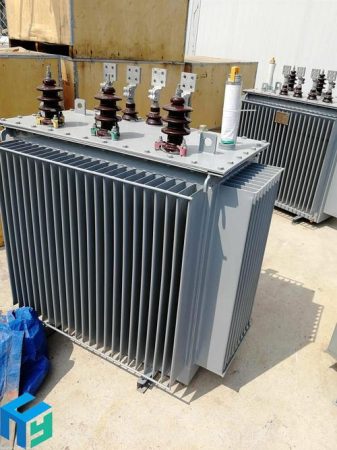
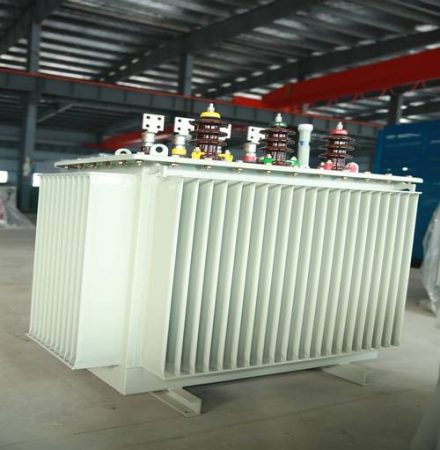
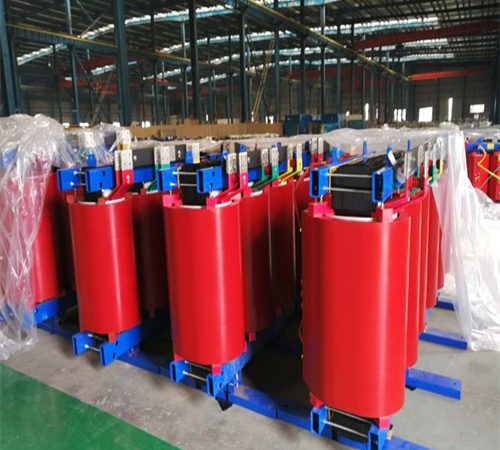
SC(B)10 is the epoxy resin cast, three-phase dry-type transformer that most Chinese plants supplied for a decade before the SCB13/SCB14/SCB18 ladder took over: 100–2000 kVA, 10 kV primary, 0.4 kV secondary, Class F insulation, winding rise ≤100 K, and partial discharge below 5 pC. This page gives you the full parameter table, explains what each number actually buys you, and states plainly where SC(B)10 is still the right call — and where a newer series is the better spend.
Standards baseline: IEC 60076-11 (dry-type) · GB/T 10228 (dry-type power transformer parameters) · IEC 60076-5 (short-circuit withstand) · IEC 60529 (IP ratings) · IEC 60076-10 (sound) · 50 Hz design, 60 Hz on request · UL 1561 listing [Confirm: available on request — not automatic on a GB-designed unit].
1. What SC(B)10 Actually Means
The model code carries three of the answers you need before you read a single loss figure.
| Code element | Chinese | What it means |
| S | 三相 | Three-phase. A “D” prefix would mean single-phase. |
| C | 环氧树脂浇注(固体绝缘) | Cast resin encapsulated windings — the dry-type construction, no liquid dielectric. |
| B | 低压箔绕 | Low-voltage winding is copper foil. No “B” (SC10) means a conventional wire-wound LV winding. |
| 10 | 性能水平代号 | A loss-level series code, not an energy-efficiency grade. This trips up buyers constantly — see section 5. |
| 100/10 | — | 100 kVA rated, 10 kV primary class. |
Two practical consequences. First, “SC(B)10” as written in brochures covers both the foil-wound and wire-wound variants, so always state which one you are quoting. Foil-wound LV windings handle the high secondary currents of a 1000 kVA-plus unit better and give a more uniform ampere-turn distribution, which is why you see SCB rather than SC on the larger ratings. Second, the “10” tells you nothing about compliance on its own — it points to a generation of design, and that generation is now behind the current Chinese minimum energy performance standard [Confirm: verify the current GB 20052 table for your kVA and voltage class before you commit to a new-build project].
2. Where Cast Resin Dry-Type Belongs
Cast resin earns its price premium in one place: it can sit next to the load, indoors, with no oil, no oil containment, and no fire pump.
That is why the applications list is always the same — high-rise buildings, airports, rail stations, ports, power plants, substations, and anywhere with a high fire-safety requirement or an explosive-atmosphere risk. Installing at the load centre instead of at the substation perimeter shortens low-voltage runs, and at 400 V the copper you save is usually worth more than the transformer premium.
The counter-argument, which you should hear before you buy:
- Above roughly 2.5 MVA, or at 35 kV, oil-immersed usually wins on cost
[Confirm: crossover varies by market and by enclosure requirement]. Cast resin gets expensive quickly at the top of the range, and the largest castings are the hardest to make void-free. - Dry-type has less thermal inertia. It tolerates short-term overload worse than a liquid-filled unit of the same rating, so a plant with heavy motor starting surges needs a bigger margin than it would with oil.
- Cast resin is not a “fit and forget” device — see section 8.
If you are still weighing the two technologies at the concept stage, the honest comparison lives in oil-immersed vs dry-type: how to choose, and the construction detail is set out in the dry-type transformer buyer’s guide.
3. SC(B)10 Technical Parameters, 100–2000 kVA
The table below reproduces the manufacturer’s published figures for the 10 kV class. Load losses are at 75 °C, which is the reference temperature for a Class F winding.
| Model | Rated kVA | Voltage combination (kV) | No-load loss P₀ (W) | Load loss Pₖ (W, 75 °C) | Short-circuit impedance (%) | Winding rise (K) | Partial discharge (pC) | Sound level dB(A) | Weight (kg) |
| SCB10-100/10 | 100 | 10±2×2.5% / 0.4 | 360 | 1570 | 4 | ≤100 | <5 | ≤55 | 750 |
| SCB10-160/10 | 160 | 10±2×2.5% / 0.4 | 480 | 2130 | 4 | ≤100 | <5 | ≤55 | 950 |
| SCB10-200/10 | 200 | 10±2×2.5% / 0.4 | 550 | 2530 | 4 | ≤100 | <5 | ≤55 | 930 |
| SCB10-315/10 | 315 | 10±2×2.5% / 0.4 | 790 | 3470 | 4 | ≤100 | <5 | ≤55 | 1600 |
| SCB10-400/10 | 400 | 10±2×2.5% / 0.4 | 880 | 3990 | 4 | ≤100 | <5 | ≤55 | 1750 |
| SCB10-630/10 | 630 | 10±2×2.5% / 0.4 | 1220 | 6010 | 6 | ≤100 | <5 | ≤55 | 2100 |
| SCB10-800/10 | 800 | 10±2×2.5% / 0.4 | 1440 | 7260 | 6 | ≤100 | <5 | ≤55 | 2400 |
| SCB10-1000/10 | 1000 | 10±2×2.5% / 0.4 | 1700 | 9500 | 6 | ≤100 | <5 | ≤55 | 2800 |
| SCB10-1600/10 | 1600 | 10±2×2.5% / 0.4 | 1800 | 15000 | 6 | ≤100 | <5 | ≤55 | 3500 |
| SCB10-2000/10 | 2000 | 10.5±2×2.5% / 0.4 | 3000 | 17300 | 6 | ≤100 | <5 | ≤55 | 4200 |
Standard build: 3-phase, 50 Hz, Class F insulation, average winding rise ≤100 K by resistance method, off-circuit tap changer ±2×2.5% on the HV winding. Weights are for the bare unit without enclosure; multiply by 2.205 for pounds.
Four rows to query before you send this table to a client:
- SCB10-1600 at 1800 W no-load sits below the 1000 kVA row’s 1700 W by only 100 W while the 2000 kVA row jumps to 3000 W. That is an unusually flat progression for a silicon-steel design. Get the type-test report value
[Confirm: no-load loss at 1600 kVA]. - SCB10-200 weighs less than SCB10-160 (930 kg vs 950 kg). Almost certainly a transcription issue in the brochure
[Confirm]. - The 2000 kVA row is listed at 10.5 kV while every other row is 10 kV. Mixing nominal voltages inside one table is a spec-sheet red flag; confirm the required primary before ordering
[Confirm]. - A flat ≤55 dB(A) from 100 kVA to 2000 kVA is a marketing simplification, not a measurement. See section 8.
Also note the stated coverage is “50–2500 kVA” but the published table stops at 100–2000 kVA. Ratings below 100 kVA and above 2000 kVA exist but are not in this dataset [Confirm].
4. The Six Numbers That Decide Your Spec
No-load loss (P₀) — billed 8,760 hours a year. It is the magnetising loss in the core and it does not care whether you are drawing 10% or 100% load. Every kilowatt of P₀ costs about $1,050/year at $0.12/kWh.
Load loss (Pₖ) — billed on the square of the load. At a 0.6 load factor, 1 kW of load loss costs roughly $380/year.
Worked example, SCB10-1000 at β=0.6, 8,760 h, $0.12/kWh:
Annual kWh = P₀ × 8760 + Pₖ × β² × 8760 = 1.7 kW × 8760 + 9.5 kW × 0.36 × 8760 = 14,892 + 29,959 = 44,851 kWh → about $5,380/year
Over a 20-year service life that is roughly $108,000 in losses against a machine that costs a fraction of that to buy — which is exactly why the loss figures, not the purchase price, should drive your shortlist [Confirm: your tariff, your load factor, your currency].
Impedance (4% up to 400 kVA, 6% from 630 kVA). Higher impedance limits fault current but worsens voltage regulation and increases load loss. If your switchgear has a fixed kA rating, the impedance is the number that decides whether the downstream gear survives a fault — state it, don’t inherit it.
Winding rise (≤100 K). This is Class F under IEC 60076-11. It is the difference between winding temperature and ambient, measured by the resistance method on a type test. A 100 K rise on a 40 °C ambient day means windings at 140 °C, and the temperature controller’s alarm and trip setpoints must be chosen against that [Confirm: hot-spot allowance and controller setpoints with the manufacturer].
Partial discharge (<5 pC). The single best predictor of whether the casting is void-free. A void inside epoxy is a place where PD will slowly erode insulation and fail the unit years later. Typical acceptance for cast resin is ≤10 pC, so <5 pC is a premium target — insist on the measured value on the test certificate, not the brochure [Confirm: acceptance limit in your contract].
Sound level. See section 8 — this is the number most often contested on site.
And a seventh that is not in the table: weight and footprint drive floor-loading and door-width checks. A 2800 kg unit on a raised floor of a high-rise is a structural question, not an electrical one.
5. SC(B)10 vs SCB13 vs SCB14 vs SCB18
Be careful with the framing here. The “10” is a series code, not an efficiency grade, and the whole ladder matters more than any single number.
| Series | Technology | Typical position today | Best fit |
| SC(B)10 | Silicon steel, cast resin, pre-2020 loss level [Confirm: current GB 20052 grade] | Legacy/economy tier | Replacement-in-kind on an existing SC(B)10 base, spares, price-driven retrofit, export markets where national MEPS does not apply |
| SCB13 | Improved silicon steel and core geometry, materially lower P₀ [Confirm] | Mid tier | New commercial and light industrial where the budget won’t stretch to Grade 1 |
| SCB14 | Grade 2 under GB 20052 [Confirm: current edition] | Strong default | New builds, data rooms, commercial towers — the best loss-per-dollar point for most projects |
| SCB18 | Grade 1 under GB 20052 [Confirm: current edition] | Top tier | 7×24 duty, green-building certification, ESCO and utility tenders |
Our honest recommendation: if this is a new installation, price SCB13 and SCB14 alongside SC(B)10 and let the loss calculation decide. Where the transformer runs lightly loaded for years — a campus, a station, a standby-fed building — the no-load saving from the newer core usually repays the premium. Where the unit is a direct swap on an existing base, where the civil works and cabling are already sized, or where the buyer is replacing a failed unit on a fast outage clock, SC(B)10 remains a legitimate, widely-installed choice.
Detail on the two newer tiers: SCB13 series cast resin dry-type transformer and SCB14 dry-type transformer, Grade 2 efficiency.
6. Enclosure, IP Rating and Cooling
The standard build ships without an enclosure, IP00, which means unguarded live terminals. IP00 is fine only inside a locked, restricted-access electrical room.
| Rating | What it protects against | Where it belongs | Derating to expect |
| IP00 | Nothing. Live parts accessible | Locked indoor electrical room, restricted access | None — full rating |
| IP20 | Solid objects ≥12.5 mm; finger-safe. No water protection | Indoor plant rooms, clean and dry | Minimal [Confirm] |
| IP23 | Adds water sprayed up to 60° from vertical | Sheltered/covered locations, semi-exposed plant areas | A few percent; confirm with manufacturer [Confirm] |
| NEMA 3R / outdoor kiosk | Rain, sleet, snow; not an IP equivalent (roughly IP24-class behaviour) | True outdoor installation | Usually requires forced-air cooling and a larger enclosure [Confirm] |
Two things buyers get wrong. IP23 is not outdoor-rated — it protects against spray from above at an angle, not against driving rain or a wash-down. And an enclosure costs you capacity: a box that keeps water out also keeps heat in, so the rating you buy is the rating you get only if the cooling was designed for the box.
Enclosure materials are normally mild steel, stainless steel or aluminium, prepared by pickling, phosphating and powder coating. On a coastal or industrial site, specify the corrosion category rather than just a paint colour — ISO 12944 C4 or C5, not “marine grade” [Confirm: site corrosivity category].
Cooling is AN (natural air) as standard, with AF (forced air) fans as an option that can add substantial short-term capacity [Confirm: fan-rated kVA uplift for your rating]. Worth knowing before you rely on it: fans are the loudest thing on a dry-type transformer, and a unit that is quiet on AN can jump several dB the moment they start. The cooling classes guide explains the AN/AF and ONAN/ONAF naming properly.
The temperature controller and load recorder mount on the low-voltage side of the enclosure. Ask for PT100 sensors in the windings, alarm and trip contacts wired out to your BMS, and a serial link — typically RS-485 Modbus RTU, with Modbus TCP as an option [Confirm: protocol and point list].
7. Temperature Rise and Partial Discharge in Plain Terms
Class F insulation (155 °C) with a 100 K average winding rise is the standard pairing for cast resin. The reason that margin matters: insulation ageing is driven by temperature, not by load. A unit running 10 K hotter ages materially faster.
But do not import the oil-immersed “10 K halves the life” rule of thumb here. That rule was developed for cellulose insulation in oil; cast resin follows the IEC 60076-11 thermal class curves, and the relationship is different [Confirm: thermal class and expected service life at your operating temperature].
Partial discharge deserves more attention than it usually gets. PD is measured on a new, clean, dry unit at room temperature in a factory. On site, humidity and conductive dust raise the number. That is the practical reason a cast resin transformer in a dusty cement plant or a humid coastal substation needs periodic cleaning — the insulation is excellent, but a conductive film over the bushing and terminal surfaces will track.
8. Noise: What a Flat dB(A) Number Hides
A single ≤55 dB(A) figure across 100–2000 kVA is not how these machines behave. Real cast resin units start in the high 40s at small ratings and climb into the 60s at 2000 kVA [Confirm: sound power level per rating from the type-test report].
Three things to get right:
- Ask for sound power (L_WA), not just sound pressure. Sound power is the declared type-test quantity. In a free field, sound pressure at 1 m is roughly L_WA − 11 dB, and it drops another 6 dB each time you double the distance. A hard-walled plant room reflects and will read higher than the free-field estimate
[Confirm: room correction for your installation]. - Frequency changes the hum. Core noise is magnetostriction at twice the line frequency — 100 Hz at 50 Hz, 120 Hz at 60 Hz. A 60 Hz unit’s hum is perceptibly different, and low-frequency hum is what carries through walls into occupied spaces.
- Structure-borne sound beats air-borne sound. Anti-vibration pads under the feet and flexible connections on the busbars are usually the cheapest decibels you will ever buy — far cheaper than oversizing the core.
For a worked example of how a noise limit gets met in practice, see the city hospital low-noise cast resin transformer project.
9. Taking SC(B)10 to a 60 Hz North American Site
This is where most import projects go wrong, and it is all fixable if you raise it at RFQ stage rather than after shipment.
- Frequency is a design input, not a setting. A 50 Hz winding design and a 60 Hz one are not interchangeable. At the same voltage, 60 Hz means lower flux density, so a purpose-built 60 Hz core can be smaller; the guaranteed loss values and impedance simply do not transfer between the two. Running a 50 Hz unit on 60 Hz at nameplate voltage is usually thermally safe, but the published P₀ and Pₖ become invalid
[Confirm with the manufacturer for your specific rating]. - Voltages need translating. 10 kV becomes 12.47 kV or 13.8 kV; 0.4 kV becomes 480Y/277 V (600Y/347 V in Canada). Say which one you want.
- BIL is not the same. IEC 10 kV class is commonly LI 75 kV; the ANSI 15 kV class is commonly 95 kV BIL
[Confirm: insulation level required by your utility]. - Vector group notation differs. Dyn11 in IEC notation is the same physical connection as Dyn1 in ANSI clock-hour notation. Put both on the drawing so the termination crew does not guess.
- Standards and listing. IEC 60076-11 is the design standard; a unit sold into the US typically needs UL 1561 listing, and Canadian installations look to CSA. A listing is not automatic on a GB-designed product
[Confirm: available on request]. Installation falls under NFPA 70 (NEC) Article 450 — note in particular that dry-type transformers above 112.5 kVA drive fire-resistant room requirements that catch importers out[Confirm: with your AHJ against the current code edition]. - Efficiency regulation. US distribution transformer efficiency is set by DOE 10 CFR Part 431 Subpart K — §431.196 covers low-voltage dry-type and §431.198 covers medium-voltage dry-type. If you are selling into the US market, coverage and compliance level must be confirmed before quoting
[Confirm].
The full standard-by-standard mapping is laid out in IEC 60076 vs ANSI/IEEE for export transformers.
10. What to Put in the RFQ
Send this and you will get a quote you can actually compare against another one:
- Rated kVA, and whether it is AN-rated or AN/AF-rated
- Primary voltage and tap range, secondary voltage, frequency (50 or 60 Hz)
- Vector group, in both IEC and ANSI notation
- Required short-circuit impedance, and the available fault level at the primary terminals
- Applicable design standard — IEC 60076-11, UL 1561, or both
- Enclosure: IP00, IP20, IP23 or outdoor kiosk; material and corrosion category (ISO 12944)
- Guaranteed P₀ and Pₖ in watts, with the reference temperature stated
- Guaranteed sound power level L_WA, or a sound pressure limit with the measurement distance
- Partial discharge acceptance limit and test report requirement
- Temperature controller: PT100 sensors, alarm/trip contacts, protocol (Modbus RTU/TCP)
- Ambient temperature, altitude, and whether the room is ventilated — derating starts above 1000 m and 40 °C per IEC 60076-2
[Confirm: derating factors for your site] - Harmonic duty, if the load includes VFDs, rectifiers, UPS or EV chargers — see below
- Required listing marks, and whether the AHJ requires third-party certification
11. Compliance and Standards
| Standard | Covers | Why it matters on this product |
| GB/T 10228 | Dry-type power transformer parameters and requirements (Chinese industry standard) | The baseline the published table is written to |
| IEC 60076-11 | Dry-type transformers, including fire behaviour (F1), environmental (E2) and climatic (C2) classes | The international equivalent; ask which classes the unit is declared to [Confirm] |
| IEC 60076-2 | Temperature rise, plus altitude and ambient correction | Where your derating numbers come from |
| IEC 60076-3 | Insulation levels and dielectric tests | BIL/LI selection |
| IEC 60076-5 | Short-circuit withstand | The “high short-circuit and lightning-impulse withstand” claim |
| IEC 60076-10 / -10-1 | Sound power measurement | The only defensible way to compare noise quotes |
| IEC 60529 / IEC 62262 | IP and IK ratings | Enclosure claims; IK matters in schools and public buildings |
| UL 1561 | US dry-type transformer standard | Required for most US listings [Confirm: available on request] |
| ANSI/IEEE C57.12.01, C57.12.51 | US dry-type requirements and ventilated dry-type | Referenced alongside UL on North American specs |
| IEEE C57.110 | K-factor definition for harmonic duty | Needed when the load is non-linear |
| NFPA 70 (NEC) Art. 450 | Installation, including fire-resistant room thresholds | Your AHJ enforces this, not the manufacturer |
| ISO 12944 | Corrosion protection by paint system | Envelope/enclosure specification, C3–C5 [Confirm] |
| GB 20052 | China minimum energy performance standard (MEPS) | Chinese-market compliance; overseas clients will ask for IEC/EU/DOE figures instead [Confirm: current edition and grade] |
| EU Ecodesign 2019/1783 | PEI for distribution transformers | EU market entry [Confirm: applicability and tier] |
| DOE 10 CFR 431 Subpart K | US distribution transformer efficiency (§431.196 LV dry-type, §431.198 MV dry-type) | US market entry [Confirm: coverage and level] |
12. FAQ
Is SC(B)10 still worth buying? Yes in three situations: a direct replacement on an existing SC(B)10 base where civil works and cabling are already sized; a spares or fast-outage purchase; and export markets where no national MEPS applies. For a new installation, price SCB13 and SCB14 alongside it and let the loss calculation decide — on lightly loaded duty the newer core usually pays for itself.
Does the “10” mean a 10% loss level, or an energy-efficiency grade? Neither. It is a Chinese series/loss-level code. It tells you which generation of core and winding design the unit belongs to, and it is not an efficiency grade under GB 20052. Never let a quotation equate the two [Confirm: grade against the current standard table].
Can I run this transformer on a 60 Hz supply? Not on the published data. Frequency is a design input; the guaranteed loss figures and impedance are valid only at the designed frequency. Specify 50 Hz or 60 Hz explicitly at RFQ and get separate guaranteed values for whichever you need [Confirm with the manufacturer].
How much will it cost me to run? Use annual kWh = P₀ × 8760 + Pₖ × β² × 8760. For an SCB10-1000 at a 0.6 load factor and $0.12/kWh that is about 44,850 kWh/year, roughly $5,380/year — more than $100,000 over a 20-year life. Run the same calculation with your own tariff, load factor and currency before you compare quotes.
Do I need an enclosure, and what rating? If the unit is inside a locked, restricted-access electrical room, IP00 is acceptable. Anywhere a person can reach the terminals, IP20 is the minimum. IP23 handles spray from above but is not an outdoor rating — outdoor needs a NEMA 3R-class kiosk. Remember that an enclosure reduces usable capacity [Confirm: derating for your rating and box type].
Is cast resin really maintenance-free? It is oil-free, which removes oil sampling, oil containment and fire-suppression cost. It is not zero-maintenance. You still need periodic cleaning of the windings and bushings, terminal torque checks, insulation resistance measurement, and verification that air paths and fans are clear. Conductive dust plus humidity is the most common cause of premature failure in cast resin units.
Will 55 dB(A) be quiet enough for a hospital or office? Treat 55 dB(A) as an unverified marketing figure and ask for guaranteed sound power level per rating. Also budget for structure-borne sound: anti-vibration pads and flexible busbar links typically deliver more real-world reduction than money spent on the core. In occupied buildings, the fan stage matters too — a unit that is quiet on AN gets noticeably louder when AF starts.
Can an SC(B)10 handle harmonics from drives, UPS or EV chargers? Only if it was designed for it. Non-linear load heats windings and core through harmonic currents, and a standard unit will run hotter than its rating implies. Tell the manufacturer the harmonic spectrum or the connected non-linear kVA so they can size the winding, and where appropriate specify a K-factor rating per IEEE C57.110 [Confirm: K-factor or harmonic-derating requirement for your site].
What do I need to send for an accurate quote? The 13 items in section 10. The five that change the price most are rated kVA, frequency, guaranteed P₀ and Pₖ in watts, enclosure/IP rating, and the applicable standard and listing marks.