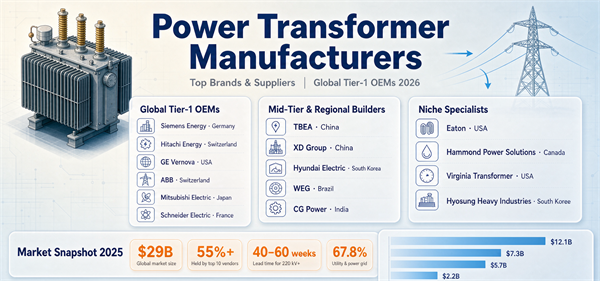
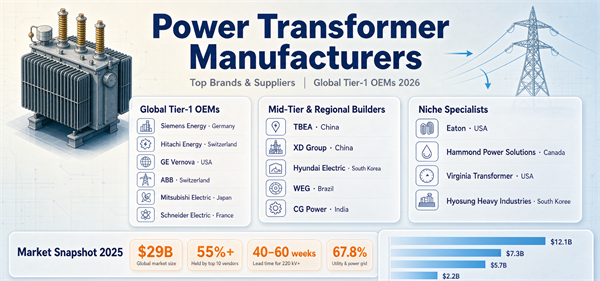
above roughly 10 MVA, six manufacturers hold most of the world’s power-class order book — Hitachi Energy, Siemens Energy, GE Vernova, Mitsubishi Electric, Toshiba Energy Systems & Solutions and ABB — and in 2026 most of them are quoting 36 to 60 months. If you need a 5–50 MVA substation unit inside two years, the realistic names sit one tier down: HD Hyundai, Hyosung, TBEA, China XD, WEG, Prolec GE, CG Power, Efacec, Pauwels, SGB-SMIT. Choose the tier first, then the brand. Below: all four tiers, 14 manufacturers compared side by side, the seven weighted checks we scored them on, and the lead-time and price data behind it — sourced and dated.
Search “power transformer manufacturers” today and you’ll get a dozen ranking pages. Read three and you’ll notice something: the names are familiar, the order changes every time, and almost nobody tells you how the list was built.
This page does. Here’s what’s different.
Why most “top brands” lists can’t answer your question
A ranking needs a single axis of “goodness.” Power transformer buying doesn’t have one.
Consider two buyers. Buyer A needs a 30 MVA, 132/33 kV substation transformer for a utility — three-year delivery window, witnessed FAT, IEC 60076. Buyer B needs a 400 MVA generator step-up unit for a combined-cycle plant — 18 kV to 400 kV, OFAF cooling, OLTC, a 30-year service agreement, and an outage window that cannot move.
Any list that ranks one manufacturer above another for both of those buyers is hiding the only variable that matters. There are maybe a dozen plants on earth that can wind, dry, vacuum-fill, impulse-test and physically move Buyer B’s unit. Buyer A has fifty options and should be optimizing for something else entirely — usually lead time and guaranteed losses.
So instead of a league table, we sort suppliers into four tiers and tell you which tier your project belongs to. Then we give you the scorecard, because the scorecard is the part you actually reuse.
What actually counts as a power transformer
This matters more than it sounds, because the two words get used interchangeably and the procurement paths are completely different.
IEEE C57.12.80 draws the line cleanly. A power transformer transfers energy between the generator and the distribution primary circuits — it’s generally custom-designed for a site, large enough to enter for internal repair, usually fitted with an on-load tap changer, and expensive relative to its installation cost. A distribution transformer takes energy from a distribution primary circuit to a consumer’s secondary; it’s compact, built for stock, rarely regulates voltage, and gets replaced rather than repaired when it fails.
| Power transformer | Distribution transformer | |
| IEEE definition | Moves energy from generation toward the distribution primary | Moves energy from the distribution primary to the consumer |
| Practical rating band | Above ~10 MVA | Roughly 5 kVA to ~10 MVA (most far smaller) |
| Voltage position | Transmission / sub-transmission | Distribution primary to utilization voltage |
| Design peak efficiency | Near full load | Around 40–60% load |
| Tap changer | Usually OLTC | Usually off-circuit (DETC) |
| Typical cooling | ONAN / ONAF / OFAF | ONAN or dry-type AN/AF |
| Built to | A site-specific spec | Stock designs and catalogue ratings |
Definitions per IEEE C57.12.80 standard terminology; rating bands reflect common industry practice rather than the standard itself.
One consequence almost every list misses. The US federal efficiency rule that everybody panics about applies to distribution transformers, not power ones. Under DOE’s definition at 10 CFR 431.192, a covered distribution transformer has an input voltage of 34.5 kV or less, an output voltage of 600 V or less, runs at 60 Hz, and is rated 10–2,500 kVA (liquid-immersed) or 15–2,500 kVA (dry-type). A true power-class unit almost always falls outside all four conditions. So if you’re buying above 10 MVA, the April 23, 2029 DOE compliance date may not touch your unit at all — but it very likely touches the substation auxiliaries, the dry-type station service unit, and anything pad-mounted downstream. Sort that out before you copy-paste a compliance clause into the RFQ.
That date is real, though, and it belongs in your contract: DOE’s 2024 final rule (89 FR 29834, published April 22, 2024) requires compliance with the amended distribution transformer standards on and after April 23, 2029, and compliance keys off the date a unit was manufactured or imported — not your purchase order date. If some of your scope is covered, get the applicable efficiency tier written into the PO.
How we scored them: seven checks, 100 points
Publish something like this before you send your RFQ. It’s what turns opinions into a decision your boss will sign.
| # | Criterion | Weight | What good looks like |
| 1 | Standards fit for your market | 20 | IEC 60076 series for most export markets; IEEE C57.12.00 / C57.12.90 for North America; EU Ecodesign (EU) 2019/1783 for Europe |
| 2 | Verifiable test evidence | 18 | Routine test report per unit with the serial number on it; type-test or short-circuit-withstand documentation (IEC 60076-5) where specified |
| 3 | Reference match at your rating | 18 | References at your MVA, your kV class, your cooling class and your duty — not “we build power transformers” |
| 4 | Honest production capacity | 14 | Can name the slot: which production week, on which line, contingent on what |
| 5 | Quality system you can audit | 12 | ISO 9001 with manufacturing in scope at the plant address; ISO 14001 / 45001 as supporting evidence |
| 6 | Commercial transparency | 10 | Incoterms stated, guaranteed losses vs “typical,” FAT included vs extra, warranty trigger defined |
| 7 | Service reach where you are | 8 | Named commissioning engineers in your region, a spares path, and a contractual response time |
Scoring bands: 85–100 award · 70–84 award with conditions · 55–69 second-source only · below 55 drop.
Where does “brand” sit in that table? Nowhere. That’s deliberate. Brand is a proxy for “somebody has already done this verification for you,” and once you’ve done it yourself — which takes about a week — the proxy stops carrying useful information.
The four supplier tiers at a glance
| Tier | Who’s in it | Typical band | Typical lead time | Price index | Main risk |
| 1 — Global OEM | Hitachi Energy, Siemens Energy, GE Vernova, Mitsubishi Electric, Toshiba ESS, ABB | 100–1,500+ MVA, up to 1,100 kV | 75–150+ weeks | 100 (base) | You are not their priority account; slots are allocated |
| 2 — Regional builder | HD Hyundai, Hyosung, TBEA, China XD, WEG, Prolec GE, CG Power, Efacec, Pauwels, SGB-SMIT, Elsewedy | 10–500 MVA, up to 400 kV | 30–80 weeks | 72–88 | Capacity booked out; limited price movement |
| 3 — North American specialist | Virginia Transformer, Howard Industries, ERMCO, Delta Star, Niagara Transformer, Hammond Power Solutions, Rex Power Magnetics | 5 kVA – 10 MVA, some to 100 MVA | 8–40 weeks | 65–90 | Narrow range; may not scale to a multi-year programme |
| 4 — Export-focused factory | Export manufacturers, including TransNine | 50 kVA – 63 MVA, up to 110 kV | 20–65 weeks | 45–68 | Verification burden lands on you; standards mapping must be checked |
Price index is relative and indicative — Tier-1 = 100 for an equivalent specification. It is not a quote. Real pricing moves with copper, grain-oriented electrical steel grade, guaranteed losses, cooling class and Incoterms.
Two things to notice. First, the tiers overlap badly on paper: a Tier-2 builder and a Tier-4 factory may both quote 25 MVA. The difference is what happens when something goes wrong, and how much verification work you inherit. Second — and this surprises people — lead time does not correlate with price. In 2026 several Tier-3 specialists can deliver faster than a Tier-1 OEM on a unit one-tenth the size, because they’re building from a stocked design instead of entering a queue.
14 power transformer manufacturers compared
Sorted by tier, not by rank. We deliberately don’t publish revenue or market-share numbers: they go stale, they’re inconsistently defined, and they don’t help you write a specification. “Where they’re strongest” is a read from public product ranges and published project types.
| Manufacturer | HQ | Where they’re strongest | Best fit | What to check |
| Hitachi Energy | Switzerland / Japan | UHVAC, UHVDC, GSU, digital monitoring (TXpert, EconiQ) | Major transmission, HVDC interconnection, plant step-up | Which plant gets your order; the service entity in your country |
| Siemens Energy | Germany | Large and medium power, HVDC, phase-shifting, to 765 kV | Transmission, renewable integration, grid replacement | Factory approval under the relevant AVL |
| GE Vernova | USA | GSU, autotransformers, HVDC, SVC, lifecycle services | Generation, transmission, brownfield replacement | Slot confirmation in writing; tap-changer spares lead time |
| Mitsubishi Electric | Japan | Large capacity, shell-form, gas-insulated | Power stations, space-constrained urban substations | Transport envelope along your actual route |
| Toshiba Energy Systems & Solutions | Japan | Large power, gas-insulated, site-assembled units | Sites with transport restrictions | Site-assembly scope, and who supervises it |
| ABB | Switzerland | Grid packages, digital monitoring, high-efficiency designs | Where the ABB platform is already specified | Overlap with Hitachi Energy post-divestment — confirm which entity is the manufacturer of record |
| HD Hyundai Electric | South Korea | EHV, GSU, mobile and phase-shifting units | Utility and heavy industrial projects | Local code compliance for your AHJ |
| Hyosung Heavy Industries | South Korea | EHV, GSU, special transformers to 765 kV | Transmission and grid-support duty | Reference list at your exact rating |
| TBEA | China | UHV, HVDC, power and distribution at volume | Large grid programmes, EPC packages | Which of several plants is actually on the AVL |
| China XD Electric | China | UHVDC converter transformers, full voltage range | State-grid-scale programmes, export EPC | Import restrictions and local content rules in your market |
| Baoding Tianwei Baobian | China | Utility power to 750 MVA, 500 kV | Utility networks, large industrial | Same-plant verification as above |
| WEG | Brazil | Power and industrial to 230 kV+, among the shortest lead times | Latin American and industrial projects, renewable step-up | Regional certification for your market |
| Prolec GE | Mexico / USA | Pad-mount and power class for North America | US utilities, co-ops, industrial substations | DOE pathway for anything covered after April 23, 2029 |
| CG Power & Industrial Solutions | India | DISCOM and substation upgrade volumes | South Asian utility programmes | Third-party type-test evidence at your kV class |
Below these, European mid-tier names worth knowing when Tier-1 windows are closed: Efacec (Portugal), Pauwels (Belgium/Ireland), SGB-SMIT (Germany), Elsewedy Electric (Egypt). In North America, Virginia Transformer, Howard Industries, ERMCO, Delta Star and Niagara Transformer are the names that show up when you need somebody physically close to site — see our broader electrical transformer manufacturers comparison across all four tiers for how they score against the same seven checks.
Market context, for scale: the global power transformer market was put at roughly USD 27.5 billion in 2025 and projected to reach about USD 52.2 billion by 2035, a 7.4% CAGR, with Asia-Pacific taking around 43.7% share (Research Nester, accessed October 2026). Consolidation is active — American Superconductor acquired Brazil’s Comtrafo for about USD 162 million in December 2025 to widen its power and distribution range (same source).
The three numbers that decide it in 2026
Rank positioning is interesting. These three are what actually determine whether your project energizes on time and on budget.
1. Lead time — and specifically, the slot
Two clocks run at once, and mixing them up is the most expensive scheduling mistake in this industry.
Clock one is the build. Drawing approval, core steel procurement, winding, drying, assembly, tanking, testing. This is what most “lead times” quote.
Clock two is the queue. Where your order sits behind everyone else’s. This is what determines your date.
Reported 2026 figures, by class:
| Transformer class | Reported lead time | Source |
| Distribution, ≤5 MVA | 8–14 months | Nexus Power, Transformer Lead Times in 2026, accessed Oct 2026 |
| Medium power, 5–50 MVA, ≤72.5 kV | 18–28 months | Nexus Power, accessed Oct 2026 |
| Power class, 50–200 MVA, 138 kV | 36–48 months | Nexus Power, accessed Oct 2026 |
| HV power, >200 MVA, 230 kV+ | 42–60 months and rising | Nexus Power, accessed Oct 2026 |
| Substation, 5–25 MVA | 65–95 weeks | SecondWatt 2026 survey data, accessed Oct 2026 |
| Substation, 25–50 MVA | 85–110 weeks | SecondWatt, accessed Oct 2026 |
| Generator step-up, >50 MVA | 100–150+ weeks | SecondWatt, accessed Oct 2026 |
| Power transformers, all classes, average | 128 weeks in Q2 2025 (GSU: 144 weeks) | POWER Magazine, cited by SecondWatt |
The driver is structural, not cyclical. Generator step-up demand has been reported up about 274% since 2019 as AI data centers, renewables and grid replacement all stack at once (Ruisitelectric, Power Transformer Lead Times in 2026, accessed Oct 2026). Grain-oriented electrical steel is scarce. Adding a high-voltage line takes two to three years and requires specialized labor the industry didn’t train through the 2010s. Roughly 200 GVA of new capacity was expected online during 2026 — but new lines sell into existing backlog, and multiple trackers put any real easing closer to 2030.
Everyone is responding by building local. Hitachi Energy announced a USD 1 billion US investment including USD 457 million for a large power transformer plant in South Boston, Virginia, described as set to be the largest such facility in the country (Hitachi Energy press release, September 2025, cited by PW Consulting). Siemens Energy is building large transformer capacity in Charlotte to 765 kV (Siemens Energy corporate update, July 2024, ongoing into 2025, same source). Utilities are locking years of capacity in advance: Hitachi Energy signed roughly EUR 350 million of long-term framework agreements with France’s Enedis in September 2026 (pv magazine, September 28, 2026, cited by GridReadiness’s October 2026 update).
That last item is your warning. Framework agreement holders get the slots. Everyone else waits.
What to do about it: ask for the slot, in writing — which production week, on which line, contingent on drawing approval by which date. “Approximately 40 weeks” is not a slot. Slot reservations and letters of intent placed before your design is frozen have been reported to compress post-permit procurement from roughly 48 months down to 12–18 months (Ruisitelectric, accessed Oct 2026). Then freeze the spec, because every change re-enters the queue.
2. Evidence, not the word “compliant”
“IEC 60076 compliant” is a design claim. It is not evidence. Before a unit is released you want:
- Routine tests per unit — winding resistance, ratio and vector group, insulation resistance, dielectric tests, no-load and load loss measurement. The full list is in transformer routine testing: what every unit should pass.
- Type or special tests where specified — lightning impulse, short-circuit withstand per IEC 60076-5, sound level per IEC 60076-10.
- A witnessed FAT with a signed protocol before release.
And get the plant name, not just the brand. Approved vendor lists qualify plants, not logos. Four questions in writing: which legal entity is the manufacturer of record; which plant address will my unit be built at; is that plant on the AVL; and if the plant changes after award, do I have the right to re-approve. A supplier who answers those four quickly is telling you something useful. One who sends a brochure is also telling you something.
3. Total owning cost, using your load factor
Power transformers are usually assumed to run near nameplate for decades, which is exactly why loss capitalization decides awards. Here’s a worked example you can copy.
Two quotes for a 20 MVA, 66/11 kV, ONAN/ONAF substation transformer:
| Quote A | Quote B | |
| Purchase price | $620,000 | $705,000 |
| No-load loss (guaranteed) | 22 kW | 16 kW |
| Load loss at 75 °C (guaranteed) | 105 kW | 98 kW |
Illustrative only. Substitute the guaranteed figures from your own quotes.
Method 1 — annual energy. At a 75% load factor and $0.11/kWh, 8,760 hours:
- Quote A: no-load 22 × 8,760 = 192,720 kWh/yr; load (0.75)² × 105 × 8,760 = 517,388 kWh/yr; total 710,108 kWh/yr → $78,112/yr
- Quote B: no-load 16 × 8,760 = 140,160 kWh/yr; load (0.75)² × 98 × 8,760 = 482,895 kWh/yr; total 623,055 kWh/yr → $68,536/yr
- Annual saving **$9,576**. On an $85,000 premium, that’s an 8.9-year payback on a 30-year asset. Quote B wins.
Method 2 — capitalized losses, the way utilities actually evaluate. TOC = P + A × no-load loss + B × load loss, with illustrative public-power factors of $6.35/W for no-load and $3.67/W for load loss at around 70% capacity factor:
- Quote A: $620,000 + (22,000 × $6.35) + (105,000 × $3.67) = $620,000 + $139,700 + $385,350 = $1,145,050
- Quote B: $705,000 + (16,000 × $6.35) + (98,000 × $3.67) = $705,000 + $101,600 + $359,660 = $1,166,260
- Quote A wins by $21,210.
Same two quotes. Opposite answers.
The reason isn’t the math — it’s that the A and B factors embed somebody else’s carrying charges and load assumptions. Break-even here lands at about $6.70/W on the load-loss factor, well above the range most utilities publish. So state the load factor and the evaluation method in your RFQ, and require guaranteed losses with a stated tolerance and penalty. “Typical losses” is not a number you can put in a contract.
Five moves when Tier 1 is closed
Because in 2026 it usually is, for delivery inside 2028.
- Reserve a slot before the design freezes. Refundable slot reservations and LOIs are standard practice now, and they’re the single biggest schedule lever available to you.
- Freeze a standard specification. Every customization re-enters the queue. One. Frozen. Then walk away from it.
- Qualify a second source while you still have time. Diversifying into Tier-2 and verified Tier-4 factories takes about six weeks if you start before the RFQ becomes urgent, and it’s the difference between one bid and three.
- Spec-build against a typical one-line. Order against a standard voltage class and site one-line without a committed project. Pay the carrying cost; the unit becomes an option the moment you find a site.
- Price the secondary market honestly. Used and refurbished units can save 24+ months. Quality is highly variable — bring an independent test agent, and screen any pre-1979 unit for PCBs.
How to shortlist in six steps
- Fix the numbers. MVA, primary/secondary voltage, vector group, %Z from the short-circuit study, cooling class, OLTC or DETC, BIL, ambient and altitude.
- Fix the standard. IEC 60076 or IEEE C57.12 — pick one family before you request anything, because they diverge in test requirements and sometimes in insulation levels.
- Fix the load factor. Same number goes to every candidate, and it goes into the RFQ.
- Send the identical RFQ to two or three names in your tier. Same scope table: Incoterms, winding material, guaranteed losses with tolerance, cooling class, FAT scope, warranty trigger, spares list.
- Score before you look at price. Seven weighted criteria, 100 points. Award at 85+, award with conditions at 70–84.
- Normalize, then capitalize. Then award on TOC, not on purchase price. The full parameter-by-parameter walkthrough is in our power transformer buying guide.
Where export-focused factories fit — including us
Straight talk, because the other comparison pages won’t offer it: TransNine is in Tier 4, and we wrote this page. Disclose and move on.
When Tier 4 is the right answer: repeat programmes with a frozen design (twenty, fifty, two hundred units of the same rating); EPC packages where the transformer is one line item; budget-constrained utility rollouts where a Tier-2 price can’t clear the business case; ratings up to about 63 MVA and 110 kV, where the engineering is well understood and the differentiation is execution rather than invention. Our own oil-immersed transformer range covers the volume end of that, and the sizing logic for larger units is laid out in our page on 35 kV large-capacity oil-immersed power transformers.
When it’s the wrong answer: one-off EHV or GSU units, where the verification burden exceeds the saving; projects whose AVL lists only certain plants and won’t be amended; and North American projects that need a UL listing the factory doesn’t hold in the applicable category. UL 1561 and UL 1562 cover specific construction classes — confirm the applicable one with an NRTL before assuming equivalence. “IEC compliant” is not a listing.
And the entry fee is real: this tier only works if you can verify, either in-house or with a third-party inspector. If you want the verification steps and the failure modes spelled out, our China power transformer manufacturer buyer’s guide goes deeper than this page can.
One example of what a matched reference looks like, rather than a logo wall: an 11 kV / 33 kV compact substation programme for an overseas utility EPC — repeat units, FAT witnessed, and the award turned on production slot capacity rather than unit price. If your references don’t line up that closely with your own duty, keep looking.
Frequently asked questions
Who is the largest power transformer manufacturer in the world? It depends entirely on the metric — revenue, units shipped, or MVA delivered — and every ranking page quietly picks a different one, which is why no two lists agree. By high-voltage capability and installed base, Hitachi Energy, Siemens Energy and GE Vernova are consistently in the top group. The better question: which manufacturers have shipped your MVA at your voltage, under your standard, in the last five years?
How many power transformer manufacturers should I invite to bid? Three. Two is a negotiation with no market signal; five or more and you’ll get two serious proposals and three copies of a brochure. Invite three from the correct tier, send them identical specifications, and require complete bids before you compare anything.
What is the difference between a power transformer and a distribution transformer? Per IEEE C57.12.80, a power transformer transfers energy between generation and the distribution primary circuits — custom-designed for the site, large enough to enter for repair, usually with an OLTC. A distribution transformer takes energy from the distribution primary to the consumer — compact, stock-built, rarely voltage-regulating. In practice: above about 10 MVA versus below it.
Does the DOE April 23, 2029 efficiency rule apply to my power transformer? Usually not. The DOE definition at 10 CFR 431.192 covers units with input ≤34.5 kV, output ≤600 V, 60 Hz, 10–2,500 kVA liquid-immersed or 15–2,500 kVA dry-type. A true power-class unit typically fails all four conditions. But the dry-type station service unit, substation auxiliaries and downstream pad-mounts in the same project very often are covered — and compliance keys off the manufacture or import date, not your PO date.
How long does a power transformer take to deliver in 2026? Reported ranges: 65–95 weeks for 5–25 MVA substation units, 85–110 weeks for 25–50 MVA, 100–150+ weeks for generator step-up above 50 MVA, and 36–60 months for large power-class and HV units above 200 MVA. Published figures that look shorter generally describe catalogue or stocked designs built against an open slot.
How much does a power transformer cost in 2026? Pricing has moved sharply — tracking of transformers as a class puts the increase at around 77% since 2019, with some distribution classes up to 95% (POWER Magazine data cited by SecondWatt, accessed October 2026). A single number isn’t useful across classes; what is useful is relative position. On an index where Tier-1 is 100, regional builders typically land at 72–88 and export-focused factories at 45–68 for an equivalent specification.
Is it cheaper to buy from China? Usually yes on unit price — often meaningfully — but price isn’t the whole cost. Add third-party inspection, longer verification cycles, import duties, shipping risk on heavy and oversize units, and the standards-mapping work. On a one-off EHV unit the incremental cost often erases the discount. On a repeat programme with a frozen design, it usually doesn’t.
What certifications should a power transformer manufacturer hold? ISO 9001 with manufacturing in scope at the plant address is the floor. Add ISO 14001 and 45001 as supporting evidence. Market-specific: IEC 60076 series for most export markets, IEEE C57.12.00 and C57.12.90 for North America, EU Ecodesign (EU) 2019/1783 for Europe, and a UL listing in the applicable category where the AHJ demands one. Verify certificate numbers in IAF CertSearch and UL Product iQ rather than accepting PDFs.
Can I trust a manufacturer’s own test reports? Trust, then verify. The report should carry your unit’s serial number, the standard and edition it was tested to, and the measured values — not just pass/fail. For power class, ask which tests were done in-house versus witnessed by a third party, and whether the test lab holds CNAS or equivalent accreditation for those methods. If your spec calls for witnessed FAT, witness it.
Should I buy a used or refurbished transformer? For projects that need to energize inside 24 months, it’s often the only channel that meets the date — substation units have gone 85 to 150 weeks new. The risk is manageable with a defined protocol: dissolved gas analysis, oil quality, turns ratio, insulation power factor, sweep frequency response analysis, and PCB screening on anything built before 1979. Budget for an independent test agent.
What should be in the documentation package? Per-unit routine test reports, certified drawings including the GA drawing, material declarations, tap-changer and bushing documentation, oil analysis results, transport and handling instructions, and a warranty whose trigger date is stated clearly. If any part of the scope is DOE-covered, add the compliance statement with the manufacture date.
Do renewable and data center projects need a different transformer? Yes, in three specific ways. Inverter duty brings harmonic content you either derate for per IEEE C57.110 or specify a K-factor rating. Cycling duty — charge and discharge twice a day for BESS — puts thermal cycles on insulation quite unlike steady utility load. And data centers run at high load factor continuously, which shifts the economic balance toward low load loss rather than low no-load loss. We cover the selection logic in step-up transformers in renewable energy: role and selection.