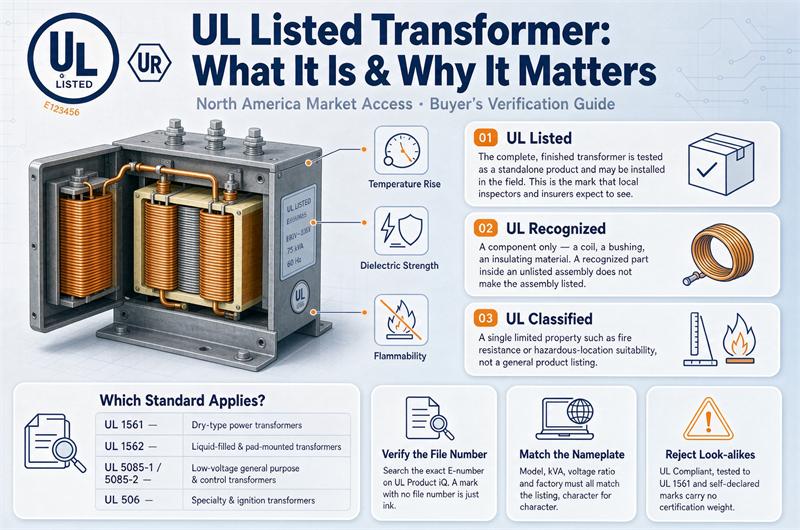
If a supplier sends you a transformer and says “it’s UL certified,” stop there. That sentence by itself tells you almost nothing. Underwriters Laboratories issues more than one kind of mark, and the words people use around them (certified, compliant, approved) get mixed up on job sites every week. The short version: a UL Listed transformer is a complete, finished product that passed the full safety test for its standard and carries a file number you can look up. A “UL certified” sticker with no file number behind it is just ink on metal.
This guide walks through what UL Listing actually covers, which standard applies to your unit, how to confirm a supplier’s claim before you sign the purchase order, and the mistakes that get shipments rejected at the port or fail inspection in the field. If you want the full range we build, start from our products overview.
UL Listed, UL Recognized, and UL Classified are not the same thing
Buyers mix these up constantly, and the mix-up is expensive. Here is the clean split.
| Mark | What it covers | Can it ship as a stand-alone unit? | What it does NOT give you |
|---|---|---|---|
| UL Listed | The complete product, tested as installed | Yes, ready for field use | Component-level ratings inside |
| UL Recognized | A single component (a coil, a bushing, an insulation system) | No, only goes inside another listed product | Whole-unit compliance |
| UL Classified | One specific property (fire resistance, hazardous-location use) | Depends on scope | General product listing |
A Recognized component inside an unlisted assembly does not make the assembly Listed. The phrase “tested to UL 1561” on a datasheet means nothing unless a real file number sits behind it. When your spec says “UL Listed,” you are asking for the whole machine, not a part.
The standards that actually apply
Two standards cover almost every power transformer shipped into North America, with a hard line at 600 V.
| Standard | Covers | Typical use |
|---|---|---|
| UL 1561 | Dry-type general-purpose and power transformers at 600 V and below | 480 V to 208Y/120 V, 600 V to 480Y/277 V distribution |
| UL 1562 | Dry-type transformers above 600 V (and, per many manufacturer references, liquid-filled and pad-mounted designs at higher voltage) | 690 V PV to 480 V, medium-voltage units |
| UL 5085 | Low-voltage control transformers (small kVA) | Control panels, PLC, fan circuits |
| UL 1446 | Insulation systems (a material certification, not a product) | Inside the winding, never a stand-in for Listing |
Liquid-filled and pad-mounted units are evaluated against the applicable UL product standard for their voltage class. Confirm the exact standard at design freeze with the lab, because the wrong standard on the certificate is the fastest way to fail a utility review.
For the dry versus liquid choice that drives which standard you land in, see our guide on oil-immersed vs dry-type transformers.
Why UL Listing matters in the US market
Four parties will ask about the mark before your transformer ever energizes:
- The AHJ (Authority Having Jurisdiction). The local inspector checks the nameplate against UL Product iQ during rough-in and final inspections. No listing, no sign-off.
- The insurer. Underwriters routinely require listed equipment on commercial property. An unlisted unit that starts a fire is a clean reason to deny the claim.
- The utility. Many utilities will not interconnect a pad-mounted or substation unit without a recognized Listing mark and the right file number.
- The buyer on resale. A listed unit carries a paper trail. An unlisted one is harder to finance, insure, and flip.
That is the quiet value of a real UL Listed transformer. Compliance stops being a variable in your schedule.
How to verify a UL claim in four steps
Do not take a PDF or a screenshot as proof. Run these four checks every time.
- Get the file number. Ask for the UL file number (often an “E” or “MH” prefix plus digits). No number, no deal.
- Look it up in UL Product iQ. Search productiq.ul.com (the UL Online Certifications Directory) by company name or file number. The certificate should be active, not expired.
- Match the standard, voltage, and kVA. The listing must name UL 1561 or UL 1562 (or 5085) and cover your actual rating. A 690 V unit listed only to 1561 is wrong.
- Match the manufacturer and factory. The name on the certificate, the nameplate, and your purchase order must agree. A certificate for a different factory is not your unit.
Watch for the three red flags: “UL Recognized” (component only), “UL 1446” (insulation material only), and “built to UL standard” (no listing at all). None of those equals Listed.
Reading the nameplate is where most of these checks live, so keep our nameplate reading guide open while you inspect the unit.
The 600 V cliff: why your 690 V PV unit needs UL 1562
This is the trap that catches solar and BESS projects. North American UL splits at 600 V. A 480 V to 208Y/120 V unit falls under UL 1561. A 690 V PV inverter to 480 V isolation transformer is over the line and needs UL 1562. Spec the wrong standard and the unit can be rejected at customs, at utility interconnection, or at final inspection. The fix is cheap on paper and painful in the field: name the right standard in the spec before the factory builds the sample.
UL Listing is safety, not efficiency
A common buyer confusion: “It’s UL Listed, so it must be efficient.” No. UL Listing proves the unit is safe (temperature rise, dielectric strength, short-circuit withstand, fire risk). Energy efficiency is a separate rulebook. In the US, distribution transformer efficiency comes from DOE 10 CFR Part 431, with a new compliance date of April 23, 2029. A transformer can be UL Listed and still miss the efficiency floor. Check both, separately.
Canada needs the “c” prefix: cUL or cULus
If the unit ships to Canada, a plain UL mark is not enough. Canadian authorities recognize the cUL or cULus mark (the “c” prefix). Dry-type distribution transformers there are also covered by CSA C22.2 No. 47. A UL-only unit with no “c” can be turned away at provincial inspection. If your project spans both countries, ask for cULus so one certificate covers the whole footprint.
K-factor and harmonics: UL 1561 special transformers
Server farms, UPS systems, and VFD cooling loads are non-linear. They pump harmonics back into the transformer, and the neutral current can run close to or above the phase current. UL 1561 frames K-rated special transformers for exactly this. The rule of thumb buyers use in 2026: K-13 for mixed commercial loads, K-20 for GPU-heavy AI clusters. A K-rated design also calls for a 200 percent neutral conductor. Write that into the order in writing, because a standard isolated transformer will not cover it.
What UL Listing really costs in time and money
First-time certification is not a stamp. Plan for it.
- Sample testing: 4 to 8 weeks for electrical, thermal, and mechanical evaluation.
- Factory inspection: UL visits the plant to confirm the production unit matches the sample.
- Follow-up service: quarterly factory checks for the life of the listing. This is why a UL mark is trustworthy and why a one-time test report is not.
- Total first-run window: roughly 6 to 12 weeks, longer if the insulation system or materials need their own evaluation.
The cost varies with unit complexity, test scope, and factory audit needs. Treat it as a market-entry investment, not a line-item you can skip. A unit that fails inspection costs more in delay than the certification ever did.
Mistakes buyers make most often
- Writing “UL certified” instead of “UL Listed” and accepting a Recognized component.
- Assuming UL 1446 (insulation) equals a listed transformer.
- Picking UL 1561 for a unit that is actually above 600 V.
- Forgetting the “c” for Canada.
- Thinking Listing covers efficiency and skipping the DOE check.
- Trusting a certificate screenshot instead of looking the file number up live.
- Letting the factory name on the PO differ from the certificate.
A spec clause you can paste today
Drop this into your procurement doc:
> Transformer shall be UL Listed to UL 1561 (or UL 1562 where primary voltage exceeds 600 V) with a valid UL file number verifiable in UL Product iQ at award. UL Recognized components, UL 1446 insulation-system marks, and “built to UL standard” language are not accepted as substitutes for Listing. For Canadian sites, the mark shall be cULus.
That single paragraph removes most of the ambiguity that lets a supplier substitute a weaker claim.
The bottom line
A UL Listed transformer is a finished product with a file number you can verify, tested to a named standard, and checked at the factory on a schedule. The danger is not that buyers skip UL. The danger is that they accept a weaker mark that sounds like UL and find out at inspection. Name the mark, name the standard, look up the file number, and match the nameplate to the purchase order. Do those four things and UL Listing stops being a risk on your critical path. For real project references and how these units perform in the field, browse our project case studies. For more North American spec guides, see our resources library, and for a unit we build to the mark, see the UL Listed 480 V to 380 V transformer. The team at TransNine Electric can review your spec before you award the PO.
FAQ
What does UL Listed mean on a transformer? It means the complete, finished transformer was tested by UL against the applicable product standard (such as UL 1561 or UL 1562) and passed. The unit carries a UL mark plus a file number, and the factory is subject to ongoing follow-up inspection.
Is UL Listed the same as UL Recognized? No. UL Listed covers the whole product and can be installed as a stand-alone unit. UL Recognized covers a single component, like a coil or insulation system, and may only be used inside another listed product. A Recognized part does not make an assembly Listed.
What is the difference between UL Listed and UL Classified? UL Listed evaluates the full product for safety per its standard. UL Classified evaluates one specific property, such as fire resistance or hazardous-location suitability, within a limited scope. Classified is not a general product listing.
Which UL standard applies to my transformer? For dry-type units at 600 V and below, UL 1561. For dry-type above 600 V (and many liquid-filled or pad-mounted designs), UL 1562. Small control transformers use UL 5085. UL 1446 is an insulation-system material standard, not a product listing.
Why does 600 V matter for UL Listing? UL splits at 600 V. A 480 V to 208Y/120 V transformer uses UL 1561. A 690 V PV to 480 V unit is over the line and needs UL 1562. Spec the wrong standard and the unit can be rejected at customs, interconnection, or final inspection.
Is UL 1446 the same as a UL Listed transformer? No. UL 1446 certifies the winding insulation system as a material. It does not test the full unit for short-circuit, overload, or fire safety. A transformer with only a 1446 mark is not UL Listed.
How do I verify a supplier’s UL claim? Get the UL file number, look it up live in UL Product iQ (the UL Online Certifications Directory), confirm the standard and rating cover your actual voltage and kVA, and confirm the manufacturer and factory match the nameplate and purchase order. Do not accept a screenshot as proof.
Does UL Listing mean the transformer is energy efficient? No. UL Listing is about safety. Efficiency in the US comes from DOE 10 CFR Part 431, with a new compliance date of April 23, 2029. A unit can be UL Listed and still fall short of the efficiency rule.
Do I need a different mark for Canada? Yes. Canada recognizes cUL or cULus (the “c” prefix). A plain UL mark without the “c” can be rejected at provincial inspection. For cross-border projects, ask for cULus so one certificate covers both countries. Dry-type units there also fall under CSA C22.2 No. 47.
What does UL Listing cost in lead time? First-run certification commonly runs 6 to 12 weeks including sample testing and factory inspection, plus quarterly follow-up checks for the life of the listing. Complexity, test scope, and material evaluations can extend the window.
What is a K-rated transformer under UL 1561? It is a dry-type transformer built for non-linear (harmonic) loads, with a K-factor rating and typically a 200 percent neutral conductor. K-13 suits mixed commercial loads; K-20 suits GPU-heavy AI clusters. Spec the K rating in writing.
Can a Recognized component be used where Listed is required? No. Where the code or the AHJ requires a Listed product, a Recognized component does not satisfy it. The component must sit inside a separately listed assembly to be acceptable.