Here is the honest answer up front: there is no transformer price list. Not in 2026, and not for the units most people are shopping for. What exists is a ladder of benchmarks that move by class, rating, winding material, certification, and where the unit is going to sit when it is energized.
This page is about money. If you want to know how long you will wait, our companion piece on transformer lead times in 2026 covers the clock. If you want to know how to choose, the complete buying guide and our project record cover selection and delivered references. This one answers the question people actually ask first: what is this thing going to cost me, and why did the last quote come in at triple the first one.
The short answer: what a transformer costs in 2026
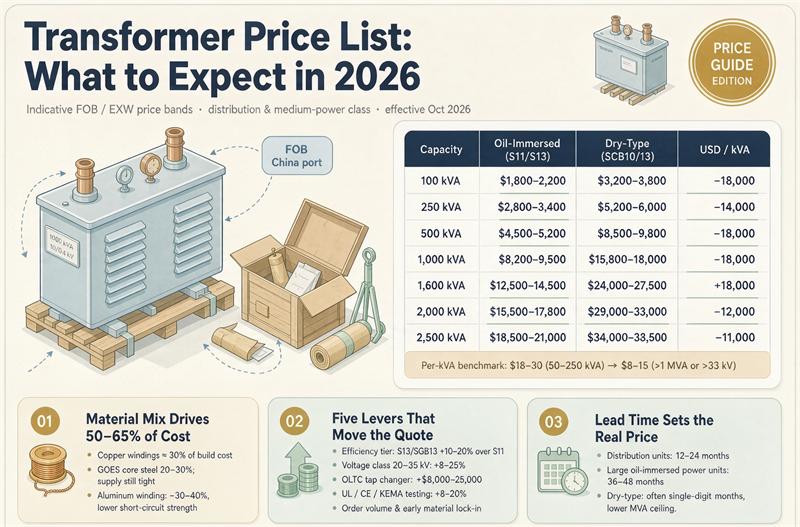
If you only take one table away from this page, take this one. These are benchmark ranges, not quotes, and they mix three different denominators on purpose, because that mix is exactly where most budgets go wrong.
| Class and rating | Equipment, US market | FOB China, IEC standard | Installed, US |
|---|---|---|---|
| Pole-mount, 100 kVA single-phase | $4,500–7,000 | $1,800–2,200 (oil-immersed) | $8,000–16,000 |
| Pad-mount, 100 kVA single-phase | $12,000–18,000 aluminum / $14,500–21,000 copper | no direct IEC equivalent (US-spec product) | $22,000–36,000 |
| Pad-mount, 500 kVA three-phase | $38,000–56,000 aluminum / $45,000–65,000 copper | ~$4,500–5,200 (IEC unit, not US-spec) | $80–300 per kVA installed |
| Dry-type cast resin, 1,000 kVA | $19,000–38,000 aluminum VPI / $25,000–49,000 copper | $15,800–18,000 FOB | varies widely by room and code |
| Oil-immersed distribution, 1,000 kVA | distributor stock varies | $8,200–9,500 FOB | n/a |
| Large power transformer, 100 MVA | $1.5M–2.1M; highly customized up to ~$4M | $1M–2.5M (Asia, 66/220 kV class) | materials ~50–55%, engineering ~25–30%, logistics ~15–25% |
| Generator step-up, 500 MVA class | above $6M | quote only | quote only |
| Large power, 300 MVA | $6M–10M (was $3M–5M in 2019) | quote only | quote only |
Three things jump out of that table, and each one deserves its own section below.
First, the denominators are not the same. “Equipment” means the box. “Installed” means the box plus the pad, the trench, the crane, the permits, the labor, and the utility coordination. For a 100 kVA pad-mount, the install roughly doubles the bill. For a 100 MVA substation unit, installation and commissioning are 15–25% on top of a number that already starts at seven figures.
Second, the China column is not the same product. A $4,500 IEC-standard 500 kVA oil-immersed unit and a $38,000 US pad-mount are different machines: different enclosure, different bushings, different product standard, different listing path. Comparing them directly is the single most common budgeting error we see.
Third, per-kVA pricing falls as rating rises. A 100 kVA unit runs $18–30/kVA at the small end. A 100 MVA unit runs $15–21/kVA. Same physics, same materials, but the fixed costs (engineering, tank, testing, documentation) get spread over more capacity. More on that below.
Why there is no real price list
Above roughly 100 MVA, 99% of large power transformers are custom-made. There is no catalog, no SKU, no list price. Utilities and industrial grids dictate exact short-circuit impedance to match existing units in parallel, exact dimensions to fit decades-old concrete pads, and exact transport weights to clear specific rail lines and bridges on the delivery route. Cooling configuration gets tuned to the site climate. Every one of those choices moves the price.
Below that line, genuinely list-like products exist. Standard distribution transformers in standard ratings with standard taps, dry-type cast resin units in the standard ladder, pad-mounts in the standard single-phase and three-phase sizes. These are the rows where a benchmark table is honest and useful.
So when a factory page shows you a clean price table for a 10,000 kVA unit, treat it as a starting point for a conversation, not a budget. A widely cited rule of thumb in the LPT market: the final check your finance team signs runs 15–25% above the initial quote, once site-specific engineering, heavy-haul logistics, and change orders land.
The 2026 price ladder, class by class
Distribution transformers (pole and pad)
This is the most liquid, most benchmark-able tier. US market equipment pricing for pad-mounts, single-phase, aluminum versus copper windings:
| Rating | Aluminum | Copper |
|---|---|---|
| 25 kVA | $8,000–11,000 | $9,500–13,000 |
| 50 kVA | $10,000–14,000 | $12,000–16,500 |
| 100 kVA | $12,000–18,000 | $14,500–21,000 |
| 167 kVA | $15,000–22,000 | $18,000–26,000 |
| 250 kVA | $18,000–27,000 | $22,000–32,000 |
| 333 kVA | $22,000–33,000 | $26,000–38,000 |
Three-phase pad-mounts at the same kVA cost 40–70% more than single-phase, because of the extra windings and the bigger core. A 75 kVA single-phase runs $11,500–18,500; the three-phase 75 kVA runs $16,000–26,000.
Pole-mounts are the cheap sibling: a 100 kVA pole-mount runs $4,500–7,000 against $12,000–18,000 for the pad-mount. Pad-mounts cost 2–3x upfront, but most new residential and commercial development is now required to be underground, which makes pad-mounts the default regardless of price.
Biodegradable fluid (FR3 or natural ester) adds 8–15% to the unit. Non-standard voltage ratios or tap configurations add 20–40% and weeks to the delivery. Both are avoidable if you freeze the spec early.
For a deeper look at this class, our pad-mounted transformer sizes and prices guide breaks down the rating-by-rating detail.
Dry-type transformers
Dry-type units run 40–60% above oil-immersed equivalents in the same rating, driven by insulation material cost and lower per-model production volume. A cast-resin unit typically adds another 15–30% over VPI (vacuum pressure impregnated) construction.
FOB China benchmark for standard dry-type, three-phase, 10–11 kV primary:
| Rating | VPI aluminum | VPI copper | Cast resin copper |
|---|---|---|---|
| 100 kVA | $6,000–10,000 | $8,000–13,000 | $10,500–16,500 |
| 500 kVA | $12,000–22,000 | $16,000–28,000 | $21,000–36,000 |
| 1,000 kVA | $19,000–38,000 | $25,000–49,000 | $32,000–62,000 |
| 2,500 kVA | $46,000–78,000 | $59,000–101,000 | $77,000–130,000 |
Voltage class is the second-biggest price lever after capacity: 20–24 kV adds 8–15% over the 10–11 kV benchmark, and 33–35 kV adds 15–25%. For North American projects at 15 kV and 25 kV classes, UL or CSA compliance adds another 8–20% against a standard IEC-certified unit.
Large power transformers and GSUs
The defensible 2026 benchmark for new large power transformer procurement is $15,000–21,000 per MVA (USITC data, cited by the National Laboratory of the Rockies supply-chain analysis). That puts a 100 MVA unit at $1.5M–2.1M, and a highly customized 100 MVA unit can reach about $4M. The single-unit ceiling in the analysis sits near $10M.
For calibration on the escalation: a 300 MVA unit that cost $3–5M in 2019 now runs $6–10M. Ultra-high-voltage units in the 765 kV class exceed $15M. A 500 MVA GSU starts above $6M.
If you are budgeting an AI data center campus, the installed per-MVA view is more useful than the equipment view: GSUs run roughly $25,000–40,000 per MVA installed, large power transformers $30,000–50,000 per MVA, medium-voltage distribution $40,000–70,000 per MVA, and pad-mount distribution $50,000–90,000 per MVA installed. The total transformer line item for a 200 MW campus lands between $15M and $30M depending on configuration.
Where the money actually goes
For an LPT, the cost stack has been modeled as three tiers:
- Materials: 50–55%. Raw copper for windings, grain-oriented electrical steel (GOES) for the core, carbon steel for the tank. DOE data puts core steel and copper at roughly half of total cost, about a quarter each. These move with commodity indexes daily.
- Engineering and auxiliaries: 25–30%. Engineering hours, high-voltage bushings, load tap changers, dissolved gas analysis monitors, specialized fluids.
- Logistics and commissioning: 15–25%. Heavy-haul transport (Schnabel rail cars for the big ones), factory acceptance testing, site assembly, oil filling, final high-voltage testing. Another analysis puts logistics at a tighter 3–20%, depending on rating and route.
That stack is why two quotes for “the same” 100 MVA unit can differ by a million dollars. One includes a Reinhausen OLTC and full FAT with witness; the other does not. Neither is dishonest. They are different scopes.
Why the same kVA costs 6x more in the US
Take the 100 kVA oil-immersed distribution unit. FOB China: $1,800–2,200. US pad-mount equivalent: $12,000–18,000. Here is the honest bridge between those two numbers.
| Layer | What it adds |
|---|---|
| Product spec | US pad-mount = dead-front construction, enclosed cabinet, IEEE C57.12.34-class product. The China number is a standard IEC pole/pad unit. Different machine, not a discount. |
| Certification | UL or CSA compliance adds 8–20% on dry-type; utility-spec listing on pad-mounts adds its own engineering and test burden. |
| Tariffs | Section 301 on Chinese goods: 25%. Section 232 on transformers (HTS 8504): 25%, effective 2026-04-06, with units above 10,000 kVA deferred to 2027-12-31. Copper tariffs of up to 50% stack on the winding material. Confirm the exact stacking with your broker; it depends on classification and origin. |
| Freight and handling | Ocean freight, drayage, customs brokerage, inland transport. |
| Distribution and install | Importer margin, distributor stock, crane, pad, trench, permits, utility coordination, commissioning. |
The practical takeaway is not “buy from China” or “buy American.” It is that a factory FOB number is not a budget number, and the gap is not markup. It is a stack of real, itemizable costs. If you want the full sourcing walk-through, the IEC versus ANSI/IEEE standards guide explains which certification path your destination actually requires and what each one costs you.
What moved prices in 2026
Prices did not drift up. They stepped up. The four defensible measures, side by side, because they use different denominators:
| Measure | Reading | Basis |
|---|---|---|
| Transformer producer price index, July 2026 vs January 2020 | +91.4% | BLS PPI, re-based by NextMSC |
| Transformer PPI, annual average 2019 to 2025 | +80.6% | same series |
| Power transformer unit price vs 2019 | +77% | Wood Mackenzie |
| Generator step-up unit price vs 2019 | +45% | Wood Mackenzie |
| Distribution transformer price vs 2019 | +45% to +95% | Wood Mackenzie |
| Real-terms price, most stretched segments | 2.6x pre-pandemic | IEA |
| 100 kVA pad-mount vs 2020 | +60% to +80% | market reporting |
Behind those numbers: GOES prices roughly doubled since 2020, copper is up more than 50% over the same window, and Section 232 duties plus copper tariffs of up to 50% flowed straight through to unit prices. Demand did its part too: power transformer demand is up 116% since 2019, distribution up 34–41%, and GSU demand up 274%, with data centers absorbing the steepest share.
What to expect from here (2026 into 2029)
Nobody who publishes data on this expects meaningful relief before 2030. The reasons are structural:
- GOES is a five-company oligopoly. Cleveland-Cliffs operates the only US mill for high-grade material (Butler Works, Pennsylvania). A new GOES mill costs over $1B and takes 4–6 years from site selection to production. New domestic capacity does not produce commercial-grade steel before 2030–2031.
- OEMs are not at capacity, and that is the problem. Large power transformer facilities run at about 70% utilization globally in 2026, heading to 80% by 2030. The constraint is capital and skilled winding labor, not a bad quarter.
- New capacity arrives late. Hitachi Energy’s $528M Gallman, Mississippi plant (announced 2026-09-15) starts production in 2029. The $457M South Boston, Virginia expansion only broke ground in June 2026. Siemens Energy’s Nuremberg expansion lands in 2028. New transformer lines take 24–36 months to commission, so 2023-era capital does not move 2026 slots.
- The deficit persists. Wood Mackenzie models a 30% national supply deficit for power transformers and 6% for distribution, persisting into the 2030s without coordinated intervention.
One market signal worth watching: the “transformer desperation index,” which tracks the premium buyers pay for refurbished units just to secure delivery, now reads 1.7–1.9 (a 50% premium is the 1.5 threshold). A reading that high means the official lead-time statistics understate actual market stress.
For buyers, the practical planning assumption for 2027–2028 is flat-to-rising prices with no delivery relief. Budget escalation, not deflation.
How to read a quote
Most “surprise” invoices are not price increases. They are scope you did not know was excluded. Before you sign, force every supplier onto the same ten-point sheet:
- Incoterm. EXW, FOB, CIF, or DAP. An EXW number is not a landed number.
- Dutiable value and duty payer. Who pays Section 301 and Section 232, and is the dutiable value the invoice value or something else.
- Testing scope. Routine tests included? FAT included? Third-party witness included, and who pays their travel.
- Loss guarantees. Actual P0 (no-load) and Pk (load) values with tolerance, not a class label. Our routine testing guide lists what a certified unit must show.
- Spare parts. Bushing inserts, gauges, relief device. Budget $800–2,500 for a critical installation.
- Fluid. Mineral oil or FR3 ester (adds 8–15%), and how much.
- Accessories. Tap changer type, monitoring, enclosure finish. Standard configurations only, unless you priced the custom.
- Warranty. Duration, what it covers, response time, who pays freight on a failure.
- Price validity. Commodity pass-through clauses. A 90-day validity in a copper spike is a 90-day gamble.
- Delivery in writing. Slot or week count, with the penalty and the remedy.
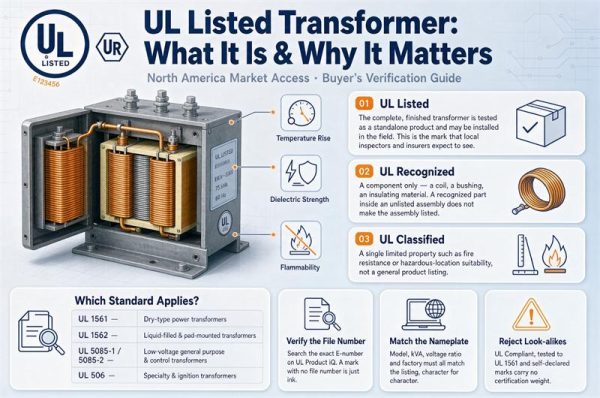
Two red flags. A quote more than 20% below market usually means aluminum substituted for copper, tests skipped, or loss values that do not meet the efficiency class you specified. And “UL-ready” is not “UL listed”: ready means the design was aligned to the standard, listed means a listing mark on the nameplate after testing. Know which one you are buying, because your AHJ will.
The price-time trade
Price and lead time are the same lever in this market. Pad-mount units currently quote 16–24 weeks; rush fees run 10–25% if you need to jump the queue. Volume orders of three or more units typically earn 5–15% discounts.
At the large end, the binding constraint is time, not money: 128 weeks for main power transformers, 144 weeks for GSUs, up to 208 weeks for specialty configurations. The single biggest compression lever a buyer controls is design freeze before order placement. Changing impedance, BIL, or noise level after the slot is booked can slide a 128-week delivery into the 156–208 week band. Freezing the spec early is worth more than any discount you will negotiate.
Refurbished and used units
The refurbished tier is real, liquid, and expensive. Hyperscalers are paying 40–60% premiums over new-equipment pricing just to secure delivery within 12 months instead of 48–60. Refurbished large power transformers typically land at 50–70% of new cost with delivery in 4–6 weeks instead of the 30–65 week new-build queue.
That trade can be rational for non-critical service or as a bridge during construction. It is not rational without evidence. Before buying a refurbished unit, demand: dissolved gas analysis (DGA) on the oil, measured routine test results on the actual serial number (not the type-test report), the warranty in writing, and the name of the shop that did the work.
When the efficiency premium pays
Efficiency tiers cost money up front. DOE 2016-compliant units add 5–15%. Higher loss-class designs (S13/NX1 tier) add 10–20% over baseline. Amorphous-core units add 15–25% on the no-load side.
Two things make the premium worth pricing rather than skipping. First, capitalized losses: at 25 years, 7% discount, and $0.12/kWh, the present value of no-load losses runs about $12.25 per watt. On a 1,000 kVA unit, the 25-year present value of losses can differ by $18,000 between a standard and a premium design. Second, the compliance cliff: DOE distribution transformer rules under 10 CFR 431.196 take effect 2029-04-23. A unit ordered today that meets only the current table can strand below the new line on delivery. Buying to the 2029 table now costs little and removes that risk entirely. Our power transformer buying guide walks the selection sequence in full.
The bottom line
Transformer pricing in 2026 is not a list. It is a ladder you can read once you know the class, the rating, the denominator, and the duty stack. Standard distribution and dry-type units have honest benchmark ranges, and the $/kVA falls predictably as rating rises. Large power and GSU units are custom by definition, benchmarked per MVA, and running 77% above 2019 on the power side. Tariffs add up to 50% on China-sourced units before freight, and installed costs add 15–25% on top of the biggest machines.
Expect flat-to-rising prices through 2028 with no delivery relief, because the GOES oligopoly and the winding-bay constraint do not clear before 2030. Freeze your spec early, buy the efficiency tier you can capitalize, and never compare an EXW number to an installed number.
FAQ
What does a transformer cost in 2026?
Benchmark ranges: a 100 kVA single-phase pad-mount runs $12,000–18,000 for equipment and $22,000–36,000 installed. A 100 MVA large power transformer runs $1.5M–2.1M, with highly customized units reaching about $4M. Dry-type units run 40–60% above oil-immersed equivalents.
Is there an official transformer price list?
No. Above roughly 100 MVA, 99% of large power transformers are custom-made to site-specific impedance, dimension, and transport constraints. Standard distribution, dry-type, and pad-mount ratings do have published benchmark ranges, which is what the tables on this page provide.
Why is the same kVA so much cheaper from Chinese factories?
Three reasons: the China number is usually FOB (no freight, no duty), it is usually a standard IEC unit rather than a US-spec pad-mount, and it excludes certification and installation. After Section 301 and Section 232 duties (25% each) and freight, the gap narrows substantially.
How much have transformer prices gone up?
The BLS transformer producer price index is up 91.4% from January 2020 to July 2026. Wood Mackenzie measures unit prices up 77% for power transformers, 45% for GSUs, and 45–95% for distribution against a 2019 baseline.
What is a fair price per kVA?
Small distribution units (50–250 kVA) run $18–30/kVA. Medium units (315–1,000 kVA) run $10–20/kVA. Large power units run $8–15/kVA on the equipment side and $15–21/kVA (per MVA) on the USITC procurement benchmark. Installed pad-mounts run $80–300/kVA.
How much does a pad-mounted transformer cost installed?
A 100 kVA single-phase pad-mount runs $22,000–36,000 installed, including pad, cabling, grounding, and labor. A 150 kVA unit runs $12,000–28,000 installed, and a 400 kVA unit $25,000–60,000, depending on trenching and site complexity.
How much does a large power transformer cost?
Budget $15,000–21,000 per MVA. A 100 MVA unit is $1.5M–2.1M; a highly customized 100 MVA unit can reach about $4M. A 300 MVA unit now runs $6M–10M, against $3M–5M in 2019. A 500 MVA GSU starts above $6M.
Do tariffs apply to transformers bought from China?
Yes. Section 301 adds 25%. Section 232 on HTS 8504 adds another 25%, effective 2026-04-06, with units above 10,000 kVA deferred to 2027-12-31. Copper tariffs of up to 50% apply to winding material. Confirm exact stacking with your customs broker.
Are refurbished transformers worth the discount?
Refurbished units run 50–70% of new cost and deliver in 4–6 weeks, but buyers are paying 40–60% premiums in the tightest segments. The trade is rational for non-critical service or bridge capacity, provided you get DGA results, serial-number routine test reports, and a written warranty.
How much more does an energy-efficient transformer cost?
DOE 2016-compliant units add 5–15%. S13/NX1-tier designs add 10–20%. Amorphous-core units add 15–25%. On a 1,000 kVA unit, the 25-year present value of the loss difference can be about $18,000, which usually exceeds the purchase premium.
Why do transformer prices vary so much between quotes?
Scope. One quote includes FAT with witness testing, spare parts, freight, and commissioning; another is equipment-only EXW. Non-standard voltage ratios or taps add 20–40%. Force every supplier onto the same ten-point spec sheet before comparing.
Will transformer prices come down in 2027 or 2028?
Plan on flat-to-rising. GOES supply is a five-company oligopoly, new OEM capacity arrives in 2028–2029, and Wood Mackenzie models deficits persisting into the 2030s. The desperation index for refurbished units at 1.7–1.9 suggests the official lead-time numbers still understate market stress.