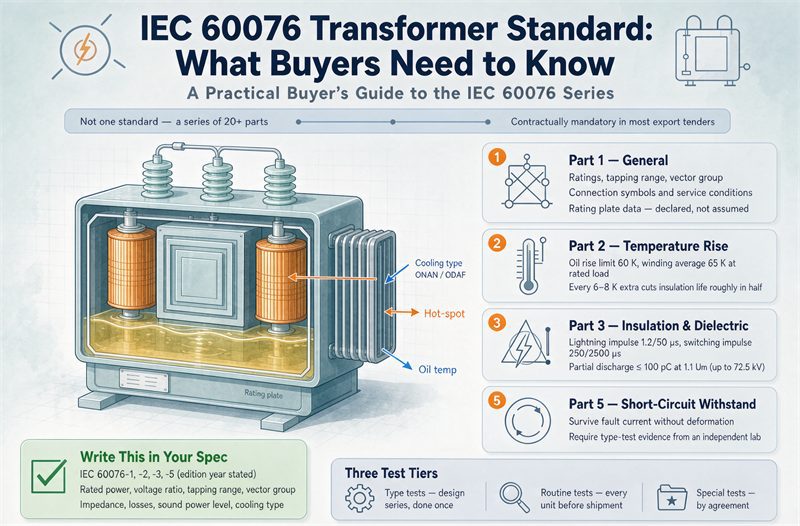
Here is the single most useful thing to know before you read another word: writing “IEC 60076 compliant” on your specification proves almost nothing. It is the weakest line in most transformer bids, and suppliers know it. IEC 60076 is not one standard. It is a series of more than 20 numbered parts, each covering a different slice of how a transformer is rated, built, tested, and documented. A unit can honestly claim “built to IEC 60076” while obeying a 2006 edition of one part and a 2018 edition of another, and two such units can still fail side by side on your grid.
This page is for the person who has to write the spec, read the quote, or witness the test. By the end you will have three concrete things: which parts actually carry weight in procurement, a spec clause you can copy today, and a plain read on how IEC 60076 differs from IEEE C57 so your factory acceptance test passes the first time. Our resource library collects the deeper pieces, and TransNine Electric builds to the parts listed below.
What IEC 60076 actually is, and what it is not
IEC 60076 is published by the International Electrotechnical Commission. It covers power transformers up to roughly 765 kV to 800 kV, including oil-immersed units, dry-type units, auto-transformers, multi-winding units, and phase-shifting designs. Most of the world outside North America runs on it: the European Union adopts it as EN IEC 60076 through CENELEC, most of Asia and the Middle East reference it, and China mirrors it as GB/T 1094.
What it is not: a certificate, a single test, or a pass/fail stamp. It is a shared vocabulary. When two quotes both say “IEC 60076,” the only meaningful question is which parts and which edition each one actually used to set the numbers on the rating plate. Everything useful flows from that.
The seven parts that carry the weight in procurement
You do not need all 20-plus parts. For the vast majority of power and distribution transformer orders, seven parts do the heavy lifting, with a technical specification (60076-20) handling efficiency math. The edition year matters as much as the part number, so it is listed here on purpose.
| Part | What it governs | Current edition | When it shows up in your job |
|---|---|---|---|
| IEC 60076-1 | General requirements: ratings, tappings, connections, rating plate, test definitions | 2011 | Every spec, every quote, every nameplate |
| IEC 60076-2 | Temperature rise for liquid-immersed transformers | 2011 | Thermal verification, service-life argument |
| IEC 60076-3 | Insulation levels and dielectric tests | 2013 | Dielectric (impulse) acceptance, safety |
| IEC 60076-5 | Ability to withstand short circuit | 2006 | Grid-connected units, fault survival proof |
| IEC 60076-7 | Loading guide for oil-immersed transformers | 2018 | Operational planning, cyclic and emergency load |
| IEC 60076-10 | Determination of sound levels | 2016 | Environmental permits near homes or hospitals |
| IEC 60076-11 | Dry-type transformers, including E/C/F classes | 2018 | Any cast-resin or VPI dry-type unit |
| IEC TS 60076-20 | Energy-performance evaluation (PEI method) | 2017 | Loss guarantees, EcoDesign alignment |
Two things to keep in your head. First, the short-circuit part (60076-5) is still the 2006 edition in most contracts, so do not assume “latest” means newer here. Second, 60076-11 brings its own three-letter class system (E for environment, C for climate, F for fire behaviour) that oil-immersed units simply do not use. If your dry-type quote omits the E/C/F codes, the supplier has not finished the specification.
Why “IEC 60076 compliant” is the weakest line in your spec
Two gaps make that phrase nearly useless on its own.
The first gap is the edition year. IEC 60076-2:2011 changed how dynamic loading and hot-spot modeling are handled versus the 1993 edition. A bid that says “IEC 60076-2” without the year could mean either one. On a thermal acceptance test, that difference is the difference between passing and re-testing in a slot you cannot rebook.
The second gap is the part list. “Complies with IEC 60076” tells a manufacturer nothing about which parts you are holding them to. The series spreads dielectric testing, temperature rise, short-circuit withstand, sound, and dry-type construction across different parts. If you do not name them, you have not specified anything, and two offers that both say “compliant” will not be comparable.
A spec clause you can actually copy
Replace the vague sentence with something a factory can price. This is a working template, not legal advice; confirm the edition against your target grid code before you freeze the design.
> Transformer shall be designed, manufactured, and tested in accordance with IEC 60076-1:2011, IEC 60076-2:2011, IEC 60076-3:2013, and IEC 60076-5:2006 (or latest revisions in force at contract signature), with short-circuit withstand demonstrated by calculation or independent type test. Dry-type units shall additionally meet IEC 60076-11:2018 and declare E, C, and F classes. Losses shall be declared and guaranteed at reference conditions per IEC TS 60076-20:2017. Routine test reports and, where specified, type-test certificates from an ISO/IEC 17025 accredited laboratory shall accompany delivery.
That single paragraph does more than a page of “compliant.” It names the parts, pins the editions, demands the evidence, and gives the supplier a number to quote against. See how the same discipline looks in delivered equipment in our project record.
IEC 60076 vs IEEE C57: the six differences that change your acceptance test
Your grid picks the family. IEC 60076 governs IEC-grid markets at 50 Hz (and 60 Hz when specified). IEEE C57 governs North America. Neither is “right.” They are different conventions, and a factory will build to either once you name it. The trap is assuming the numbers mean the same thing across the two. They do not.
| Difference | IEC 60076 | IEEE C57 | Why it changes your test |
|---|---|---|---|
| Ambient basis | 20 °C yearly average | 30 °C average | Cooling and rating assumptions start from different heat budgets |
| Temperature rise | 60 K top oil, 65 K winding | 65 K top oil, 65 K winding | A “65 °C rise” unit means different things in each system |
| Loss reference temp | Commonly 75 °C | Commonly 85 °C for the standard 65 K rise | Two “IEC” quotes can still differ because reference temp differs |
| Cooling notation | ONAN, ONAF, OFAF | OA, FA, FOA | Same hardware, different label; translate both on the drawing |
| Phase relation | Clock-hour vector notation | Polarity, additive or subtractive | The physical outcome matches; the report wording does not |
| Insulation coordination | Highest voltage for equipment plus assigned impulse levels | BIL tables by system voltage | Do not convert between the two on nominal voltage alone |
Our IEC vs ANSI/IEEE guide for export transformers walks the dual-compliance path for units that must serve both grids, including the type-test evidence that lets one qualification cover two markets.
How to verify a supplier’s IEC 60076 claim
A claim on a datasheet is not proof. Before you pay, ask for four things, and do not let any of them be waved away.
- Routine test report on the actual serial number. Every unit should show winding resistance, ratio, impedance at principal tap, no-load and load losses, applied-voltage and induced-voltage withstand, and partial discharge. Our routine testing guide lists exactly what a certified unit must pass.
- Type-test certificate from an independent, ISO/IEC 17025 accredited laboratory. For grid-class oil-immersed units, the short-circuit mechanical test certificate is the one you cannot skip. It is a type test, not a per-unit check, so one valid certificate covers the design series.
- Third-party inspection, where the project demands it. Utility tenders and EPC subcontracts routinely require an independent witness at factory acceptance. Decide up front who pays the witness travel, because that line is where budgets quietly drift.
- A nameplate that matches the clause. The rating plate should declare rated power, voltage ratio and tapping range, vector group, impedance voltage, no-load and load losses, sound power level, cooling method, and the E/C/F classes for dry-type units. If a number on the plate contradicts the quote, stop and resolve it before shipment. Our nameplate reading guide shows the field-by-field read.
IEC 60076 and efficiency: the standard measures, the law sets the floor
This is the part most buyers mix up. IEC 60076 tells you how to measure and declare losses. It does not tell you how low they must be. That floor comes from regulation.
In the European Union, EU Regulation 548/2014 sets minimum no-load and load loss limits, with its Tier 2 requirements applying since 1 July 2021. IEC 60076 (specifically the PEI method in IEC TS 60076-20:2017) supplies the measurement method, tolerances, and reference conditions that make one supplier’s loss figure comparable to another’s. A quote that cites one without the other is incomplete.
In the United States, the relevant floor is the DOE distribution transformer energy conservation standard under 10 CFR 431.196, with a compliance date of 23 April 2029. A unit ordered today that meets only the current table can land below the new line on delivery. Buying to the 2029 table now costs little and removes that risk entirely. So when you see “IEC 60076” on an efficiency claim, ask which regulation is actually doing the limiting, because the standard alone never sets the number.
Dry-type vs oil-immersed: which parts apply
The applicable parts follow the hardware, not a copy-paste from another tender.
- Oil-immersed units: lean on IEC 60076-1 (general), -2 (temperature rise), -3 (dielectric), -5 (short-circuit), and -7 (loading) when cyclic or emergency duty is in play. Sound matters near occupied sites, so pull in -10.
- Dry-type units: IEC 60076-11:2018 is the core document, with its E, C, and F class system. Specifying F1 fire behaviour for a hospital, school, data center, or underground space is not optional when the local code restricts flammable material. E2 and C2 matter for damp, condensation-prone, or cold-climate basements.
- Special duty (HVDC, BESS step-up, converter): the IEC 60076-22 series is increasingly written into tender specs for converter transformers and battery-energy-storage step-up units.
Pick the parts that match the unit in front of you. Our product range is organized the same way, by construction type, so the standard and the catalog line up.
Mistakes buyers make most often
A short list, drawn from specification reviews we have been asked to fix.
- Writing “compliant with IEC 60076” with no edition and no part list, then wondering why two quotes are not comparable.
- Assuming a 60 Hz North American unit and a 50 Hz IEC unit are interchangeable at the same voltage without an engineering review.
- Comparing load losses quoted at different reference temperatures as if they were the same number.
- Treating “UL ready” or “IEEE aligned” as “listed” or “tested to the standard.” Ready is a design intent; listed is a mark on the nameplate after testing.
- Forgetting the altitude correction. Both IEC 60076-1 and IEEE C57.12.00 require derating above 1,000 meters because thinner air hurts cooling and dielectric strength.
- Skipping the sound-level requirement (60076-10) until the environmental permit bounces the substation siting.
RFQ quick-reference checklist
Drop this into your request for quotation so every supplier answers the same questions.
- Rated power in kVA or MVA, primary and secondary voltages, highest voltage for equipment.
- Frequency (50 Hz or 60 Hz) stated explicitly.
- Vector group and short-circuit impedance with tolerance.
- Tapping range and tap-changer type, if any.
- Cooling method (ONAN, ONAF, AN, AF, or AN/AF).
- Declared no-load and load losses at the reference temperature, with tolerance.
- Sound power level where the permit requires it.
- Dry-type only: E, C, and F classes.
- Routine test report per serial number, type-test certificate where specified, and third-party witness scope.
- The exact IEC 60076 part numbers and editions you are holding the supplier to.
The bottom line
IEC 60076 is a series, not a stamp, and “compliant” without editions and part numbers proves nothing. Name the seven parts that matter (-1, -2, -3, -5, -7, -10, -11, plus -20 for efficiency), pin the edition years, and demand the test evidence by serial number and by independent certificate. Keep the six IEC-versus-IEEE differences in view so your acceptance test passes the first time, and remember that the standard measures losses while the regulation (EU 548/2014 or US DOE 10 CFR 431.196, effective 23 April 2029) sets the floor. Do those things and two “IEC 60076” quotes finally become something you can put side by side.
FAQ
What is IEC 60076 in simple terms?
IEC 60076 is the international series of standards that defines how power transformers are rated, built, tested, and documented. It is published by the International Electrotechnical Commission and covers oil-immersed, dry-type, and special-duty transformers up to about 765 kV to 800 kV. It is a set of more than 20 parts, not a single certificate.
How many parts does IEC 60076 have?
The series spans more than 20 published parts and technical specifications. For most procurement, seven carry the weight: 60076-1 (general), -2 (temperature rise), -3 (dielectric), -5 (short circuit), -7 (loading), -10 (sound), and -11 (dry-type), with IEC TS 60076-20 handling efficiency evaluation.
Is IEC 60076 mandatory?
In most export markets it is contractually mandatory rather than a standalone law. Utility tenders, EPC subcontracts, and many national grids require it, often alongside a local equivalent such as GB/T 1094 in China or EN IEC 60076 in the EU. Treat it as the global baseline and any local code as an added layer.
What does IEC 60076-1 cover?
IEC 60076-1:2011 sets the general requirements: rated values and definitions, tapping range, connection symbols, rating-plate data, and the definitions of routine, type, and special tests. Every transformer specification should reference this part because it defines the terms the rest of the series uses.
What is the difference between IEC 60076 and IEEE C57?
IEC 60076 is a single numbered series used in IEC-grid markets, while IEEE C57 is a family of separately numbered standards used in North America. They differ on ambient basis (20 °C vs 30 °C), temperature rise (60/65 K vs 65/65 K), loss reference temperature (75 °C vs 85 °C), cooling notation (ONAN vs OA), phase relation (clock-hour vs polarity), and insulation coordination (IEC levels vs BIL tables).
Can one transformer comply with both IEC 60076 and IEEE C57?
Yes, at a stated frequency, a unit can be engineered to pass both test regimes from one core and geometry. This dual-compliant path is documented in projects where one qualification serves multiple grids and can shorten effective lead time, but it requires explicit design intent and type-test evidence for both families.
What does IEC 60076-11 cover for dry-type transformers?
IEC 60076-11:2018 covers dry-type power transformers, including cast-resin and VPI construction, and defines the E (environment), C (climate), and F (fire behaviour) class system. E2 resists frequent condensation and pollution, C2 operates down to -25 °C, and F1 means self-extinguishing fire performance with limited smoke.
What tests are mandatory under IEC 60076?
Routine tests run on every unit: winding resistance, voltage ratio, impedance at principal tap, no-load and load losses, applied-voltage and induced-voltage withstand, and partial discharge measurement. Type tests such as the short-circuit withstand (60076-5) and dielectric impulse (60076-3) are demonstrated on the design series, often by independent laboratory certificate.
How do I verify a supplier’s IEC 60076 claim?
Ask for the routine test report on the actual serial number, a type-test certificate from an ISO/IEC 17025 accredited laboratory for the critical tests, third-party witness scope where the project requires it, and a nameplate that matches the specification clause. A datasheet claim without those four items is not proof.
Does IEC 60076 set efficiency limits?
No. IEC 60076 defines how to measure and declare losses (the PEI method in IEC TS 60076-20:2017). The mandatory efficiency floor comes from regulation: EU 548/2014 in Europe and the US DOE standard under 10 CFR 431.196, with a compliance date of 23 April 2029. Always ask which regulation is setting the limit.
Why do two IEC 60076 quotes differ on losses?
Because load losses are referenced to a temperature, and IEC commonly uses 75 °C while other conventions use 85 °C. Two quotes that both say “IEC” can still use different reference temperatures, different declared tolerances, and different edition years, so the loss numbers are not directly comparable until you align those baselines.
What should I write in my transformer specification?
Name the exact parts and editions (for example IEC 60076-1:2011, -2:2011, -3:2013, -5:2006, and -11:2018 for dry-type), declare the rated values and tolerances you want on the rating plate, require the routine and type-test evidence, and state the efficiency regulation that sets the floor. A copy-ready clause is in the body of this article.