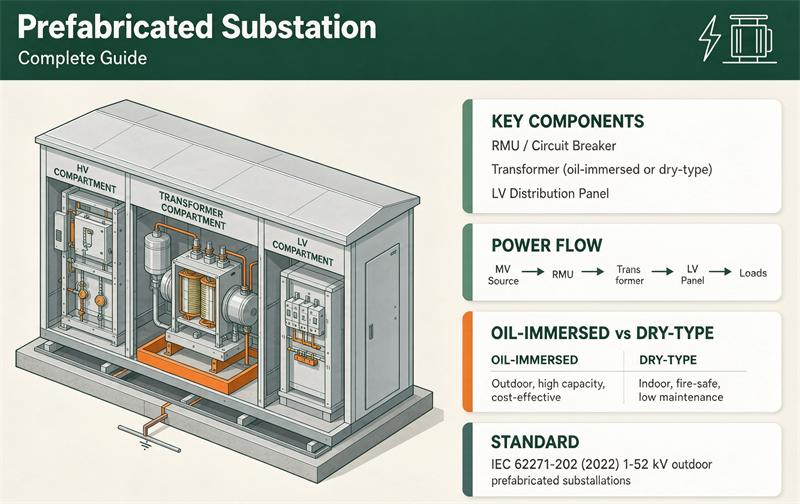
Every guide on this topic opens the same way. A prefabricated substation is a transformer, some medium voltage switchgear, and a low voltage panel, all bolted into one enclosure, built and tested in a factory, then dropped on a concrete pad. All true. And then they move on to the six types and the six benefits, which is where they stop being useful.
Here is the sentence that actually decides whether your project works. The kVA on the transformer nameplate is not the kVA you can pull out of the box. Put a 1,000 kVA transformer in a sealed enclosure in Phoenix in July and you no longer have 1,000 kVA. You have something less, and how much less depends on a number that almost never makes it into a purchase order: the enclosure class.
That is what this guide is built around. If you read one thing, read the second section.
What you get out of the rest of it:
- what the standard actually covers, in plain language, including what the 2022 third edition changed
- why “American type” and “European type” are sales names, not standard categories, and what the standard actually sorts by
- which standard applies if the project is in the United States, because IEC 62271-202 alone will not get you past an AHJ
- where the money moves, with the honest spread that vendor pages will not print
- where schedules really slip, and it is not the three days of on site work
- twelve questions buyers ask us, answered with numbers
Everything here is written for the person who has to sign the order. Where a figure is somebody else’s arithmetic, it says so.
What a prefabricated substation actually is
The formal definition comes from IEC 62271-202. The current edition is IEC 62271-202:2022, edition 3.0, published 2022-06-22, developed by IEC technical committee TC 17/SC 17C. Its scope covers enclosed, cable connected AC substations on networks above 1 kV and up to and including 52 kV, at power frequencies up to and including 60 Hz, operated from inside (walk-in) or from outside (non walk-in), designed for outdoor installation at locations where the public can get close and where personnel protection is required. A corrigendum issued in August 2023 is included in the current copy.
Three things in that scope do real work:
- 52 kV is the ceiling. Above that you are in transmission substation territory and this standard stops applying.
- Public accessibility is assumed. The whole enclosure rating, the door interlocks and the internal arc classification exist because a member of the public might be standing next to the box.
- Cable connected. Overhead line terminations take you out of this standard’s scope.
What it is not: it is not a pad mounted transformer. A padmount is a transformer with some fuses and maybe a switch, and in North America it lives under a completely different standard family. It is also not a switching kiosk, which has switchgear and no transformer. If there is no transformer, you do not have a substation, you have a switchgear enclosure, and a different set of rules applies.
The number on the transformer is not the number on the box
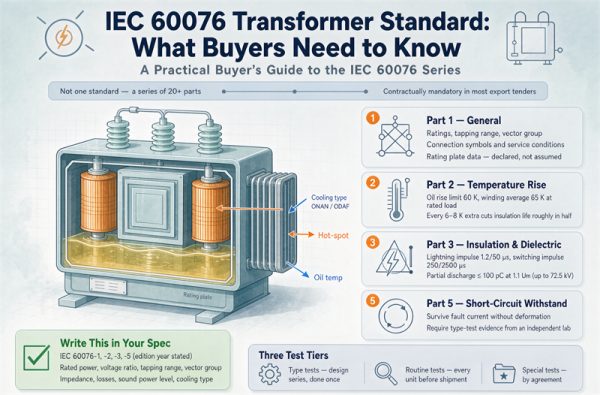
A transformer rated in free air is rated against a defined ambient. IEC 60076-2 and the ANSI/IEEE equivalents both work from a 40 °C maximum ambient, with lower monthly and annual averages. Seal that same transformer inside a steel box in the sun and the air around it is hotter than the air outside the box, sometimes by a lot. Hotter cooling air means less load for the same winding temperature. That is the entire problem.
IEC 62271-202 handles this with two tools.
Enclosure class. The enclosure is assigned a class that caps the temperature difference between the inside and the outside of the transformer compartment. Published commentary on the 2022 edition describes six classes: 5, 10, 15, 20, 25 and 30, corresponding to the permitted temperature rise difference in kelvin. A class 10 enclosure allows 10 K of internal temperature rise. A class 30 allows 30 K, which sounds generous until you work out what the transformer is breathing.
Load factor. Annex D of the standard gives curves for the load factor of a transformer inside an enclosure, so you can convert free air rating into in-box rating. The 2022 edition corrected Figure D.1, which covers mineral oil immersed transformers. That is a real correction with real consequences: if your supplier’s curves came from a 2014 vintage drawing package, they may be working from the wrong figure.
The practical consequence is simple and it bites hardest on the projects that least expect it:
| Site condition | What it does to your usable rating | What to write in the order |
|---|---|---|
| Enclosure class too low for the climate | Continuous load must be derated, sometimes by 10 to 20 percent | State the class required, and the design ambient it was calculated at |
| Ambient above 40 °C | Winding runs hotter for the same load | State the site maximum ambient, and require the rated power at that ambient |
| Altitude above 1,000 m | Air is thinner, cooling and external clearances both degrade | State site altitude in metres, require correction per IEC 60076-2 or IEEE C57.91 |
| Direct sun on a dark enclosure | Solar gain adds to internal air temperature | Ask for the Annex G solar radiation assessment, not a guess |
| High load factor with no ventilation | Heat has nowhere to go | State forced ventilation, thermostat setpoint, and the derating with fans out of service |
Ask two questions before you sign. What enclosure class is this, and what is the load factor curve with it. If the answer comes back as “it is a 1,000 kVA substation,” you are talking to someone who has not done this before.
The four families, and the names people use for them
Walk into any supplier meeting and you will hear “American type” and “European type.” Those are industry nicknames. They are not categories in any standard, and treating them as if they were is how mismatched enclosures get shipped.
| Family | Layout | Typical voltage | Typical kVA | Where it wins | Where it hurts |
|---|---|---|---|---|---|
| Walk-in compartmented (called European) | Separate HV, transformer and LV compartments, full height cabinets | 11 to 36 kV | 200 to 3,150 | Utility and industrial sites where crews work inside | Bigger footprint, more doors to seal |
| Integrated padmount style (called American) | Transformer, HV protection and LV distribution packed into one compact tank | 12 to 24 kV | 100 to 2,500 | Underground loop and radial distribution, tight sites | Less room to work, hotter transformer |
| Non walk-in compact kiosk | Everything served from outside, no entry | 12 to 24 kV | 50 to 1,250 | Street corners, small commercial, landscaping | Maintenance is awkward, ventilation is the whole game |
| Containerised or skid | ISO frame or steel skid, built to be moved | 11 to 40.5 kV | up to about 5,000 | Mining, temporary power, sites that relocate | Transport permits, route surveys, crane planning |
| E-house or power centre | Walk-in, multiple bays, full MV lineup, often more than one transformer | 11 to 36 kV | several MVA | Data centre campuses, large process plants | Longest lead time, most custom engineering |
The standard sorts enclosures by walk-in versus non walk-in and by who can reach them. It does not sort them by continent. When you write your spec, write walk-in or non walk-in, write the enclosure class, write the ingress and impact ratings, and let the supplier call it whatever they like in the brochure.
You can see how we split the range in the product catalogue, and the YBW series prefabricated compact substation is the walk-in compartmented layout that most utility and industrial buyers end up on.
What is inside, and the parts buyers forget
The five big items are obvious: MV switchgear or ring main unit, transformer, LV panel, protection and metering, enclosure and auxiliaries. The failures happen in the second list.
| Component | What to ask | Why it bites |
|---|---|---|
| Interconnections between HV and transformer | Busbar or cable, and who type tested the assembly | This is where pre fabricated units fail dielectric tests, not at the individual components |
| Auxiliary power and heaters | Voltage source, heater wattage, thermostat setpoint | Condensation kills more electronics than heat does |
| Ventilation and louvres | Free area, fan rating, behaviour with fans failed | Defines your real continuous rating |
| Earthing system | Single point or mesh, touch and step voltage study | The enclosure is publicly accessible, so touch voltage is a design input |
| Oil containment | Bund or sump volume, and the local threshold that triggers a plan | In the US, aggregate above ground oil storage above 1,320 gallons pulls you into SPCC planning |
| Access doors and aisles | Minimum clear opening, free height of the operating aisle | IEC 62271-202:2022 introduced minimum dimensions for access doors (6.104.4) and free height of the operation aisle (6.105.3) |
| Fire and smoke detection | Sensor type, what it trips | Often the difference between an insurance approved install and a rejected one |
| Electronic equipment environment | Where relays and comms gear sit, temperature and humidity band | New Annex H in the 2022 edition covers installation conditions for electronic equipment |
One more thing worth asking about, because it is invisible in a drawing: who owns the interface between the HV switchgear and the transformer. If two vendors built those two parts and a third party assembled the box, nobody has type tested the combination, and the standard’s dielectric requirements apply to the assembly, not the parts.
IEC 62271-202:2022, the clauses that change your order
The third edition is a technical revision, not a tidy-up. Here is what changed and what each change should turn into on your purchase order.
| Topic in the 2022 edition | What changed | What you should write |
|---|---|---|
| Title and scope | Extended to cover high voltage switchgear prefabricated substations, not just transformer substations; CEADS included as a possible MV/LV component | State which configuration you are buying, and that the scope covers it |
| Rated power (5.101.1) | Now defined as a three parameter rated value | Require capacity, total losses and temperature rise limits together. A single kVA number is no longer a complete rating |
| Enclosure class | Six classes corresponding to permitted internal temperature rise difference | State the class and the design ambient it is calculated at |
| Internal arc classification | Commentary on the 2022 edition describes IAC-A (operator protection, door open), IAC-B (public protection, doors closed) and IAC-AB (both) | State which you need, and require the test report, not the datasheet |
| Access dimensions | Minimum dimensions for access doors (6.104.4) and free height of the operation aisle (6.105.3) introduced | Check the drawings against the numbers before FAT |
| Dielectric performance (7.2.101) | Influence of surrounding elements on non metal enclosed HV parts, or HV parts without an earthed screen, now considered | Ask how the interconnection insulation was assessed |
| Solar radiation | New informative Annex G with a test procedure for the effect of solar radiation on internal temperature | Request the Annex G assessment for hot, sunny sites |
| Electronic equipment | New informative Annex H on installation conditions | Specify where relays and comms sit and what band they must survive |
| Load factor curves | Annex D retained, Figure D.1 for mineral oil transformers corrected | Ask for the curve and confirm it is post 2022 |
| Temperature rise test (7.5) | Methods clarified; dry type transformers get a defined multi step approach | Ask which method was used and for the report |
| Structure | Whole document reviewed against IEC 62271-1:2017 | Clause numbers moved, so old specs citing 2014 clause numbers will not line up |
That last row matters more than it looks. If your company spec was written against the 2014 edition, your clause references are stale. Every clause number in a 2022 order has to be re-checked.
If you want more on how the standard families differ, our resources library has a piece on IEC 60076 versus ANSI/IEEE for export transformers.
If the project is in the United States, that is not your standard
This is the fork that vendor guides blur. IEC 62271-202 is an IEC document. A US authority having jurisdiction does not accept it by itself. What gets you a permit is equipment listed by a nationally recognised testing laboratory, plus NEC compliance, plus whatever the serving utility demands.
| What you are buying | What governs it in the US |
|---|---|
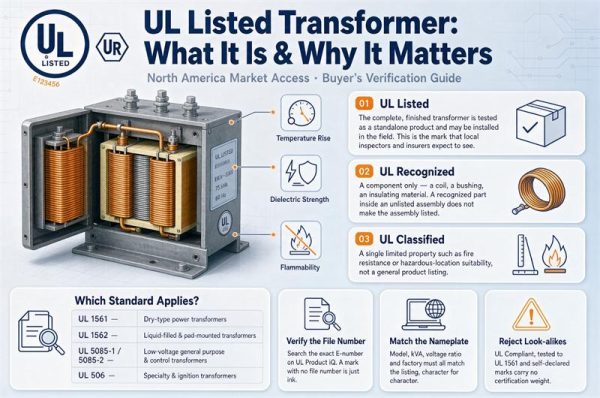
| Pad mounted distribution transformer | IEEE C57.12.34 for the product, IEEE C57.12.28 for enclosure integrity, UL 1561 for dry type up to 600 V, UL 1562 for dry type above 600 V up to 35 kV |
| Installation | NEC Article 450 for transformers, NEC 110.26 for working space, NEC 250 for grounding and bonding |
| Utility owned equipment | NESC, not the NEC. Utilities apply their own material standards on top |
| Metal enclosed switchgear | ANSI/IEEE C37.20 family, with IEEE C37.20.7 covering arc resistant construction by accessibility type |
| Dry type transformers by voltage | UL 1561 covers up to 600 V, UL 1562 covers 601 V to 35,000 V |
Two practical notes. First, working space is a real permitting item, not a suggestion. NEC 110.26 sets the clear space in front of equipment and it does not shrink just because the equipment is inside a pretty enclosure. Second, the utility gets a vote. In most interconnections the serving utility’s material standard overrides whatever you and your supplier agreed, so get that document before you finalise the design, not after.
What it really costs, and where the money moves
Vendor pages love a single percentage. They are less keen on publishing a baseline. Here are figures that have been published by a named third party, along with the awkward part.
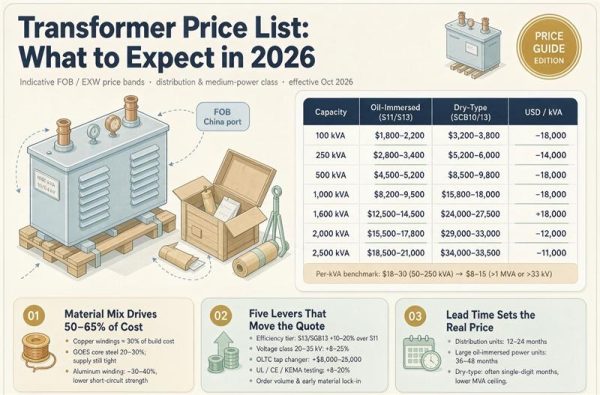
Third party published cost bands, retrieved 2026-10-15, from htyel.com compact substation guides. These are published indications from a supplier of compact substations, not quotations, and not a market survey.
| Cost line | Conventional build | Compact or prefabricated build | Reported saving |
|---|---|---|---|
| Equipment purchase, around 1 MVA | $180,000 to $220,000 in one article; $60,000 to $90,000 in another | $140,000 to $175,000 in one article; $85,000 to $130,000 in another | around 20 percent, or a premium, depending on which page you read |
| Civil works and foundation | $85,000 to $130,000 | $15,000 to $28,000 | about 80 percent |
| Installation labour | $60,000 to $90,000 | $20,000 to $35,000 | about 65 percent |
| Permitting and inspection | $12,000 to $22,000 | $8,000 to $15,000 | about 35 percent |
| 25 year maintenance | $95,000 to $130,000 | $60,000 to $85,000 | about 35 percent |
| 25 year total | $432,000 to $592,000 | $243,000 to $338,000 | about 30 to 43 percent |
Now the awkward part, and this is the most honest thing in this article. The same publisher quotes 1 MVA equipment at $180,000 to $220,000 on one page and at $60,000 to $90,000 on another. Same year, same capacity class, a spread of roughly 60 percent. That is not us catching them out, that is what this market actually looks like. The spread comes from things you control:
- Loss level. A low loss core costs more up front and less over 25 years. Whether that trade is worth it depends on your load factor and your electricity price, and nobody can answer it for you without those two numbers.
- Enclosure class and cooling. A hotter box needs a bigger transformer or forced ventilation. Both cost money.
- Switchgear medium. SF6, solid insulated, dry air and vacuum are not the same price, and in some jurisdictions SF6 reporting obligations will decide it for you.
- Coating and materials. Coastal corrosion class and stainless or galvanised hardware add real cost.
- Transport. An oversize load permit, a route survey and a police escort are line items, not rounding errors.
Here are the percentages you will read on vendor pages, and what each one usually measures.
| Claim you will see | What it usually measures | What is usually left out |
|---|---|---|
| 60 to 75 percent faster | Factory hours moved off the critical path | Permitting, transformer manufacturing, shipping, utility witness |
| 20 to 40 percent lower CAPEX | Equipment plus civil plus labour, self reported | Whether the two options were the same rating, same losses, same climate |
| 40 to 60 percent smaller footprint | Envelope area | NEC 110.26 working space, fence setbacks, crane access |
| 80 percent less civil work | No building to construct | Pad, ground grid, trenches, oil containment, drainage still exist |
| 25 year TCO 30 to 43 percent lower | Modelled, with assumed maintenance and escalation | Discount rate, and whether maintenance savings are measured or assumed |
Treat every one of those as a hypothesis to test against your own numbers, not a fact to quote to your board.
Where schedules actually slip
The “installed in three days” line is true and irrelevant. Three days is the last three days. Here is where the other months go.
| Step | What it depends on | What slips it |
|---|---|---|
| Design and approval drawings | Utility and consultant review cycles | Late utility material standard, missing short circuit study |
| Transformer manufacture | Core steel, copper, winding capacity | Capacity above about 5 MVA is the long pole. Published vendor figures for 2026 run 36 to 52 weeks; other published 2026 ranges for 5 to 50 MVA run 75 to 110 weeks. Get your own date in writing |
| Switchgear manufacture | Breaker and RMU lead times | Custom protection schemes, SF6 free designs in short supply |
| Factory assembly and FAT | Slot in the assembly hall | Late component, failed dielectric test on interconnections |
| Transport | Route survey, permits, escort, crane availability | Bridge limits, road width, seasonal load restrictions |
| Foundation | Pour and cure | Frost depth in cold climates, 28 day cure before setting the unit |
| Termination and SAT | Cable pulls, terminations, testing | Missing utility witness slot |
| Energisation | Utility acceptance | Anything above, discovered late |
Two of those are outside your supplier’s control and both are worth putting on your own critical path: the permit route survey, and the utility witness date. For how this looks on a real programme, the 11 kV and 33 kV compact substation programme for an overseas utility EPC is the closest thing we have to a worked example, and the rest of our project case studies covers the sites where the same kit went in under tighter constraints.
The civil work that does not disappear
Prefabrication moves work into a factory. It does not abolish the site.
- Pad or foundation. Reinforced concrete sized for the unit, with depth set by local frost penetration. In parts of the northern US that is well over a metre, and shallow pads heave.
- Grounding. A mesh or ring with a touch and step voltage check. Publicly accessible enclosures make this a design input, not a formality.
- Cable trenches and ducts. Usually the single largest remaining on site scope.
- Oil containment. If you have a liquid filled transformer, check the aggregate above ground oil volume against the local threshold. In the US, SPCC planning is triggered above 1,320 gallons of aggregate above ground oil storage capacity, and a single large unit can cross that line on its own.
- Drainage. The pad should shed water, and cable entries should not become wells.
- Clearances. Working space in front of the equipment, plus whatever the fire code wants for setbacks.
- Access. A crane needs to get to the pad, and the truck needs to get to the crane. This sounds obvious and it is the second most common cause of a missed energisation date.
Heat, altitude, salt and cold
| Condition | What happens | What to specify |
|---|---|---|
| Ambient above 40 °C | Cooling air is above the rating basis before any load | Site maximum ambient, and the rating at that ambient |
| Strong sun on the enclosure | Solar gain raises internal air temperature | IEC 62271-202 Annex G assessment, reflective coating, ventilation |
| Altitude above 1,000 m | Thinner air, less cooling, lower external insulation strength | Site altitude, correction per IEC 60076-2 or IEEE C57.91, higher BIL if required |
| Coastal or de icing salt | Corrosion of enclosure and hardware | Corrosion category, coating specification, stainless or hot dip galvanised hardware |
| Freeze and thaw cycling | Condensation inside the enclosure, on busbar insulation and relay boards | Thermostatically controlled heaters, gasketed entries rated for the minimum temperature |
| Heavy dust or sand | Blocked louvres, tracking on insulation | Filtered ventilation, higher ingress rating, more frequent inspection |
| Seismic | Racking and anchorage failure | Site specific seismic design, not a standard detail from a catalogue |
Dry type or oil inside the box
This choice is made inside the enclosure, so it is not the same decision as choosing a standalone transformer, and the enclosure class interacts with it.
- Dry type. Preferred where fire risk, indoor or dense urban siting, or environmental rules on oil matter. Heavier, usually more expensive at the same rating, and noisier than people expect. Ventilation is more critical because there is no oil moving heat around.
- Liquid filled. Cheaper per kVA, better overload behaviour, and easier to cool in a hot box. Brings oil containment, fire separation and, in some jurisdictions, reporting obligations with it.
If you want the full treatment of that trade, see oil immersed versus dry type transformers. For a prefabricated enclosure specifically, add one line: whichever you pick, ask for the load factor curve for that transformer type in that enclosure class, because the correction is not the same for the two.
Internal arc: pick the right accessibility class
Arc resistant construction is sold as a feature. It is actually a statement about who is protected and in what state the equipment is in.
Under IEC 62271-202, internal arc classification is sorted by accessibility. Published commentary on the 2022 edition describes three: IAC-A for operator protection with doors open, IAC-B for public protection with doors and covers closed, and IAC-AB for both. US practice talks about arc resistant switchgear by accessibility type under IEEE C37.20.7.
The buying rule is straightforward. If the box sits where the public can walk past it, you need public protection with the doors closed, and that is not the same test as operator protection. If your crews work inside it energised, you need the other one. If both are true, you need both, and you should say so explicitly.
Then ask for the test report. Not a brochure line, not a certificate of conformity. The actual report, with the arc current, the duration, the ignition point and the pass criteria. Arc classification is a type test. If nobody can produce the report, assume it does not exist.
FAT, SAT and what you should actually witness
Factory acceptance testing is the whole point of buying prefabricated, and most buyers waste it by showing up without a list.
Ask for the type and routine test split up front. Type tests cover the design and are done once; routine tests are done on your unit. A unit can pass every routine test and still be built to a design that was never type tested, which is why the split matters.
Worth seeing in person or on video:
- dielectric tests on the assembled unit, including the HV to transformer interconnection
- functional and protection scheme checks, trip by trip
- enclosure checks, door interlocks, ingress rating, coating thickness
- wiring and labelling verification against the approved drawings
Worth accepting on paper, from an accredited lab:
- temperature rise, which is a type test and takes too long to watch
- internal arc, which is destructive and already done
- short time and peak withstand current
- loss measurement
Ask for ISO/IEC 17025 accreditation on the reports you accept on paper. It is the difference between a lab result and a letter.
Where prefabricated loses
It is a good answer for a lot of projects and a bad answer for some, and you should know which is which before the vendor tells you otherwise.
- Above 52 kV. Out of scope for IEC 62271-202. Transmission substations are still built on site.
- Very large transformers. Once the transformer cannot be shipped assembled, the factory integration advantage starts to disappear.
- Highly custom layouts. Standardisation is where the savings come from. Bespoke engineering pays the custom price either way.
- Where a single failed part must be replaceable from local stock. Integrated units are easier to replace as a unit than to repair with whatever is on the shelf.
- Where the utility has its own material standard. It wins. Read it first.
- Sites a truck and crane cannot reach. Roof tops, tight urban rear access, soft ground, no turning radius.
- Aggressive seismic or flood design. Site specific analysis is required and the enclosure does not exempt you.
- Where you already have a building. Retrofitting an existing room is usually cheaper than buying a new enclosure.
A spec clause you can copy
Paste this into your RFQ and edit the numbers. The bracketed items are the ones most often left blank.
Prefabricated substation, outdoor, [walk-in / non walk-in], to IEC 62271-202:2022
including corrigendum 1 (2023).

Rating shall be stated as a three parameter value:
  rated power                : [   ] kVA
  total losses               : [   ] W at [   ] K reference
  temperature rise limits    : winding [   ] K, top oil or surface [   ] K

Enclosure class             : [5 / 10 / 15 / 20 / 25 / 30]
Design ambient, maximum      : [   ] deg C
Design ambient, annual mean  : [   ] deg C
Site altitude                : [   ] m, with correction applied
Solar radiation assessment   : required, to Annex G
Internal arc classification  : [IAC-A / IAC-B / IAC-AB], test report to be provided

Transformer                  : [dry type / liquid filled], [   ] kV / [   ] kV,
                               vector group [   ], impedance [   ] percent
HV switchgear                : [RMU / VCB / other], [   ] kV, [   ] kA for [   ] s
LV panel                     : [   ] A main, form of separation [   ]
Auxiliaries                  : anti condensation heaters [   ] W, thermostat set [   ]
                               deg C, ventilation [natural / forced] [   ] m3/h

Testing                      : type test reports to be provided from an ISO/IEC 17025
                               accredited laboratory; routine test reports for this
                               unit; FAT witnessed by the purchaser at [   ].

Documentation                : load factor curve for this transformer type in this
                               enclosure class, general arrangement drawings,
                               earthing and touch voltage calculation, transport
                               drawing with mass and centre of gravity.
Ten minutes before you send the RFQ
- Write down the site maximum and annual mean ambient in degrees Celsius.
- Write down the altitude in metres.
- Decide walk-in or non walk-in, and why.
- State the load, then state the load you expect in ten years, and size for the second one.
- Get the utility’s short circuit level and fault clearing time.
- Decide the internal arc accessibility class based on where the box will physically sit.
- Ask for the load factor curve, and check the usable kVA against your load from step 4.
- Check the transport route, not the truck, the route: bridges, width, weight limits.
- Confirm who witnesses FAT and book the date now.
- Confirm the governing standard, IEC or US, before the drawings start.
FAQ
What is a prefabricated substation? A factory assembled, factory tested enclosure containing medium voltage switchgear, a distribution transformer, low voltage distribution, protection and metering, and the auxiliary systems that keep it running. Under IEC 62271-202:2022 it covers cable connected AC units above 1 kV up to 52 kV, up to 60 Hz, walk-in or non walk-in, outdoors, in publicly accessible locations.
Is a prefabricated substation the same as a compact substation, a packaged substation or a unit substation? Compact, packaged, box type and kiosk substation are all used for the IEC style product. Unit substation usually means the North American indoor or outdoor assembly of MV switchgear, transformer and LV switchgear, built to ANSI and UL documents rather than IEC 62271-202. Same idea, different standards, and the drawings are not interchangeable.
What does IEC 62271-202:2022 cover that the 2014 edition did not? A three parameter rated power definition, minimum dimensions for access doors and operating aisle free height, an informative annex on solar radiation, an informative annex on installation conditions for electronic equipment, a wider scope that includes HV switchgear prefabricated substations, and a corrected load factor figure for mineral oil transformers.
Why is my 1,000 kVA substation not delivering 1,000 kVA? Because the transformer is sealed inside an enclosure, and the enclosure class limits how much hotter the internal air can get. Above the base 40 °C ambient, at altitude, or in direct sun, the usable continuous rating drops below the free air nameplate. Ask for the load factor curve.
What enclosure class should I specify? The one that keeps the transformer inside its temperature limits at your design ambient and your load factor. There is no universal right answer. The six classes commonly cited for the 2022 edition are 5, 10, 15, 20, 25 and 30, corresponding to permitted internal temperature rise difference in kelvin.
How much does a prefabricated substation cost? Published third party bands for around 1 MVA put equipment alone anywhere from about $60,000 to $220,000 depending on the source, with civil works and installation adding far less than a conventional build. A 25 year total has been published at roughly $243,000 to $338,000 for compact against $432,000 to $592,000 for conventional. Treat all of it as an indication and get your own quotation.
Are prefabricated substations actually cheaper? On civil work and installation labour, yes, consistently, and by large margins. On equipment, not always. Whether the total is lower depends on your enclosure class, your loss level, your transport route and your maintenance assumptions.
How long does installation take on site? Setting, terminating and commissioning can be a few days. The project is months, and the long pole is usually transformer manufacturing plus transport permitting, neither of which is on the three day plan.
Does IEC 62271-202 satisfy a US inspector? No. US jurisdictions want equipment listed by a nationally recognised testing laboratory plus NEC compliance, and utilities apply their own material standards. Pad mounted transformers sit under IEEE C57.12.34 and C57.12.28 with UL listing, and installation sits under NEC Articles 450, 110.26 and 250.
What is the difference between IAC-A, IAC-B and IAC-AB? They are internal arc classifications by accessibility. Published commentary on the 2022 edition describes IAC-A as operator protection with doors open, IAC-B as public protection with doors and covers closed, and IAC-AB as both. Ask which you need based on where the unit sits and how it is operated, and require the test report.
Do I still need a foundation? Yes. A reinforced pad sized for the unit, deep enough for local frost penetration, with grounding, cable entry, drainage and, for liquid filled units, oil containment. Prefabrication removes the building, not the site work.
When should I not use a prefabricated substation? Above 52 kV, with transformers too large to ship assembled, when the design is genuinely bespoke, when the utility standard dictates otherwise, when the site cannot take a truck and crane, when seismic or flood design is site specific, and when you already have a building that will do.