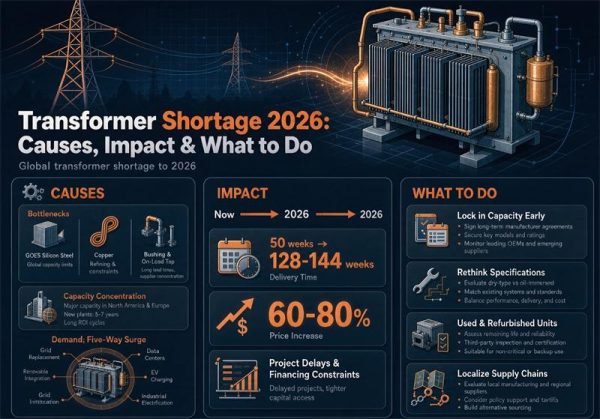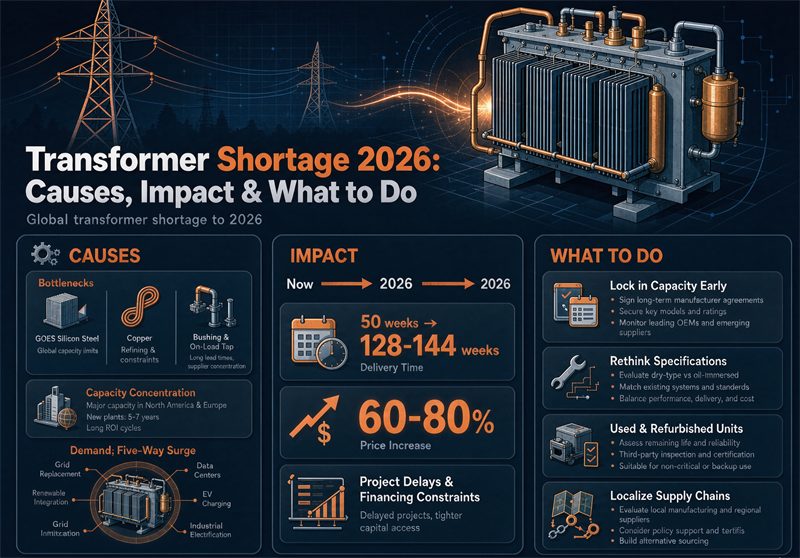
A large power transformer in 2026 takes about 128 weeks to arrive. A generator step-up unit runs closer to 144 weeks. That is two and a half to three years from purchase order to energization, and it is the number that decides whether a data-center campus, a utility substation, or a solar farm connects on schedule or drifts into the next budget cycle.
Here is the part most coverage gets wrong: the shortage is not one shortage. It is four demand waves landing on the same factory floors, and the squeeze is not spread evenly. Distribution-class availability has been improving through 2026, while large power and generator step-up classes have not loosened at all. If your project is a 1,000 kVA pad-mount, the window is painful but workable. If it is a 138 kV or 230 kV step-up, you are competing with hyperscalers who booked slots two years out.
This guide walks through what is actually happening, what it costs, what governments and manufacturers are doing about it, and the seven procurement moves that change your timeline. The numbers shift every quarter, so treat the bands below as planning ranges, not quotes.
What “the shortage” means in 2026
The single most useful frame is the class split. Wood Mackenzie’s second-quarter 2025 survey put the national supply deficit at roughly 30 percent for power transformers and 6 to 10 percent for distribution units. Those two numbers moved in opposite directions through 2026: distribution-class lead times narrowed by about 30 percent as catalog lines caught up, while the large-power and GSU shortage stayed pinned.
| Segment | 2026 supply pressure | What buyers see |
|---|---|---|
| Three-phase pad-mounted, 500 to 5,000 kVA | Tight, and analysts expect it to worsen | Multi-year lists at some US shops; spec changes cost months |
| Single-phase and pole-mounted distribution | Improving but still extended | Better than the 2023 peak, still far above normal |
| Dry-type, cast-resin and VPI | Moderate | Shorter schedules than oil-immersed, especially below 5 MVA |
| Medium power, 5 to 60 MVA | Severe | 18 to 30 month windows are common; slots are rationed |
| Large power and GSU, above 60 MVA | Most severe | 128 to 144 week averages; custom design dominates the timeline |
The takeaway for a project manager: do not treat every transformer like one commodity. A pad-mount slips into a different queue than a 200 MVA GSU, and the mitigation that saves you weeks on one can waste months on the other.
The 2026 lead-time ladder
These are observed market windows from order to factory acceptance, not list prices. They move with the quarter, so a number from March should be re-verified in September.
| Transformer class | Typical 2026 lead time | Notes |
|---|---|---|
| Distribution, pad-mount or pole, under 2.5 MVA | 30 to 50 weeks | Was 8 to 12 weeks pre-2021 |
| Dry-type, under 1 MVA | 8 to 16 weeks | Simplest supply chain, no tank or oil |
| Dry-type, 1 to 5 MVA | 9 to 12 months from drawing approval | Faster than oil-immersed of the same rating |
| Medium power, 5 to 50 MVA | 18 to 30 months | Rationed slots |
| Large power, 50 to 200 MVA, 138 kV | 36 to 48 months | The data-center interconnection choke point |
| High-voltage power, above 200 MVA, 230 kV plus | 42 to 60 months and rising | Custom design dominates |
| GSU and converter transformers | 144 weeks average, specialty to 208 weeks | Per Wood Mackenzie; Reuters put tight units at 3 to 4 years |
A distribution transformer that shipped in 12 weeks in 2019 now ships in 30 to 50. A large power unit that shipped in about a year now ships in closer to three. The bottom of the market, common catalog distribution units, sits at roughly 26 to 40 weeks, and that is the band Wood Mackenzie models narrowing further by 2030. Everything above it gets harder, not easier.
Four causes, not one
The shortage is structural because demand and supply moved in opposite directions at the same time. On the demand side, four waves stacked:
- AI and hyperscale data centers. Generator step-up transformer demand is up about 274 percent since 2019, the steepest jump in the Wood Mackenzie dataset. Hyperscalers are reserving entire production slots years ahead or paying premiums that price out solar developers and smaller utilities.
- Aging grid replacement. More than half of North America’s roughly 40 million in-service distribution transformers have passed their 33-year design life. DOE puts the share at about 55 percent. That replacement demand never goes away and competes with every new build for the same factory output.
- Renewables and storage interconnection. Every solar farm and wind plant needs step-up transformers, and the interconnection queue keeps stacking.
- Reshoring, EV charging, and electrification. Factory electrification and EV charging corridors pulled demand that previously had slack.
On the supply side, three bottlenecks:
| Bottleneck | What it does | Scale |
|---|---|---|
| Grain-oriented electrical steel (GOES) | The silicon-iron core material is made by a handful of mills; the US has one domestic producer, Cleveland-Cliffs | GOES prices roughly doubled since 2020; mill queue 9 to 15 months |
| Copper and bushings | Winding conductor plus high-voltage bushings and tap-changer contacts | Bushing queue at ~130 weeks is the longest single pole |
| Skilled labor and plant capacity | Coil-winding and dielectric testing need people trained over years; new lines take 24 to 36 months | Global LPT utilization ~70 percent in 2026, path to 80 percent by 2030 |
The detail that explains the timeline: a new high-voltage transformer line takes years to staff, qualify, and fill with slots already sold into backlogs. OEMs are not running at 95 percent and choking on one bad quarter. They are running at about 70 percent, and the constraint is capital and trained labor, not output.
Where the weeks actually go
When a buyer asks why a certified unit takes the time it does, the honest answer is a calendar, not a defense. A typical large unit moves through these stages:
- Design freeze. Drawings, loss guarantees, impedance, and the accessory list get locked and signed. Every change after this point reopens the materials list.
- Core steel order. GOES delivery itself can run 10 to 16 weeks, because the mills are the true bottleneck of the whole industry.
- Winding and assembly. Copper or aluminum coils are wound, insulated, and processed in batches.
- Testing. Routine tests, turns ratio, no-load and load loss, impedance, and a full temperature-rise test on the first unit of each design. The test bay is genuinely contested space at every factory.
- Third-party witness and packing. Adds weeks on top.
The part almost nobody plans for: high-voltage bushings sit on a ~130 week queue. A finished transformer with tank and windings ready can still wait in the OEM yard for a single bushing. That is why a design change that bumps impedance, noise, or BIL rating can push a 128 week delivery into the 156 to 208 week band. Design freeze before order placement is the single biggest compression lever a buyer controls.
What the shortage costs
Lead time, not unit price, is the binding constraint for most 2026 buyers, because a 128 week window forces a 30 month planning horizon no matter what you are willing to pay. The downstream math is brutal:
- A six-month slip on a hyperscale campus energization, fed by 100 to 300 MVA with N+1 redundancy, translates into hundreds of millions of deferred revenue. GE Vernova’s data-center-related orders roughly tripled to over $2 billion.
- Industry estimates cited in mid-2026 coverage put 30 to 50 percent of planned US data-center capacity at risk of delay in 2026, with equipment, not funding or permits, as the binding constraint.
- Stranded assets: completed generation or shell buildings sitting idle for months waiting on a substation step-up.
- Price escalation: power transformer prices are up about 77 percent since 2019, GSU up about 45 percent, and distribution up 45 to 95 percent. Section 232 steel duties at 25 percent and copper tariffs up to 50 percent have flowed straight into unit prices.
- Import exposure: roughly 80 percent of large power transformers used in the US are imported, and US transformer imports more than doubled, from $16.1 billion to $35.4 billion, between 2020 and 2025.
The pattern has a name in the trade: the AI tax. Data-center operators secure factory capacity years ahead, and non-data-center buyers, solar developers, utilities, and industrial planners get squeezed into whatever is left.
What governments and manufacturers are doing
The response moved from awareness to emergency documentation in under a year.
- DOE Distribution Transformer Working Group. After a March 2023 workshop found that inconsistent utility specifications were a major cause of long lead times, DOE tallied over 80,000 different distribution transformer varieties nationwide. The working group spent 2025 producing three resources on component interchangeability and SKU reduction, and held a progress webinar on March 5, 2026. National Grid reported cutting 223 of roughly 700 distribution SKUs, about a 32 percent reduction, as one utility-side example.
- Presidential Determination, April 2026. Under the Defense Production Act, transformers, high-voltage breakers, conductors, and electrical core steel were named essential to national defense, citing long lead times and limited domestic capacity. The action accelerates process; it does not build transformers this cycle.
- CISA NIAC, June 2024. That report described utilities waiting two to four years and set a goal of lifting domestic large-power transformer production toward 50 percent by 2029 from an estimated share near 20 percent.
- New plants are coming, slowly. Hitachi Energy announced a $528 million Gallman, Mississippi plant on September 15, 2026, the cornerstone of about $1.5 billion in US expansion, with production start scheduled for 2029. Siemens Energy’s Nuremberg site is adding capacity with a 50 percent increase targeted, landing in 2028. None of this is next-quarter relief.
The practical read: the supply side is attacking the shortage from the specification end (fewer SKUs, batch production) and the capacity end (new lines by 2028 to 2029). Through 2027, the bottleneck is slot allocation, not price.
Seven levers that actually change your timeline
Not all of these fit every project. The point is to pick by class and treat transformer procurement as a calendar discipline, not a purchase order.
| Lever | What it does | Quantified effect |
|---|---|---|
| Freeze the spec before you shop | Voltage, impedance, loss level, accessories locked once | Pulls a specialty build (156 to 208 wk) back toward the 128 wk standard band |
| Standard kVA and voltage | Factories push common combos through faster | Drops you into the shorter queue DOE is trying to widen |
| Book the slot in writing | A delivery estimate is not a reservation | Locks a week, not a maybe |
| Buy remanufactured for schedule-critical units | Rebuilt, ANSI-tested, warranted | 30 to 65 weeks down to 4 to 6 weeks, at roughly half the cost |
| Hold buffer stock | 3 to 6 months of common kVA and voltage | Carrying cost is a fraction of a 6-month outage on critical load |
| Reserve capacity | Pay a premium for guaranteed slots on predictable volume | Helps annual programs, not one-off urgent needs |
| Bridge with mobile or skid substations | 30 to 100 MVA, temporary | 12 to 18 month bridge while the permanent unit ships |
One warning on the export path: qualified Korean and Indian capacity is reachable for 2027 to 2028 delivery in the 110 to 220 kV classes, but only if you have already type-qualified the OEM. If you have not, a 9 to 15 month qualification program gets added to the timeline and cancels the benefit. Dry-type is the one segment where qualified Korean and Indian capacity is widely available for 2027.
Buying remanufactured without the risk
Remanufactured distribution transformers perform equivalently to new at roughly half the cost and 4 to 6 weeks instead of 30 to 50, when the OEM queue is full. The catch is the rebuild quality, not the technology. Before you buy, require four things:
- A unit-specific ANSI or IEEE test report with measured values, not a template.
- A dissolved gas analysis (DGA) on the oil, so you know the internal history.
- A written warranty of at least one year, ideally two.
- A named shop that did the work, not a broker reselling someone else’s rebuild.
A used unit pulled from a retiring plant can save two years if the testing comes back clean. A unit with elevated acetylene or carbon monoxide in the oil has seen a real fault and needs careful assessment before re-energization. The routine testing our shop runs on every unit is the difference between a bargain and a liability.
The 2027 to 2028 window
If your energization date is 2027 or 2028, the realistic paths are narrower than the headlines suggest. Domestic US production will not arrive in time for those projects, and Defense Production Act preferences apply to federal procurement, not private development. European and Korean second-tier manufacturers, running 20 to 32 month lead times, are the fastest viable path for many 2027 to 2028 projects, and they can build to US specifications. The window is narrowing as North American demand pressures those shops too, so the move is to qualify and reserve now, not to wait for domestic capacity that lands in 2029.
For context on the standards split when you source from IEC builders for a US or North American site, the IEC versus ANSI/IEEE comparison lays out the BIL and testing differences that decide whether a unit clears local acceptance.
A decision checklist for 2026
Before you write the purchase order, answer these:
- Which class is this, and which queue does it sit in?
- Is the spec frozen, or will a change reopen the materials list?
- Does it need to be new, or does it just need to work? (Remanufactured may hold the date.)
- Have you reserved the production slot in writing, with the winding and test-bay weeks named?
- Are bushings and tap-changer contacts covered, or are they the long pole?
- If sourcing from an export OEM, is type qualification already in place?
- Do you have buffer stock on the common kVA and voltage you actually fail on?
The buyers winning in 2026 stopped treating “new” and “remanufactured” as a quality decision and started treating them as a timeline portfolio: planned replacements on long lead, schedule-critical units on remanufactured or mobile bridge, emergencies from stock.
If you are scoping a new unit, the power transformer buying guide covers the specification details that decide whether your order lands in the fast queue or the custom one. For distribution-class planning, the distribution transformer manufacturers guide maps the suppliers actually shipping in 2026. Our full product index and resource library are the starting points, and our project list shows these units in the field.
Bottom line
The transformer shortage in 2026 is real, structural, and uneven: distribution is easing while large power and GSU stay pinned at two to three years. The constraint is slot allocation and skilled labor, not price, and new domestic capacity does not land until 2028 to 2029. The buyers who finish on schedule are the ones who froze the spec early, reserved the slot in writing, and treated remanufactured and mobile bridging as timeline tools rather than compromises.
FAQ
How long is a transformer lead time in 2026? Distribution-class units run 30 to 50 weeks, dry-type under 5 MVA about 9 to 12 months from drawing approval, medium power 18 to 30 months, large power 36 to 48 months, and GSU or converter units around 144 weeks, with specialty units to 208 weeks. These shift quarterly.
Is the transformer shortage getting better or worse? Mixed. Distribution availability narrowed about 30 percent through 2026, but large power and GSU classes have not loosened. Wood Mackenzie models a 30 percent power deficit and 6 to 10 percent distribution deficit.
Why are transformers taking so long to build? Four stages stack: design freeze, a GOES core-steel order that can run 10 to 16 weeks, winding and assembly, contested test-bay time, and third-party witness. High-voltage bushings sit on a roughly 130 week queue and can hold a finished unit in the yard.
What is causing the 2026 transformer shortage? Four demand waves (AI data centers, aging-grid replacement, renewables interconnection, reshoring and EV) hit supply bottlenecks in GOES steel, copper, bushings, and trained labor at the same time.
Will new US transformer factories fix it soon? Not before 2028 to 2029. Hitachi Energy’s Gallman, Mississippi plant was announced September 15, 2026 with production start in 2029; Siemens Energy’s Nuremberg capacity expansion lands in 2028.
Is it cheaper to buy a remanufactured transformer? Usually about half the cost of new, at 4 to 6 weeks instead of 30 to 50, if the unit is rebuilt and ANSI-tested with a real test report and warranty. Verify DGA, measured test values, and who did the work.
What did the government do about the shortage? DOE’s Distribution Transformer Working Group pushed SKU reduction and interchangeability (National Grid cut about 32 percent of its SKUs), and an April 2026 Presidential Determination named transformers essential to national defense under the Defense Production Act.
How does the shortage affect data centers? Data centers compete for the same slots and often reserve them years ahead, pushing lead times on 138 kV and 230 kV step-up units to 3 to 4 years and putting 30 to 50 percent of planned US capacity at delay risk in 2026.
Are transformers more expensive now? Yes. Power transformer prices are up about 77 percent since 2019, GSU about 45 percent, and distribution 45 to 95 percent, with Section 232 steel and copper tariffs flowing into unit prices.
Can I import a transformer to beat the wait? Qualified Korean and Indian capacity runs 20 to 32 months and is reachable for 2027 to 2028 delivery, but only if you have already type-qualified the OEM. Otherwise add 9 to 15 months of qualification.
What should I do first if I need a transformer in under a year? Decide whether it must be new or just must work. If schedule-critical, price remanufactured or a mobile bridge, freeze the spec, and reserve any new slot in writing with the winding and test weeks named.
Why are there 80,000 kinds of distribution transformers? DOE tallied over 80,000 distinct distribution transformer varieties in the US because utilities specified differently for decades. Cutting that SKU sprawl lets factories batch production instead of re-engineering one-off builds, which is the working group’s main lever.