There is no single answer to “how long is a transformer lead time in 2026.” The distance between a 1,000 kVA dry-type unit for a building and a 300 MVA generator step-up unit is measured in years, not weeks. If you came here for one number, the honest one is this: plan on 30 weeks for the fastest distribution unit, and somewhere between 144 and 210 weeks (almost three to four years) for a large generator step-up machine. Everything in between scales with size, voltage, and which factory floor your order lands on.
This guide is the companion to our shortage explainer. That piece covers why the market is tight. This one answers the question every project manager actually asks: when does my transformer ship, what drives that date, and what can I do to pull it in. We will give you a clean ladder by class, show you where the weeks actually go inside a factory, explain what a vendor quote’s “lead time” really includes (and what it hides), and lay out the levers that genuinely shorten the wait. You can browse our product range and the rest of our technical library for the deeper specs.
The 2026 lead-time ladder at a glance
Treat the numbers below as 2026 observation bands, not guarantees. They shift every quarter as order books fill and empty. The right-hand column shows the pre-2020 norm so you can see exactly how far we have stretched.
| Transformer class | Typical 2026 lead time | Pre-2020 norm | What mainly drives it |
|---|---|---|---|
| Dry-type distribution, up to 2,500 kVA / 36 kV | 8 to 32 weeks (20 to 32 typical) | 4 to 12 weeks | No oil impregnation step; shortest winding stacks; fastest-recovering class |
| Oil-immersed distribution and pad-mounted, up to 10 MVA | 30 to 65 weeks | 8 to 16 weeks | Tank fabrication, oil processing, bushing and tap-changer availability |
| Medium power, 5 to 60 MVA | 60 to 120 weeks (18 to 30 months) | 20 to 40 weeks | Custom design, type-test scope, competition for factory slots |
| Large power, above 100 MVA | 110 to 160+ weeks | 40 to 52 weeks | Only a handful of qualified plants; custom design dominates |
| Generator step-up (GSU), 50 MVA and up | 144 to 210 weeks; specialty past 4 years | about 50 weeks | Gas, solar-plus-storage, and hyperscale data centers; demand up 274 percent since 2019 |
Two things to hold onto. First, the spread inside a single row is real, not sloppy reporting. A dry-type unit can quote 8 weeks from a stocking distributor or 32 weeks from a Tier-1 OEM depending on size, region, and whether it is a catalog rating. Second, the tail is where projects die. A custom large-power or GSU unit quoted at “160 weeks” in early 2026 can slip past four years once a single component queue bites. We get into that next.
Why there is no single lead time
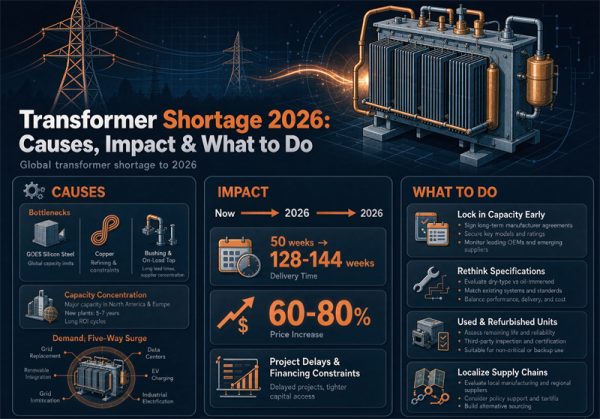
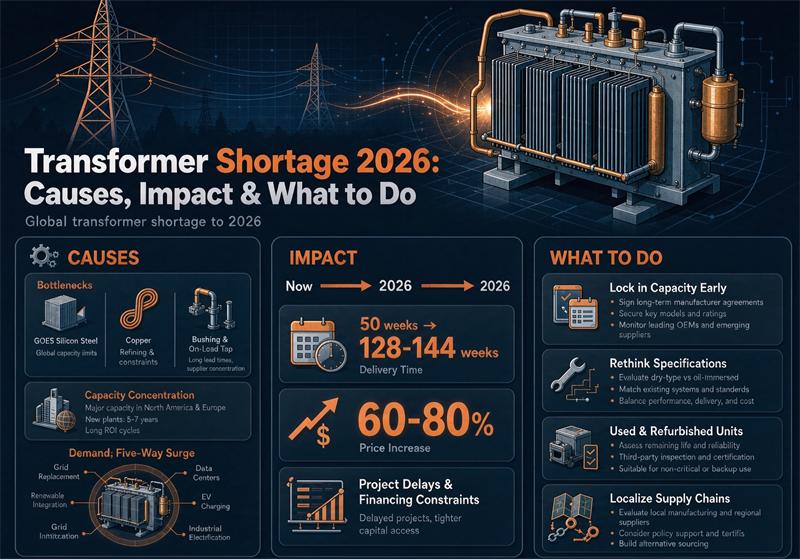
The reason one number will not work is that four demand waves are landing on the same factory floors at once. Wood Mackenzie’s second-quarter 2025 survey puts U.S. power-transformer demand up 116 to 119 percent since 2019, distribution demand up 34 to 41 percent, and generator step-up demand up a staggering 274 percent. Prices followed: power units up about 77 percent, GSU about 45 percent, and select distribution classes up 45 to 95 percent since 2019.
Those waves are:
- Grid modernization. More than half of North America’s roughly 40 million in-service distribution transformers are past their 33-year design life, so a large share of every order book is pure replacement demand that never goes away.
- AI data centers. Hyperscalers are reserving factory slots years ahead. A single campus can pull the megawatts of a small city, and it all funnels through large-power and GSU units.
- Renewables and storage. Every solar farm and battery site needs step-up and interconnection transformers.
- Electrification everywhere else. EV charging, reshoring of semiconductor and battery plants, building electrification, and mining all draw on the same winding and steel capacity.
The supply base did not expand at anything like that rate. Global large-power-transformer factory utilization sits near 70 percent in 2026 and is modeled to reach 80 percent by 2030. There is slack, but not much, and adding it takes years. This is a structural squeeze, not a blip you wait out.
Where the weeks actually go: five clocks
When a buyer asks why a certified unit takes two years, the honest answer is a calendar, not a defense. Every part of the schedule is attached to a material, a test bay, or a freight booking. We break it into five clocks.
1. The design-freeze clock. Nothing starts until the specification is closed: voltage ratio, impedance, vector group, tap range, cooling class, loss limits, accessory list, and test scope. This is the stage buyers most often drag out with late harmonic changes or revised site conditions. Every change after the freeze reopens the bill of materials and pushes the slot. This clock is the one lever you fully control.
2. The materials clock. Grain-oriented electrical steel (GOES) is the real bottleneck of the industry. Mill delivery alone runs 10 to 16 weeks, and Cleveland-Cliffs is the only domestic U.S. producer, with plants in Pennsylvania and Ohio. Copper, on-load tap changers, high-grade pressboard, and bushings each carry their own queue. We detail the worst of these in the next section.
3. The production clock. Winding is batch-processed: coils are wound, insulated, and processed in runs so quality stays repeatable. Oil-immersed units add tank fabrication, oil filling, and sealing. This is the part people imagine when they think “building a transformer,” and it is the most predictable slice of the timeline.
4. The test-bay clock. A certified unit earns its timeline here. Routine tests, factory acceptance tests (FAT), and third-party witness inspections (the full set is in our routine testing guide) all queue for contested test bays at every factory we know. A unit that is physically finished can still wait weeks for a free bay and a witness.
5. The freight and commissioning clock. Large power and GSU units are oversize loads that need permits, escorts, and sometimes barge or rail. Then site commissioning, which depends on your own civil and electrical readiness. None of this is in the factory quote, but all of it is in your energization date.
The component queue is the hidden risk
Here is the part most lead-time articles miss, and it is the most important thing to understand in 2026. A DOE-funded national laboratory supply-chain report (TP-5700-96742, May 2026) found that high-voltage bushings can run up to 130 weeks, longer than the transformer they bolt into, with no domestic source above 345 kV. On-load tap changers run 80 to 90 weeks from a single U.S. producer, and pressboard has exactly one domestic manufacturer.
What this means in practice: your tank and windings can be done, and the whole project still stalls waiting for one bushing. The report also notes that manufacturers manage this scarcity partly by asking buyers to accept alternate makes. That makes your specification itself a schedule lever. A spec that names one bushing make inherits that component’s queue. A performance specification permitting equivalents can draw on inventory already on the floor. Read that twice before you send the drawing.
The regional reality: US Tier-1 vs Europe vs qualified Asian export
The constraint in 2026 is mostly in order books, not in physics. A China-based or Korean factory with its own winding and core processing can quote standard distribution ratings considerably faster than a saturated U.S. utility supplier, because its order book is not buried under a decade of deferred grid work. The trade-off is qualification, tariffs, and supply-chain-security exposure, not speed. If your project must clear U.S. Buy America or foreign-entity rules, our export standards guide shows how IEC and ANSI/IEEE compliance maps onto those requirements.
| Source of supply | Large power (above 100 MVA) | Distribution class | What to weigh |
|---|---|---|---|
| U.S. Tier-1 OEM | 128 to 160+ weeks; 2028 slots effectively closed | 30 to 50+ weeks | Single domestic GOES source; bushing queue; BABA and FEOC compliance built in |
| European Tier-1 | 110 to 160 weeks | 30 to 50 weeks | Siemens Nuremberg adding 50 percent capacity by 2028; IEC alignment |
| Qualified Asian export (China, Korea, India) | 40 to 70 weeks at lower tiers; 110 weeks at the top | 8 to 32 weeks | Faster only where the order book allows; qualification, Section 232 tariffs, and FEOC rules are the real work |
The practical takeaway: if your project can use a qualified export source and you have done the certification homework, you can often cut a year or more versus a Tier-1 U.S. slot. If you have not qualified that second source yet, the savings are theoretical, because qualification itself takes months. That is why we keep a public list of distribution-transformer manufacturers and a track record of delivered projects: the time to build the second-source relationship is now, not when the Tier-1 quote slips.
What “lead time” in a quote really means
Most lead-time disappointment is a reading problem, not a factory problem. Before you put a date in your schedule, ask the vendor exactly what the number covers. Here is the checklist we hand to procurement teams.
- Ex-works or delivered? A 40-week ex-works quote becomes 44-plus weeks the moment ocean freight, customs, and site delivery are added. For an oversize large-power unit, add permits and escort lead time on top.
- Slot reservation or production start? Some quotes count from when you pay the deposit and “reserve” a slot that may be 18 months of queue before a single coil is wound. Others count from drawing release. Know which one you were given.
- Does it include FAT and witness? If your contract requires third-party inspection, confirm the test-bay window is baked into the date, not stacked on after.
- Is the price index-linked? With GOES and copper moving, many contracts now carry indexation or surcharges. A low lead-time quote with open-ended surcharges is not the bargain it looks like.
- Watch the empty-slot quote. A vendor promising a custom 33 kV unit in eight weeks is usually describing an empty factory slot, not a repeatable schedule. If it sounds too good against every competitor, the slot is the only thing that is real.
How to compress your wait: levers that move the weeks
Ordering earlier helps, but “order early” is advice, not a plan. Here are the levers that actually move the calendar, with the savings buyers report in 2026.
| Lever | Typical saving | What it costs or risks |
|---|---|---|
| Freeze the specification early | 28 to 80 weeks avoided (no reopen) | Nothing. Pure discipline |
| Performance spec instead of named components | Pulls from floor inventory when bushings or tap changers are queued | Needs engineering acceptance of equivalents |
| Remanufactured unit | 30 to 65 weeks down to 4 to 6 weeks, at roughly half the cost | Verify DGA, ANSI testing, and warranty; know who rewound it |
| Mobile or skid-mounted bridge unit | 12 to 18 months of bridge capacity | Rental or interim capital; not a permanent answer |
| Reserve a slot before design is final | 48-month path down to 12 to 18 months | Capital at risk if the design changes |
| Qualify a second (export) source | Opens the 40 to 70 week tiers | Qualification lead time. Do it now, not under pressure |
| Buffer stock of common kVA | Removes the wait entirely for stocked sizes | Carrying cost, but a fraction of a critical-load outage |
The pattern is clear. The levers you control completely (freeze the spec, qualify a second source, stock common sizes) beat the levers you rent (mobile bridges, slot reservations). Our complete buying guide for 2026 walks through how to sequence these so you are not paying for emergency measures you could have designed out.
Tier 1, Tier 2, or export: a buyer’s call
If you only remember one thing from this section, make it this: match the source to the risk. A standard distribution unit for a commercial building does not need a Tier-1 nameplate and should not wait 50 weeks for one. A 300 MVA GSU feeding a combined-cycle plant is a different animal, where pedigree, type testing, and local service outweigh a few saved weeks.
Tier 1 gets you the deepest track record and the easiest compliance story, at the longest queue and highest price. Tier 2 and qualified export sources get you speed and often lower cost, provided you have done the certification and accepted the tariff and supply-security math. The mistake we see most is treating every transformer as the same procurement problem. It is not. Sort your units by criticality first, then by lead time.
When will it get better? The 2028-2029 capacity wall
If you are hoping the market loosens in 2026 or 2027, plan against that hope. The new capacity everyone is talking about lands at the end of the decade. Hitachi Energy announced a 528 million dollar expansion at its South Carolina facility in September 2026, with output expected in 2029. Siemens is adding roughly 50 percent winding capacity at its Nuremberg plant, online around 2028. A separate U.S. investment in Virginia runs to about 457 million dollars. New transformer plants take three to five years to build and staff with skilled winders and core assemblers, so the relief curve is steep only after 2028.
That timing matters for your strategy. It means the buyers winning right now are the ones treating transformer capacity as a planning input from day one of project feasibility, not a purchase order placed after financing closes. It also means a second-source qualification started in 2026 pays off exactly when the 2028 slots begin to open.
Your procurement checklist for this quarter
If you have a transformer in your plan and you read this far, here is what to do before the quarter ends.
- Freeze the specification. Every week of indecision after this point is a week added to the slot.
- Sort units by criticality, not by habit. Standard distribution does not need a Tier-1 queue.
- Qualify a second source now, especially if any unit is above 10 MVA or uses a named exotic component.
- Pre-order standard configurations against a spec, even before project award, where your volumes justify it.
- Put index-based pricing clauses in the contract so material spikes transfer predictably.
- Hold three to six months of common kVA and voltage combinations if a critical load depends on them.
- Ask every vendor the five questions from the quote-reading section, in writing.
Bottom line
Transformer lead times in 2026 run from about 30 weeks for the fastest distribution unit to 144 to 210 weeks for a large generator step-up machine, and the gap is widening at the top, not the bottom. The hidden risk is not the transformer body but the component queue behind it, where a single bushing can outlast the unit that needs it. The only levers you fully own are freezing the drawing early and qualifying a second source, and meaningful capacity relief does not arrive until 2028 or 2029. Every unit you specify should be sorted by criticality before it is sorted by price.
FAQ
How long is a transformer lead time in 2026? Distribution-class units run roughly 30 to 65 weeks, medium power 60 to 120 weeks, large power above 100 MVA about 110 to 160 plus weeks, and generator step-up units 144 to 210 weeks. Dry-type distribution can be as fast as 8 to 32 weeks.
Why are transformer lead times so long right now? Four demand waves hit the same factory floors at once: grid modernization on an aging fleet, AI data-center builds, renewables and storage, and broad electrification. Supply has not kept pace, and GOES steel, bushings, and tap changers are individually constrained.
What is the longest lead time component inside a transformer order? High-voltage bushings, which a 2026 DOE laboratory report put at up to 130 weeks, longer than the transformer itself, with no domestic U.S. source above 345 kV. On-load tap changers run 80 to 90 weeks from a single domestic producer.
Is a dry-type transformer faster than an oil-immersed one in 2026? Usually yes. Dry-type distribution units skip the oil impregnation step and run about 8 to 32 weeks, while oil-immersed distribution and pad-mounted units run 30 to 65 weeks.
Do U.S. Tier-1 lead times differ from Asian export lead times? Yes, often by a year or more at the top end. U.S. Tier-1 large-power slots run 128 to 160 plus weeks with 2028 effectively closed, while qualified Asian export sources quote 40 to 70 weeks at lower tiers. Qualification, tariffs, and FEOC rules are the trade-off.
What does “lead time” actually include in a vendor quote? It varies. Confirm whether the number is ex-works or delivered, whether it counts from slot reservation or production start, and whether factory acceptance tests and third-party witness are included. Freight, permits, and site commissioning are usually not in the quote.
How can I shorten my transformer wait? Freeze the specification early, use a performance spec instead of naming components, qualify a second source, hold buffer stock of common sizes, or use a remanufactured unit that ships in 4 to 6 weeks at roughly half cost. Mobile bridges cover 12 to 18 months.
Is buying a remanufactured transformer safe? It can be, if the unit is disassembled, rewound where needed, retanked, oil-filled, and ANSI tested, with dissolved-gas analysis on the core and a real warranty. Verify who rewound it and what testing backs the claim.
When will transformer lead times improve? Not before 2028 at the earliest. Major expansions such as Hitachi Energy’s 528 million dollar South Carolina plant land around 2029, and Siemens adds Nuremberg capacity around 2028. New plants take three to five years to build and staff.
Why do large power and GSU transformers take the longest? Very few plants worldwide are qualified to build them, custom design dominates the schedule, and they pull the longest component queues. Generator step-up demand alone is up 274 percent since 2019.
Does the 2029 DOE efficiency rule affect lead times? Indirectly. New designs already carry more material to meet the April 23, 2029 efficiency floor, which adds content and schedule risk to units ordered in 2026. Factor the rule into loss capitalization now to avoid stranded inventory.
How much have transformer prices risen since 2019? Power units are up about 77 percent, GSU about 45 percent, and select distribution classes 45 to 95 percent. One utility rate case showed a small distribution unit going from 3,730 dollars in 2020 to 7,879 dollars in 2026, a 111 percent increase.