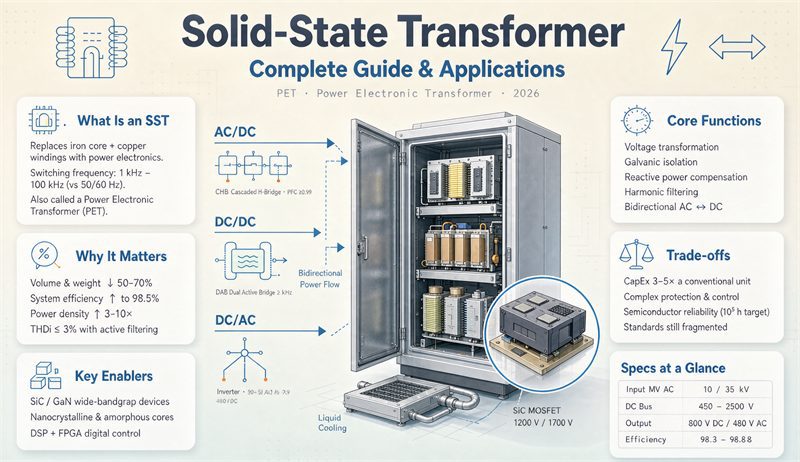
A solid-state transformer (SST), also called a power electronic transformer (PET), does the job of a conventional transformer with power electronics instead of a steel core and copper windings. It converts medium-voltage AC to DC, steps it down through a high-frequency transformer, and converts back to whatever your load needs. Including DC directly. The pitch is real: it is smaller, smarter, bidirectional, and it can feed an 800V DC bus without a separate rectifier. The catch is also real, and most vendor pages skip it. In 2026 an SST is not a catalog item you order by kVA. It is a pilot-stage, 2-to-3-times-more-expensive, 10-to-15-year-life system with no finished IEEE product standard. This guide tells you both halves, with numbers, so you can decide whether one belongs in your next spec.
If you are shopping for a conventional unit today and just landed here by accident, start with our dry-type transformer guide. That is the iron-and-copper machine an SST is meant to replace in some applications, and it is the cheaper, proven option for most of them. For the full range we build, see the product index, or browse the rest of our technical resources.
SST at a glance
| Question | Short answer (2026) |
|---|---|
| What is it? | A power-electronics converter that behaves like a transformer but adds DC ports, voltage regulation, and bidirectional control |
| How much does it cost? | About $80–120 per kW for a medium-voltage module; 1.5x to 3x a conventional transformer of the same rating |
| How efficient? | The SST stage runs ~98.5%; a conventional distribution transformer already runs 98–99.5%, so raw efficiency is not the win |
| Can I buy one off the shelf? | Mostly no. 1 MW-class modules and field pilots exist; volume products land 2027–2029 |
| How long does it last? | Target 10–15 years versus 30–40 for conventional iron; first-year failure rates run higher |
| Is there a standard? | No finished IEEE product standard. IEEE P3105 is still a draft; you stitch compliance from a patchwork |
| Where does it win? | 800V DC data centers, megawatt EV charging, PV-plus-storage hubs, DC microgrids, traction |
How a solid-state transformer works
A conventional transformer is a passive device. You feed it 50/60 Hz AC, magnetic coupling does the voltage step, and that is the whole story. An SST breaks the job into three active stages:
- AC to DC (rectification). The incoming medium-voltage AC is rectified. This is where SiC MOSFETs or IGBTs do the switching.
- High-frequency DC to DC through a medium-frequency transformer (MFT). This is the actual isolation and voltage conversion, but it happens at 10–100 kHz instead of 50/60 Hz. That high frequency is the trick: a transformer rated for tens of kilohertz needs a fraction of the iron and copper a 50 Hz unit needs.
- DC to AC (inversion), or straight DC out. If the load wants AC, the last stage inverts. If the load wants DC. An 800V DC bus, a battery, a charging pile. You skip the last stage and tap the DC link directly.
The components that matter are the wide-bandgap semiconductors (silicon carbide, SiC; gallium nitride, GaN), the medium-frequency magnetics (nanocrystalline or ferrite cores), the DC-link capacitors, and a DSP or FPGA running the control loops. Common topologies are the cascaded H-bridge (CHB) for the input stage, and the dual-active-bridge (DAB) or LLC for the isolation stage.
What this means for you: an SST is closer to a variable-frequency drive than to the gray tank in your substation. It regulates voltage actively, filters harmonics, supports reactive power, isolates faults in microseconds, and flows power both ways. None of that is free. Every one of those capabilities is silicon that can fail, firmware that must be patched, and heat that must be pumped out.
The numbers that actually matter
Vendors love to say an SST is “30% more efficient” or “half the size.” Both claims need a context check.
Efficiency. A conventional liquid-immersed or cast-resin distribution transformer already sits at 98–99.5% at full load. An SST stage sits around 98.5%. In a pure AC-to-AC service. Take medium-voltage AC in, medium-voltage AC out. A conventional transformer’s ~99% is genuinely hard to beat, and an SST can actually lose ground because of its own conversion losses. The real efficiency story is not the transformer stage. It is the system. A conventional data-center feed runs grid AC through a transformer, a UPS, a rectifier, and a PDU. Five or more conversion steps, each leaking a percent or two. An SST can collapse that into one step and a DC bus. A published 2.4 MW / 800V DC design comparison found the SST saved only about 19.8 kW versus the traditional link at 72% load, and when two units share the load in a 2N scheme (each at ~36%), the efficiency gap shrank to 0.94 percentage points. At 2026 Chinese electricity prices that particular unit did not pay back on energy savings alone. Roughly a 9-year simple payback and a negative net present value at 8% over 15 years. The savings are real but smaller than the brochure implies.
Size and weight. Here the claim holds up. A 1 MVA SST occupies about 40% less volume and weighs about 50% less than a conventional distribution transformer of the same rating (conservative figure; some vendors quote one-third to one-fifth). That matters in urban substations, offshore platforms, and mobile or vehicle-mounted applications where floor space is the constraint.
Cost. This is where the honest number lives. The 2026 average selling price for a three-phase medium-voltage SST module in the 500 kVA to 2 MVA range is roughly $80–120 per kW. Against a conventional transformer that industrial buyers price at $30–50 per kW, that is a 1.5x to 3x premium depending on rating and integration level. For data-center substation duty, one industry estimate puts the SST at 2–3x a conventional oil-filled transformer of equivalent rating, adding $1–2 million per MW of incremental capital versus a conventional substation. The cost is driven by SiC devices, medium-voltage packaging, and the absence of volume manufacturing. Not by the magnetics, which are now the cheap part.
Life and reliability. A conventional transformer runs 30–40 years and asks for little. An SST targets 10–15 years, and reliability studies put first-year failure rates around 1.8% versus 0.5% for conventional units, with mean time between failures in the 8–10 year range versus 25+ for iron. The weakest link is not the semiconductors. It is the DC-link capacitors. Electrolytic caps dry out, and their life roughly doubles for every 10°C you keep them cooler (the Arrhenius rule). Redundancy, condition monitoring, and predictive maintenance are how SST makers close the gap, and the U.S. DOE ARPA-E program has a stated goal of a 30-year service life by 2028. Treat those numbers as aspirational today.
Where an SST actually beats a conventional transformer
An SST earns its premium in exactly the situations a passive transformer cannot serve. Four of them:
- DC-native loads. If your load is fundamentally DC. An 800V DC data-center bus, a battery energy storage system, a DC fast-charging hub. A conventional transformer still needs a separate rectifier and often a UPS. The SST folds that into one box and removes conversion stages. This is the single strongest case.
- Bidirectional flow is required. Vehicle-to-grid, storage discharge, islanded microgrids, and regenerative braking all need power to move both ways. A conventional transformer does that passively, but it cannot control it. An SST regulates the flow, ride-throughs faults, and limits fault current on purpose.
- Space is the binding constraint. When you cannot fit a conventional substation. A city core, an offshore platform, a retrofitted basement. The 40–50% volume and weight reduction is worth paying for.
- Power quality is part of the spec. If you need active harmonic filtering, reactive support, voltage stabilization, or soft inrush on every energization, an SST delivers those natively. A conventional unit delivers none of them.
Where you should NOT buy one yet
The inverse is just as important, and almost no vendor page states it plainly:
- Plain low-voltage or medium-voltage distribution with no DC load and no bidirectional requirement. A conventional transformer wins on cost and life by a mile.
- Cost-sensitive, 30-year-life expectations. If your asset model assumes a fit-and-forget unit that outlives the building, an SST is not there yet.
- Projects that need a UL-listed, plug-and-play transformer. There is no finished product standard and no established listing path (more on that below), so lead time and qualification risk are on you.
- Anything where a 1–3 year slip breaks the business case. SST supply is thin, SiC wafers have their own lead times, and qualified integrators are few.
The standards and certification gap
This is the part most guides omit, and it is the part that will actually stall your project. There is no single published SST product standard. An IEEE recommended practice for the design and integration of solid-state transformers in the electric grid. Project IEEE P3105. Is still in draft status under the IEEE Power Electronics Society (contact: Marco Liserre). It aims to knit together the legacy transformer tests and map them onto the SST’s medium-frequency magnetics, but until it publishes, every SST program stitches its own compliance path from a patchwork of existing documents:
| Standard | What it covers | Where it touches an SST |
|---|---|---|
| IEEE P3105 (draft) | Design and integration of SSTs in the grid | The would-be umbrella spec; not published yet |
| IEEE 1547 / 1547.1 | DER interconnection and conformance | Where the SST interfaces or acts as a DER or storage gateway |
| IEEE 519 | Harmonic limits | Power quality at the point of common coupling |
| IEEE C57 / IEC 60076 | Conventional transformer requirements | Reference for insulation, BIL, and temperature rise. Written for line-frequency magnetics |
| IEC 62477-1 | Safety of power electronic converter systems | The converter hardware and its protection |
| IEC 61000 series | Electromagnetic compatibility | Emissions and immunity |
| IEC 61850 | Substation communications | Monitoring and control integration |
| IEC 62443 | Industrial cybersecurity | Securing the SST’s controls and comms |
| IEC 60270 | Partial discharge measurement | Insulation qualification of the medium-frequency transformer |
| UL 1741 | Inverters/converters for DER (US) | Grid-interactive functions and certification |
For a U.S. project this is the hard part: because the SST is a converter first and a transformer second, the familiar UL listing route for a dry-type or liquid-immersed unit does not map cleanly. You will lean on UL 1741 for the grid-interactive converter functions, IEEE 1547 for interconnection, and IEC 62443 for the fact that your transformer now runs firmware. The upshot: write your own validation plan. The sensible sequence is offline model, controller hardware-in-the-loop, power hardware-in-the-loop at the low-voltage ports, then full medium-voltage type and certification testing. The first time firmware meets a medium-voltage fault should never be on energized hardware.
For context on what a finished standard actually looks like for the conventional machines an SST replaces, our IEC versus ANSI/IEEE comparison walks through the C57 and IEC 60076 families that govern ordinary transformers. And shows why the SST world envies that clarity.
The application that is really driving demand: 800V DC data centers
If you read one section, read this one. The SST went from lab curiosity to boardroom topic because of AI data centers, and specifically because of NVIDIA’s 800V DC roadmap. The problem is simple arithmetic. A Blackwell rack draws about 145 kW; a Vera Rubin NVL72 climbs to 330 kW; Rubin Ultra and Kyber push toward 570 kW; the next generation targets roughly 1 MW per cabinet. Feeding that over 54V distribution means current in the thousands of amps and copper that does not fit. NVIDIA published an 800V DC architecture white paper (first at OCP in October 2025, version 2.0 in August 2026) that lays out a three-step path: a rack-level 660 kW power shelf in 2026, a cluster-level 2 MW bus in 2027, and the terminal design where an SST takes medium-voltage AC straight to 800V DC and deletes the step-down transformer, switchgear, and secondary distribution. At 800V the current drops to about one-fifteenth of the 54V case, and vendors quote 40–45% less copper in the distribution runs. The SST’s job in that picture is to convert 10 kV or 13.8 kV AC to 800V DC in a single step at 97–98% and feed the racks.
This is why the SST market, small today, is growing fast: roughly $169 million globally in 2024, an estimated $195–205 million in 2026, and a projected $936 million by 2030, a 19–32% compound rate depending on the research house. Total-cost-of-ownership parity with conventional builds is expected around 2030–2032 as SiC volumes scale.
Our data-center transformer solutions page covers the conventional side of that same problem. The 480V and 415V feeds, the K-factor units, the redundancy schemes. And is the right read if your data center is still on AC distribution. If you want to see conventional units we have actually shipped, our project list is the place.
The other applications follow the same logic:
- Megawatt EV charging. A 1 MW-plus charging hub needs AC/DC conversion and DC isolation anyway; the SST removes stages and shrinks the footprint. Multi-gun current sharing and future ultra-high-power readiness come built in.
- PV-plus-storage hubs. The SST gives flexible AC/DC ports so solar, storage, and load hang off one DC bus, smoothing output fluctuations in milliseconds and raising self-consumption. One 200 MW reference design claimed over RMB 10 million in annual electricity savings, though treat vendor figures as optimistic until you see the load profile.
- Rail traction and marine. Replacing a bulky 50 Hz traction transformer with a lighter power-electronic unit cuts weight and recovers regenerative braking energy. Hitachi Energy’s SST line started here.
- DC microgrids and AC/DC hybrid grids. The SST is the energy router between subsystems, coordinating islanded and grid-connected operation.
Thermal management, cooling, and reliability engineering
Because an SST is mostly semiconductors switching at high frequency, heat is the central engineering problem. And it is a different problem from keeping a conventional transformer cool. A conventional unit relies on oil or air convection that you can read about in our cooling class explainer; an SST’s silicon needs active liquid cooling at high power, with microchannel cold plates pushing heat-transfer coefficients above 5,000 W per square meter per kelvin. Two physics facts bound the design: nanocrystalline core material tops out around 105–120°C and loses up to 75% of its usable flux density above 50 kHz, and a stray inductance of even 1 nH in a high-frequency loop can induce a 1,000 V spike. That is why packaging and laminated busbars are a survival problem, not a detail.
Reliability is a system discipline, not a component choice. The failure split in field studies runs about 63% power modules, 23% DC-link capacitors, 12% gate drives, with the rest in controls. Modular designs need constant cell-voltage balancing, and a cascaded topology that loses balance in one module can cascade into a breakdown. The mitigation is redundancy plus online monitoring: predict the capacitor that will dry out, flag the device that is drifting, and swap a module instead of replacing a unit. It works, but it is a different maintenance contract than “inspect the oil every few years.”
60 Hz, North America, and what changes
Most SST literature is written for 50 Hz grids and IEC certification. For North America, two things shift. First, your medium-voltage side is 60 Hz and your common classes are 13.8 kV, 34.5 kV, and up. And the SST must still handle the harmonic and grounding conventions of those systems. Second, the standards gap above is wider here, because UL 1741 and IEEE 1547 are the anchors and neither was written for a transformer that is also a converter. Plan for a custom interconnection study and a custom commissioning test plan rather than a drop-in listing. None of this changes the core verdict: an SST is a grid-edge power-electronics system, and in North America it is bought as a project, not a product.
How to write an SST specification today
Because there is no standard to point at, the spec has to carry the weight a standard would normally carry. Adapt this block to your project and put real numbers in the brackets:
PROJECT: [site / application, e.g. 2 MW 800V DC data-center feed]
RATING: input [13.8 kV, 60 Hz, 3φ] output [800 V DC, ±%] power [kW/MW]
TOPOLOGY: [CHB input + DAB isolation, or as proposed] switching [kHz]
DEVICES: [SiC MOSFET, voltage class, supplier] cooling [liquid, °C target]
EFFICIENCY: target [97.5%] at [50%] load; report curve 25–100%
DC PORTS: [number, voltage, max current, isolation] AC PORTS: [if any]
BIDIRECTIONAL: [yes/no] max reverse power [kW]
POWER QUALITY: harmonics to IEEE 519; reactive range [MVAr]; inrush [limit]
PROTECTION: fault-islanding time [µs]; downstream coordination note
STANDARDS: IEEE 1547, IEEE 519, UL 1741, IEC 61850, IEC 62443, IEC 60270
COMMS: [protocol, cybersecurity to IEC 62443]
VALIDATION: offline sim → controller HIL → power HIL → MV type test
WARRANTY: [years] MTBF target [hours] spare-module strategy [hotswap?]
DELIVERY: [weeks] FAT/SAT at [location] training [days]
The line that protects you most is the validation sequence. Ask the supplier to demonstrate controller and power hardware-in-the-loop before any medium-voltage energization, and require the full type test against the patchwork standards above. A vendor that cannot produce that plan is not ready to ship to your site.
Bottom line
A solid-state transformer is a genuine technology, not a buzzword, but in 2026 it is a project-grade power-electronics system, not the gray tank you reorder by kVA. It wins where the load is DC-native, bidirectional, space-constrained, or power-quality-sensitive. Above all in 800V DC AI data centers and megawatt charging. It loses on cost (1.5x to 3x), life (10–15 years versus 30–40), and standards clarity (IEEE P3105 is still a draft, so you write your own compliance path). Buy it where the system savings are real, and buy a conventional transformer everywhere else.
FAQ
What is a solid-state transformer in plain terms? It is a power-electronics device that does what a transformer does. Change voltage and isolate circuits. But with semiconductors and a high-frequency magnetic stage instead of a 50/60 Hz iron core, adding DC ports, active control, and bidirectional power flow.
Is an SST the same as a regular transformer? No. A regular transformer is passive and magnetic; an SST is active and electronic. The SST can regulate voltage, filter harmonics, flow power both ways, and output DC directly, but it costs more, lives shorter, and needs its own validation.
How efficient is a solid-state transformer? The SST conversion stage runs about 98.5%. A conventional distribution transformer already runs 98–99.5% at full load, so raw efficiency is not the SST’s advantage. The advantage is system-level: it removes separate rectifiers, UPS stages, and conversion losses in DC-native applications.
How much does an SST cost compared with a conventional transformer? A medium-voltage SST module runs roughly $80–120 per kW in 2026, which is about 1.5x to 3x a conventional transformer of the same rating. For data-center substation duty the premium can add $1–2 million per MW of incremental capital.
Why is everyone talking about SSTs for data centers? AI racks now draw 300–1,000 kW, and feeding them over low-voltage DC means enormous currents. NVIDIA’s 800V DC roadmap (white papers in 2025 and 2026) uses an SST to take medium-voltage AC straight to 800V DC, cutting current to about one-fifteenth of the 54V case and shrinking copper by 40–45%.
Can I buy a solid-state transformer off the shelf today? Largely no. What exists in 2026 is 1 MW-class modules and field pilots; volume products are expected around 2027–2029. Treat any 2026 purchase as an engineered project, not a catalog order.
How long does an SST last? Targets are 10–15 years, versus 30–40 years for conventional iron-and-copper units. First-year failure rates run higher, and the weakest component is typically the DC-link capacitor.
Is there a standard for solid-state transformers? Not a finished one. IEEE P3105, the recommended practice for SST design and integration in the grid, is still in draft. Until it publishes, projects rely on a patchwork of IEEE 1547, IEEE 519, IEC 62477-1, IEC 61850, IEC 62443, IEC 60270, UL 1741, and the conventional C57/IEC 60076 families for reference.
What does an SST do to a substation’s cooling and maintenance? It shifts the thermal problem from passive oil or air convection to active liquid cooling of the power stage, with microchannel cold plates. Maintenance becomes predictive and condition-based. Monitoring capacitors and devices. Rather than periodic oil inspection.
Where should I NOT use an SST yet? Plain distribution with no DC load and no bidirectional need, cost-sensitive 30-year-life assets, projects that require a plug-and-play UL-listed transformer, and anything whose schedule cannot absorb a 1–3 year slip.
Which companies are building SSTs? Incumbents including GE Vernova, Hitachi Energy, and Siemens Energy are adapting power-electronics lines; specialist developers such as Resilient Power Systems target the data-center segment; and research programs such as FREEDM at NC State laid the academic groundwork.
How do I specify an SST if there is no standard? Write the spec to carry what a standard would: rating, topology, device class, efficiency curve, DC/AC ports, power quality to IEEE 519, protection and fault-islanding times, the standards patchwork, communications and cybersecurity, a validation sequence (offline sim to controller and power HIL to medium-voltage type test), warranty, MTBF target, and spare-module strategy.