A solar PV transformer is not a commodity line item you check off in the RFP. Most developers learned that the hard way: a set of off-the-shelf distribution units that could not handle the harmonic profile of a plant’s string inverters cost one U.S. developer $2.8 million in replacements and six weeks of lost peak-summer generation. At 200 MW and climbing, with 1500V DC architectures and hybrid storage coupling, the transformer between your inverter and the grid is the single most consequential balance-of-plant decision you make.
This guide is written from the buyer’s side, not the vendor’s. We correct three claims you will see repeated on manufacturer blogs, show the sizing math with derating, compare the real cost including 25-year losses, and hand you a paste-ready RFQ. Browse our product range and the rest of our technical library for the deeper specs behind each recommendation here.
What a solar PV transformer actually does
Photovoltaic panels make DC. The inverter turns that DC into low-voltage AC, typically 480V, 600V, 690V, or 800V three-phase. The transformer’s job is to step that AC up to the medium-voltage collector voltage (13.8kV, 23kV, 34.5kV are common in North America) and from there, often through a substation transformer, up to the transmission grid.
Two inverter architectures drive the topology:
- Central inverter. One large inverter feeds one large step-up transformer. A 4 MW central inverter on a single 4.5 MVA unit is still the default above 100 MW. The current waveform is relatively clean because central inverters include output filters.
- String inverter. Many smaller inverters cluster, each near its own inverter-duty transformer (600V to 900V secondary). This is where 1500V DC systems live in 2026, and where harmonic loading gets ugly.
Note one point that gets mangled in vendor copy: the transformer does not really run “bidirectional.” Power flows from the inverter winding to the grid winding. The real challenge is that the inverter-side winding sees a non-sinusoidal, low-power-factor, rapidly ramping current every single day. That is what separates a solar-rated unit from a general-purpose distribution transformer. Our deeper write-up on step-up transformers in renewable energy covers the collector-to-grid chain in full.
The three numbers that decide everything
You can shortlist 90 percent of suppliers once you lock three numbers: kVA, voltage ratio, and impedance.
kVA. Size to the inverter AC output at unity or near-unity power factor, then add margin. Modern inverters run at PF 0.99 or 1.0, so kVA tracks kW closely. Add 10 to 15 percent for cloud-edge irradiance spikes, DC/AC array oversizing, and low-voltage-ride-through (LVRT) overcurrent. A plant with a 1.3 DC/AC ratio does not need a 1.3x bigger transformer, because the inverter clips at its AC nameplate, but you still size to the inverter’s full AC rating continuously.
Voltage ratio. Match the secondary to the inverter output and the primary to the collector or grid voltage. Common pairs: 0.48/13.8kV, 0.6/23kV, 0.69/34.5kV, 0.8/35kV. Get this wrong and the unit is scrap.
Impedance (%Z). The utility’s short-circuit level and voltage-regulation needs set this. For a solar substation transformer, 5.5 to 7.5 percent is the typical band. Too low and fault current exceeds switchgear rating; too high and voltage regulation fails during reactive support. This single number triggers more interconnection rejections than any other.
Worked example: sizing a 50 MW plant
Say a 50 MWp ground-mount plant with a 1.25 DC/AC ratio, so inverter AC nameplate is about 40 MW. Using twenty 2.0 MW central inverters:
- Per-inverter transformer: 2,000 kW / 0.99 PF = 2,020 kVA. Add 10 percent margin for LVRT and oversizing, round to the next standard size: 2,500 kVA.
- Collector: twenty 2.5 MVA units (50 MVA nameplate) feed a 34.5 kV collector.
- Substation: one 50 MVA transformer lifts 34.5 kV to the 110 kV or 230 kV transmission point.
Now apply site derating. The plant sits at 45°C ambient and 1,500 m elevation. Per IEC 60076, derate 0.4 percent per °C above 40°C and 0.5 percent per 100 m above 1,000 m:
- Temperature: 0.4 × (45 – 40) = 2.0 percent
- Altitude: 0.5 × (1,500 – 1,000) / 100 = 2.5 percent
- Total derate about 4.5 percent
So that 2,500 kVA nameplate behaves like roughly 2,390 kVA on site. Specify 5 percent headroom (or step up to the next standard size) so the unit holds nameplate on the hottest afternoon. We applied exactly this discipline on the step-up transformers we delivered for a 50 MW solar PV plant.
Pad-mounted, skid-mounted, or unit substation
The enclosure format matters as much as the electrical spec. Three styles dominate:
| Format | Typical kVA | Footprint | Best fit |
|---|---|---|---|
| Pad-mounted | 100 to 5,000 kVA | Single concrete pad, 1 to 2 days install | C&I rooftop, community solar, tight sites |
| Skid-mounted | 1,000 to 15,000 kVA | Steel base frame, 3 to 5 days | Medium utility-scale farms |
| Unit substation | 5,000 to 30,000+ kVA | Integrated MV switchgear + LV panel, 1 to 2 weeks | Large plants above 10 MW |
Pad-mounted units are the workhorse for commercial and community solar: pre-filled, pre-tested, delivered as one piece, dead-front design with no exposed live parts (what North American utilities expect at grade). Skid-mounted puts the transformer and auxiliaries on a structural frame for plug-and-play deployment and shorter foundations. Unit substations integrate switchgear, transformer, and distribution in one enclosure, cutting site wiring and commissioning time, but cost 20 to 40 percent more than separate components.
Oil, vegetable ester, or dry-type
| Fluid | Power range | Fire point | When to use |
|---|---|---|---|
| Mineral oil | 100 kVA to 100+ MVA | ~160°C | Default for outdoor utility-scale |
| Vegetable ester | 100 kVA to 30 MVA | >300°C | Environmentally sensitive or fire-conscious sites |
| Dry-type (VPI or cast resin) | 100 kVA to 15 MVA | No liquid | Indoor, rooftop, strict fire codes |
Oil-immersed is the cost-effective choice above 1 MVA and handles the largest capacities with natural cooling (ONAN) scaling to forced (ONAF). Vegetable ester gives a biodegradable, high-fire-point alternative that eases permitting in protected areas. Dry-type eliminates oil containment entirely, which is why it is not optional but mandatory for rooftop arrays, building-integrated PV, and indoor inverter rooms where fire codes ban liquid-filled gear. Cast resin in particular resists moisture and salt, a real advantage in coastal or tropical sites. For the fire-code and indoor decision, our dry-type selection guide walks the trade-offs.
Four specs that separate solar-ready from commodity
Four specifications belong in every solar RFP. Skip any one and you are buying a liability.
- Harmonic withstand, expressed as a K-factor per IEEE C57.110. The inverter injects 5th, 7th, and 11th order currents into the low-voltage winding. A properly rated unit runs at full nameplate kVA under that spectrum. Skip it and winding hot-spots run 15 to 20°C above the nameplate suggests.
- Thermal cycling design, not steady-state. A solar unit sees 0 to 100 to 0 percent load every day: cold soak at night, fast ramp at sunrise, sustained full load midday, abrupt drop at dusk. Reinforced insulation and cooling tuned to shed top-oil heat add maybe 3 percent to cost but roughly double expected insulation life.
- Outdoor enclosure. NEMA 3R is the floor. Within 10 km of a coast, specify ISO 12944 C5-M corrosion protection on the tank and all exposed hardware, or the padlock will not open by year three.
- Grid interconnection data. The EPC needs the unit’s impedance and regulation characteristics to model the interconnection study. The manufacturer must supply test reports, not catalogue averages.
Standards: what each one really means (and three corrections)
Solar transformer specs are a thicket of standard numbers. Here is what each actually governs, plus three errors we see repeated on manufacturer blogs.
| Standard | What it covers |
|---|---|
| IEEE 1547 | Interconnection of distributed energy resources in North America. Drives voltage regulation, ride-through, power quality. |
| IEEE C57.110 | Harmonic loading (K-factor) calculation for non-linear loads. Use this to justify the K-rating. |
| IEEE C57.12.90 / C57.12.00 | Routine and type tests / general requirements for liquid-immersed transformers. |
| IEEE C57.12.34 | Pad-mounted, dead-front integral transformers. What many U.S. utilities actually want on the nameplate. |
| IEC 60076 (incl. 60076-3 PD) | Global benchmark for power transformers; partial-discharge limits matter because inverters age insulation. |
| UL 1561 / UL 1562 | Dry-type transformers at or below 600V / above 600V. |
| NEMA 3R / ISO 12944 | Enclosure ingress / corrosion class. |
Three corrections worth printing on a sticky note:
- UL 1741 is not a transformer standard. It covers inverters, converters, controllers, and interconnection equipment. The transformer appears in the interconnection study, but it is not “UL 1741 listed.” Blogs that say “the transformer must meet UL 1741” are confusing the inverter standard with the transformer.
- The DOE efficiency compliance date is 2029, not 2026. The federal rule (10 CFR 431, published across 89 FR 29834 and 90 FR 43371) sets a compliance date of 2029-04-23 for liquid-immersed and dry-type distribution transformers. If a vendor cites “DOE 2026,” they are a year early. Ask for the measured no-load and load loss from routine tests against the 2029 levels.
- K-factor 4 is the old minimum, not the modern default. K-4 suits legacy central inverters with THDi below 3 percent. Modern string inverters run THDi of 3 to 5 percent and call for K-13; mixed or weak-power-factor plants need K-20. Specifying K-4 on a 2026 string-inverter plant under-rates the unit.
For the full standards hierarchy when you are exporting or crossing code boundaries, our IEC vs ANSI/IEEE standards guide lays out which document governs what.
The real cost: EXW, landed, installed, and 25-year TCO
Most published prices are EXW China factory quotes. Those are useful as a floor, not a budget. Reference EXW ranges seen in 2026 for oil-immersed units: 500 kVA around $6,000 to $12,000, 1 MVA around $10,000 to $18,000, 2 MVA around $18,000 to $35,000, 5 MVA custom. Three things those numbers leave out:
- Landed cost. Freight, insurance, crating, and tariffs. Section 232 steel measures and transformer-specific duties can add materially; for large units the landed multiplier over EXW is often 1.3 to 1.8 depending on capacity and origin.
- Installed cost. Concrete pad, cable, MV switchgear or fuses, surge arresters, labor, commissioning. This commonly exceeds the transformer price itself on small sites.
- 25-year TCO. A transformer’s core is energized 24/7/365, so no-load loss spends money even at midnight. Take a 2,500 kVA oil unit with 2.0 kW no-load and 18 kW load loss at full load, at a 22 percent capacity factor and $0.10/kWh:
| Loss stream | Annual energy | 25-yr present cost @7% |
|---|---|---|
| No-load (2.0 kW, always on) | 17,520 kWh | about $21,700 |
| Load (18 kW at 22% CF) | 7,630 kWh | about $9,500 |
| Total | 25,150 kWh | about $31,200 |
Premium-efficiency designs (low-loss cores, better windings) cut no-load loss 30 to 40 percent and pay back inside the plant’s life. Specifying on TCO, not on the EXW line, is the single biggest lever on levelized cost of energy.
Lead time reality (plan early)
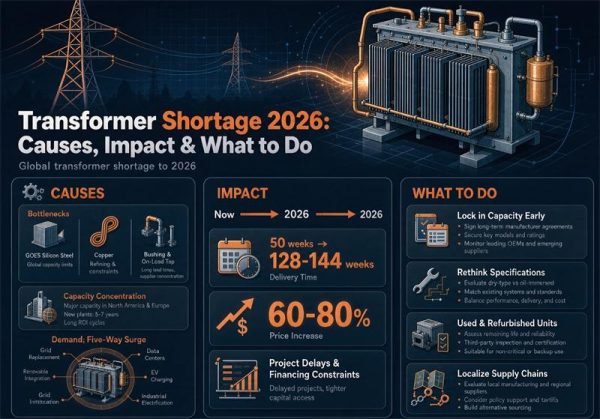
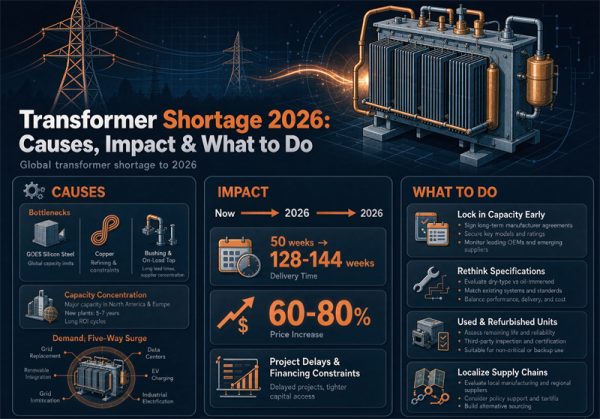
Solar transformers compete for the same constrained inputs as every other transformer: grain-oriented electrical steel (GOES), windings, test bays, and especially high-voltage bushings, which can queue 100+ weeks. Observed 2026 lead-time bands run roughly 30 to 50 weeks for distribution-class pad-mounts, 9 to 12 months for dry-type 1 to 5 MVA, 18 to 30 months for medium power, and 36 to 60 months for large power and GSU-class units.
The practical lesson from the shortage and lead-time reporting we track: freeze the electrical spec before the inverter is even selected, because a late change to impedance, BIL, or noise level can slide a 128-week slot to 156 to 208 weeks. Design freeze is the only compression lever the buyer controls.
A paste-ready RFQ checklist
Send this block to any supplier and you will separate the capable shops from the catalogue resellers:
SOLAR PV TRANSFORMER - RFQ
Plant size (MWp / DC) and DC/AC ratio: ______
Inverter AC output per unit (kW) and count: ______
Secondary (inverter) voltage: 480 / 600 / 690 / 800 V
Primary (collector/grid) voltage: ______ kV
Frequency: 60 Hz (NA) / 50 Hz
Required kVA per unit (with margin): ______
Vector group: Dyn11 (confirm with utility)
Impedance %Z target: ______ (utility short-circuit level: ______ kA)
K-factor per IEEE C57.110: K-4 / K-13 / K-20 (inverter THDi: ______%)
Cooling: ONAN / ONAF / AN / AF
Fluid: mineral oil / vegetable ester / dry-type
Enclosure: NEMA 3R; C5-M if within 10 km coast: Y/N
Tap changer: NLTC +/-2x2.5% min / OLTC
BIL (HV): ______ kV
Altitude (m) and max ambient (C) for derating: ______
Standards: IEEE 1547 / C57.12.90 / C57.12.34 or IEC 60076
Routine + type test reports required: Y/N
Target EXW and desired ready date: ______
Five mistakes that cost revenue days
- Undersizing to inverter nameplate without margin. Cloud-edge and LVRT overcurrent push past the AC rating; the unit trips on peak-sun days, exactly when generation is worth most.
- Skipping the K-factor. Winding hot-spots climb 15 to 20°C, insulation ages in years instead of decades, and premature failure takes the inverter offline.
- Ignoring altitude and temperature derating. A 2,500 kVA nameplate at 45°C and 1,500 m behaves like 2,390 kVA. Skip the headroom and you clip at the worst possible moment.
- Wrong vector group or tap range. The utility’s grounding philosophy and voltage-regulation needs are not optional; a mismatch means the interconnection study fails.
- Buying on EXW price alone. The cheapest unit often has the highest 25-year loss bill and the weakest test documentation, which surfaces at commissioning, not at bid.
North America specifics: 60 Hz, UL, AHJ
For U.S. and Canadian projects, a few region-specific points:
- Frequency is 60 Hz and the common collector voltages are 13.8 kV and 34.5 kV.
- Dyn11 is the widely used vector group for solar step-up because it handles unbalanced loading and provides the neutral for grounding, but confirm with the utility’s interconnection requirements document before finalizing.
- Listing vs compliance. Pad-mounted liquid units are commonly specified to IEEE C57.12.34; dry-type units reference UL 1561 (at or below 600V) or UL 1562 (above 600V). Do not accept a bare “UL listed” claim without the specific standard and the certificate.
- AHJ and NEC. The Authority Having Jurisdiction signs off on the installation. NEMA 3R is the enclosure floor; C5-M corrosion protection applies within 10 km of the coast.
- Tariffs. Section 232 steel and transformer-specific measures affect landed cost; build them into the budget early.
How to read a quote and verify the unit
When quotes come back, verify before you sign:
- Ask for routine test reports to IEEE C57.12.90 or IEC 60076-1, not catalogue averages. Measured no-load and load loss against the 2029 DOE levels is the number that protects your TCO.
- Confirm the nameplate shows BIL, impedance with tolerance, vector group, tap range, and the K-factor calculation per C57.110.
- Check the partial-discharge level for IEC 60076-3 compliance; inverters accelerate insulation aging if PD is loose.
- Watch for phantom lead times. An “8-week” slot that has not been reserved in the factory order book is a sales number, not a delivery commitment. Get the slot confirmed in writing.
Bottom line
A solar PV transformer is a 25-year balance-of-plant decision, not a check-box. Size to inverter AC output with 10 to 15 percent margin and derate for site heat and altitude, pick the enclosure and fluid for the install location (dry-type is mandatory indoors and on most rooftops), and demand K-13-class harmonic rating for modern string inverters. Then buy on 25-year TCO and verified test data, not on the EXW line, and freeze the spec early because the lead-time clock starts the moment you change impedance or BIL. Our delivered project track record shows what disciplined scheduling and tested units look like in the field.
FAQ
What size transformer do I need for a solar farm? Size to the total inverter AC output at unity or near-unity power factor, then add 10 to 15 percent for cloud-edge spikes, DC/AC oversizing, and LVRT overcurrent. Round to the next standard kVA. A 40 MW AC plant using twenty 2.0 MW inverters lands at twenty 2,500 kVA units before site derating.
What is the difference between a step-up and a pad-mounted solar transformer? Step-up describes the electrical function: raising inverter AC to collector or grid voltage. Pad-mounted describes the enclosure: a sealed, dead-front unit on a concrete pad. A unit can be both, and most North American community and C&I solar transformers are.
Do I need a K-factor rated transformer for PV? Yes for any inverter-coupled unit. Use K-4 only for legacy central inverters with THDi below 3 percent. Modern string inverters (THDi 3 to 5 percent) need K-13, and mixed or weak-power-factor plants need K-20. K-rating follows IEEE C57.110.
Is UL 1741 a transformer standard? No. UL 1741 covers inverters, converters, controllers, and interconnection equipment. The transformer is modeled inside the interconnection study but is not UL 1741 listed. Transformer compliance runs through IEEE C57.12.90 or IEC 60076 and, for pad-mounts, IEEE C57.12.34.
Oil-immersed or dry-type for a rooftop solar system? Dry-type, almost always. Rooftop and indoor installations are usually governed by fire codes that ban liquid-filled equipment, and dry-type removes the oil-containment requirement. Cast resin also resists coastal moisture and salt.
What impedance should a solar substation transformer have? Typically 5.5 to 7.5 percent at the substation. The exact value comes from the utility’s short-circuit level and voltage-regulation needs. Too low exceeds switchgear fault rating; too high fails reactive support during ride-through.
How much does a solar PV transformer cost in 2026? EXW China reference ranges run about $6,000 to $12,000 for 500 kVA, $10,000 to $18,000 for 1 MVA, $18,000 to $35,000 for 2 MVA, and custom for 5 MVA. Landed cost, installed cost, and 25-year losses add substantially, so buy on TCO, not the EXW line.
What lead time should I plan for a solar transformer? Roughly 30 to 50 weeks for distribution-class pad-mounts, 9 to 12 months for dry-type 1 to 5 MVA, 18 to 30 months for medium power, and 36 to 60 months for large power and GSU-class units in 2026. Freeze the spec early; late changes to impedance or BIL extend the slot dramatically.
Does the DOE 2026 efficiency rule apply to solar transformers? The federal efficiency rule (10 CFR 431) applies, but the compliance date is 2029-04-23, not 2026. Spec the unit to the 2029 levels now and ask for measured no-load and load loss from routine tests rather than catalogue averages.
What vector group is used for solar step-up transformers? Dyn11 is the common choice because it handles unbalanced loading and provides the neutral for grounding, but the utility’s interconnection requirements document sets the final answer. Confirm before finalizing the spec.
How do I size for altitude and high temperature? Per IEC 60076, derate about 0.4 percent per °C above 40°C and 0.5 percent per 100 m above 1,000 m. A 2,500 kVA unit at 45°C and 1,500 m behaves like roughly 2,390 kVA, so specify about 5 percent headroom.
What should I ask for in a solar transformer quote? Routine and type test reports to IEEE C57.12.90 or IEC 60076-1, the K-factor calculation per C57.110, BIL, impedance with tolerance, vector group, tap range, partial-discharge level, enclosure class, and a written, reserved lead-time slot.