a 25 kVA transformer is two different products wearing one label. Single-phase at 120/240 V it gives you 104 amps. Three-phase at 208Y/120 V it gives you 69. Those aren’t variations on a theme — they’re different machines, and picking the wrong one is the most expensive mistake in this size class. Price runs from roughly $400 for a basic export unit to several thousand dollars landed and installed in the US, and the spread is almost entirely about which of those two you meant plus what’s wrapped around it.
Here’s the part that decides everything else: three-phase 25 kVA isn’t a standard DOE rating. The federal table jumps from 15 to 30 kVA on the three-phase side. Your 25 kVA three-phase unit has to be interpolated, and a lot of builders would rather sell you a 30. That one fact changes price, lead time, and what you should ask for.
TransNine Electric builds distribution transformers from small single-phase cans up, and what follows is the sequence we’d walk you through before you send a single RFQ.
Key numbers
| Item | Value | Why it matters |
| 25 kVA, single-phase, 120/240 V | 104 A | The number people actually search for |
| 25 kVA, three-phase, 208Y/120 V | 69.4 A | Same nameplate, two-thirds the current |
| 25 kVA, three-phase, 480Y/277 V | 30.1 A | Small commercial services |
| DOE coverage — input | ≤34.5 kV | 10 CFR 431.192 |
| DOE coverage — output | ≤600 V | A 4,160 V secondary is outside the definition |
| DOE coverage — frequency / capacity | 60 Hz; liquid 10–5,000 kVA, dry 15–5,000 kVA | 25 kVA is covered either way |
| Liquid-immersed min efficiency, single-phase 25 kVA (at 50% load) | 98.95% through 4/22/2029; 99.00% from 4/23/2029 | 10 CFR 431.196 |
| Liquid-immersed, three-phase 25 kVA | No table row — interpolation gives 98.77% / 99.01% | Our arithmetic, not a published value |
| Low-voltage dry-type min efficiency, single-phase 25 kVA (at 35% load) | 98.00% through 4/22/2029; 98.60% from 4/23/2029 | Different per-unit load than liquid |
| Low-voltage dry-type, three-phase 25 kVA | No table row — interpolation gives 98.12% / 98.49% | Our arithmetic |
| Published no-load loss, three 25 kVA single-phase pad-mount spec sheets | 80 W / 115 W / 125 W | Retrieved 2026-10-10 |
| Published load loss, same three sheets | 290 W / 420 W / 441 W | Retrieved 2026-10-10 |
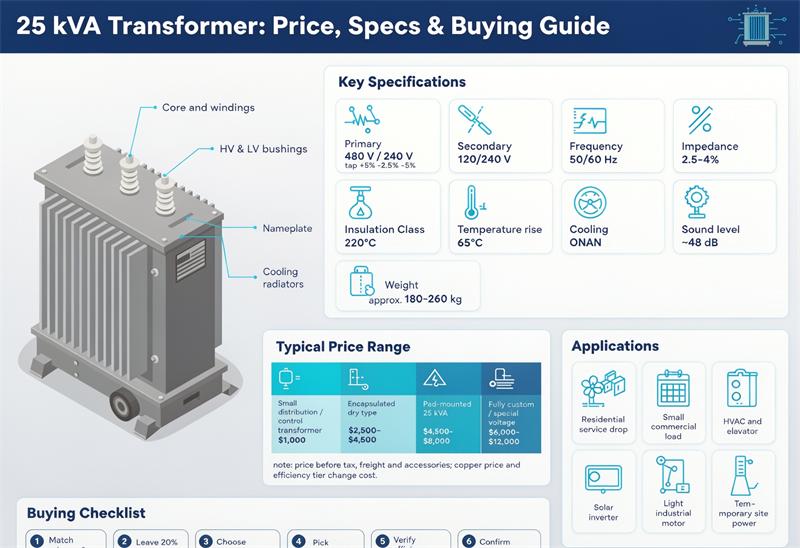
| Typical 25 kVA single-phase pad-mount | ~362 kg total, 68 kg oil, about 840 × 740 × 610 mm | Fits on a small pad, one crane pick |
| Fault current at ~2% impedance | ~5,200 A on a 240 V secondary | Sets your secondary AIC |
| 45 W of extra no-load loss | 394 kWh/year, about $55 at 13.9 ¢/kWh | Why loss tier matters less at this size |
Start here: single-phase or three-phase?
Everything downstream — voltage, enclosure, price, lead time — forks off this one answer.
Single-phase 25 kVA is the North American residential workhorse: a 12.47 kV or 13.8 kV (or 24.94 kV) primary stepped down to 120/240 V split-phase. It’s what feeds a house, a farm pump, a small irrigation service, a cell tower, or a handful of homes off one can. It hangs on a pole or sits on a pad. It is deeply standardized, which is why it’s cheap and why it ships fast.
Three-phase 25 kVA is a light commercial machine. Same kVA, but the current per phase is much lower, and the whole point is usually a three-phase load: a small shop, a lift station, a packaged rooftop unit, a bank of machinery, a small EV charging cluster. It’s pad-mounted or indoor dry-type in nearly every case.
The trap: people see “25 kVA” on an old nameplate or a load schedule and assume it’s interchangeable. It isn’t. Put a three-phase motor on a single-phase transformer and it simply won’t run. Put single-phase-only loads on a three-phase unit and you’ll have a phase balance problem nobody budgeted for.
If you’re replacing something, read the nameplate before you do anything else — phase, primary voltage, secondary voltage, and kVA are printed on it, and how to read a transformer nameplate walks through each field.
What 25 kVA actually delivers
Amps are what you’re really shopping for, so here’s the arithmetic, straight from kVA ÷ (volts × √3) for three-phase and kVA ÷ volts for single-phase:
| Configuration | Full-load current |
| Single-phase, 120/240 V | 104 A |
| Single-phase, 240 V | 104 A |
| Three-phase, 208Y/120 V | 69.4 A |
| Three-phase, 240 V delta | 60.1 A |
| Three-phase, 480Y/277 V | 30.1 A |
Two things fall out of that table.
On a single-phase 25 kVA, one big load can eat the whole unit. A Level 2 EV charger running at 80 A and 240 V is 19.2 kW and 80 of your 104 amps. Add a house panel and you’re done. That’s why 25 kVA comes up in EV charger conversations, and why it’s usually the wrong size for more than one charger.
“How many houses can it feed?” has no universal answer. 25 kVA at 0.9 power factor is about 22.5 kW of real power. Average US household consumption runs on the order of 10,500 kWh a year, which is roughly 1.2 kW averaged over 8,760 hours — but peak demand is several times the average, and every house peaks at a different moment. That gap between average and peak is called diversity, and it’s the number your utility uses. It’s why the honest answer ranges from four homes to ten, and why you should ask the serving utility rather than a transformer catalog.
The specs worth arguing about at 25 kVA
At this size, most parameters are settled by convention. These are the ones that aren’t.
Voltage class and BIL. Match the primary to what the utility actually delivers at that pole or pad — 12.47 kV, 13.2 kV, 13.8 kV, or 24.94 kV are the common ones — and match the BIL to the class. Per IEEE C57.12.00 practice, a 12.47 kV class unit is typically 95 kV BIL and a 24.94 kV class unit typically 125 kV. The low-voltage side on a 1.2 kV class secondary is commonly 30 kV BIL. Get this wrong and you’ve bought a unit that can’t be installed on that feeder.
Impedance. Small single-phase units commonly land around 2%, and that number cuts both ways. Low impedance means excellent voltage regulation and happy motor starting, and it also means high fault current: 104 A ÷ 0.02 is about 5,200 A into a bolted fault on the 240 V secondary. Your utility’s source impedance usually knocks that down, but your secondary panel and main breaker have to be rated for whatever the calculation actually produces at that location.
Temperature rise. 65 °C rise is the distribution norm (80 °C hot spot). A 55/65 °C dual-rated unit gives you extra loading capability later, which is cheap insurance on a unit that might serve a growing load for thirty years.
Taps. Standard is ±2 × 2.5% on the primary, usually a five-position switch. If the feeder runs long or the voltage at that location is chronically high or low, the tap range is the cheapest fix you’ll ever buy.
Winding material. Aluminum is the distribution default and it’s lighter. Copper costs more — published commentary puts the premium somewhere in the 15–30% range — and buys you conductivity and a more compact core-coil. At 25 kVA the practical difference in efficiency is small; the real reasons to pick copper are terminal compatibility and your own spec.
Enclosure and feed. NEMA 3R for outdoor. Loop feed or radial feed: loop means six bushings and a switch that lets the utility sectionalize around you, radial means you’re the end of the line. For a small single-phase unit, decide this up front — it’s built into the tank.
Sound. Around 48 dBA is typical for a 25 kVA pad-mount, and it matters more than people expect when the pad sits next to a bedroom wall.
Protection. Bayonet fuse, ELSP current-limiting fuse, or a completely self-protected (CSP) design that puts fusing and a breaker inside the tank. CSP costs more and removes the external cutout and arresters from your scope.
DOE coverage: 25 kVA is in scope — and the table has no three-phase row
Two things are true at once here, and almost nobody writing about this size gets either one right.
It’s covered. Under 10 CFR 431.192, a distribution transformer has an input of 34.5 kV or less, an output of 600 V or less, is rated for 60 Hz, and falls between 10 and 5,000 kVA if it’s liquid-immersed or 15 and 5,000 kVA if it’s dry-type. A 25 kVA unit at 12.47 kV to 120/240 V, 60 Hz, meets all four tests. So does a 25 kVA dry-type at 480 to 208Y/120.
The date that governs is the manufacturing or import date, not your PO and not your delivery. Under DOE’s April 2024 final rule (89 FR 29834), the amended levels apply to units manufactured or imported on or after April 23, 2029.
And here’s the wrinkle. Pull up 10 CFR 431.196 and look at the standard kVA rows. Liquid-immersed single-phase runs 10, 15, 25, 37.5, 50, 75 and up. Liquid-immersed three-phase runs 15, 30, 45, 75, 112.5, 150 and up. There is no 25 kVA row on the three-phase side of either the liquid-immersed or the low-voltage dry-type table.
That’s not an oversight you can ignore. The section says units with ratings not appearing in the table get their minimum efficiency “determined by linear interpolation of the kVA and efficiency values immediately above and below that kVA rating.” So a 25 kVA three-phase unit’s floor is interpolated between 15 and 30 kVA.
| Type and period | Per-unit load | Single-phase 25 kVA | Three-phase 25 kVA |
| Liquid-immersed, mfg 1/1/2016 – 4/22/2029 | 50% | 98.95% (table value) | 98.77% (interpolated) |
| Liquid-immersed, mfg on/after 4/23/2029 | 50% | 99.00% (table value) | 99.01% (interpolated) |
| Low-voltage dry-type, mfg 1/1/2016 – 4/22/2029 | 35% | 98.00% (table value) | 98.12% (interpolated) |
| Low-voltage dry-type, mfg on/after 4/23/2029 | 35% | 98.60% (table value) | 98.49% (interpolated) |
The single-phase figures are table values from 10 CFR 431.196, retrieved 2026-10-10. The three-phase figures are our own linear interpolation between the 15 kVA and 30 kVA rows, using the method the section specifies — they are not printed in the regulation.
Practical consequence: if your load will tolerate 30 kVA, ask for a 30. It’s a catalog rating, the efficiency floor is printed rather than derived, and you’ll likely get a faster quote and a shorter lead time than a 25 kVA three-phase unit that has to be built and justified as a non-standard rating.
More on how IEC and ANSI/IEEE documentation differ for export units is in the resources library — worth a skim if you’re importing rather than buying domestic.
One more thing that confuses people who read the CFR. An editorial note on part 431 records that at 90 FR 43371 (September 9, 2025), under the Congressional Review Act and Pub. L. 119-8, DOE removed amendments to several sections that had taken effect December 23, 2024, and the affected sections reverted to the December 22, 2024 version. The 2029 tables come from the April 2024 rule and are unaffected. If a supplier cites a 2024 amendment to argue a later date, check which rule they mean.
Check the cut sheet yourself: the loss arithmetic
Here’s a twenty-second test you can run on any quote, and it’s worth running.
Efficiency at a given load = output ÷ (output + no-load loss + load loss × load²). DOE evaluates liquid-immersed units at 50% load and low-voltage dry-type at 35% load.
Take three published 25 kVA single-phase pad-mount spec sheets we pulled on 2026-10-10:
| Source | No-load loss | Load loss | Efficiency at 50% load (computed) |
| Spec sheet A | 80 W | 290 W | 12,500 ÷ 12,652.5 = 98.79% |
| Spec sheet B | 115 W | 420 W | 12,500 ÷ 12,720 = 98.27% |
| Spec sheet C | 125 W | 441 W | 12,500 ÷ 12,735 = 98.15% |
The liquid-immersed floor for a 25 kVA single-phase unit in this period is 98.95%. All three computed values land below it.
We’re not going to claim those products are non-compliant, because there’s a much more likely explanation: published loss figures get measured at different conditions (one sheet stated no-load loss at 105% of rated voltage, another gave load loss at 85 °C), and the “efficiency” line on a marketing sheet is often printed at a different load point than the standard uses. Sheet A above also prints “98.90%” on the same page as the 80 W and 290 W figures, and those two don’t reconcile at any per-unit load.
The takeaway isn’t “don’t buy those.” It’s don’t accept a printed efficiency number as evidence. Ask two questions: at what per-unit load was that efficiency determined, and can I have the certified test report showing no-load and load loss. A supplier who can answer both is a supplier worth buying from.
Pole, pad, or dry-type: what each one really costs you
The unit price is only part of what you’re buying.
Pole-mount. The cheapest machine and usually the cheapest install if there’s already a pole with capacity. It’s also the one that needs a bucket truck and a line crew, and an outage if you’re tying into an energized feeder. A 25 kVA pole-mount can is light — published figures put it in the neighborhood of 300–450 lb — which keeps the handling simple.
Pad-mount. The cabinet costs more than a can because it’s tamper-resistant, lockable, and dead-front per IEEE C57.12.28. But everything is ground-accessible afterward: fuses, tap changer, oil level, all reachable without a truck. Typical published figures for a 25 kVA single-phase pad-mount are about 362 kg total (68 kg of oil) at roughly 840 × 740 × 610 mm — one small pad, one crane or a skid-steer, no bucket truck for the rest of its life.
Dry-type indoor. No oil, no containment, no fire-separation headache near combustible construction. You pay more per kVA and you give up outdoor durability, so this is an indoor answer — a panel room, a machine space, a commercial unit. Our dry-type transformer range covers this side; the full product catalog has the outdoor distribution units.
Where these actually land: farm services and irrigation pumps, small commercial pads, street and area lighting, telecom shelters, and industrial-park feeder work. The project write-ups show what those delivery packages look like when there’s more than one site involved.
One construction note so you don’t chase the wrong page: if what you’re actually specifying is a small dry-type single-phase unit for a panel or a machine, that’s a construction question, not a kVA question, and the single-phase cylindrical-winding transformer page goes through the winding types and works a small-unit example end to end. This page is about the 25 kVA rating across all three build types.
The money: published figures, and what actually moves your quote
We’re not going to hand you a price table and pretend it applies to you. Here’s what we found published, with sources, retrieved 2026-10-10 — and then why none of these numbers are directly comparable to each other:
| Source | Published figure | What it actually is |
| Chinese manufacturer guide | 380–650 | 25 kVA, FOB China, basic distribution unit |
| Chinese manufacturer price guide | 800–2,500 oil-filled; 1,200–2,300 dry-type | Ballpark range, incoterms not stated |
| B2B marketplace listing | 1,710–1,790 | Single-phase pad-mount, 20+ unit tier |
| US supplier listing | 1,500–9,200 | Range spanning 15–167 kVA, stainless residential series |
That’s a 20× spread on the same three words, “25 kVA transformer.” The spread is the honest answer, and it comes from four variables:
- Single-phase or three-phase — three units of copper and core versus one
- Incoterms and destination — FOB China and delivered-to-your-yard are different products financially; ocean freight, duties, and inland haulage sit between them
- Pole can versus pad-mount cabinet versus dry-type — steel, hardware, and listing cost money
- Aluminum versus copper, and how far up the efficiency ladder you climb
What’s not on that list, and this is the part that surprises people: at 25 kVA, the loss tier is not where your money should go. Take the spread in published no-load losses above — 80 W versus 125 W is 45 W. Over a year that’s 45 × 8,760 = 394 kWh. At an illustrative 13.9 ¢/kWh that’s about **$55 a year**, or roughly $1,400 over twenty-five years. Real money, but it is not the reason to choose one unit over another at this size.
Where your money actually goes on a 25 kVA job, more often than not, is the crew: the bucket truck, the outage window, the pad, the trench, the terminations. On a small unit like this, the labor and equipment to set it routinely cost more than the transformer. Buy on correct phase and voltage, correct enclosure and feed configuration, availability, and warranty — and treat efficiency as a compliance obligation you verify, not a feature you pay extra for.
For a capacity-by-capacity comparison including sizing and site clearances, see the pad mounted transformer sizes and prices guide.
Lead time, freight, and “do you have one in stock?”
Standard catalog single-phase units in common voltage classes are the fastest thing in the distribution world — often stock or a few weeks. Everything else slides:
- Non-standard ratings (including, as above, three-phase 25 kVA) move to build-to-order
- Copper windings, stainless tanks, CSP protection, special BIL all add engineering and queue time
- Published commentary on this size class puts standard lead times in the 8–14 week band depending on factory backlog, with expedite options at a premium
Freight matters more than buyers expect on a small unit. At roughly 360 kg, a 25 kVA pad-mount is a single LTL shipment domestically and a routine LCL or container share internationally — cheap per unit, but freight is quoted on dimensions and weight, so get both in writing with the quote. Air freight is physically possible at this weight and, for emergency replacements, costs more than the transformer.
Two questions that save a week: what are the shipping dimensions and mass, and are the lifting points rated for the total weight. Ask before you sign, not when the truck is there.
And one that saves a month: get the test reports with the shipment, not after it. A routine test package for a distribution transformer is a short list — winding resistance, ratio and polarity, no-load loss and current at rated voltage, load loss and impedance at rated current, applied and induced voltage withstand, and insulation resistance. If the unit arrives with a certificate of compliance and no measured values, you have no way to check the efficiency claim we talked about above, and no baseline to compare against when something looks off in year twelve.
The RFQ block
Send these and you’ll get a real number on the first pass instead of three rounds of questions.
Frequently asked questions
How many amps is a 25 kVA transformer good for?
It depends on the voltage and whether it’s single- or three-phase. Single-phase at 120/240 V: 104 amps. Three-phase at 208Y/120 V: 69.4 amps. Three-phase at 480Y/277 V: 30.1 amps. Three-phase at 240 V delta: 60.1 amps. Anyone who gives you a single number without asking the voltage is guessing.
How many houses can a 25 kVA transformer serve?
Somewhere between four and ten, and the number that decides it is your utility’s diversity factor, not the transformer. 25 kVA at 0.9 power factor is about 22.5 kW of real power; how many homes that covers depends on how much of each home’s peak lands at the same time. Ask the serving utility.
Is a 25 kVA transformer covered by DOE efficiency rules?
Usually yes. The federal definition covers transformers with an input of 34.5 kV or less, an output of 600 V or less, rated 60 Hz, between 10 and 5,000 kVA liquid-immersed or 15 and 5,000 kVA dry-type. A 12.47 kV to 120/240 V, 60 Hz unit meets all four. The amended levels apply based on manufacturing or import date — on or after April 23, 2029.
Why isn’t there a 25 kVA three-phase row in the DOE table?
Because 25 isn’t a standard three-phase rating. The tables step 15, 30, 45, 75, 112.5, 150 kVA and up. The regulation directs you to linearly interpolate between the ratings immediately above and below, which for 25 kVA three-phase liquid-immersed gives roughly 98.77% through April 22, 2029 and about 99.01% after. Consider specifying 30 kVA instead — it’s a printed rating with a printed efficiency floor.
What does a 25 kVA transformer cost?
Published figures we found on 2026-10-10 run from about $380 FOB China for a basic unit to $1,710–1,790 at volume tiers, with US listings for residential stainless pad-mount series spanning $1,500 to $9,200 across 15–167 kVA. Those numbers aren’t comparable to each other — different incoterms, specs, and quantities. Landed US cost for a single pad-mount unit is typically in the low thousands before installation.
What’s the difference between a 25 kVA pole-mount and a 25 kVA pad-mount?
The pad-mount costs more because of the tamper-resistant cabinet, dead-front terminations, and locking hardware. The pole-mount is cheaper to buy but needs a bucket truck and line crew for every service call afterward. A 25 kVA pad-mount is roughly 362 kg and about 840 × 740 × 610 mm, so it’s one small pad and one pick.
What are typical losses on a 25 kVA transformer?
On the 25 kVA single-phase pad-mount spec sheets we pulled, no-load loss ranged 80 to 125 W and load loss ranged 290 to 441 W. That spread is the whole point: ask for certified values with the test conditions rather than accepting a printed efficiency percentage.
Do I need copper windings?
Usually no. Aluminum is the distribution standard and it’s lighter. Copper carries a premium — published commentary puts it at 15–30% — and at this size the efficiency gain is small. Specify copper when your own standard requires it or when terminal compatibility matters.
How long does a 25 kVA transformer take to get?
Common single-phase catalog configurations can be stock or a few weeks. Non-standard ratings, copper windings, stainless tanks, and CSP protection push you into build-to-order, and published commentary for this size class puts standard lead times around 8–14 weeks depending on backlog.
Can I put a 25 kVA transformer indoors?
Yes, as a dry-type unit — that’s the whole reason dry-type exists, since there’s no oil to contain. Ventilation, clearance, and fire separation still apply. An oil-filled pad-mount is an outdoor machine.