Most buyers answer the efficiency question wrong before they open a catalog. They hear “efficient saves money” and spec the highest class on every unit, then wonder why the lightly loaded spare transformer never pays back. Efficiency is not a checkbox. It is a load-matched financial decision, and two facts decide most of it.
First, the federal floor is about to move. The DOE updates its distribution-transformer efficiency rules under 10 CFR Part 431, and the next compliance date is April 23, 2029. A unit you buy in 2026 to today’s table can fall below the 2029 line before its case is even painted. Second, a transformer you oversize by 50 percent to “leave headroom” runs at a lower efficiency at its real load than a correctly sized unit, so the upgrade you actually needed was smaller, not fancier.
This guide shows the method our engineers use to pick the right efficiency level for a given load, how to read the numbers vendors quote, what the 2029 change means for your order timing, and what to put in the spec so you get measured losses instead of promises. Our technical library and product range cover the hardware; this page is about the choice.
Two losses, not one
A transformer wastes energy in two completely different ways, and the split tells you where your money goes.
No-load loss (core loss, P0). This happens the moment the unit is energized and stays flat whether you pull 5 percent or 100 percent of rating. It is the core humming all day. A substation feeder that sits at 30 percent load for 20 years pays no-load loss for every one of those hours.
Load loss (copper loss, Pk). This scales with the square of the current. At half load you burn one quarter of the full-load winding loss. A base-loaded plant running at 85 percent lives in load loss; a rarely used backup transformer barely touches it.
The mistake is treating “efficiency” as a single percentage. A unit that wins on no-load may lose on load, and your load profile decides which one matters. If the transformer is energized constantly but lightly loaded, chase no-load. If it is hammered at high load, chase load loss with more copper.
The method that ends price arguments: capitalized losses
Stop comparing purchase prices. Compare total cost of ownership with losses capitalized. The standard form is:
> TCO = Purchase price + A × P0 + B × Pk
Where:
- A is the capitalized value of one watt of no-load loss over the asset life (dollars per watt).
- B is the capitalized value of one watt of load loss, and B = A × (load factor)².
Worked example. Take a 1,000 kVA three-phase unit, 60 Hz, running 8,760 hours a year at a 60 percent average load, electricity at $0.12/kWh, 25-year life, 7 percent discount. The capitalized factors come out to roughly A = $12.25 per watt of no-load loss and B = $4.41 per watt of load loss at that 60 percent load factor.
| Scenario | P0 (W) | Pk (W) | Capitalized losses |
|---|---|---|---|
| Standard (DOE 2016 minimum) | 1,500 | 9,000 | $58,065 |
| Premium (IE3-class, ~30% lower) | 1,000 | 6,300 | $40,033 |
The premium unit saves about $18,000 in present-value energy cost over 25 years. If the upfront premium is $6,000 to $9,000, payback lands around four to six years, and everything after that is free. The point is not the exact numbers. The point is that you can now rank bids by TCO instead of by sticker, and the A and B factors shift hard with your load factor and electricity price.
At a 30 percent load factor, B drops to about $1.10 per watt, so no-load loss dominates and an amorphous core (which crushes P0) wins big. At 85 percent load, B climbs near $8.85 per watt, so load loss dominates and you want copper, not exotic core steel. Same transformer, opposite right answer.
The vocabulary nobody agrees on
Vendors quote four different languages for the same idea. Here is the map.
| Region / framework | What they call it | Notes |
|---|---|---|
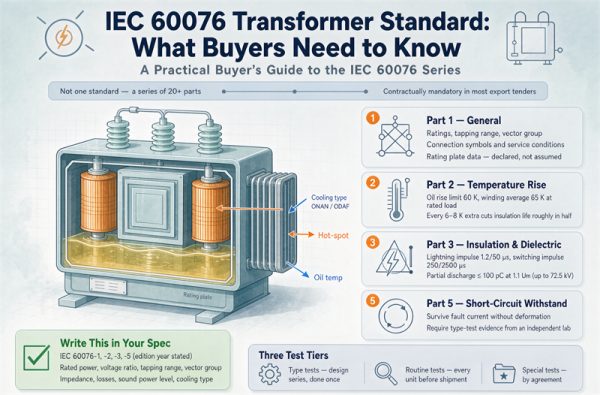
| IEC 60076-20 (international) | IE1, IE2, IE3, IE4 | Loss-evaluation framework; IE3 cuts total losses ~30 to 40% vs IE1 |
| United States (10 CFR 431) | DOE 2016 table by kVA | No “IE” classes; efficiency set by kVA and phase |
| European Union | Ecodesign 548/2014, Tier 2 | Updated by (EU) 2019/1783 |
| China | GB 20052-2024, NX1/NX2/NX3 | NX1 is the top tier, ~30 to 50% below NX3 |
North American buyers also meet legacy terms: NEMA TP-1 (1996/2002, voluntary), NEMA Premium (2010, about 30 percent fewer load losses than TP-1), and the DOE 2016 mandatory minimum that took effect January 1, 2016 and sits close to NEMA Premium for dry-type units. For the cross-border standards picture, our IEC vs ANSI/IEEE guide lays out which certificate opens which market.
One trap: a Chinese NX1 unit and a U.S. DOE 2016 unit may land at similar losses but are proven under different test points, so “equivalent” is not “interchangeable” until someone runs the right tests.
The 2029 cliff is already here
The DOE did not stop at the 2016 rule. The next revision under 10 CFR Part 431 raises the minimum efficiency floor again, with a compliance date of April 23, 2029 (published as 89 FR 29834 and amended at 90 FR 43371). What this means for a 2026 or 2027 order:
- If you spec to today’s table only, you risk buying a unit that is legal on delivery day but below the 2029 line, leaving you with a stranded asset if a retrofit, expansion, or rebate program later demands the newer level.
- Specifying to the 2029 table now costs a little more upfront and removes that risk. Amorphous and high-grade CRGO designs already clear the 2029 bar, so the “future-proof” premium is often zero for the right core choice.
- Utilities and some jurisdictions are already writing the 2029 level into incentive and rebate rules, which can pull payback forward by a year or two.
The practical move: tell your supplier which compliance date you are buying against, in writing, and ask for a loss guarantee referenced to that table.
Pick by load factor, not by slogan
Forget “always buy IE3.” Match the class to how hard the unit actually works.
| Load profile | What to chase | Right class |
|---|---|---|
| Backup, <20% load, short life | Lowest first cost | Standard compliance |
| Always-on but light (substation, renewable feeder) | No-load loss | IE3 or amorphous |
| Commercial building, 50 to 70% | Balanced | IE2 to IE3 |
| Data center, 70 to 90% | Load loss + heat | IE3, verified |
| Base-loaded plant, 60 to 85% | Load loss | IE2 to IE3 with more copper |
| Hospital, 24/7 critical | Both, verified | IE3 |
The Ruis S11 vs S13 vs S20 comparison makes the same point the hard way: at $0.08/kWh a basic S11 can stay cheaper than S13 on strict total cost, because the efficiency premium never recovers. At $0.15/kWh the payback accelerates by roughly $300 a year. The math is sensitive to your real rate and load, which is why a generic “buy the best” rule is incomplete.
Right-sizing: the upgrade you forgot
Oversizing is the silent efficiency killer. A transformer loaded at 30 percent of nameplate runs less efficiently than one loaded at 60 percent, because no-load loss is fixed while you are only using a slice of the rated capacity. CSA C802.4 documents cases where downsizing a 75 kVA unit to 30 or 45 kVA at the real load saved more energy than jumping an efficiency tier.
The guidance: size for your load plus a modest margin (roughly 20 percent, not 50), then spend the efficiency budget on the loss type your profile actually burns. If you need headroom for future growth, model the growth year and size to that, rather than padding the order “just in case.” Rightsizing plus a correct efficiency class usually beats max-efficiency-on-an-oversized-unit by a wide margin.
Dry-type, oil, or amorphous
Fluid choice is an efficiency decision, not just a fire-safety one.
- Dry-type (VPI or cast resin). Indoor and rooftop default where fire codes forbid liquid. Runs hotter, so it leans on low load loss and good cooling. Our dry-type selection guide covers construction trade-offs.
- Oil-immersed. Better heat removal per dollar, longer life under load, and easier to push to high kVA. The lower operating temperature slows insulation aging, which is the main life limit.
- Amorphous core. Cuts no-load loss by 60 to 80 percent versus grain-oriented steel, for a 15 to 50 percent premium. Worth it when the unit is energized constantly but lightly loaded (substations, renewable feeders, data centers on PUE targets). Payback runs three to eight years depending on idle ratio and price. For a heavily loaded large power unit, high-grade CRGO with optimized windings usually wins instead.
Efficiency and longevity travel together: less loss means less heat means slower aging. A premium unit is often the longer-lived unit, not just the cheaper-to-run one.
North America specifics
If the unit lands in the U.S. or Canada, a few local facts matter.
- The DOE 2016 mandatory minimum took effect January 1, 2016. Dry-type low-voltage units are tested at 35 percent of nameplate; liquid-immersed units at 50 percent. Same efficiency percentage, different test point, so compare like with like.
- DOE 2016 efficiency by kVA for three-phase low-voltage dry-type: 15 kVA at 97.89%, 75 at 98.60%, 150 at 98.83%, 300 at 99.02%, 500 at 99.14%, 750 at 99.23%, 1,000 at 99.28%.
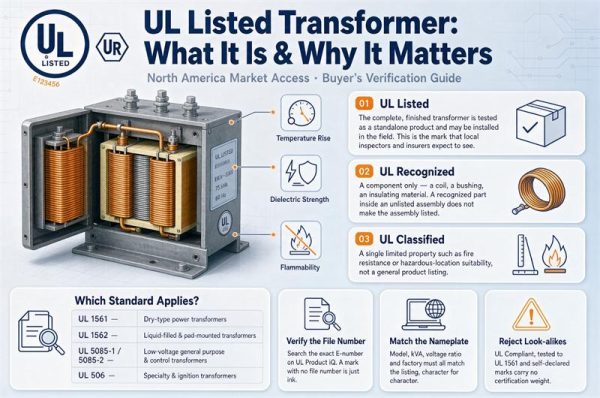
- Standards stack: UL 1561 (dry-type) or UL 1562 (medium-voltage dry), IEEE C57.12.00 / C57.12.34 for liquid, NEMA TP-1 as the historical benchmark, and your AHJ reading NEC for installation.
- Single-phase dry-type stayed at the NEMA TP-1 level because of small sales volume, so do not assume “DOE 2016” covers every single-phase unit you see.
How to read the loss numbers on a nameplate
The nameplate is where claims become facts. Pull three things:
- P0 (no-load loss) in watts at rated voltage and frequency.
- Pk (load loss) in watts at rated current, with the reference temperature stated (usually 75°C for liquid, 85°C or nameplate for dry).
- The test basis (35% load for dry, 50% for liquid under 10 CFR 431) and the standard cited.
Our nameplate reading guide walks through every field. If a quote shows only a single efficiency percentage and no P0/Pk split, send it back. You cannot capitalize a number you do not have.
The verification checklist
Catalog lines that say “low-loss design” with no measured watts are not data. Before you commit:
- Require guaranteed maximum P0 and Pk in watts, referenced to the exact standard and test point.
- Require a unit-specific routine test report tied to the serial number, not a family average. IEC and IEEE allow about 10 to 15 percent tolerance on guaranteed no-load loss, so the measured unit can land above the guarantee.
- Ask for core material and grade (CRGO thickness, or amorphous), since that is what drives P0.
- Confirm the compliance date you are buying against (today’s table or the 2029 table).
- For harmonic-rich loads, specify K-factor and oversized neutral so the real losses match the quoted ones.
Every unit we ship is proven against these points in our routine testing program, which is the difference between a bargain and a liability when the energy bill arrives.
A spec block you can paste into an RFQ
Transformer efficiency specification
- Rating: ______ kVA, ______ phase, ______ V primary / ______ V secondary
- Compliance: 10 CFR 431 (specify 2016 table OR 2029 table)
- Guaranteed maximum no-load loss P0: ______ W at rated V and 60 Hz
- Guaranteed maximum load loss Pk: ______ W at rated current, 75°C ref (liquid) / 85°C (dry)
- Test basis: 35% load (dry) or 50% load (liquid) per 10 CFR 431
- Core: CRGO grade ______ or amorphous; state lamination thickness
- Efficiency class target: IE___ (IEC 60076-20) or equivalent
- Documentation: unit-specific routine test report, signed, per serial number
- Tolerance: IEC/IEEE 10 to 15% on guaranteed no-load loss accepted
- Harmonic load: K-___ if PCS/drive present; oversized neutral if required
Drop that into the bid package and watch the vague quotes separate from the real ones.
Bottom line
Efficiency is a load-matched financial choice, not a rank. Split the losses, capitalize them with A and B, and buy the class your load factor earns. Watch the DOE 2029 date so you do not strand the asset on delivery. Right-size before you up-class. And put measured P0 and Pk in the spec, because the catalog average is not your unit. The method above is how we spec our own delivered projects, from hospitals to hyperscale data centers.
FAQ
What is an energy efficient transformer? It is a unit engineered to cut no-load and load losses through better core material, wound conductors, and tighter build quality. Under IEC 60076-20 it lands at IE2, IE3, or IE4; in the U.S. it meets the 10 CFR 431 efficiency table for its kVA.
How much can a high efficiency transformer save? A jump from a standard unit to an IE3-class unit cuts total losses about 30 to 40 percent. On a 1,000 kVA unit at 60 percent load and $0.12/kWh, that is roughly $18,000 in present-value energy cost over 25 years, against a $6,000 to $9,000 premium.
What is the difference between no-load and load loss? No-load loss is the core loss that runs whenever the transformer is energized, flat across load. Load loss is the winding loss that scales with the square of the current, so it dominates at high load and nearly vanishes at low load.
Is an amorphous core transformer worth the extra cost? Usually yes when the unit is energized constantly but lightly loaded, because amorphous cuts no-load loss 60 to 80 percent. Payback runs three to eight years. For a heavily loaded large power unit, high-grade CRGO with more copper often wins instead.
What efficiency standard applies in the United States? The DOE mandatory minimum under 10 CFR Part 431, effective January 1, 2016, with the next revision compliant from April 23, 2029. Dry-type low-voltage units are tested at 35 percent load, liquid-immersed at 50 percent.
What is the DOE 2029 compliance date? April 23, 2029. The rule raises the minimum efficiency floor again. Specifying to the 2029 table on a 2026 or 2027 order avoids buying a unit that falls below the line before its service life starts.
Should I always buy the highest efficiency class? No. At low load factors and low electricity prices, the premium may never recover, and an oversized high-class unit runs less efficiently than a right-sized lower-class one. Match the class to your load factor.
How do I calculate transformer total cost of ownership? Use TCO = purchase price + A × P0 + B × Pk, where A is the capitalized cost of one watt of no-load loss over the life and B = A × (load factor) squared. Rank bids by TCO, not sticker price.
Why does right-sizing matter for efficiency? A transformer at 30 percent of nameplate runs less efficiently than one at 60 percent, because no-load loss is fixed while you use only part of the rated capacity. Sizing with a modest margin beats oversizing plus a higher class.
What load factor means I should chase no-load loss? Anything always-on but light: substations, renewable feeders, backup or rarely loaded units. When the transformer sits energized for years at low load, no-load loss is where the money goes.
How do I verify an efficiency claim? Require guaranteed maximum P0 and Pk in watts, referenced to the standard and test point, plus a unit-specific routine test report tied to the serial number. IEC and IEEE allow about 10 to 15 percent tolerance on guaranteed no-load loss.
Does a more efficient transformer last longer? Indirectly, yes. Lower losses mean less heat, and lower operating temperature slows insulation aging, the main life limit. An efficient unit is often the longer-lived unit as well as the cheaper-to-run one.