A marine isolation transformer is the one piece of kit that lets a boat or ship take clean, safe shore power without tying its hull electrically to every other boat on the dock. Size it from the shore-power service, not from a brand chart: a 50 A / 240 V connection is a 12 kVA floor, a 100 A connection is 24 kVA, and you add a 1.2x marine headroom on top. Pick the standards chain that matches the vessel: IEC 60092 for international flag states, IEEE 45 and 46 CFR 111 for US waters, ABYC E-11 for a recreational boat. Then decide the enclosure, the shield and the harmonic rating, because those are what separate a unit that survives a salt-air engine room from one that does not.
This guide walks the whole chain. Our product index, resource library and project list hold the supporting detail if you want to go deeper on any step.
What a marine isolation transformer actually does
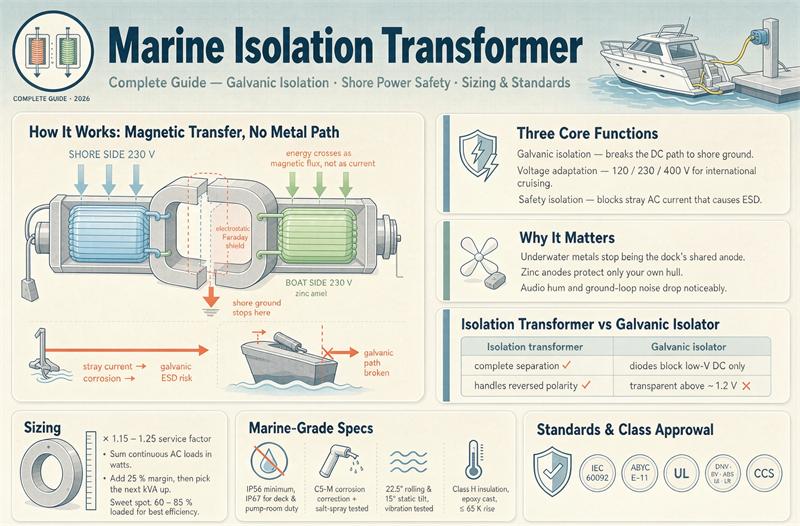
An isolation transformer separates the shore supply from the vessel’s own electrical system with two independent windings and a magnetic core. Shore power energises the primary; the secondary induces a clean, separate supply for the boat. There is no metal path between the two sides, so stray shore current cannot travel through your hull, your through-hull fittings, your propeller shaft or your bonding system.
That single fact does three jobs at once. It blocks galvanic corrosion caused by stray DC between dissimilar metals in seawater. It removes the shore ground from your vessel’s safety ground, which kills a common shock path at the dock. And it buffers voltage spikes and noise from a dirty marina supply before they reach sensitive electronics. A transformer that also steps voltage gives you a separately derived onboard supply, which is why shore-power units are rated in primary and secondary voltage pairs.
One thing it does not do: it does not change frequency. A 60 Hz transformer on a 50 Hz supply sees about 20 percent more magnetic flux and must have its voltage de-rated by the same amount. For a boat that crosses between regions, specify a 50/60 Hz universal design, or keep a separate frequency converter for frequency-sensitive loads.
Sizing it from the shore-power service
Start from the connection you actually have, because that is the ceiling the transformer must clear. The standard shore services translate to a minimum kVA like this:
| Shore-power service | Calculation | Minimum kVA |
|---|---|---|
| 120 V / 30 A, single-phase | 120 x 30 / 1000 | 3.6 kVA |
| 120 V / 50 A, single-phase | 120 x 50 / 1000 | 6.0 kVA |
| 240 V / 50 A, single-phase | 240 x 50 / 1000 | 12.0 kVA |
| 240 V / 100 A, single-phase | 240 x 100 / 1000 | 24.0 kVA |
| 400 V / 63 A, three-phase | 1.732 x 400 x 63 / 1000 | 43.6 kVA |
| 400 V / 125 A, three-phase | 1.732 x 400 x 125 / 1000 | 86.6 kVA |
For a three-phase service the formula is root-3 x line voltage x line current / 1000. For single-phase it is simply volts x amps / 1000. Match the transformer to the service, then work out the real load.
Take a mid-size yacht example. Connected load might be 2,400 W of air conditioning, 1,500 W water heater, 1,500 W galley, 1,000 W battery charger, 800 W lights and electronics, and 500 W entertainment, a total of 7,700 W. Not all of that runs at once, so a realistic peak is about 5,500 W. At a mixed-load power factor of 0.85 the apparent demand is 5,500 / 0.85 = 6,471 VA. Apply the 1.2x marine headroom for continuous duty and you get 7,765 VA, which rounds to a 12 kVA transformer, matching the 50 A / 240 V service. Check the current: 12,000 VA at 240 V single-phase is 50 A, which is exactly the service rating, so the margin is thin and a 15 kVA unit is the safer pick if you expect to add load.
A current figure worth remembering: at 400 V three-phase, each kVA draws about 1.44 A; at 440 V about 1.31 A; at 480 V about 1.20 A. Working in amps matters when you size cable and protection on the secondary side.
Which rulebook applies to your vessel
This is the part most guides skip, and it is the part that decides whether your unit passes inspection. There is no single global “marine standard”; you pick the chain by flag, trading area and vessel type.
| Rulebook | What it is | Applies to | What it actually checks |
|---|---|---|---|
| IEC 60092 | Electrical installations in ships | International flag states, most of the world | General, switchgear, single-phase equipment; the shipboard electrical baseline |
| IEC 60076 | Power transformers | Design foundation everywhere | Insulation, temperature rise, testing |
| IEEE 45 | Recommended practice, electric installations on ships | North American vessels | US-aligned shipboard practice |
| 46 CFR 111 | US Coast Guard electric systems rules | US-flagged and US waters | Federal law: construction, temperature rise, protection, corrosion |
| ABS / DNV / LR / BV / CCS / KR / NK | Classification societies | Commercial, passenger, offshore, flagged | Type approval, witnessed tests, build survey |
| ABYC E-11 | US recreational boat standard | Private US boats under about 20 m | 120/240 V AC, shore-power grounding |
| SOLAS / IMO | Safety of life at sea | Passenger and cargo ships | Fire, life-safety aspects |
| IEC-ISO-IEEE 80005-1 | High-voltage shore connection | Cruise, ferries, ports | HV shore-power interface |
The practical split is simple. A private recreational boat in US waters is built and installed to ABYC E-11 on a 120/240 V system; it does not need class approval. A commercial, passenger, offshore or flagged vessel needs type approval from a society such as ABS, DNV, LR, BV or CCS, and the society will witness acceptance tests. International work leans on IEC 60092 plus the society rules. US-flagged work must also satisfy 46 CFR 111, which is law, not guidance. Our guide to dry-type transformers covers why dry-type is the default construction for this duty, and our IEC versus ANSI comparison explains where the two families diverge if you are exporting between them.
The temperature-rise limit most spec sheets gloss over
46 CFR 111.20-5 is explicit, and it is a hard ceiling, not a suggestion. Based on a 40 C ambient, the temperature rise above ambient must not exceed:
| Insulation class | Maximum rise above 40 C ambient |
|---|---|
| Class A | 55 C |
| Class B | 80 C |
| Class F | 115 C |
| Class H | 150 C |
Those numbers are the rated rise, measured by the resistance method. Now add the engine room. The same regulation assumes a 45 C ambient for non-rotating equipment in an engine room and 50 C for rotating machinery in boiler, engine and auxiliary rooms. If the ambient is higher than 40 C, the unit must be de-rated so the total temperature is never exceeded. A 115 C-rise (Class F) unit in a 50 C engine room has a rise budget of 105 C, which is about 91 percent of its 40 C rating. A 150 C-rise (Class H) unit in the same room is good to about 93 percent. The de-rating is small, but it is mandatory and it must be on the nameplate. This is why a marine unit rated for a 40 C ambient cannot simply be dropped into a hot machinery space without the manufacturer confirming the derated capacity.
Losses and efficiency, and why to ask for measured numbers
Marine transformers spend their life energized, and on a vessel the losses are paid for twice: once in fuel or shore tariff, and again in cooling load inside an enclosed space. The loss model is the same as anywhere else: at a given loading, total loss equals no-load loss plus load loss times the square of the load factor. A representative 25 kVA marine dry-type unit at half load, with no-load loss around 250 W and load loss around 900 W at 75 C, burns roughly 475 W, or about 4,160 kWh a year, which at $0.10/kWh is about $416 a year and a 30-year present value near $5,160 using a 7 percent factor. Small in absolute terms, but it scales with kVA and it is avoidable by choosing a lower-loss design up front.
The catch is the number you are quoted. Ask for the routine-test measured no-load and load loss from the actual acceptance test, not the design estimate. Measured values on the test report are what you can hold the supplier to, and on a classed vessel the society surveyor witnesses that test.
Enclosure, shield and K-rating: the details that decide survival
Three choices separate a unit that lasts from one that corrodes out in two seasons.
Enclosure rating follows the installation location. A sheltered switchboard room is fine with IP23 or NEMA 1-2. An engine room with drips and oil vapor wants IP44 to IP54 or NEMA 12. An exposed weather deck calls for IP56 or NEMA 4X in 304 stainless. 46 CFR 111.01-11 makes corrosion-resistant parts mandatory on any equipment that can be damaged by corrosion, so do not treat the enclosure as an afterthought.
The electrostatic shield is a copper screen between the primary and secondary windings. A single shield, bonded to the shore ground, intercepts capacitive and high-frequency noise from the shore side and gives the only controlled point to connect the shore safety ground. Some designs use a double shield for stricter noise isolation. The grounding scheme is the critical detail: the shore ground connects to the shield only, the vessel secondary neutral and the transformer case are bonded at one single point on the boat side, and the shore and vessel grounds are not directly tied. That single-point bond is what keeps the isolation intact while still providing shock protection.
K-rating matters because shore power and modern vessel loads are rich in harmonics. Battery chargers, variable-speed drives, inverters and switched-mode supplies all push non-sinusoidal current that heats a standard transformer more than its nameplate suggests. A K-rated unit is built for that extra heating. Specify K-4, K-9, K-13 or K-20 from a harmonic load study; do not assume a standard unit is adequate for a hotel-load heavy vessel.
Dry-type versus oil-immersed on a boat
It can be oil-immersed, but dry-type dominates. Ventilated, vacuum-impregnated, cast-resin or fully potted dry units remove the fire and oil-spill risk that matters in enclosed machinery spaces and above all on passenger vessels. Large shore-power units for cruise ships are almost always dry-type for exactly that reason. Oil-filled units still appear on some larger or legacy installations where power density wins, but the fire-safety case for dry-type is strong and most new builds go that way.
Installation, weight and vibration you have to plan for
A transformer is a heavy, rigid mass on a platform that moves, and that drives three things the catalogue never mentions. Weight sets handling and the load on the foundation or the deck. A small recreational unit runs 20 to 80 kg, but a 100 kVA marine-duty unit is around 680 kg (about 1,500 lb), and larger shore-power machines are several tonnes, so the crane, the skid and the through-deck load path are part of the specification, not an afterthought. Vibration and inclination require a vibration-rated, drip-proof mounting with the windings and core braced for continuous wave motion; a unit that loosens its clamping loses its short-circuit withstand and develops winding noise. Ventilation matters even for a sealed unit, because the heat has to leave the enclosure into a space that may already be at 45 to 50 C, and the derating in the temperature-rise rule above is exactly what you pay if the ventilation is wrong. Plan the cable entry, the service access and the lift path before you approve the drawing, because a transformer that cannot be lifted into place or reached for inspection is a transformer you will regret.
Lead time and the price spread nobody tells you
Lead time tracks the level of customisation. Small recreational units are often stock or a few weeks out. Custom marine-duty and classed units run 12 to 24 weeks for medium ratings and 24 to 40 weeks for large shore-power machines, longer when class witnessing and special stainless enclosures are involved. Freeze the inputs, the voltages, the enclosure, the shield and the approval basis before the drawing is approved; a late change resets the clock.
The price spread is wider than most buyers expect, and it tracks what the unit is actually built and certified to do. A 3.6 kVA recreational unit lists around $3,650. A 100 kVA US-made, fully potted, stainless, NRTL-listed unit is about $36,400. Basic 400/400 V shore-power isolation units from Asian suppliers start well under $5,000 per 100 kVA. The gap is not a markup; it reflects enclosure, potting, certification and country of manufacture. When you compare quotes, compare the rulebook, the enclosure, the shield and the witnessed test, not just the kVA.
A short specification block you can paste into an RFQ
| Field | What to state |
|---|---|
| Service voltage and phase | e.g. 400 V three-phase, 50 Hz; or 240 V single-phase, 60 Hz |
| Required kVA | From shore service plus 1.2x headroom, confirmed against load study |
| Secondary voltage | Match vessel system; state separately derived supply if needed |
| Frequency | 50 Hz, 60 Hz, or 50/60 Hz universal |
| Insulation class and rise | Class F 115 C, or Class H 150 C; state ambient |
| Electrostatic shield | Single or double; bonded to shore ground |
| Enclosure | IP56 / NEMA 4X stainless for deck; IP44-IP54 for engine room |
| K-rating | From harmonic study: K-4 / K-9 / K-13 / K-20 |
| Standards and approval | IEC 60092 + society (ABS/DNV/LR); or IEEE 45 + 46 CFR 111 + ABYC E-11 |
| Losses | Request routine-test measured no-load and load loss |
| Witnessed tests | State which society surveys the acceptance test |
| Mounting | Vibration-rated, drip-proof, accessible for inspection |
Our marine transformer product page covers the ranges we build against these rules, and our routine-testing guide explains the acceptance tests a society surveyor will witness.
Bottom line
A marine isolation transformer is sized from the shore-power service, not a brand chart: 50 A at 240 V is a 12 kVA floor, 100 A is 24 kVA, plus a 1.2x marine headroom. The rulebook you must satisfy follows the vessel: ABYC E-11 for a US recreational boat, IEC 60092 plus a classification society for a flagged commercial or passenger vessel, and 46 CFR 111 whenever US law applies. Make the enclosure, the electrostatic shield and the K-rating explicit in the specification, ask for measured loss figures from the witnessed test, and compare quotes on the standard and the certification, not just the kVA, because the real price spread runs from under $5,000 to over $36,000 for the same nominal rating.
FAQ
What size marine isolation transformer do I need? Start from the shore-power service. Single-phase kVA = volts x amps / 1000; three-phase kVA = root-3 x line volts x amps / 1000. Add a diversity figure for loads that never run together, divide by power factor, then apply a 1.2x marine headroom for continuous duty. A 50 A / 240 V single-phase service is a 12 kVA floor; a 240 V / 100 A service is 24 kVA.
Is a galvanic isolator the same as an isolation transformer? No. A galvanic isolator sits in the green grounding conductor and blocks low-voltage DC galvanic current; it does not isolate the live and neutral. An isolation transformer gives full winding separation between shore and vessel and can also establish a separately derived onboard supply. For complete shock, spike and corrosion protection, the transformer is the stronger device; the two are often used together, not as substitutes.
Does a marine isolation transformer change frequency? No. It passes the supply frequency unchanged. A 60 Hz transformer used on a 50 Hz supply sees about 20 percent more magnetic flux and must have its voltage de-rated by the same amount, so for international cruising specify a 50/60 Hz universal design or add a separate frequency converter for frequency-sensitive loads.
What temperature rise is allowed on a marine transformer? Under 46 CFR 111.20-5 the rise above a 40 C ambient must not exceed 55 C for Class A, 80 C for Class B, 115 C for Class F, and 150 C for Class H insulation. In an engine room the assumed ambient is 45 to 50 C, so the unit must be de-rated so the total temperature is not exceeded; a 115 C-rise unit in a 50 C room is good to about 91 percent load.
Why does a marine transformer need an electrostatic shield? A copper shield between the primary and secondary intercepts capacitive and high-frequency noise currents from the shore side and gives a controlled point to bond the shore safety ground. The shield is grounded on the shore side; the vessel secondary neutral and case are bonded at a single point on the boat side. That single-point scheme is what keeps the shore and vessel grounds separated, which is the whole point of the isolation.
What enclosure rating do I need? In a sheltered switchboard room, IP23 / NEMA 1-2 is enough. In an engine room with drips and oil vapor, use IP44 to IP54 or NEMA 12. On an exposed weather deck, specify IP56 or NEMA 4X in 304 stainless. 46 CFR 111.01-11 makes corrosion-resistant parts mandatory on any equipment that can be damaged by corrosion.
What standards apply to a marine isolation transformer? IEC 60092 is the international baseline for shipboard electrical installations, with IEC 60076 as the transformer design foundation. In North America you also meet IEEE 45 and 46 CFR 111 (USCG). Commercial vessels need type approval from a classification society such as ABS, DNV, LR, BV or CCS. US recreational boats under ABYC E-11 use a 120/240 V system, not IEC voltages.
Can a marine isolation transformer be oil-immersed? It can, but dry-type (ventilated, vacuum-impregnated or cast-resin, or fully potted) dominates because it removes the fire and oil-spill risk in enclosed or passenger spaces. Large shore-power units for cruise ships are almost always dry-type for that reason.
What is a K-rated marine isolation transformer for? Shore power and modern vessel loads are rich in harmonics from drives, chargers and switched-mode supplies. A K-rated transformer is designed for the extra heating those non-sinusoidal currents cause. Specify K-4, K-9, K-13 or K-20 based on the harmonic load study; do not assume a standard unit is adequate.
How much does a marine isolation transformer cost? It varies enormously by enclosure, potting, certification and origin. A 3.6 kVA recreational unit lists around $3,650, a 100 kVA US-made fully potted stainless NRTL-listed unit is about $36,400, and basic 400/400 V shore-power isolation units from Asian suppliers start well under $5,000 per 100 kVA. The spread is real and reflects what each unit is actually built and certified to do.
How long is the lead time? Small recreational units are often stock or a few weeks. Custom marine-duty and classed units run 12 to 24 weeks for medium ratings and 24 to 40 weeks for large shore-power machines, longer if class witnessing and special enclosures are involved. Freeze the inputs before drawing approval to avoid a late change that resets the clock.
Do I need class society approval for a boat transformer? For a private recreational boat under ABYC E-11, no class approval is required, but the unit should still be built and installed to a recognised standard. For any commercial, passenger, offshore or flagged vessel, type approval and witnessed acceptance tests from the relevant society are effectively mandatory.