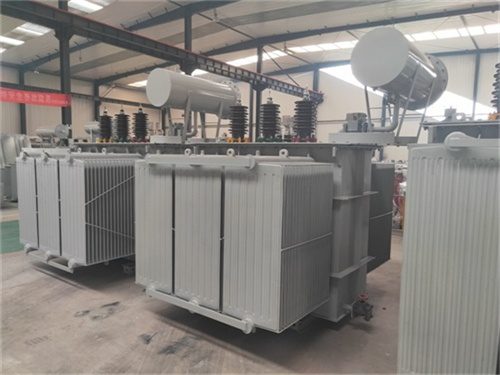
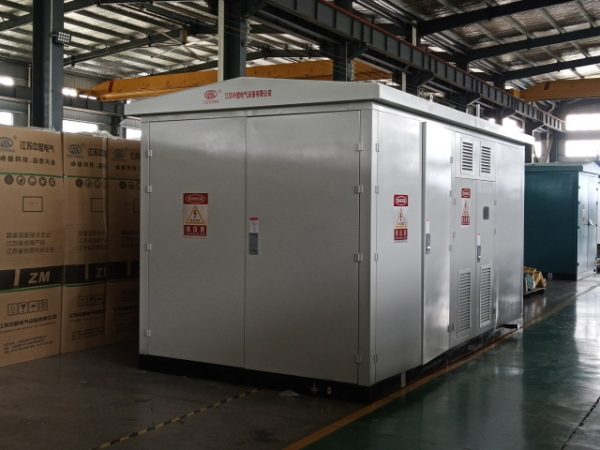
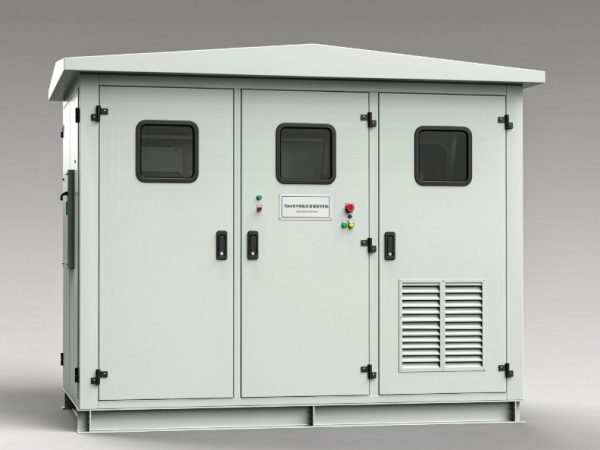
A cast resin dry-type transformer encapsulates its windings in epoxy resin under vacuum instead of immersing them in oil. That removes the combustible liquid, which is why this design is the default choice inside occupied buildings, metro stations, hospitals and data halls — anywhere a fire or an oil spill is unacceptable. It costs more per kVA than an oil-filled unit and it is not the right answer outdoors or above roughly 36 kV, but for indoor medium-voltage distribution up to about 2,500 kVA it is usually the lowest-risk option on the market.
Standards baseline: designed and type-tested to IEC 60076-11 (fire behaviour class F1, environmental class E2, climate class C2 where specified), IEC 60076-1/2/3/5/10, GB/T 10228 (Chinese dry-type standard, quoted alongside IEC for domestic projects), GB 20052 (China MEPS). For North America: UL 1561 listing and DOE 10 CFR Part 431 Subpart K coverage to be confirmed per shipment — [Confirm: current UL file number and DOE applicability for the exact kVA and voltage class].
1. What a Cast Resin Dry-Type Transformer Actually Is
The definition matters because “dry-type” covers two very different constructions, and buyers frequently compare quotes for two different products without realising it.
A cast resin (or epoxy cast) transformer has its windings sealed inside a solid epoxy body. The resin is poured or injected under vacuum so it penetrates every gap in the winding, then oven-cured into a hard, void-free block. The result is a monolithic coil: the copper cannot move, moisture cannot reach it, and the conductor is insulated by a solid rather than by a liquid.
An open-wound VPI (vacuum pressure impregnated) transformer also has no oil, but the windings are impregnated with polyester or epoxy varnish and left exposed. It is lighter and cheaper, and it runs cooler, but the conductor surface is not sealed.
Both are “dry-type.” They are not interchangeable in a specification, and they do not behave the same way in a damp, dusty or salt-laden environment. Our cast resin dry-type range is built on the first construction; the comparison in Section 5 shows where the second one makes sense.
The operating principle is unchanged from any other transformer: an iron core couples a magnetic field between a primary and a secondary winding, and the turns ratio sets the voltage ratio. What the epoxy does is replace oil as both the electrical insulation and the mechanical restraint. Everything below follows from that one substitution.
2. How the Windings Are Cast (and Why the Process Decides the Quality)
The manufacturing steps are worth knowing because almost every field failure of a cast resin unit traces back to a process defect, not to a design error.
- Winding. The low-voltage winding is usually copper or aluminium foil wound as a continuous sheet with layer insulation; the high-voltage winding is typically a segmented disc or layer winding of round or flat wire. Foil winding gives excellent radial short-circuit strength and even current distribution on the LV side.
- Lead-out and bracing. Leads are routed and braced before casting — once the resin cures, nothing moves.
- Drying and pre-heating. The coil is dried and brought to temperature so the resin wets the conductor instead of being chilled by it.
- Vacuum degassing. Air and moisture are pulled out of the winding and out of the resin. This is the step that determines the partial discharge level.
- Casting under vacuum. Resin — typically a filled epoxy with silica flour for crack resistance and thermal conductivity — flows into the mould.
- Gel and cure. A controlled oven cycle cross-links the resin. Rushing this step is the classic cause of internal cracking later.
- Demould, finish, test. Every unit gets a routine test set before shipment; the routine testing guide lists what those tests are and what the certificates should say.
Two things follow directly. First, partial discharge is a process signature, not a design feature — see Section 3. Second, a cast coil is effectively unrepairable: a cracked casting usually means a new coil, which is why transport, lifting and thermal cycling deserve more attention on this design than on an oil-filled unit.
3. The Five Standard Advantages, Audited
Marketing copy for this product tends to overstate three of the five claims. Here is what each one actually buys you, and what to put in the specification instead.
| Claim as usually written | What is actually true | What to specify |
| “Epoxy is non-combustible, so there is no fire risk” | Epoxy is an organic polymer. It burns, it chars, and it decomposes when heated. What it does is self-extinguish and not sustain a flame once the source is removed. The correct claim is fire behaviour class F1 under IEC 60076-11, which is a type-test result, not a material property [Confirm: F1 test report on file] | “Fire behaviour class F1 per IEC 60076-11, with test report” — and keep the surrounding installation compliant (NEC 450.21(B) fire-resistant room requirements apply to dry-types above 112.5 kVA in most US jurisdictions [Confirm: AHJ]) |
| “Withstands 180 °C and above” | 180 °C is the thermal class limit of a Class H insulation system — a rating for insulation life, not a fire or overload capability [Confirm: Class F or Class H per order] | Insulation thermal class (F = 155 °C, H = 180 °C) plus the winding temperature rise limit (100 K for Class F, 125 K for Class H under IEC 60076-11) |
| “Dielectric strength 20 kV/mm” | That is a bulk material figure measured on a test coupon. It does not design anything: insulation coordination is set by the system BIL, the impulse voltage distribution inside the winding, and the partial discharge inception voltage [Confirm: material datasheet] | Rated insulation level (for example 12/28/75 kV or 24/50/125 kV) and a partial discharge acceptance limit |
| “Partial discharge ≤5 pC” | The normal acceptance level for a cast resin transformer is ≤10 pC under IEC 60076-11. ≤5 pC is a premium figure and it must appear on the type-test report for the exact rating you are buying [Confirm: measured PD on type test] | “Measured partial discharge ≤10 pC at 1.5 Um/√3” (or ≤5 pC if you are paying for it) on the test certificate, not in the brochure |
| “Excellent heat dissipation and strong overload capability” | Cast resin runs hotter than oil — there is no liquid to carry heat to a radiator. Overload capability comes from the AN/AF cooling rating and from thermal class headroom, not from the casting [Confirm: AF uplift factor] | AN rating as the base, AF uplift as a separate declared figure, and fan start on a winding-temperature threshold |
The genuinely strong points, which do not need exaggeration: no oil means no bund, no oil sampling, no oil fire load, no environmental spill risk; the solid insulation tolerates condensation and pollution far better than an open-wound design (that is what climate class C2 and environmental class E2 certify); and the monolithic coil has genuinely excellent short-circuit strength per IEC 60076-5.
4. Typical Technical Parameters
Values below are typical of a cast resin dry-type unit in the 100–2,500 kVA range at 10–11 kV primary. Every number marked with a placeholder must come from the type-test report for the exact rating you are buying, not from a range in a brochure.
| Parameter | Typical value | Note for the specification |
| Rated capacity | 100–2,500 kVA (common steps: 315, 630, 800, 1,000, 1,250, 1,600, 2,000, 2,500) | Above ~2,500 kVA and above 36 kV, compare against oil-immersed before committing |
| Primary voltage | 10 kV / 11 kV / 20 kV / 35 kV (IEC); 12.47 / 13.8 / 34.5 kV (North America) | Name the North American class explicitly — 10 kV does not exist on a US one-line |
| Secondary voltage | 0.4 kV (IEC); 480Y/277 V (US); 600Y/347 V (Canada) | 400 V and 480 V are not interchangeable for downstream equipment |
| Frequency | 50 Hz or 60 Hz | Must be stated at RFQ. See FAQ 4 |
| Vector group | Dyn11 (IEC) / Dyn1 (ANSI drawing convention) [Confirm] | Same physical connection, different clock notation |
| Insulation thermal class | Class F (155 °C) standard, Class H (180 °C) optional [Confirm] | Class affects temperature rise limit, size and price |
| Winding temperature rise | ≤100 K for Class F, ≤125 K for Class H [Confirm] | Measured by resistance method per IEC 60076-2 |
| Partial discharge | ≤10 pC standard, ≤5 pC on request [Confirm: type-test value] | Must be on the certificate |
| Short-circuit impedance | 4% (≤630 kVA), 6% (≥800 kVA), 8% on request [Confirm] | Impedance sets the fault level your switchgear must withstand — see Section 10 |
| Cooling | AN standard; AF optional with 1.4–1.5× uplift [Confirm] | AF capacity disappears if the fans fail; never count it as firm capacity |
| Enclosure | IP00 (bare), IP20 (indoor standard), IP23, IP31, IP54 with enclosure | IP23 is not an outdoor rating; see Section 7 |
| Sound level | Typically 50–65 dB(A) depending on rating [Confirm: declared LWA] | Declared value is a sound power level LWA per IEC 60076-10, not a 1 m sound pressure — see FAQ 6 |
| Monitoring | PT100 sensors in each winding, thermostat/thermistor trip, optional RS485 Modbus RTU/TCP | Ask which protocol; “smart monitoring” without a protocol is unusable |
5. Cast Resin vs VPI vs Oil-Immersed
This is the decision that actually determines lifetime cost, and it is asked far less often than it should be.
| Factor | Cast resin (epoxy) | Open-wound VPI | Oil-immersed |
| Fire behaviour | F1 available, self-extinguishing [Confirm] | Depends on system; usually not F1 | Combustible liquid, needs bund/fire separation |
| Moisture and pollution | Excellent — sealed conductor; C2/E2 certifiable | Poor — exposed conductor surface | Excellent — sealed tank |
| Cooling efficiency | Moderate — solid insulation, air only | Best of the dry types | Best — liquid carries heat out |
| Overload headroom | Good with thermal class + AF | Good | Best |
| Max practical rating | ~2,500 kVA (higher on request); Um up to 36 kV | Similar | Up to very large power transformers |
| Outdoor use | Needs an enclosure; derating applies | Not suitable | Native |
| Upfront cost (indicative) | Highest of the three | Mid | Lowest |
| Lifetime maintenance | Cleaning, terminals, insulation trending | Same, plus more frequent cleaning | Oil sampling, filtration, seal monitoring |
| Best fit | Occupied buildings, metros, hospitals, data halls, marine | Dry, clean, indoor industrial switchrooms | Outdoor substations, utility, large MVA |
The honest counter-position: if the transformer is going outdoors, or above roughly 2,500 kVA, or is on a tight budget with no fire constraint, oil-immersed usually wins on cost and thermal performance. Cast resin earns its premium by removing the fire and spill scenario, not by being electrically better. Our side-by-side comparison of oil-immersed vs dry-type walks through that trade in more detail.
6. Loss Economics: Why Part-Load Behaviour Dominates
No-load loss (P0) is constant from the moment the transformer is energised. Load loss (Pk) scales with the square of the load factor.
Worked example, assumptions stated in full: a 1,000 kVA unit, P0 = 1,700 W [Confirm], Pk = 9,500 W at 75 °C [Confirm], load factor β = 0.6, continuous 8,760 h/year, tariff $0.12/kWh [Confirm: local tariff].
| Term | Calculation | kWh/year | $/year |
| No-load | 1.7 kW × 8,760 h | 14,892 | $1,787 |
| Load | 9.5 kW × 0.36 × 8,760 h | 29,959 | $3,595 |
| Total | 44,851 | $5,382 |
Now the counter-intuitive part. Building and data-centre transformers rarely sit at 60% load. At β = 0.3 the load-loss term collapses to 7,490 kWh/year while the no-load term stays at 14,892 — no-load loss becomes about two-thirds of the lifetime energy cost. So:
- Where the load factor is genuinely low (night-time-dominant buildings, redundant data halls running 2N at 25–30% each), no-load loss is the number to buy down, and an amorphous-core unit deserves a look.
- Where the load factor is high and steady (process industry), load loss matters more and the amorphous premium buys less.
- Comparing an SCB13 against an SCB14 on a 1,000 kVA unit: at roughly −20% no-load and −6% load loss [Confirm], the annual bill drops from $5,382 to about $4,809 — around $573/year, or $11,460 over 20 years at a flat tariff. Compare that against the actual price delta before you decide; on a lightly loaded unit the payback is usually short, on a heavily loaded one it is not.
- Capitalise losses in the tender. Write P0 and Pk limits into the spec and evaluate bids on purchase price plus capitalised losses. Verbal “energy saving” claims do not survive contact with a procurement spreadsheet.
Note also where the losses go physically: at β = 0.6 the unit above turns about 10.7 kW into heat, continuously, inside your building. That is a mechanical-design input for the transformer room, and it is why ventilation and room sizing get signed off late and then cost money.
7. Where Cast Resin Units Are Used
| Application | What actually drives the specification | Typical configuration |
| High-rise and commercial | Fire performance, noise, no oil in a occupied structure | Indoor, IP20, Class F, AN; low LWA; vibration pads |
| Metro and rail stations | Condensation, dust, limited ventilation, vibration | IP31–IP54 with anti-condensation heaters, C2/E2; tunnel units get filtered forced ventilation |
| Hospitals and healthcare | Noise, continuity, and (for group-2 locations) IT earthing per IEC 60364-7-710 | Low-noise cast resin, often paired with insulation monitoring devices |
| Data centres | 7×24 part-load efficiency, redundancy, harmonic spectrum | Cast resin, PT100 + Modbus to BMS/DCIM; K-factor per IEEE C57.110 only if the measured spectrum justifies it |
| Industrial (chemical, steel, cement) | Corrosive or conductive dust, high ambient temperature | IP54 enclosure with filtration, or relocate to a clean switchroom; C4/C5 coating per ISO 12944 |
| Marine and offshore | Salt spray, vibration, class approval | IP44–IP56, type-approved, 45–50 °C ambient basis |
| EV charging hubs | Highly cyclic load, outdoor siting | Usually a packaged substation rather than a bare dry-type unit |
Two specification traps appear in almost every project of this type:
- IP23 is not an outdoor rating. The second digit means protection against water sprayed at up to 60° from vertical. Outdoor siting needs an IP54-class enclosure or a NEMA 3R assembly, and a higher IP rating restricts cooling — you will derate or add fans, and fans add noise. All three have to be calculated together, not sequentially.
- “Maintenance-free” means “no oil maintenance.” It does not mean zero maintenance. Dry-type insulation fails far more often from conductive dust plus humidity forming a tracking path than from thermal ageing. Cleaning intervals are the highest-value line in the maintenance plan.
8. Project References: What You Can and Cannot Claim
Super-tall towers, full metro networks and hyperscale data halls are the three reference types most often cited for this product. They are legitimate proof that the technology is accepted at the top of the market — and they are also the easiest way to get into trouble in a tender.
- Treat published case studies as industry reference points, not as your own supply record. A project name in a brochure without a contract number, a delivery year and a rating list is an unsupported claim, and in a utility or EPC tender it will be checked.
- If you need references, supply them as: project name, year, quantity, rating, voltage, vector group, and a contactable owner or EPC. Anything less is decoration.
- Client names, building names and hyperscale operators are frequently covered by confidentiality clauses. Ask before you print.
- The three examples most commonly circulated in this category — a supertall tower in Shanghai, a metro network in Beijing, and a large data-centre campus — are not documented as our own supply record and must not be presented as such without written confirmation [Confirm: verify against contract records before any external use].
Verified, documented work is on the projects page; that is the only list to quote from.
9. Price: What Moves the Number
The figures below are domestic-market reference points converted at ¥7.10 = US$1, quoted as indicative ex-works bands. They are not a quotation, and they will not survive contact with a 60 Hz, UL-listed, high-IP, monitored configuration.
| Rating | Indicative band (RMB) | Indicative band (US$ at ¥7.10) [Confirm: FX rate and date] |
| SCB13-630 kVA | ≈ ¥31,280 [Confirm] | ≈ US$4,400 |
| SCB13-2,500 kVA | > ¥100,000 [Confirm] | > US$14,100 |
| Export-configured equivalent | — | Typically above the domestic band |
What actually drives the price, in order of impact:
- Rating. Cost does not scale linearly. Roughly, doubling the kVA adds 60–80% to the price, not 100%. If a quote shows a step of 200–300% for a doubling of capacity, ask which configuration items moved — it is usually cooling, monitoring, enclosure or a thermal-class change.
- Voltage class. A 35 kV primary costs materially more than 10 kV: more insulation, bigger clearances, higher BIL bushings.
- Winding material and construction. Copper foil costs more than aluminium foil and performs better over a 25-year life; the delta is real money and it is usually worth paying on a long-life asset.
- Enclosure and IP rating. Each step up in IP adds steel, restricts cooling, and often forces fans or derating.
- Thermal class and cooling. Class H and AF both add cost.
- Monitoring. PT100 + controller is cheap; Modbus TCP, remote I/O and cloud gateways are not.
- Certification and testing. Third-party witnessed type tests, UL listing, and special tests (PD, sound power, seismic, short-circuit withstand) are separately priced line items.
- Market and brand tier. What a premium brand buys you is a type-test dossier, a global service network and spares availability — worth paying for when the asset is critical and remote, hard to justify on a replaceable indoor unit.
The honest counter-position: on a project where the transformer room is already fire-rated, well ventilated and unoccupied, the price premium of cast resin over a modern sealed oil-immersed unit is sometimes hard to defend. Ask for both quotes.
10. How to Specify One (Selection Checklist)
Work through these in order; the first three drive everything else.
- Load, not capacity. Size from a measured or modelled load profile, not from connected load. Aiming for a steady-state load factor of 70–80% is sound practice — it leaves headroom without buying kVA you will never use, and it keeps the load-loss term honest.
- Voltage and frequency. Name the utility voltage class in the local convention (12.47 / 13.8 / 34.5 kV; 480Y/277 V or 600Y/347 V secondary) and state 50 Hz or 60 Hz as a hard requirement.
- Fault level and impedance. Impedance is not a free choice: it sets the three-phase fault current your switchgear must withstand. At 1,000 kVA and 6% impedance, the secondary fault level is roughly 24 kA at 400 V [Confirm]; specify 8% if you need to bring it down, and price the downstream gear either way.
- Environment. Indoor or outdoor, ambient temperature range, altitude (derate above 1,000 m), conductive dust, salt, corrosive gas. This sets IP rating, climate class (C2) and environmental class (E2).
- Fire and code. F1 classification, the room requirements under NEC 450.21(B) for dry-types above 112.5 kVA [Confirm: AHJ], and any local fire-engineer ruling.
- Noise. Ask for the declared sound power level LWA per IEC 60076-10, then convert to the room’s sound pressure — see FAQ 6. Do this before the room is built, not after the neighbours complain.
- Losses. Write P0 and Pk limits into the spec with a stated reference temperature (120 °C for Class F per GB/T 10228; 75 °C for many IEC and North American tenders — normalise before comparing quotes, the difference is about 14.5% of the I²R term).
- Monitoring. Which sensors, which protocol, which set-points.
- Tests and documents. Routine tests, type-test references, certificates. See the dry-type selection guide for the full scoring approach.
11. Insulation Class, Temperature Rise and Set-Points
This is the single most mis-quoted area in the whole product category.
| Item | Meaning | Typical value |
| Thermal class | The temperature the insulation system is qualified to withstand over its design life | F = 155 °C, H = 180 °C [Confirm per order] |
| Winding temperature rise | Average winding rise above ambient, measured by resistance method | ≤100 K (Class F), ≤125 K (Class H) [Confirm] |
| Hot-spot allowance | The difference between hottest spot and average winding temperature | Typically 10–15 K [Confirm] |
| Ambient design basis | Standard maximum ambient per IEC 60076-1 | 40 °C (higher for marine/industrial — derate) |
| Fan start | Winding temperature at which AF fans start | ~110 °C [Confirm with manufacturer] |
| Alarm | Winding temperature alarm | ~130 °C [Confirm] |
| Trip | Winding temperature trip | ~150 °C [Confirm] |
The correction worth making here: a statement like “normal operating temperature should not exceed 155 °C” describes the thermal class limit, not a healthy operating point. A Class F unit running with its windings at 155 °C is at the edge of its insulation qualification, not comfortably inside it. Continuous operation in the 90–110 °C winding range is what a well-sized unit actually does; the alarm and trip set-points exist to catch the cases where it does not.
Also note that the “10 K rule” — every 10 K of extra hot-spot temperature halves insulation life — comes from cellulose-paper ageing curves (IEEE C57.91) and applies to oil-immersed units. Do not transplant it onto epoxy systems; use the thermal class and the manufacturer’s loading guide.
12. Maintenance Programme
Cast resin units genuinely need less maintenance than oil-filled ones. They still need maintenance, and the schedule below is the one that prevents the failures that actually happen.
| Interval | Task | Notes |
| Monthly / quarterly walk-through | Visual: cracks in the casting, tracking marks, dust build-up, discolouration, loose or corroded terminals | Dust on the resin surface is the leading cause of tracking. In a dusty or coastal site, monthly |
| Continuous | Winding temperature readout; note ambient | Log it. A rising trend at the same load is the earliest symptom of a blocked airway |
| Quarterly | Listen. A uniform hum is normal; a buzz that changes pitch or intensity is not | See fault table below |
| Annually | De-energise, clean (dry, low-pressure air or vacuum; no solvents on the resin), check torque on all terminals, check earth bonds, check fan operation and filters | The highest-value half-day in the whole programme |
| Annually | Insulation resistance and polarisation index | Trend these, do not treat one number as pass/fail. Dry-type windings read in the hundreds to thousands of MΩ when clean and dry and collapse when surface moisture appears; a halving of your own baseline matters more than any absolute threshold [Confirm: acceptance threshold with manufacturer, IEEE 43] |
| Annually | Winding DC resistance | Compare phase-to-phase against the factory report; investigate a spread above about 2% [Confirm] |
| Annually | Thermographic survey under load | Catches loose terminals and blocked airways before they become failures |
| On event | Frequency response analysis (FRA) | After a through-fault, a relocation, or a suspected mechanical shock — not on a calendar [Confirm with manufacturer] |
| On event | Overvoltage testing | Reserve for post-repair verification at a reduced level agreed with the manufacturer. Do not repeat full factory AC withstand annually on dry-type units: solid insulation does not benefit from it, and the test is more likely to create a problem than find one [Confirm per maintenance manual] |
| Continuous where fitted | Partial discharge monitoring | Online PD sensors turn the “unknown until it fails” risk into a trend |
The routine testing guide in the resource library covers what every unit should have passed before it shipped; the schedule above is what keeps it there.
13. Fault Diagnosis
| Symptom | Most likely causes | First actions |
| Partial discharge detected or insulation resistance falling | Surface moisture or conductive dust; internal void from a casting defect; damaged insulation | Clean and dry, re-measure. If the value does not recover, it is internal — do not keep energising it and call the manufacturer |
| Winding temperature high | Overload, blocked airways, failed or never-starting fans, high ambient, enclosure derating not applied | Verify actual load current first. Most “overheating” turns out to be an airflow problem or an enclosure derating that was never applied |
| Fan noise or fans running continuously | Set-point too low; fans started on load instead of temperature | Re-set to temperature-based start. AF is a hidden noise source — an AN-rated unit is quiet and the fans add several dB |
| Abnormal sound (buzz, rattle) | Loose core clamping, loose fixing bolts, loose enclosure panels, resonance with the mounting structure | Distinguish airborne from structure-borne: anti-vibration pads are usually the cheapest and most effective fix, not a quieter transformer |
| Uneven phase temperatures | Unbalanced load, harmonic content, a single-phase cooling obstruction | Measure per-phase current and the harmonic spectrum before assuming a transformer fault |
| Earth fault or trip on energisation | Moisture during storage or transport; damaged cable termination | Dry out and re-test; check the installation, not just the unit |
14. Standards and Compliance
| Standard / regulation | What it covers | Note for export projects |
| IEC 60076-11 | Dry-type transformers; fire behaviour F1, environmental E2, climate C2 | The core dry-type standard. Grade designations are type-test results, not product-series names |
| IEC 60076-1 / -2 / -3 | General, temperature rise, insulation levels and dielectric tests | |
| IEC 60076-5 | Short-circuit withstand | |
| IEC 60076-10 / -10-1 | Sound power level determination | Declared noise is LWA, not 1 m sound pressure — see FAQ 6 |
| IEC 60529 | IP enclosure degrees | Second digit is water. 0 = none, 3 = sprayed to 60°, 4 = splash, 5 = jet |
| GB/T 10228 | Chinese dry-type transformer standard | Quoted alongside IEC for domestic projects; loss reference temperature differs |
| GB 20052 | China MEPS (minimum energy performance standard) | Chinese domestic requirement. Overseas buyers will look for EU Ecodesign or DOE instead |
| EU Ecodesign 2019/1783 | PEI-based efficiency for distribution transformers | Applies to EU-placed units [Confirm: applicability for rating and voltage] |
| DOE 10 CFR Part 431 Subpart K (§431.196 LV dry, §431.198 MV dry) | US distribution transformer efficiency | Not 10 CFR 430 — that is the appliance rule. Confirm coverage for the exact kVA and voltage class [Confirm] |
| UL 1561 | US safety standard for dry-type transformers | UL listing is a separate exercise from IEC compliance; ask for the file number, do not assume it |
| NFPA 70 (NEC) Article 450 | Installation; 450.21(B) covers dry-types above 112.5 kVA | Fire-resistant room or listed enclosure; [Confirm: AHJ] |
| IEEE C57.110 | K-factor definition for harmonic loading | Only specify K-rating if the measured spectrum justifies it |
| IEEE 43 | Insulation resistance and polarisation index testing | Use for trending method, not as an absolute dry-type threshold |
| ISO 9001 / 14001 / 45001 | Quality, environment, occupational health | Commonly requested in prequalification |
15. What Is Changing
Four trends are worth planning around, and one of them is over-hyped.
- Efficiency regulation keeps tightening. Every revision of GB 20052, EU Ecodesign and DOE pushes no-load loss down. Practical consequence: the loss figures you wrote into a specification three years ago are probably one grade below today’s market, and capitalised-loss evaluation is becoming standard rather than sophisticated.
- Monitoring is now cheap enough to be default. PT100 plus a controller used to be an option; adding Modbus RTU/TCP to a BMS or DCIM is now a modest line item, and trended winding temperature is the single best predictor of the failures in Section 13. Ask for it.
- Materials. Work continues on lower-carbon and more recyclable insulation systems, and on bio-based or low-VOC resin formulations. Treat current environmental claims carefully: “recyclable” for a cast coil is a claim about end-of-life separation, not about a certified recycled content percentage [Confirm: any percentage quoted must come from a documented assessment].
- Customisation. The real customisation on this product is not cosmetic: it is thermal class, IP and filtration, monitoring protocol, altitude derating, seismic qualification, and the vector group. Those are the options that change both price and performance.
- The over-hyped one: “smart transformer.” Remote monitoring is genuinely useful; predictive failure analytics on a device that fails roughly once a decade per hundred units is mostly a dashboard. Buy the sensors and the trending; be sceptical of the subscription.
16. FAQ: Cast Resin Dry-Type Transformers
Is epoxy resin actually fireproof? No, and you should be careful with any supplier who says it is. Epoxy is an organic polymer that will char and decompose under sustained heat. What it does is self-extinguish once the ignition source is removed, which is what fire behaviour class F1 under IEC 60076-11 certifies through a prescribed type test. The correct specification is “fire class F1 per IEC 60076-11 with test report,” not “non-combustible.” For US installations, dry-type transformers above 112.5 kVA also trigger the fire-resistant room provisions of NEC 450.21(B) regardless of the resin — [Confirm: AHJ].
What is the difference between cast resin and VPI dry-type? Both are dry-type and neither uses oil. Cast resin seals the winding inside a solid epoxy body; VPI impregnates the winding with varnish and leaves the conductor surface exposed. Cast resin tolerates moisture, dust and salt far better and certifies to climate class C2 and environmental class E2; VPI runs cooler and costs less but needs a clean, dry room. If the environment is anything other than clean and dry, specify cast resin.
Can I install a cast resin transformer outdoors? Not as a bare unit. IP23 — often offered as the “weatherproof” option — only covers water sprayed at up to 60° from vertical. Outdoor siting needs an IP54-class enclosure or a NEMA 3R assembly, and a higher IP rating restricts cooling, so you will either derate the unit or add filtered forced ventilation, and the fans add noise. Calculate all three together. If the site is genuinely outdoor and unconstrained by fire rules, price an oil-immersed alternative at the same time.
Does 50 Hz vs 60 Hz matter? Yes, and it must be settled at RFQ, not after the order. Flux is proportional to V/f, so a machine wound for 50 Hz and energised at 60 Hz will usually run thermally safe but its guaranteed losses and impedance no longer hold. A 60 Hz core can be smaller for the same rating. The noise fundamental also shifts from 100 Hz to 120 Hz, which transmits through walls more effectively. State the frequency as a hard line item.
How do I size it, and is 70–80% load factor right? 70–80% steady-state load factor is a sensible target and it is what we recommend: enough headroom for growth and step loads without paying for kVA you will never use. But size from a measured or modelled load profile, not from connected load — office floors and redundant data halls are routinely specified 40–60% oversized on connected-load arithmetic, and you then pay for that in no-load loss for 25 years.
The noise figure says 55 dB(A). What does that actually mean at the wall next to it? Probably not 55 dB(A). Type-test certificates declare a sound power level LWA under IEC 60076-10; that is not what a person hears. In a free field, sound pressure at 1 m is roughly LWA − 11 dB, it drops a further 6 dB each time the distance doubles, and hard-walled transformer rooms reflect sound back and push the level up. Always ask for LWA, convert it, and remember that switching from AN to AF adds several dB — on noise-sensitive floors, specify that fans start on a winding-temperature threshold rather than on load. Structure-borne transmission through the floor slab is usually the dominant path, and anti-vibration pads are the cheapest fix. See how this was handled on a hospital project where the constraint was a ward ceiling directly above the room.
Is maintenance really zero? No. “Maintenance-free” on this product means no oil: no sampling, no filtration, no bund, no spill plan. You still need periodic cleaning (conductive dust plus humidity causes tracking, which is the most common early-life failure of a cast resin unit), terminal torque checks, insulation resistance trending, and airway inspection. In a coastal or industrial site that means monthly walk-throughs and a proper annual shutdown. Budget half a day a year.
Why do two quotes for the same kVA differ by 20% on losses? Frequently it is the reference temperature, not the design. GB/T 10228 reports load loss at 120 °C for Class F; many IEC and North American tenders ask for 75 °C. For copper windings the I²R term is about 14.5% higher at 120 °C than at 75 °C. Normalise both quotes to the same reference temperature before you compare, then compare capitalised losses rather than purchase price.
When should I choose an amorphous-core unit instead? When the load factor is genuinely low. Amorphous metal cuts no-load loss substantially, and no-load loss is two-thirds of lifetime energy on a lightly loaded unit — but amorphous cores are typically a few dB noisier than grain-oriented steel, not quieter (magnetostriction runs the other way). Next to a ward, a classroom or a bedroom, a conventional SCB13 with anti-vibration mounting and room treatment usually beats an amorphous unit on acoustics even when it loses on losses. Compare our SCB13 series and SCB14 series against the amorphous option with your own load profile.