
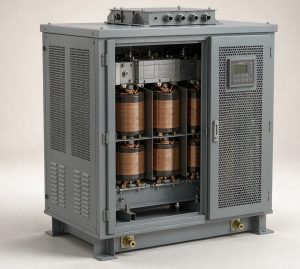
Buildings where people live, learn, heal and work need transformers that are quiet, safe and compact. Our cast-resin dry-type units — SCB13 silicon steel or SCBH15 amorphous alloy, {100 – 3,150 kVA} — contain no flammable liquid, meet IEC 60076-11 fire behaviour class F1, and are available in low-acoustic versions measured to IEC 60076-10 for hospitals, schools, commercial complexes and residential towers.
Why dry-type is the default in occupied buildings
1. Fire safety where people are in the building
Cast resin windings are encapsulated in epoxy under vacuum, so there is no liquid that can burn, leak or need containment. Our units meet IEC 60076-11 fire behaviour class F1 — self-extinguishing, low smoke — and are available halogen-free. In practice that means a transformer room inside the occupied envelope, including basements and below-grade levels, without an oil bund, a separate fire-rated vault or a dedicated suppression system. That is usually the point that settles the specification on a hospital or residential tower.
2. Acoustic performance, stated in the right units
Noise is the complaint that gets a building transformer replaced, and it is the specification most often written badly. Datasheets declare sound power level LWA in dB(A) per IEC 60076-10; what occupants hear is sound pressure at the receiver, which depends on distance and on the room. As a rough free-field guide, sound pressure at 1 m sits around 11 dB below the declared sound power, and each doubling of distance removes a further 6 dB — but reflections in a hard plant room push it back up. We quote both, and we state the level at the receiver you actually care about.
3. Energy cost across the asset life
A building transformer is energised 8,760 hours a year but typically loaded well below nameplate outside occupied hours, so no-load loss dominates lifetime energy cost. SCBH15 amorphous alloy cores cut no-load loss by roughly 40–50% against an equivalent SCB13 unit — around {9,600 kWh} per year for a 2000 kVA unit — and because that loss is heat, reducing it also reduces the cooling load on the plant room.
4. Tolerance of modern building loads
Today’s building bus carries HVAC variable-speed drives, lift drives, LED lighting drivers, UPS-backed IT and — increasingly — EV charging. Together these raise voltage and current distortion well above what a 1990s building saw. Where measured distortion justifies it, we supply K-13 rated windings to IEEE C57.110 with an oversized neutral and an electrostatic shield, so hot-spot rise stays inside class limits. Harmonic limits are usually assessed against IEEE 519 or IEC 61000-2-4.
Technical specifications
| Parameter | Specification |
|---|---|
| Rated power | {100 – 3,150 kVA} |
| Primary voltage | {6 / 10 / 11 / 20 / 35 kV} · LV/LV configurations available |
| Secondary voltage | {400 / 230 V} · {415 / 240 V} |
| Frequency | 50 Hz / 60 Hz |
| Vector group | Dyn11 standard · Yyn0 and others on request |
| Insulation system | Class F (155 °C) or Class H (180 °C) · temperature rise {100 K} |
| Core options | SCB13 grain-oriented silicon steel · SCBH15 amorphous alloy |
| Fire behaviour | IEC 60076-11 — F1, self-extinguishing, low smoke; halogen-free option |
| Sound level | Per IEC 60076-10 · LWA {55 – 70 dB(A)} — state measured value per rating |
| Partial discharge | < 10 pC — confirm per rating |
| Enclosure | IP20 / IP23 / IP31 / IP54 per IEC 60529 · impact rating to IEC 62262 for public areas |
| Cooling | AN (natural air) · AF (forced air) with temperature-controlled fans |
| Harmonic rating | Standard · K-4 / K-13 to IEEE C57.110 where measured distortion requires it |
| Monitoring | PT100 winding sensors, temperature controller with alarm and trip, RS485 Modbus RTU / TCP, BACnet gateway for BMS |
| Ambient | {40 °C} · altitude and ambient correction per IEC 60076-2 |
Low-noise options for noise-sensitive installations
| Measure | What it does | Indicative effect |
|---|---|---|
| Reduced core flux density | Lowers magnetostriction — the physical origin of transformer hum | {−3 to −5 dB} |
| Anti-vibration mounting | Breaks structure-borne transmission into the slab and the building frame | {−3 to −6 dB} at the receiver — often the single most effective step |
| Damped or insulated enclosure panels | Stops the enclosure re-radiating core noise | {−2 to −4 dB} |
| AN rating with on-demand AF | Cooling fans are frequently the loudest source when running | {−5 to −10 dB} in normal operation, because fans only run under peak load |
| Acoustic enclosure | Full wrap with lined panels and baffled ventilation | {state dB reduction per design} |
SCB13 or SCBH15: the loss-and-noise trade-off
Illustrative values for 2000 kVA, 10 / 0.4 kV, Dyn11, 50 Hz. Replace with your type-test figures.
| Model | Core | No-load loss P₀ | Load loss Pₖ | No-load energy / year | Acoustic note |
|---|---|---|---|---|---|
| SCB13 | Grain-oriented silicon steel | {2.45 kW} | {14.6 kW} | {21,500 kWh} | Quieter — the safer choice where the plant room is next to a ward, classroom or bedroom |
| SCBH15 | Amorphous alloy | {1.36 kW} | {14.6 kW} | {11,900 kWh} | Can run a few dB(A) louder — check against the room’s acoustic limit before specifying |
Where they go: application guide
| Building type | Typical rating | Acoustic target at receiver | What to specify |
|---|---|---|---|
| Hospitals | {630 – 2,500 kVA} | {≤ 45 dB(A)} | Low-noise version, anti-vibration mounting, redundant configuration for critical care. Group 2 medical locations need medical IT systems to IEC 60364-7-710 — see below. Imaging suites want a dedicated supply with low impedance for voltage dip |
| Schools & universities | {315 – 1,600 kVA} | {≤ 40 dB(A)} | Quiet operation during occupied hours; locked, impact-rated enclosure (IEC 62262) for areas accessible to students |
| Commercial complexes | {800 – 3,150 kVA} | {≤ 50 dB(A)} in plant areas | Compact footprint, IP23 enclosure, BMS monitoring over Modbus or BACnet; K-13 where HVAC and EV charging distortion warrants it |
| Residential & mixed-use | {400 – 2,000 kVA} | {≤ 35 dB(A)} at night in habitable rooms | Lowest noise option plus anti-vibration mounting — night-time background is the binding constraint, not the plant room level |
Hospitals: medical locations and imaging
Healthcare has one requirement no other building type has. In group 2 medical locations — operating theatres, intensive care, cardiac catheterisation — the supply must continue on a first fault. That is done with a medical IT (isolated terra) system to IEC 60364-7-710: a medical isolating transformer feeding the location, with an insulation monitoring device to IEC 61557-8 that alarms before a second fault can occur. We supply the isolating transformers and the associated monitoring as part of the package.
Imaging equipment is the other special case. MRI and CT scanners draw large, fast, repeated load steps and are sensitive to voltage dip, so they are normally fed from a dedicated transformer sized for the scanner’s impedance and inrush rather than shared with general services.
Enclosure and room selection
| Rating | Suits | Note |
|---|---|---|
| IP20 | Clean, dry, locked electrical room | Standard indoor; touch protection only — the room is the enclosure |
| IP23 | Plant rooms with condensation risk or occasional drips; covered semi-outdoor | The most common choice for commercial and mixed-use |
| IP31 | Rooms where dripping water is a concern | Reduced ventilation — check derating |
| IP54 | Dusty, humid or coastal plant rooms | Significantly restricts ventilation — needs forced cooling or derating, and forced cooling raises noise. Size both together |
Enclosure rating and room ventilation are one problem, not two. A cast resin transformer rejects heat to the room air; if the enclosure is sealed for dust the heat has nowhere to go, and if the plant room is small the room temperature climbs until the transformer derates. We provide the heat rejection figures so the mechanical consultant can size ventilation against them.
Compliance and standards
| Standard | Scope |
|---|---|
| IEC 60076-11 | Dry-type transformers — fire behaviour (F1), environmental (E2) and climatic (C2) classes |
| IEC 60076-10 / 60076-10-1 | Determination of sound levels, and application guide |
| IEC 60076-1 / 2 / 3 | General requirements, temperature rise, insulation levels and dielectric tests |
| IEC 60364-7-710 | Electrical installations of buildings — medical locations, including medical IT systems |
| IEC 61557-8 | Insulation monitoring devices for IT systems |
| IEEE C57.110 | K-factor definition and harmonic derating practice |
| IEEE 519 / IEC 61000-2-4 | Harmonic limits and compatibility levels for installations |
| IEC 60529 / IEC 62262 | Ingress protection (IP) and impact protection (IK) codes |
| EN 50588-1 | European standard for medium power transformers |
| EU Ecodesign Regulation 2019/1783 | Minimum efficiency (PEI) for the EU market — confirm applicable tier and rating band |
| IEEE/ANSI C57.12.01 · UL 1561 | North American dry-type requirements and listing — confirm per market |
| NFPA 70 (NEC) Article 450 | US installation requirements for transformers — confirm per project |
| ISO 9001 / 14001 / 45001 | Manufacturer quality, environmental and OH&S management |
Frequently asked questions
How noisy is a dry-type transformer, and what level should I specify?
Specify the sound power level LWA in dB(A) measured to IEC 60076-10, and separately state the sound pressure you will accept at the nearest occupied space. As a rough free-field guide, sound pressure at 1 m is about 11 dB below the declared sound power and each doubling of distance removes about 6 dB, but hard surfaces in a plant room reflect sound back up. Typical targets are around {45 dB(A)} for spaces next to hospital wards and {35–40 dB(A)} for residential and teaching spaces.
Can a cast resin transformer go in a basement or an occupied building?
Yes — that is the main reason to specify dry-type. With no liquid and IEC 60076-11 fire behaviour class F1, cast resin units can be installed in basements and below-grade plant rooms without oil containment or a separate fire-rated vault in most jurisdictions. Confirm with the local authority having jurisdiction and the applicable wiring regulations.
SCB13 or SCBH15 — which should I choose for a building?
SCBH15 amorphous cuts no-load loss by roughly 40–50% and is the better answer where energy cost and heat rejection matter and the plant room is remote from occupied space. SCB13 is usually quieter, which makes it the safer choice where the room sits next to a ward, classroom or bedroom. Decide against both your loss target and your acoustic limit.
What IP rating do I need for an indoor transformer?
IP20 for a clean, dry, locked electrical room; IP23 where condensation or occasional drips are possible, which is the common choice in commercial plant rooms; IP54 only for dusty, humid or coastal rooms, and then you must size forced cooling or accept derating, because a sealed enclosure restricts ventilation.
Do hospitals need special transformers?
Two things. Group 2 medical locations — theatres, intensive care, cardiac — require a medical IT system to IEC 60364-7-710, with an isolating transformer and insulation monitoring to IEC 61557-8 so the supply continues on a first fault. Separately, imaging equipment such as MRI and CT should have a dedicated transformer sized for its inrush and voltage dip sensitivity rather than sharing general services.
Do modern buildings need K-rated transformers?
Only where measured distortion justifies it. HVAC variable-speed drives, lift drives, LED drivers, UPS and EV chargers all raise distortion, but a well-designed modern installation often stays within limits without K-rating. Assess against IEEE 519 or IEC 61000-2-4, and specify K-13 where the measurement says you need it.
Specifying a building project? View the SCB13 cast-resin series → for low-noise, fire-safe distribution.