
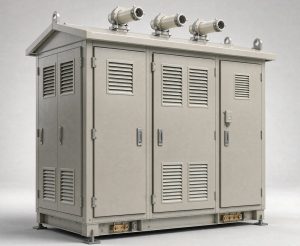
From rural electrification to urban grid backbone expansion, we supply the full distribution chain: hermetically sealed oil-immersed units from S11 to S22 (15 – 31,500 kVA) with conservator-free corrugated tanks, cast resin dry-type transformers for indoor and fire-restricted zones, and YBW prefabricated compact substations to IEC 62271-202 that cut on-site civil work. Efficiency to GB 20052 and IEC 60076, with SZ11 on-load tap-changing for grid voltage regulation.
What utilities need from a distribution transformer
1. Efficiency level, specified by standard
No-load loss is a fixed cost you pay every hour of a transformer’s 30-plus-year life, and on a utility fleet it multiplies across thousands of units. The loss level ladder — S11, S13, S20, S22, and SH15 amorphous — is where the decision sits. We build all of them and quote the loss figures against both GB 20052 (Chinese minimum energy performance standard) and the equivalent IEC and EU Ecodesign parameters, so a project specified in either system is unambiguous.
2. Maintenance-free sealed construction
Our S11–S22 distribution units use a hermetically sealed corrugated tank — no conservator, no breather, no oil level checks. The corrugated walls flex to absorb oil expansion, the oil never contacts atmospheric moisture, and the unit is sealed for life. For a utility running tens of thousands of pole and plinth units, that removes an entire category of routine site work.
3. Weatherproof and site-tolerant
Standard units cover {−25 °C to +40 °C} ambient with altitude correction to IEC 60076-2 above {1,000 m}. Coastal and industrial sites get upgraded finishing to ISO 12944 corrosion categories {C4 / C5}, with stainless or GRP enclosures available for compact substations. Dry-type units for indoor and fire-restricted zones carry IEC 60076-11 fire behaviour class F1.
4. Speed of deployment
Distribution programmes are judged on schedule, not on datasheets. A prefabricated compact substation arrives with HV switchgear, transformer and LV panel already wired and factory-tested, so site work is a foundation, a cable termination and a commissioning test. That is the difference between a civil build measured in weeks and an installation measured in days.
Distribution transformer specifications
| Parameter | Specification |
|---|---|
| Type | Oil-immersed sealed (S11 / S13 / S20 / S22 / SH15) · cast resin dry-type (SCB series) for indoor duty |
| Rated power | {15 – 31,500 kVA}. Above roughly {3,150 kVA} units move into power transformer territory — see power transformers |
| Primary voltage | {6 / 10 / 11 / 20 / 22 / 33 / 35 kV} |
| Secondary voltage | {400 / 230 V} · {415 / 240 V} · other on request |
| Frequency | 50 Hz / 60 Hz |
| Phases | Three-phase · single-phase for rural spur supplies |
| Vector group | Dyn11 standard · Yyn0, Dyn5, Yzn11 available |
| Impedance voltage | {4% – 6%} per IEC 60076-1 |
| Tank | Hermetically sealed corrugated wall (conservator-free) · conventional conservator design for higher ratings |
| Cooling | ONAN · ONAF for higher ratings |
| Tap changing | Off-circuit ±2 × 2.5% · on-load (SZ11) for regulating duties |
| Insulating fluid | Mineral oil IEC 60296 · natural ester IEC 62770 and synthetic ester IEC 61099 options |
| Ambient | {−25 °C to +40 °C} · altitude correction above {1,000 m} per IEC 60076-2 |
| Protection | Pressure relief device, oil temperature indicator, oil level indicator, Buchholz relay on conservator designs |
| Finishing | ISO 12944 corrosion category {C4 / C5} for coastal and industrial sites |
| Sound level | Per IEC 60076-10 · state measured value per rating |
Efficiency levels: S11 to S22 and SH15
Illustrative values for 1000 kVA, 10 / 0.4 kV, Dyn11, 50 Hz. Replace with your type-test figures. Confirm the current edition of GB 20052 and its grade mapping before publishing.
| Model | Core material | No-load loss P₀ | Load loss Pₖ (75 °C) | Positioning |
|---|---|---|---|---|
| S11 | Silicon steel | {1.15 kW} | {10.3 kW} | Legacy replacement and budget-driven programmes |
| S13 | Silicon steel | {0.83 kW} | {10.3 kW} | Common utility standard |
| S20 | Silicon steel, higher grade | {0.66 kW} | {10.3 kW} | Low-loss specification |
| S22 | Silicon steel, premium grade | {0.55 kW} | {10.3 kW} | Lowest-loss silicon steel option |
| SH15 | Amorphous alloy | {0.32 kW} | {10.3 kW} | Lowest no-load loss; strongest on lightly loaded rural feeders |
YBW prefabricated compact substations
A compact substation — known as a package substation, kiosk substation or prefabricated substation depending on the market — integrates HV switchgear, transformer and LV distribution in a single factory-built enclosure. Our YBW range is built to IEC 62271-202, the international standard for HV/LV prefabricated substations, and is fully assembled, wired and tested before shipment.
| Parameter | Specification |
|---|---|
| Standard | IEC 62271-202 (HV/LV prefabricated substation) |
| HV side | {10 / 11 / 20 / 24 / 33 / 35 kV} · ring main unit, load break switch or circuit breaker, surge arresters, metering |
| Transformer | Up to {2,500 kVA} · oil-immersed sealed or cast resin dry-type |
| LV side | {400 / 230 V} · ACB or MCCB outgoing feeders, metering, power factor correction, spare ways |
| Enclosure | IP33 / IP43 / IP54 · galvanised steel, stainless steel, GRP or concrete-look finish · anti-condensation and filtered ventilation |
| Internal arc | Internal arc classification per IEC 62271-202 — confirm classification per design |
| Testing | Routine and type tests, full factory acceptance test (FAT) with witnessed testing available |
| Options | RTU and SCADA telemetry, remote monitoring, cable test facility, earthing and lightning protection |
| Typical applications | Utility distribution, real estate and township supply, EPC programmes, renewables collector points, temporary construction supply |
Compact substation versus a conventional civil substation
| Factor | Conventional civil substation | Prefabricated compact substation |
|---|---|---|
| On-site civil works | {Weeks} — building, cable trenches, equipment plinths | {1–2 days} — prepared foundation or pad |
| Commissioning | {Several weeks} | {1–3 days} after delivery |
| Footprint | Larger | {30–50%} smaller |
| Interface risk | Multiple vendors, site coordination | Single source, factory-wired and pre-tested |
| Relocation | Not practical | Can be relocated as demand moves |
| Best for | Large nodes with long design life and expansion plans | Fast rollout, land-constrained sites, repeatable EPC programmes |
The economic case is strongest on repeatable programmes: once the first unit is approved, every subsequent site is a delivery and a termination rather than a construction project.
Oil-immersed or dry-type?
| Type | Where it fits | Trade-off |
|---|---|---|
| Oil-immersed sealed (S11–S22 / SH15) |
Outdoor pole, plinth and pad sites; the utility default | Lowest cost per kVA, sealed for life, best outdoor thermal performance — but it is a liquid-filled unit |
| Cast resin dry-type (SCB series) |
Indoor substations, basements, commercial basements, fire-restricted zones | IEC 60076-11 class F1 fire behaviour, no liquid — higher first cost and larger footprint per kVA |
Most utility programmes run oil-immersed outdoors and switch to dry-type only where the room is enclosed or the fire officer requires it.
Grid voltage regulation
Where feeder voltage drifts with demand, SZ11 on-load tap-changing transformers hold supply stable without interrupting the load. SZ11 is the Chinese designation for a three-phase oil-immersed transformer with on-load tap changing at performance level 11 — internationally specified as an oil-immersed OLTC transformer.
| Feature | Specification |
|---|---|
| Tap changer | On-load to IEC 60214-1 · {±8 × 1.25%} or {±16 steps} |
| Control | Local, remote, or automatic voltage control with line drop compensation |
| Integration | Position feedback and control to SCADA over Modbus, IEC 60870-5-104 or IEC 61850 |
| Mechanical endurance | {state rated operations per duty} |
Compliance and standards
| Standard | Scope |
|---|---|
| IEC 60076-1 / 2 / 3 | General requirements, temperature rise, insulation levels and dielectric tests |
| IEC 60076-7 | Loading guide for oil-immersed power transformers |
| IEC 60076-10 | Determination of sound levels |
| IEC 60076-11 | Dry-type transformers — fire behaviour, environmental and climatic classes |
| IEC 62271-202 | High-voltage/low-voltage prefabricated substations — the governing standard for compact substations |
| EN 50464-1 | Three-phase oil-immersed distribution transformers, 50 Hz, up to 2,500 kVA and 36 kV |
| IEC 60214-1 | On-load tap-changers — performance and type tests |
| IEC 60296 / 61099 / 62770 | Mineral oil, synthetic ester and natural ester insulating fluids |
| GB 20052 | Chinese minimum energy performance standard for distribution transformers — confirm current edition and grade mapping |
| EU Ecodesign Regulation 2019/1783 | Minimum efficiency (PEI) for the EU market — confirm applicable tier and rating band |
| DOE 10 CFR 430 | US energy conservation standards for distribution transformers — confirm applicability per rating and market |
| IEEE C57.12.00 / C57.12.90 / C57.12.20 | North American general requirements, test code and pad-mounted equipment |
| ISO 12944 | Corrosion protection of steel structures by protective paint systems |
| ISO 9001 / 14001 / 45001 | Manufacturer quality, environmental and OH&S management |
Frequently asked questions
What is a hermetically sealed distribution transformer, and how is it different from a conservator type?
A sealed unit uses a corrugated tank with no conservator and no breather. The corrugated walls flex to absorb oil expansion and contraction, so the oil never contacts atmospheric moisture. In practice that means no oil level checks, no breather maintenance and no moisture ingress for the life of the unit — a meaningful saving on a fleet of outdoor distribution transformers. A conservator design is still used on higher ratings where the oil volume is large.
Which efficiency level should I choose — S11, S13, S22 or SH15?
Match it to the load profile and the procurement rule you must satisfy. S11 suits budget-driven replacement programmes. S13 is a common utility standard. S22 is the lowest-loss silicon steel option where the specification demands it. SH15 amorphous gives the lowest no-load loss of all and pays back best on lightly loaded rural feeders, where no-load loss dominates the life-cycle cost.
What does SH15 mean?
SH15 is the Chinese designation for an oil-immersed distribution transformer with an amorphous alloy core — the oil-filled counterpart to the SCBH15 dry-type amorphous unit. In international specifications it is written simply as an amorphous alloy distribution transformer, and we quote the loss values in IEC terms alongside the Chinese type code.
What is a compact substation, and which standard applies?
A compact substation — also called a package substation, kiosk substation or prefabricated substation — integrates HV switchgear, transformer and LV distribution in one factory-built enclosure. The governing international standard is IEC 62271-202. Because it is assembled and tested at the factory, site work is reduced to a foundation, cable termination and commissioning.
How long does a compact substation take to install?
Site work is typically a prepared foundation or pad plus cable termination, with commissioning in {1–3 days} after delivery, against {several weeks} of civil construction for a conventional substation. Exact figures depend on foundation design and local approvals.
Oil-immersed or dry-type for my project?
Oil-immersed sealed units are the utility default outdoors: lowest cost per kVA and the best thermal performance. Dry-type cast resin is specified where the transformer sits indoors, in a basement, or in a fire-restricted zone, because it carries IEC 60076-11 class F1 fire behaviour and contains no liquid — at higher first cost.
Procuring for a utility or EPC program? Explore the YBW compact substation → or contact our export team for project pricing.