
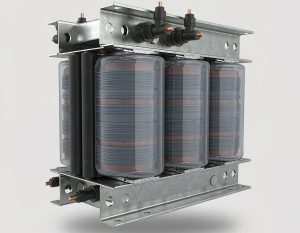
Cast resin dry-type transformers are the default choice for data center power distribution: no flammable liquid, tolerance of the harmonic currents drawn by UPS and PDU loads, and no separate fire-rated substation building. Our data center range covers 315–3150 kVA, 10 / 20 / 35 kV primary to 400 V secondary, with K-13 rated windings and optional SCBH15 amorphous alloy cores for the lowest no-load loss on 24/7 duty.
Why data centers specify dry-type transformers
1. Fire safety and indoor placement
Epoxy resin encapsulated HV and LV windings contain no oil, so there is no flammable liquid inventory, no oil containment bund and — in most jurisdictions — no requirement for a separate fire-rated transformer vault. Our units meet IEC 60076-11 fire behaviour class F1 (self-extinguishing, low smoke, low toxicity), with halogen-free construction available on request. That makes them suitable for indoor electrical rooms, basement and below-grade plant rooms, and rooftop plant decks — typically the single deciding factor against oil-immersed units in a white-space building.
2. Harmonic tolerance under UPS and PDU loads
Rectifier and IGBT front-ends draw non-sinusoidal current, which drives extra eddy-current and stray losses into the windings. Our data center units are supplied with K-13 rated windings per IEEE C57.110, combining an oversized neutral conductor, a grounded electrostatic shield between HV and LV, and a low-eddy-current conductor design — so hot-spot temperature rise stays inside insulation class limits even at full harmonic load. K-4 and K-20 ratings are available on request.
3. Redundancy without extra floor area
We build to N+1, 2N and 2(N+1) schemes with tightly matched impedance (typically 6% ±10%) and vector group, so parallel units share load evenly and any single unit can be isolated without dropping the hall. Forced-air (AF) cooling delivers 40–50% additional rating headroom to cover the period a redundant unit is out of service.
4. Efficiency where it actually matters
A data hall transformer is energised 8,760 hours a year but rarely loaded beyond 30–60%. No-load loss therefore dominates lifetime energy cost — far more than load loss. SCBH15 amorphous alloy cores cut no-load loss by roughly 40–50% versus an equivalent silicon-steel SCB13 unit; for a 2000 kVA unit that is about 9,600 kWh of avoided losses every year.
Technical specifications
| Parameter | Specification |
|---|---|
| Rated power | 315 – 3150 kVA (higher ratings on request) |
| Primary voltage | 10 / 11 / 20 / 35 kV · 13.8 / 34.5 kV for North America · off-circuit taps ±2 × 2.5% or ±5% |
| Secondary voltage | 400 / 230 V (IEC) or 480 / 277 V (ANSI) |
| Frequency | 50 Hz / 60 Hz |
| Vector group | Dyn11 (Yyn0 and others on request) |
| Impedance voltage | 4% – 6% (6% typical for parallel operation) |
| Insulation / temperature rise | Class F (155 °C) or Class H (180 °C); rise 100 K / 125 K |
| Harmonic rating | K-13 standard · K-4 and K-20 on request (IEEE C57.110) |
| Fire / environmental class | IEC 60076-11 — F1 fire behaviour, E2 environmental, C2 climatic |
| Partial discharge | < 10 pC — confirm per rating |
| Enclosure | IP20 / IP23 standard · IP31 / IP54 and NEMA 1 / 2 / 3R options |
| Cooling | AN (natural air) · AF forced-air for peak-load headroom |
| Sound level | 55 – 70 dB(A) — state measured value per model |
| Monitoring | PT100 winding sensors (3 phases + spare), RS485 Modbus RTU / TCP, alarm and trip contacts, optional Ethernet gateway for BMS / DCIM / SCADA |
| Core options | High-permeability grain-oriented silicon steel (SCB13) or amorphous alloy (SCBH15) |
SCBH15 vs SCB13 vs SCB11 — no-load loss comparison
Illustrative values for 2000 kVA, 10 / 0.4 kV, Dyn11, 50 Hz. Replace with your type-test figures before publishing.
| Model | Core material | No-load loss P₀ | Load loss Pₖ (75 °C) | No-load energy / year |
|---|---|---|---|---|
| SCB11 | Silicon steel | 3.06 kW | 14.6 kW | 26,800 kWh |
| SCB13 | Silicon steel | 2.45 kW | 14.6 kW | 21,500 kWh |
| SCBH15 | Amorphous alloy | 1.36 kW | 14.6 kW | 11,900 kWh |
That is roughly 9,600 kWh saved per year per 2000 kVA unit against SCB13 — about 4 tonnes of CO₂ at a 0.42 kg/kWh grid factor. Amorphous is the right call when the site runs 24/7, the electricity tariff is high, or the operator reports against a PUE or ESG target. Two things to weigh: amorphous cores are slightly larger and can run a few dB(A) louder, so check the acoustic limit before specifying.
Typical configurations for a data hall
- Voltage and rating — 10 / 20 / 35 kV primary stepped down to 400 V (or 480 V for ANSI markets) for server hall distribution; 1000–2500 kVA is the most common band per pod.
- Enclosure and cooling — IP23 enclosure with forced-air (AF) cooling for peak-load headroom; IP54 and special finishes for coastal or high-dust sites.
- Monitoring — PT100 winding sensors plus a temperature controller with alarm and trip contacts, and an RS485 interface running Modbus RTU or TCP mapped into BMS, DCIM or SCADA. BACnet/IP and SNMP gateways available.
- Shielding and earthing — grounded electrostatic shield between HV and LV windings to attenuate common-mode noise from UPS and PDU switching; oversized neutral for triplen harmonics.
Which K-factor do you actually need?
| Rating | Typical application | Guidance |
|---|---|---|
| K-4 | Moderate VFD content, small rectifier loads | Lowest cost — only where measured THD is genuinely low |
| K-13 | Standard data center: 6-pulse / 12-pulse UPS, mixed IT load on PDUs, chiller and pump VFDs on the same bus | Our default recommendation |
| K-20 | Legacy SCR rectifier UPS, very high harmonic density | Over-specify only with measured data — it adds cost and a small loss penalty |
Compliance and standards
| Standard | Scope |
|---|---|
| IEC 60076-11 | Dry-type transformers — fire behaviour (F1), environmental (E2), climatic (C2) classes |
| IEC 60076-1 / 2 / 3 | General requirements, temperature rise, dielectric tests |
| EN 50588-1 | European standard for medium power transformers |
| IEEE C57.110 | K-factor definition and harmonic derating practice |
| IEEE / ANSI C57.12.01 & C57.12.51 | North American requirements for dry-type transformers |
| UL 1561 | US listing for dry-type general purpose transformers — confirm per project and market |
| EU Ecodesign Regulation 2019/1783 | Minimum efficiency (PEI) for power transformers placed on the EU market — confirm applicable tier and rating band |
| ISO 9001 / 14001 / 45001 | Manufacturer quality, environmental and OH&S management |
Frequently asked questions
Can a dry-type transformer be installed inside a data center building?
Yes. With no flammable liquid and IEC 60076-11 fire behaviour class F1, cast resin transformers can be placed in indoor electrical rooms, basements and below-grade plant rooms without oil containment or a separate fire-rated vault in most jurisdictions. Always confirm with the local authority having jurisdiction and the electrical code in force.
Do data centers use dry-type or oil-immersed transformers?
Indoor white-space buildings almost always specify cast resin dry-type transformers for fire safety. Oil-immersed units appear mainly in outdoor yard substations where fire separation distance is available.
Do I still need K-13 windings with a modern UPS?
It depends on the measured harmonic spectrum. Active front-end IGBT UPS units often produce under 5% current THD at the transformer secondary, and standard windings are then sufficient. K-13 remains the safe default where legacy 6-pulse SCR UPS, large chiller VFDs or pump drives share the bus.
What is the difference between SCB13 and SCBH15?
SCB13 uses grain-oriented silicon steel; SCBH15 uses an amorphous alloy core. The difference is almost entirely in no-load loss, which SCBH15 reduces by roughly 40–50%. Because data hall transformers are energised continuously at partial load, that is where the lifetime saving comes from.
How do I size transformers for an N+1 data hall?
Size each unit so the remaining units carry the full hall load within their AF rating when one is out of service, then match impedance and vector group across the set so load divides evenly.
What monitoring can be integrated with our DCIM?
PT100 winding temperature sensors on all three phases plus a spare, driving alarm and trip contacts, and an RS485 interface running Modbus RTU or TCP. Ethernet, BACnet/IP and SNMP gateways are available for direct DCIM, BMS or SCADA integration.
Specifying a data center build? Compare the SCBH15 amorphous alloy series → for the lowest no-load loss.