A transformer is a static electrical device that moves energy from one circuit to another through electromagnetic induction, usually to raise or lower AC voltage without changing its frequency. It works because a changing current in the first coil builds a magnetic field in an iron core, and that changing field induces a voltage in a second coil. The voltage ratio between the two sides equals the ratio of their coil turns.
If you are buying or specifying one, the physics matters less than what the ratings, standards, and type mean for your job. This guide explains the concept in plain English, then shows the numbers and specifications you will actually see on a quote.
What an Electrical Transformer?
A transformer does one job: it changes voltage. It takes alternating current (AC) at one voltage and delivers AC at another, higher or lower, while keeping the frequency the same. It does this with no moving parts and no direct electrical connection between the input and the output.
The key word is *static*. Unlike a motor or a generator, a transformer has nothing that spins or wears out mechanically. That is a big reason units stay in service for 20 to 40 years.
Two facts trip up a lot of first-time buyers:
- A transformer only works on AC, never DC. A steady DC current makes a steady magnetic field, and a steady field induces no voltage. Only a *changing* field does.
- A transformer never changes frequency. If you feed it 60 Hz, you get 60 Hz out. If your load needs 50 Hz, that has to come from the source, not the transformer.
How a Transformer Works, Step by Step
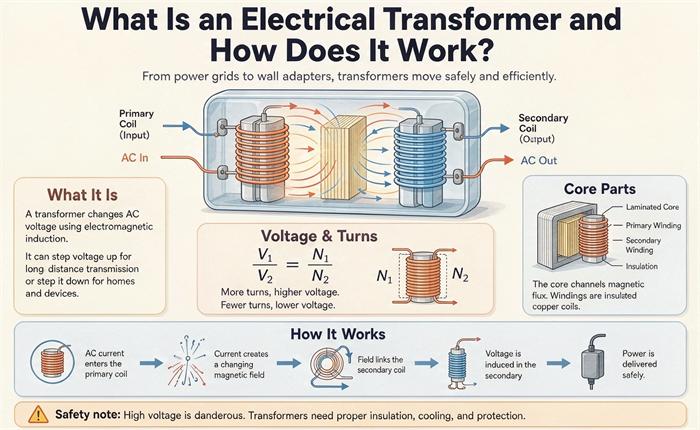
The whole process comes down to electromagnetic induction, the principle Michael Faraday described in 1831. Here is the chain:
- An AC source feeds the primary winding. Current flows back and forth.
- That alternating current creates an alternating magnetic field in the core.
- The core, made of laminated steel, guides almost all of that field to the secondary winding.
- Because the field keeps changing, it induces a voltage in the secondary winding (Faraday’s law).
- Connect a load and current flows out, delivering power with no wire touching the primary side.
The energy moves by magnetism alone. That is why a transformer can sit between a high-voltage line and a sensitive device and keep them electrically separate, a property called galvanic isolation.
The Turns Ratio: How Voltage Changes
The voltage out depends on the number of turns of wire on each coil. This is the single most useful formula in transformer work:
`V1 / V2 = N1 / N2`
where V is voltage and N is the number of turns. If the secondary has fewer turns than the primary, voltage drops (step-down). If it has more, voltage rises (step-up).
A quick example: a primary with 100 turns and a secondary with 50 turns gives a 2:1 ratio, so a 240 V input becomes 120 V out. The current does the opposite, which is why stepping voltage up for transmission lets you step current down and cut line losses.
Why AC and Not DC
This is worth saying plainly because it surprises people. A transformer needs a changing magnetic field to work. AC naturally reverses direction 50 or 60 times a second, so the field keeps changing. DC holds steady, the field holds steady, and nothing is induced on the secondary. If your source is DC, you need a converter or an electronic power supply, not a transformer.
The Main Parts of a Transformer
A real unit is more than two coils, but the core and windings do the actual work.
Core
The core is a closed loop of thin steel sheets (laminations) that gives the magnetic field a low-resistance path. The laminations cut down eddy-current losses. In power units the core is often grain-oriented silicon steel; some designs use amorphous metal to trim no-load losses.
Windings
The primary winding connects to the source and makes the field. The secondary winding picks up the induced voltage and feeds the load. Windings are copper or aluminum conductors wrapped around the core legs, insulated from each other and from the core.
The Rest of the Hardware
Depending on size and type, a transformer also carries:
- Insulation between windings and to ground (air, resin, paper, or oil)
- A tank (oil-filled units) or enclosure (dry-type) that protects the active parts
- Bushings that pass conductors through the tank while keeping insulation
- A cooling system: radiators and fans for oil units, natural or forced air for dry-type
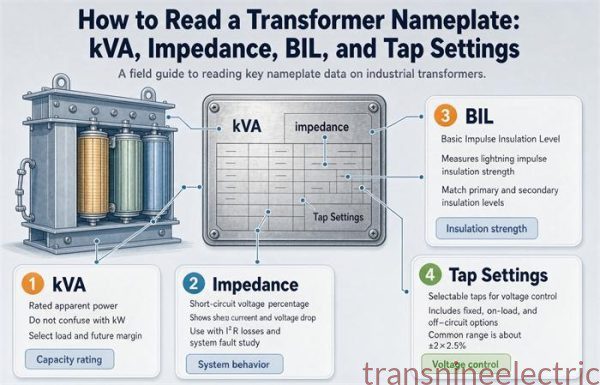
- A tap changer that nudges the turns count to fine-tune output voltage
- Protection such as a Buchholz relay and pressure-relief device on larger oil-filled units
Step-Up vs Step-Down Transformers
The only difference is the turns ratio.
- A step-up transformer has more secondary turns, so voltage rises. Power plants use these to push voltage up to transmission levels (for example 11 to 25 kV generation stepped up toward 400 kV) so current drops and losses on the line fall.
- A step-down transformer has fewer secondary turns, so voltage falls. These are the units on utility poles and in pad-mounted boxes that bring 11 or 33 kV down to the 400/230 V your building uses.
Some units, such as isolation and autotransformers, serve other jobs, but step-up and step-down are the workhorses of the grid.
Types of Transformers You Will Actually Buy
When you go to market, the catalog is organized by job, not by physics. Here is the short version with the numbers buyers care about.
| Type | Typical rating | Common voltage | Cooling | Efficiency (approx.) | Where you use it |
|---|---|---|---|---|---|
| Distribution | 10 kVA to 5 MVA | MV primary to 400/230 V secondary | Dry-type air or mineral-oil | 95 to 99.5% | Commercial, residential, light industrial |
| Power | 10 MVA to 1,000+ MVA | 33 kV up to several hundred kV | Oil with radiators or fans | 98 to 99.8% | Substations, transmission tie points |
| Dry-type | 1 kVA to 20 MVA | LV to MV indoor | Natural or forced air | 96 to 99.5% | Buildings, hospitals, data centers, indoor |
| Oil-immersed | 25 kVA to 1,000+ MVA | LV through EHV | Oil natural or forced | 97 to 99.8% | Outdoor, substations, industry |
| Isolation | 0.1 kVA to 500 kVA | Usually 1:1 | Air (dry) | 90 to 99% | Safety separation, noise reduction |
| Autotransformer | 0.5 kVA to 10 MVA | Close ratios, e.g. 400 to 480 V | Air or oil | 97 to 99.5% | Small voltage trim, starting duty |
| Single-phase | 5 to 100 kVA | Residential class | Dry or oil | 95 to 99% | Homes, rural feeders |
| Three-phase | 100 kVA to 1,000+ MVA | Commercial or industrial | Dry or oil | 96 to 99.8% | Plants, districts, balanced loads |
These are typical industry ranges. Confirm exact ratings, losses, and temperature rise against the manufacturer’s test report and your local standard before you buy.
The Voltage Tiers a Transformer Connects
Transformers are sized to the point they sit in the grid. The tiers run like this:
| Tier | Voltage range | Role |
|---|---|---|
| Low voltage (LV) | 230/400 V | Final user distribution |
| Medium voltage (MV) | 1 to 33 kV | Primary distribution |
| High voltage (HV) | 66 to 220 kV | Transmission and sub-transmission |
| Extra-high voltage (EHV) | 220 to 400 kV | Long-distance transmission |
| Ultra-high voltage (UHV) | Above 400 kV, up to 765 kV | Bulk transmission |
Generation usually sits at 11 to 25 kV. Transmission lines run from 66 kV up to 765 kV. Distribution takes 11 or 33 kV down to 400/230 V for end users. Each transformer is built for one transition in that ladder.
Efficiency and Losses
Even a good transformer is not perfect. Losses split into two buckets:
- No-load (core) loss: present whenever the unit is energized, from magnetization and eddy currents in the core. It is roughly fixed regardless of load.
- Load (copper) loss: from current flowing in the windings, rising with the square of the load (I-squared-R). It grows as the unit works harder.
Efficiency typically runs 95 to 99.5% for distribution units and 98 to 99.8% for large power transformers at rated load. Because no-load loss is always there, a unit that runs lightly loaded all year is often better served by trimming no-load loss than by chasing peak efficiency.
Standards and Compliance Buyers Should Know
The label on a transformer is a promise backed by standards. The names you will see:
- IEEE C57.12.00 for liquid-immersed general requirements and IEEE C57.12.01 for dry-type, with IEEE C57.12.90 covering routine tests, in North America.
- IEC 60076 as the international umbrella for power transformers, with IEC 60076-11 covering dry-type.
- UL 1561 and UL 1562 for dry-type safety listings; NEMA ST 20 for dry-type construction.
- DOE 10 CFR Part 431 Subpart K in the United States, with updated distribution-transformer efficiency limits effective April 23, 2029.
- EU Ecodesign Regulation (EU) 2019/1783 for units placed on the European market.
- ISO 9001 for the quality system behind the build.
Exact applicable standards depend on the country and voltage class, so confirm the ones your project requires before you quote.
What This Means When You Specify a Transformer
The concept is simple; the spec sheet is where projects live or die. Before you ask for a quote, lock down these:
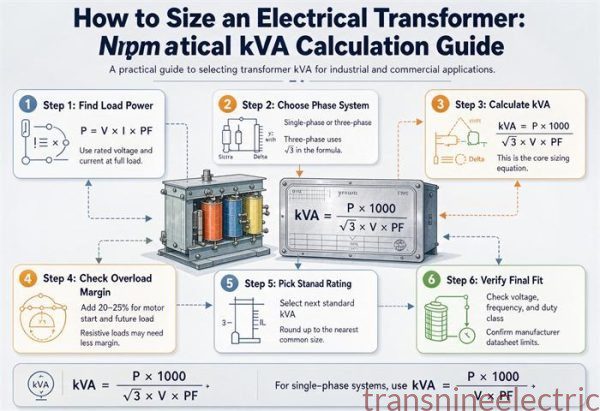
- Power rating in kVA (distribution) or MVA (power), sized to your load plus a margin.
- Voltage class on both sides: primary (what you feed it) and secondary (what your load needs).
- Phase: single-phase for small residential-style loads, three-phase for anything balanced or above roughly 50 to 100 kVA.
- Type: dry-type where fire or spill risk rules out liquid, oil-immersed where you need density and outdoor duty.
- Cooling: natural air (AN), forced air (AF), or oil natural or forced, matched to your ambient and load profile.
- Frequency: 60 Hz in North America, 50 Hz in most of the rest of the world. State it; a transformer is built for one.
- Environment: indoor or outdoor, altitude, humidity, corrosion, noise limits, and enclosure rating (IP or NEMA).
Get these right and the transformer you receive will match the one you imagined. Get them wrong and you are looking at a return, a rebuild, or a site that never quite meets code.
Frequently Asked Questions
Talk to Our Engineering Team
If you are scoping a project and not sure which rating, type, or standard applies, send us your load profile, primary and secondary voltages, and site conditions. We will come back with a sized recommendation and the test documentation to back it.