If you are a buyer, an EPC, or a facilities manager in the US, Canada, or Europe, this guide shows you how to size a transformer in plain language. No engineering degree required. You will leave with the right number, the right standard size for your region, and a short list of details to send a supplier for an accurate quote.
Quick answer (the short version): To size an electrical transformer, convert your load to kVA first—volts × amps ÷ 1,000 for single-phase, or × 1.732 for three-phase—then apply a demand factor, add 15–25% for future growth, and round up to the next standard kVA rating. Everything else (motor starting, harmonics, heat, altitude) only tells you whether to step up one size.
Start with the 4 things you actually need
Before any math, gather four inputs. Most sizing errors happen because one of these is missing or guessed.
1. Load type and phase
Is the load single-phase or three-phase? In North America, commercial and industrial sites are almost always three-phase at 480/208 V. In Europe it is three-phase at 400/230 V. Small or residential loads may be single-phase.
2. Voltage
You need the line-to-line voltage. For three-phase, use the line voltage (480 V, not 277 V on a 480Y/277 V system). Mixing line and neutral voltage is the most common beginner mistake.
3. Current, kW, or horsepower
Ideally you have amps from a nameplate or meter. If you only have kW from a utility bill, that works too (you just need the power factor as well).
4. Power factor (if you are working in kW)
Power factor (PF) is the ratio of real power to apparent power. If you do not know it, 0.8 is a safe, conservative assumption for motor-heavy sites. A lower PF means you need a bigger transformer for the same real power.
The kVA formulas (the only math you need)
Transformers are rated in kVA (kilovolt-amperes), not kW, because their heating limit is set by current, which flows regardless of power factor. So we size on apparent power.
Single-phase
kVA = V × I ÷ 1,000
Three-phase
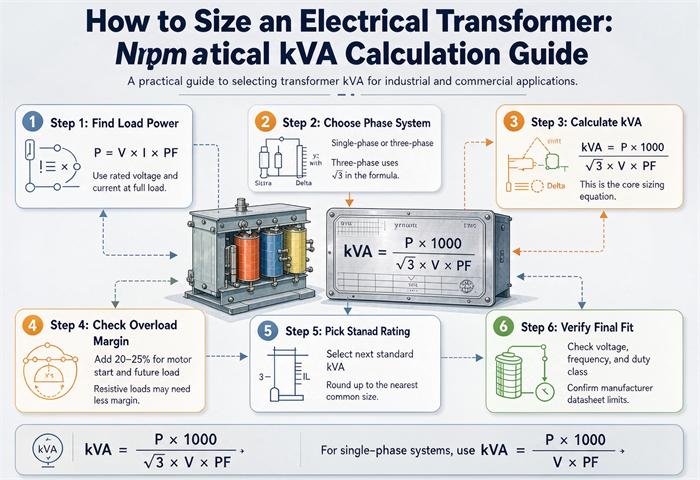
kVA = V × I × 1.732 ÷ 1,000
The 1.732 is the square root of 3 (√3). V is line-to-line voltage and I is the line current. The formula assumes a balanced load; if phases are uneven, check each phase and the neutral separately.
If your load is in kW: kVA = kW ÷ PF. A 40 kW load at 0.80 PF is 50 kVA.
How to size a transformer in 5 steps (with a worked example)
- Add up the connected load. List every motor, panel, HVAC unit, and spare you expect to feed.
- Apply a demand factor. Not everything runs at full power at once. Multiply by a realistic demand factor (0.6–0.95 depending on the facility).
- Convert to kVA. Divide the resulting kW by the power factor.
- Add 15–25% for growth. One margin only. Do this once.
- Round up to the next standard size. Never round down.
Worked example
Say you have a 480 V three-phase panel drawing 200 A, power factor 0.85.
- Calculated kVA = 1.732 × 480 × 200 ÷ 1,000 = 166 kVA
- Add 20% growth: 166 × 1.20 = 199.5 kVA
- Next NEMA standard size up = 225 kVA
At 225 kVA, the full-load current at 480 V is about 271 A, so your 200 A load runs near 74% of rating. That is a healthy operating point.
Same result from kW: 150 kW at 0.90 PF = 167 kVA; +20% = 200 kVA; round up to 225 kVA.
Standard kVA ratings — and why North America and Europe don’t match
This is where most international buyers get stuck. The “next standard size” is not the same on both sides of the Atlantic.
North America (NEMA / IEEE C57.12.00)
| Single-phase | 15 | 25 | 37.5 | 50 | 75 | 100 | 167 | 250 | 333 | 500 | ||||
|---|---|---|---|---|---|---|---|---|---|---|---|---|---|---|
| Three-phase | 15 | 30 | 45 | 75 | 112.5 | 150 | 225 | 300 | 500 | 750 | 1000 | 1500 | 2000 | 2500 |
Europe and IEC (IEC 60076)
| Common sizes (kVA) | 16 | 25 | 40 | 63 | 100 | 160 | 250 | 400 | 630 | 800 | 1000 | 1250 | 1600 | 2000 | 2500 | 3150 |
|---|
Notice the gap: a North American 225 kVA has no direct IEC twin. The closest IEC step is 250 kVA. If you are sourcing across regions, quote both and confirm which standard your project specifies.
Quick kVA-to-amps reference (three-phase)
| kVA | FLA @ 480 V | FLA @ 400 V |
|---|---|---|
| 75 | 90 A | 108 A |
| 112.5 | 135 A | 162 A |
| 150 | 180 A | 216 A |
| 225 | 271 A | 325 A |
| 300 | 361 A | 433 A |
| 500 | 601 A | 722 A |
| 750 | 902 A | 1,083 A |
| 1000 | 1,203 A | 1,443 A |
Real-world factors that can push you up a size
The formula gives a starting point. These conditions can justify stepping up one standard size.
Motor starting
Large motors can draw 5–7 times their running current at start, causing a voltage dip. Check your biggest motor against the transformer; soft starters or VFDs help.
Harmonics and K-factor
VFDs, rectifiers, LED lighting, and UPS systems create harmonic current that heats windings. In harmonic-heavy environments, specify a K-rated transformer or apply a derating factor.
Heat and altitude
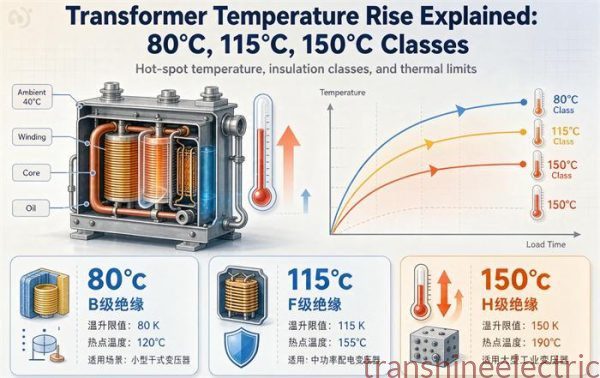
Standard ratings assume 40 °C ambient and under 1,000 m altitude. Hotter or higher sites need derating or a custom design. Tell your supplier the site conditions early.
Cooling class
Forced-air (fans) on a dry-type unit can add short-time capacity, often around 30%. Confirm what the nameplate actually guarantees before you rely on it.
Single-phase or three-phase — which do you need?
If you are serving a building or plant, the answer is almost always three-phase: 480/208 V in North America, 400/230 V in Europe. Single-phase is for small loads, a single piece of equipment, or residential connections. When in doubt, match what your existing service provides.
The real cost of guessing wrong
Undersize it and the unit runs hot, trips on peaks, ages early, and leaves no room to grow. Oversize it and you pay more up front, need more space, and carry higher no-load losses every hour of every day. Those no-load losses run continuously for the transformer’s 20–30 year life, so an oversized unit quietly wastes energy the whole time. The sweet spot is a unit running around 70–80% of rating at peak.
What to send your supplier for an accurate quote
This is the part that turns a reader into an inquiry. The more of these you provide, the faster and tighter the quote.
- Primary and secondary voltage (and whether the secondary is wye or delta)
- Single-phase or three-phase
- Required kVA, or your load data (amps, kW, power factor) so they can size it
- Enclosure / environment rating (NEMA type for North America, IP rating for Europe)
- Cooling type (dry-type, cast-resin, or liquid-filled)
- Site conditions: ambient temperature, altitude, indoor/outdoor
- Applicable standard: NEC (US/Canada) or IEC (Europe)
- Quantity and target lead time
Frequently asked questions
How do you calculate kVA for a transformer?
Use kVA = V × I ÷ 1,000 for single-phase, or kVA = V × I × 1.732 ÷ 1,000 for three-phase. If you only know kW, divide by power factor: kVA = kW ÷ PF.
How do I know what size transformer I need?
Convert your load to kVA, apply a demand factor, add 15–25% for future growth, then round up to the next standard rating (NEMA in North America, IEC in Europe).
What size transformer do I need for 100 amps at 480 V?
A 480 V three-phase load of 100 A needs about 83 kVA. With a 20% margin that is roughly 100 kVA, so the next standard NEMA size is 112.5 kVA.
Should I always add 25% when sizing a transformer?
No. A 15–25% allowance is common for planned growth, but it is a project decision, not a code rule. Do not stack several margins on top of each other.
Can a transformer be too big?
Yes. Oversizing raises purchase cost, footprint, and continuous no-load losses that run for the unit’s 20–30 year service life.
Single-phase or three-phase — which do I need?
Three-phase serves most commercial and industrial sites (480/208 V in North America, 400/230 V in Europe). Single-phase fits small or residential loads.
Do transformer standard sizes differ between the US and Europe?
Yes. North America uses NEMA/IEEE steps such as 112.5, 150, 225, 300, 500 and 750 kVA. Europe uses IEC steps such as 630, 800, 1000, 1250 and 1600 kVA.
What information should I give a supplier to quote a transformer?
Primary and secondary voltage, phase, required kVA (or load data), power factor, enclosure rating, cooling type, site conditions, the applicable standard (NEC or IEC), and quantity.