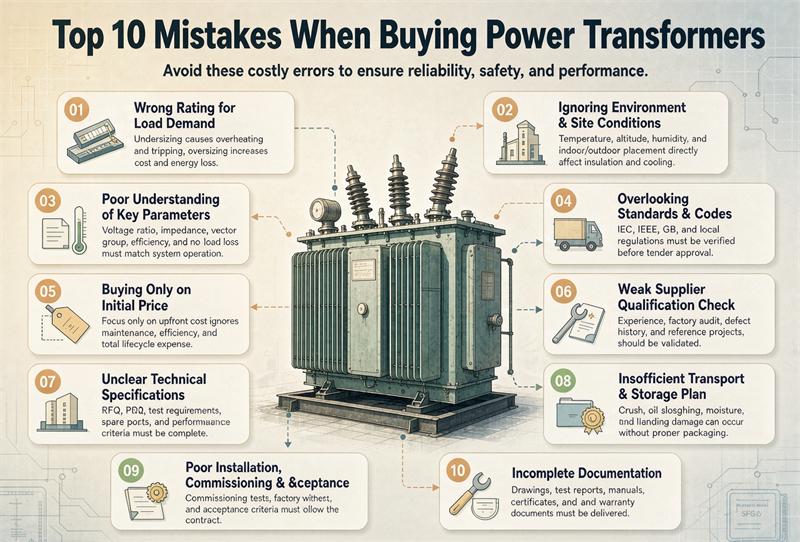
1. Buying on Price Instead of Total Cost of Ownership
This is the classic one, and it is the most expensive. A transformer that costs $20,000 less up front can burn through that saving in losses before the paint dries. The number that matters is TCO: purchase price plus the present value of every watt it wastes for the next few decades.
Quick illustration. Take a typical 1,000 kVA unit with 1,500 W no-load loss and 9,000 W load loss. Run it for 30 years at $0.10/kWh with a 7% discount rate, and the losses alone are worth roughly $64,000 in today’s money. A cheaper bid with worse losses can quietly cost you more than the premium unit over the asset’s life.
The fix: Ask every bidder for guaranteed no-load and load losses, then compare TCO, not sticker price. A few points of extra efficiency pay back fast on a 24/7 load.
2. Getting the Capacity Wrong
Sizing is where good intentions meet bad math. Undersize and the unit runs hot, ages early, and can fail under load. Oversize and you pay for copper and steel you never use, while the transformer loafs along at low efficiency.
The 15 to 25 percent rule
Size to your real maximum demand, then add a 15 to 25 percent margin. Do not size to connected load. Connected load counts every motor and heater as if they all ran at once, which they do not.
Plan for 10 to 20 years of growth
If your site will add lines, chargers, or capacity, build that into the rating now. Replacing an undersized transformer later means civil works, outage, and a second purchase. That is never cheap.
The fix: Build the load study from maximum demand, not connected load, and add headroom for the life of the asset.
3. Ignoring Efficiency Law (EU and U.S.)
You cannot ship a non-compliant transformer into the EU or the U.S. and hope for the best. Both markets have hard loss limits, and both have teeth.
European Union: EcoDesign Tier 2
EU EcoDesign sits under Regulation (EU) 2019/1781, which amended the original 548/2014. Tier 2 loss limits have been mandatory since 1 July 2021 for small, medium, and large transformers placed on the EU market. After that date, Tier 1 units generally cannot be placed on the market. Miss this and your unit fails acceptance.
United States: DOE 10 CFR Part 431
In the U.S., the rule is DOE 10 CFR Part 431. The amended distribution-transformer standards were finalized on 22 April 2024 (89 FR 29834) with compliance required from 23 April 2029. For the bands covered, efficiency steps up. For example, a three-phase 75 kVA unit moves from a 98.60% minimum (2016 to 2029) to 98.95% from the 2029 date. Large power transformers above 34.5 kV currently have no federal efficiency floor, but DOE’s 2026 supply-chain review shows the rules are being watched closely.
The fix: State the target efficiency tier in the spec and ask for the certified test report. Never assume “it meets standards” without paper.
4. Mixing Up IEC and ANSI/IEEE Standards
A transformer built to IEC 60076 is not automatically accepted under ANSI/IEEE, and vice versa. The two systems differ on everything from insulation levels and temperature rise to tap-changer practice and labeling. Ship an IEC unit to a North American site expecting IEEE acceptance and you may face rework, replacement, or a failed inspection.
This is exactly where the IEC vs ANSI/IEEE standards guide earns its keep. Read it before you write the spec, because the standard you name decides the whole design.
The fix: Name the governing standard in the RFQ and confirm the supplier has built and tested to it before.
5. Picking the Wrong Transformer Type
Oil-immersed, dry-type, cast-resin: these are not interchangeable. The right pick follows where the unit lives and what can go wrong there.
| Type | Best for | Watch out for |
|---|---|---|
| Oil-immersed | Outdoor, high capacity, heavy industrial | Fire risk, spill containment, maintenance |
| Dry-type (VPI/cast-resin) | Indoor, dense, fire-sensitive spaces | Lower cooling headroom |
| Cast-resin | Hospitals, high-rises, metros | Highest fire safety, low noise |
See the full range of transformer products we build across these types on our transformer product pages.
The fix: Let the site, fire code, and load decide the type, not the catalogue the salesperson hands you.
6. Skipping Factory Acceptance Testing
“It passed at the factory” means nothing without the report. Routine tests (ratio, winding resistance, insulation resistance, and dielectric) should run on every unit. Type and special tests (short-circuit, temperature rise) get specified by contract for the riskier jobs.
Our factory acceptance testing checklist walks through what a signed test package should contain. Hold the final payment until you have it.
The fix: Write FAT into the contract, name the tests, and refuse final payment without the signed report.
7. Underestimating Lead Times and Supply Chain Risk
Remember when a transformer arrived in a few weeks? That world is gone. After 2020, lead times for medium and large units stretched to many months, and the U.S. Department of Energy’s 2026 supply-chain review openly flagged “extended procurement timelines” as a national concern.
If your project has a commissioning date, the transformer is usually the long pole in the tent. Order it last and you will slip the whole schedule.
The fix: Lock the build-and-ship window in writing, with penalties, and order against the critical path, not the convenience of the buyer.
8. Forgetting Site Conditions and Cooling
The nameplate assumes a clean, cool, sea-level world. Your site is not that. High altitude thins the air and cuts cooling. High ambient temperature loads the insulation. Dust, salt, and humidity attack it from the outside.
What to tell the supplier
Altitude, ambient temperature range, indoor vs outdoor, pollution level (IP/IK rating), and available ventilation. Get these wrong and a perfectly good transformer overheats in year one.
The fix: Hand the supplier a site profile, not just a kVA number. Cooling class (ONAN/ONAF/AN-AF) follows from it.
9. Writing a Vague RFQ
“Send quote for 1000 kVA transformer” is not a specification. It is an invitation for ten suppliers to quote ten different machines, then for you to compare apples to engine blocks.
What a good RFQ includes
- Primary and secondary voltage, frequency, vector group
- kVA rating with the load study behind it
- Cooling class and tap-changer type
- Governing standard (IEC or ANSI/IEEE)
- Guaranteed no-load and load losses
- Site conditions (altitude, temperature, environment)
- Required tests and documentation
- Warranty, spares, and commissioning support
The fix: Treat the RFQ as the contract’s first draft. The more precise it is, the more comparable your bids become.
10. Choosing an Inexperienced Supplier with No Local Support
The lowest quote from a supplier who has never shipped to your market is a gamble you do not want to take on a 30-year asset. You want a track record, test facilities, and someone who answers the phone when something trips at 2 a.m.
Before you sign, look at real reference installations in your sector: data centers, solar farms, metros, hospitals. A supplier with proof in your sector is worth more than a cheaper one with a brochure.
The fix: Vet the supplier like the asset deserves: references, test capability, warranty, and local or responsive support.
Frequently Asked Questions
What is the most common mistake when buying a power transformer?
Choosing on price alone. The cheap bid usually hides higher no-load and load losses, so it costs more over a 20 to 30 year life. Compare total cost of ownership, not just the sticker price.
How do I size a power transformer correctly?
Base the rating on your real maximum demand plus a 15 to 25 percent margin for future growth, then check harmonics, motor starting current, and altitude. Sizing only on connected load leads to chronic overload or wasted capacity.
What efficiency standard applies to transformers in the EU?
EU EcoDesign, under Regulation (EU) 2019/1781 (which amended 548/2014). Tier 2 loss limits have been mandatory since 1 July 2021 for small, medium, and large transformers placed on the EU market.
What efficiency standard applies to transformers in the United States?
U.S. DOE 10 CFR Part 431. The amended distribution-transformer standards were finalized 22 April 2024 (89 FR 29834) and take effect 23 April 2029. Large power transformers above 34.5 kV currently have no federal efficiency floor.
Do I need factory acceptance testing for a standard transformer?
Yes. Routine tests (ratio, winding resistance, insulation, dielectric) should run on every unit, with type and special tests specified by contract. Ask for the signed test report before you pay the balance.
How long does it take to get a power transformer delivered in 2026?
Lead times stretched sharply after 2020. Medium and large units commonly need many months, and U.S. DOE flagged extended procurement timelines in a 2026 supply-chain review. Confirm the real build-and-ship window in writing before you commit.
Should you choose oil-immersed or dry-type transformers?
Pick by location and risk. Oil-immersed units cool better and suit outdoor, high-capacity, or industrial sites. Dry-type (especially cast-resin) units are safer indoors, in dense or fire-sensitive spaces, and need less fire protection.
Bottom Line: The 10 Mistakes, One Takeaway
If you remember one thing, remember this: buy the transformer for its whole life, not its first invoice. The ten mistakes above all trace back to the same habit, which is optimizing the purchase and forgetting the asset.
To recap: price over TCO, wrong capacity, skipped efficiency law, mixed standards, wrong type, no FAT, blind lead times, ignored site, vague RFQ, weak supplier. Fix those and you are already ahead of most buyers.
For a deeper walk-through, our complete 2026 buying guide and the wider procurement resources library cover sizing, standards, and testing in more detail. And if you want a sanity check on your spec, the team at TransNin Electric is happy to review it before you issue the RFQ.