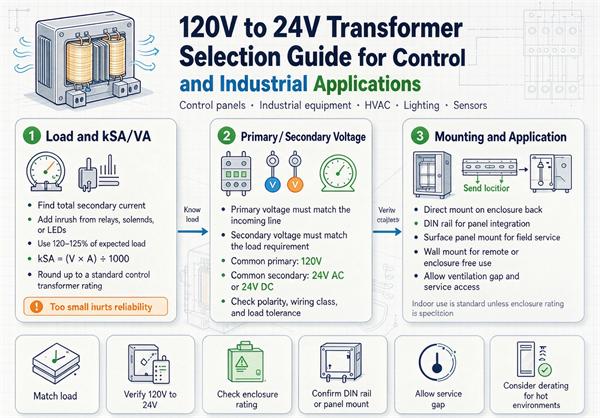
A 120V to 24V transformer, usually called a control transformer, steps 120 V AC mains down to a safe 24 V AC so you can run contactors, relays, PLCs, and sensors. Pick the right one with three checks: size the VA rating for inrush, not just steady watts; match the 120 V primary to your supply and the 24 V secondary to your load; and confirm the unit meets UL 5085 and NEC Class 2 for your panel.
This guide is written by the TransNin Electric application team for plant electricians, panel builders, and procurement buyers who need a unit that simply works on the first try.
| Application | Typical VA | Primary input | Common mounting |
| Residential / light-commercial HVAC control | 40 VA | 120 V | Foot mount, wire leads |
| Machine control panel, few contactors | 150 to 500 VA | 120 / 208 / 240 V | DIN rail or panel-foot |
| Industrial panel, many coils and VFDs | 500 to 2000 VA | 120 / 240 / 480 V | Panel-foot, shielded |
| PLC, sensors, building automation | 75 to 250 VA | 120 V | DIN rail, enclosed |
What a 120V to 24V Control Transformer Actually Does
Step-down and isolation in one box
The transformer does two jobs at once. It lowers the voltage from 120 V to 24 V, and it electrically separates (isolates) the 24 V control circuit from the mains. That isolation is why a fault on a contactor coil will not energize your 120 V bus, and why a technician can probe the low-voltage side with far less risk.
Most of these units are dry-type, encapsulated or open-frame, with a laminated silicon-steel core. Our dry-type transformer overview explains the insulation and encapsulation choices if you want the deeper background.
Where you see them: HVAC, panels, machines
You will find a 120V to 24V unit inside almost every furnace, air handler, and rooftop unit (that is the classic 40 VA “furnace transformer”). You will also find rows of them inside industrial control panels, CNC machines, conveyor lines, and building-automation cabinets powering the contactors and relays that actually move things.
Size It by VA, and Don’t Skip Inrush
This is the section that saves you from a chattering contactor and a burnt secondary. Most failures in the field come from wrong VA sizing, not from a bad unit.
Steady-load VA: add your holding loads
Transformers are rated in volt-amperes (VA), not watts, because the manufacturer does not know your load power factor. Add up the sealed (holding) VA of every device on the 24 V side: contactor coils, relay coils, pilot lights, PLC supply, timers.
A practical rule: sum the sealed VA and add a 20 to 25 percent margin for voltage drop and future expansion. If your load is 99 VA sealed, size for about 125 VA continuous headroom.
Inrush VA: the spike that decides the size
Here is the part most guides skip. When a contactor or solenoid valve energizes, its coil draws a brief surge of 3 to 10 times its sealed VA for 30 to 50 milliseconds, at a low power factor around 0.2 to 0.4. If the transformer sags during that surge, the contactor may fail to pull in, or other coils on the same 24 V bus may drop out.
Size the transformer so the worst-case inrush dip stays within about 5 to 10 percent, which keeps other coils above their roughly 85 percent hold-in voltage. In practice that means: required VA equals the largest single inrush plus the sealed VA of everything else, then add your 20 to 25 percent margin.
Worked example: a motor-control panel
Say your panel holds three NEMA Size 1 contactors (15 VA sealed, 150 VA inrush each), six pilot lights (3 VA), four relays (5 VA), and two timers (8 VA).
- Sealed total = 3 x 15 + 6 x 3 + 4 x 5 + 2 x 8 = 99 VA
- Worst-case inrush = one contactor pulls in while everything else is sealed = 150 + 99 = 249 VA
- Add 25 percent margin = 311 VA
- Select the next standard size above 311 VA: a 350 VA control transformer
Notice the steady load is only 99 VA, yet you still need a 350 VA unit to ride through the inrush. That gap is exactly why “add up the watts” fails.
Standard VA sizes to spec from
Control transformers follow a standard ladder of sizes. When you write the purchase order, pick from these rather than a round number:
| Standard VA | Secondary current at 24 V | Typical use |
| 40 VA | 1.67 A | HVAC furnace and AC control |
| 75 VA | 3.13 A | Small panel, one contactor |
| 150 VA | 6.25 A | Machine control, few coils |
| 250 VA | 10.4 A | Mixed relay and pilot load |
| 350 VA | 14.6 A | Multi-contactor panel (see example) |
| 500 VA | 20.8 A | Industrial panel, VFD-adjacent |
| 750 VA | 31.3 A | Large control and aux load |
| 1000 VA | 41.7 A | Heavy auxiliary control |
Match the Voltages
Primary: 120 V, or 120/208/240 V multi-tap
Confirm the supply your panel actually has. In North American light commercial and residential sites that is usually 120 V. In an industrial panel fed from 208 V or 240 V, choose a multi-tap primary (120 / 208 / 240 V) so one unit fits several line voltages. For a 480 V feed you would step down in two stages or pick a different primary rating; do not assume a 120 V primary will survive 480 V.
Secondary: 24 V AC, and the 50/60 Hz note
The output you want is 24 V AC. Watch two things. First, no-load secondary voltage runs a little high (often 26 to 28 V with no load) and settles near 24 V under load, which is normal. Second, these are 50/60 Hz magnetic transformers; if your market runs 50 Hz and a supplier quotes 60 Hz only, ask before you buy, because frequency is not something you can change after the fact.
Class 2 vs Non-Class 2: Do You Need Current Limiting?
What NEC Class 2 limits
A Class 2 control circuit (NEC Article 725) is power-limited, normally capped around 100 VA at 24 V AC, with the transformer’s internal impedance doing the current limiting. That built-in limit means a short on the 24 V side is far less likely to start a fire, and it often removes the need for a secondary fuse. Many HVAC and building-automation controls are designed around Class 2 sources.
When to choose a non-Class 2 unit
If your load exceeds the Class 2 VA cap, or you need a fused, higher-current 24 V bus for a large machine, you go non-Class 2 and add proper overcurrent protection. State this clearly on the spec sheet, because it changes the enclosure and fusing requirements.
Pick the Mounting and Enclosure
DIN rail, panel-foot, chassis, PCB, plug
Match the footprint to where it lives. New control panels almost always use 35 mm DIN-rail mount. Retrofit and machine builds often use panel-foot (foot-mount) with wire leads. Open chassis units drop into custom enclosures. Small PCB-mount types fit tight electronic assemblies, and plug-in wall units suit low-current doorbell or thermostat duty.
NEMA and IP ratings for the environment
| Mounting / enclosure | When to use it |
| Open chassis, IP00 | Inside a sealed panel, clean dry room |
| Enclosed NEMA 1 | Indoor control panel, no washdown |
| NEMA 3R / IP54 | Outdoor or damp location, rain splash |
| NEMA 12 / IP54 | Industrial dust, non-corrosive oil mist |
| Encapsulated | Vibration, humidity, harsh plant floor |
These units are single-phase. If you are building a three-phase power distribution scheme, our single-phase transformer range shows the form factors we build, and the full transformer catalog covers the larger dry-type and oil-immersed lines.
Shielding and Noise: Keep the 24 V Clean
Electrostatic shield
In a noisy panel, a control transformer with an electrostatic shield between primary and secondary pays for itself. The shield, bonded to ground, blocks capacitive coupling from VFDs and large motors into your 24 V control bus.
When VFDs and PLCs are nearby
If the transformer feeds a PLC or sensitive sensors next to variable-frequency drives, choose a shielded, often encapsulated unit and keep the primary and secondary wiring in separate conduits. Clean 24 V means fewer random resets and fewer “ghost” faults that eat a maintenance tech’s afternoon.
Standards and Compliance to Name on the PO
Buyers in North America and Europe expect specific references. Put them on the purchase order so the supplier cannot ship a generic unit.
- IEC 61558-2-2:2022, the particular safety standard for control transformers (dry-type, supply up to 1000 V AC, up to 25 kVA single-phase / 40 kVA polyphase). IEC 60076-11 covers the broader dry-type family.
- NEC Article 450 (transformers and vaults) and NEC Article 725 (Class 2 and Class 3 circuits).
- UL 5085 for low-voltage transformers, plus UL 508A for the industrial control panel it sits in.
- NEMA ICS 2 for industrial control equipment, and ISO 9001 for the quality system.
A technical resource library on our site collects the buyer guides that explain each of these in plainer language, and our reference installations show them running in real plants and substations.
One honest note on efficiency: the U.S. DOE distribution-transformer rule (10 CFR Part 431, Subpart K) covers liquid-immersed and dry-type distribution transformers above certain kVA. Small control transformers used for 24 V control circuits are generally outside that scope, so a “high-efficiency” label on a 120V to 24V control unit is a design claim, not a regulated number. Ask the supplier for the no-load and load-loss figures on the datasheet and compare them directly.
Fill-In Spec Sheet for Your Supplier
Before you request a quote, write down these values. If a supplier cannot fill every row, that is your answer about whether to keep looking.
| Field | What to enter |
| Primary voltage | 120 V, or 120 / 208 / 240 V multi-tap |
| Frequency | 60 Hz, or 50/60 Hz |
| Secondary voltage | 24 V AC |
| Required VA (inrush-based) | sealed load + worst inrush, plus 25 percent |
| Class 2 or non-Class 2 | state which, and the VA cap if Class 2 |
| Mounting | DIN rail / panel-foot / chassis / PCB / plug |
| Enclosure rating | NEMA 1 / 3R / 12 or IP00 / IP54 |
| Shielded | yes / no |
| Standards | IEC 61558-2-2, NEC 450 + 725, UL 5085 |
| Certifications | UL / CE / RoHS as required by market |
Before you fill this in, see how to read a transformer nameplate so you know which numbers on the supplier’s drawing are the ones that matter.
Common Mistakes Buyers Make
Sized by watts, not VA
Watts describe real power; VA describes what the windings must carry. An inductive coil with a poor power factor draws more current than its watt rating suggests. Size by VA.
Ignored inrush
The steady load looks small, the inrush looks fine for a moment, and then the contactor chatters. Size for the surge, as shown in the worked example.
Wrong primary tapping
A 240 V primary wired to 120 V gives you roughly one-quarter the VA and a wrong turns ratio. Confirm the tap matches the supply before the unit ships.
Frequently Asked Questions
What size 120V to 24V transformer do I need for a control panel?
Add the sealed VA of every 24 V device, then size for the worst single inrush plus the rest of the sealed load, and add 25 percent. A panel with 99 VA sealed and a 249 VA worst-case inrush needs about a 350 VA unit. Do not size from the steady watts alone.
Can I use a 40 VA furnace transformer for an industrial panel?
Usually no. The 40 VA size is a residential HVAC convention sized for one small contactor and a thermostat. An industrial panel with several heavy contactors will exceed both the steady and inrush rating, so you move up to 150 VA, 350 VA, or higher.
Is a 120V to 24V transformer the same as a power supply?
No. A transformer outputs AC and provides isolation; a power supply (often a switch-mode unit) rectifies AC to DC. If your device needs 24 V DC, you need a transformer plus a rectifier, or a 24 V DC power supply, not a bare transformer.
What does NEC Class 2 mean for a 24V control circuit?
Class 2 (NEC Article 725) is a power-limited circuit, generally capped near 100 VA at 24 V AC, with the transformer’s impedance limiting fault current. It reduces fire risk on a short and often removes the need for a secondary fuse. Pick non-Class 2 only when your load exceeds that cap.
Do I need a shielded control transformer?
If the unit feeds a PLC or sensors in a panel with VFDs or large motors, yes. The electrostatic shield blocks noise coupling into the 24 V bus and prevents random resets. In a clean, quiet panel, an unshielded unit is fine.
Does the U.S. DOE efficiency rule apply to 120V to 24V control transformers?
Generally not. The DOE distribution-transformer rule (10 CFR Part 431, Subpart K) targets larger liquid-immersed and dry-type distribution transformers. Small control transformers are usually outside that scope, so “high-efficiency” on a control unit is a design claim. Ask for the no-load and load-loss numbers and compare them yourself.