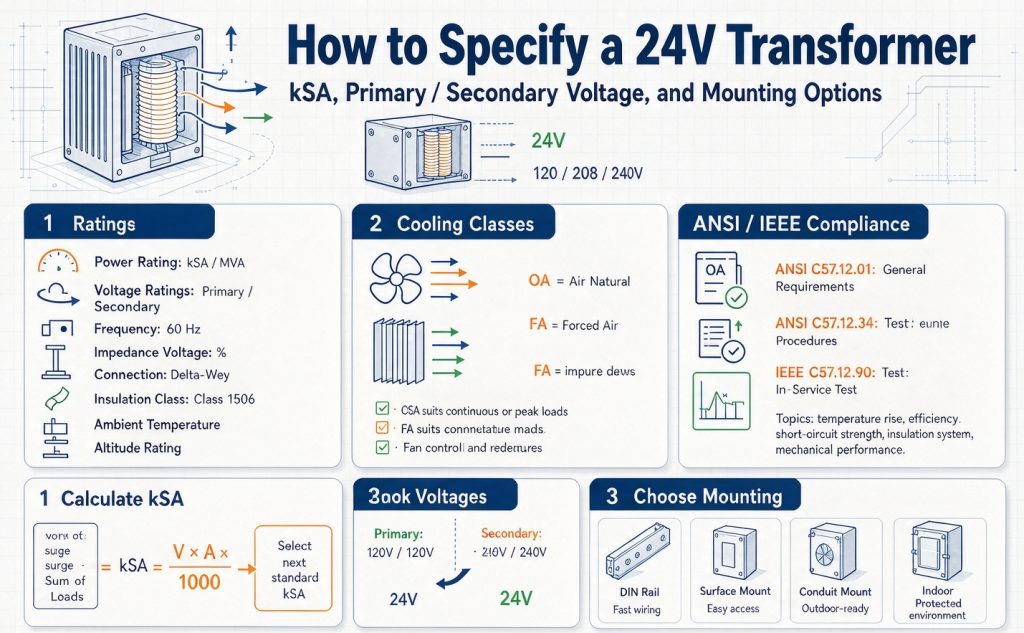
To specify a 24V transformer, give your supplier three numbers: the kVA or VA rating sized to your actual load with a 25 percent margin, the primary voltage of your mains (120, 208, 240, 277, or 480 V in North America; 230 or 400 V in Europe), and the mounting style (DIN rail, panel, chassis, PCB, or wall) that fits your enclosure, with the secondary fixed at 24 V AC. Get those three right and everything else is detail.
This guide walks North American and European buyers through each number, shows the math in plain tables, and ends with a fill-in specification sheet you can paste straight into a request for quote. If you want the short version, the three numbers above are it.
Start With the Load: kVA (or VA) and Why 24V Pulls Heavy Current
A 24 V secondary pushes a lot of amps for a small transformer. The relationship is simple: secondary current equals VA divided by 24. A 100 VA unit already moves 4.17 A; a 1 kVA unit moves 41.7 A; a 5 kVA unit moves 208 A. That is why the rating matters more than people expect on a “low voltage” transformer.
VA and kVA Are the Same Number at Different Scale
VA (volt-amperes) and kVA (kilovolt-amperes) measure the same thing. One kVA is 1,000 VA. Most control and power transformers in the 24 V world are stamped in VA because the numbers are friendlier, but once you pass about 1,000 VA it is cleaner to say kVA. Either way, the supplier needs the same information.
For reference, here is what the secondary current looks like at 24 V AC:
| Rating | Secondary current at 24 V |
| 50 VA | 2.08 A |
| 100 VA | 4.17 A |
| 250 VA | 10.4 A |
| 500 VA | 20.8 A |
| 1 kVA (1,000 VA) | 41.7 A |
| 2 kVA (2,000 VA) | 83.3 A |
| 5 kVA (5,000 VA) | 208 A |
Size to the Real Load, Then Add 25 Percent
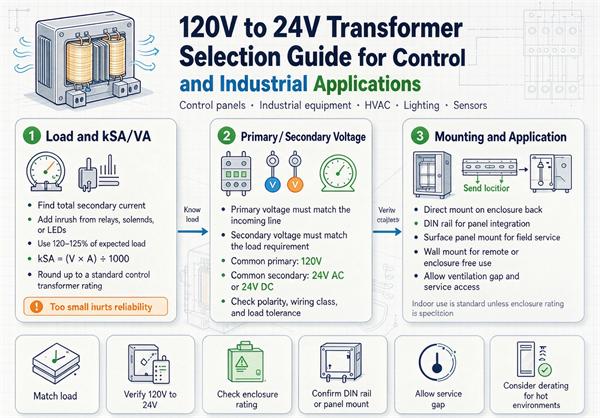
Add up the VA of every device the transformer feeds: contactor coils, relays, solenoid valves, control boards, sensors. Then multiply by 1.25. That 25 percent margin is the standard practice for continuous loads and it keeps the transformer cool instead of running it at the edge of its nameplate.
A quick example: a control circuit that pulls 38 VA sealed load on a 120 V supply needs a 50 VA transformer. The 50 VA unit is the next standard size up from 47.5 VA and leaves room for a little growth. Skipping the margin is the most common reason a transformer runs hot and fails early.
Watch Inrush and the 85 Percent Voltage Floor
Motors, contactors, and solenoids draw five to ten times their sealed VA for the first moment they energize. Size the transformer so the secondary stays above about 85 percent of 24 V during that inrush, or your contactors will chatter and your PLC will brown out. If you have a big contactor on the line, size for the inrush VA, not the running VA.
Match the Primary Voltage to Your Mains
The primary must match the voltage you are wiring it to. Get this wrong and the transformer either underperforms or damages itself. Most units are built for a single primary, a dual primary (for example 120/240 V), or a multi-tap primary that covers several inputs.
North American Primaries
Facilities in the United States, Canada, and Mexico usually run one of these:
| Common North American primary | Where you see it |
| 120 V | Branch circuits, control panels, residential |
| 208 V | 3-phase wye systems, commercial buildings |
| 240 V | Split-phase, light commercial, equipment |
| 277 V | Lighting legs of 480Y/277 V systems |
| 480 V | Industrial 3-phase, large equipment |
If your site mixes voltages, a transformer with a multi-tap primary (say 120/208/240/480 V) lets you stock one part instead of four.
European Primaries
Continental Europe runs 230 V between phase and neutral, and 400 V between phases on a three-phase system. A unit marked 220 V still connects to a 230 V mains because the tolerance covers it. If your panel has no neutral, the primary lands between two phases at 400 V.
Taps and the 50/60 Hz Question
Mains is never exactly nominal. Primary taps of plus or minus 5 percent let you compensate for a weak or strong feed so the secondary holds close to 24 V.
Frequency matters more than buyers think. A transformer designed for 60 Hz has smaller iron than one built for 50 Hz. Running a 60 Hz unit on 50 Hz risks saturating the core, overheating, and noise. Many control transformers are stamped 50/60 Hz and work on both, but confirm it before you ship across the Atlantic. North America is 60 Hz; most of Europe and Asia is 50 Hz.
Set the Secondary to 24 V: AC or DC?
This is where a lot of quotes go wrong.
24 V AC vs 24 V DC
A transformer only makes AC. If your equipment needs 24 V DC, you need a power supply (an SMPS that rectifies AC to DC), not a transformer. The rating plate tells you which: “24 V AC”, “24 VAC”, or “24 V ~” means a transformer; “24 V DC”, “24 VDC”, or the direct-current symbol means a power supply. Mixing them up is a classic mistake that burns out boards.
The 24 V AC control standard exists because it is high enough to pull in contactors and relays but low enough to be safe to touch. That is also why it is the HVAC and building-automation default.
Tolerance, Taps, and Voltage Drop Under Load
“24 V” is a nominal number. Under load the secondary sags a little, and long wire runs add drop. Specify “24 V at rated load” rather than just “24 V”, and leave the 25 percent margin from earlier so the real-world voltage stays in range. Some control transformers are wound to sit around 26 to 28 V with no load and settle near 24 V under full load, which is intentional.
Pick the Mounting That Fits the Enclosure
Mounting is not an afterthought. The wrong style means the transformer does not fit the panel, cannot be serviced, or has no protection.
DIN Rail
The 35 mm DIN rail clip is the default for modern control panels. It snaps in, snaps out, and needs no drilling. If you are building or retrofitting a panel, DIN rail is the easiest to install and the easiest to swap.
Panel or Foot Mount
Foot-mount transformers bolt to the back of an enclosure. They suit units that live inside a metal cabinet and need a solid mechanical fix. You see these in industrial control and HVAC equipment housings.
Chassis or Open Frame
An open-frame (IP00) transformer is built to sit inside a closed cabinet or enclosure of its own. It has no protection of its own, so the enclosure does the protecting. Chassis-mount units with a ventilated cover handle a dry room; sealed versions handle sheltered outdoor use.
PCB Mount
For small loads (roughly 1 to 100 VA), a printed-circuit-mount transformer solders straight onto a board. This is the choice for compact electronics and instrument power, not for panel wiring.
Wall or Knockout Mount and Enclosure Rating
Knockout-mount transformers fix directly to a conduit fitting or a handy-box cover, common in building wiring for doorbells and controls. Whatever you choose, match the enclosure rating to the site: IP00 for inside a cabinet, IP20 or IP23 for a ventilated dry room, IP54 for dust and splashing. In North American terms that maps to NEMA 1, 2, 3R, or 4.
| Mounting style | Best for |
| DIN rail | Control panels, easy service |
| Panel or foot | Inside metal enclosures, fixed equipment |
| Chassis or open frame | Cabinet-installed, needs own enclosure |
| PCB mount | Small VA board-level power |
| Wall or knockout | Building wiring, conduit, handy-box |
The Spec Lines Buyers Skip
Most requests for quote miss a few lines that change the unit you receive.
Isolation and Shielding
If you are feeding sensitive electronics, instruments, or medical gear, ask for an isolating transformer with shielded windings. It knocks down noise and ground loops that a basic unit ignores. Galvanic isolation also protects downstream equipment from a primary-side fault.
Frequency, Ambient, and Altitude
We covered frequency above. Ambient temperature and altitude also derate a transformer: hotter rooms and higher sites reduce the safe load. State the real ambient range and the site elevation so the supplier sizes for your conditions, not a textbook 40 °C at sea level.
Enclosure, IP, and Certifications
Tell the supplier the enclosure and ingress rating you need, plus the certifications the job demands: UL or cUL for the United States and Canada, CE for Europe, RoHS for restricted substances, and Class 2 where the circuit is power-limited. A Class 2 transformer (built to NEC Article 725) keeps the secondary at or below 30 V, 8 A, and 100 VA, which lets you run the wiring without conduit.
One myth worth killing: U.S. DOE 10 CFR 431 efficiency rules apply to distribution transformers, not to 24 V control and power units. Do not let a supplier quote you a “DOE-compliant” 24V control transformer as if it were a regulated distribution unit. Ask for the test report and the nameplate instead.
A Fill-in Specification Sheet
Copy this into your request for quote. The more you fill, the more comparable the offers you get back.
- Primary voltage and tolerances (for example 480 V, plus or minus 5 percent taps)
- Frequency (50 Hz, 60 Hz, or 50/60 Hz)
- Secondary voltage (24 V AC) and allowed tolerance
- Rating in VA or kVA, including the 25 percent margin
- Worst-case inrush VA, if any large contactors or motors are on the line
- Mounting style (DIN rail, panel, chassis, PCB, wall)
- Enclosure and IP or NEMA rating
- Isolation or shielding requirement
- Required certifications (UL, cUL, CE, RoHS, Class 2)
- Ambient temperature range and altitude
If reading a nameplate feels like decoding a foreign language, our guide on how to read a transformer nameplate walks each field line by line.
Common Mistakes When Specifying a 24V Transformer
- Sizing to watts instead of VA, which ignores power factor on inductive loads.
- Forgetting inrush, so contactors chatter at startup.
- Ordering a 24 V AC transformer for a 24 V DC load.
- Picking the wrong primary (120 V unit on a 240 V supply).
- Skipping the 25 percent margin, so the unit runs hot.
- Leaving the enclosure rating blank and getting an open-frame unit for a wet site.
Bottom Line
A 24V transformer is easy to specify once you hold the three numbers: rating (kVA or VA, load plus 25 percent), primary voltage matched to your mains, and a mounting style that fits the enclosure. Add the secondary tolerance, the frequency, and the certs, and your supplier can quote a unit that actually works on day one.
Our single-phase transformer range covers control and power builds from small VA up to several kVA, and the full transformer catalog lists the rest of the lineup. For the compliance side, the ANSI/IEEE vs IEC standards guide explains which codebook applies to your market. Buyers can also browse the technical resource library or see the reference installations we have shipped. For anything else, talk to the team at TransNin Electric.
Frequently Asked Questions
How do I size a 24V transformer? Add up the VA of every load the transformer feeds, then multiply by 1.25 for a continuous-load margin. If a control circuit pulls 38 VA, you need a 50 VA unit (the next standard size above 47.5 VA). Size for inrush too: a contactor can draw five to ten times its sealed VA at pull-in, so the secondary must stay above about 85 percent of 24 V during that moment.
What is the difference between 24 V AC and 24 V DC? A transformer only produces AC. If your equipment is marked 24 V DC, you need a power supply that rectifies AC to DC, not a transformer. Look at the rating plate: “24 V AC” or “24 V ~” means transformer; “24 V DC” or the DC symbol means power supply. Using the wrong one can destroy downstream electronics.
How many amps is a 24V transformer at a given kVA? Divide the VA by 24. A 1 kVA (1,000 VA) unit delivers about 41.7 A on the secondary, a 2 kVA unit about 83.3 A, and a 5 kVA unit about 208 A. Smaller units: 50 VA is 2.08 A, 100 VA is 4.17 A, 500 VA is 20.8 A.
Can I run a 60 Hz transformer on 50 Hz? Not safely without checking. A 60 Hz transformer has less iron than a 50 Hz one, so feeding it 50 Hz can saturate the core, cause overheating, and add hum. Many control transformers are rated 50/60 Hz and work on both; confirm the stamp before shipping across regions. North America is 60 Hz, most of Europe and Asia is 50 Hz.
What does Class 2 mean for a 24V transformer? Class 2 (under NEC Article 725) limits the secondary to 30 V, 8 A, and 100 VA for power-limited circuits. That limit lets you run the wiring without conduit and is the reason 24 V control circuits are common in buildings. Look for UL 5085 or equivalent listing to confirm a true Class 2 unit.
Which mounting style should I choose? DIN rail is the default for control panels because it snaps in and out for fast service. Use panel or foot mount inside a metal enclosure, chassis or open frame inside a cabinet of its own, PCB mount for small board-level loads, and wall or knockout mount for building wiring. Match the enclosure rating (IP or NEMA) to the site.
Do U.S. DOE efficiency rules apply to 24V control transformers? Generally no. DOE 10 CFR 431 efficiency standards cover distribution transformers, not small 24 V control and power units. Do not expect a “DOE-compliant” label on a control transformer, and judge the unit by its test report and nameplate instead.
What should I send to get a quote? Send the fill-in sheet from this article: primary voltage and taps, frequency, secondary voltage and tolerance, VA or kVA with margin, inrush VA if relevant, mounting style, enclosure and IP or NEMA rating, isolation requirement, certifications, and ambient plus altitude. The more complete the brief, the more comparable your offers will be.