This guide is written for that question. It separates who owns the company from where the factory is, because in Germany those two answers disagree more often than the brochures admit. It covers the German grid codes that decide your specification before you write it. And it walks through the customs change that took effect on 25 September 2026, which nobody ranking for this keyword has written about yet.
If you want the global picture rather than a country cut, our power transformer brand and supplier comparison ranks the international names side by side. This page stays inside Germany.
Two numbers to hold while you read. Since 25 September 2026, the European Union charges a flat EUR 1,140 per tonne of core steel on transformers cleared through customs, and it applies to the core already built into a finished machine. And the biggest capacity increase in German transformer manufacturing, a 50 percent expansion at Siemens Energy in Nuremberg, does not open until 2028. If your project needs iron before then, that expansion is not available to you.
“German manufacturer” is three different claims
Sellers use these as if they were the same sentence. They are not, and for public procurement they can lead to different outcomes.
Made in Germany. The unit is manufactured in Germany. For a transformer the practical test is where the core is cut and stacked, where the coils are wound, where the tank is welded, and where the machine is dried, filled and tested.
Engineered in Germany. The design work is done in Germany. The unit may be wound, assembled and tested in Poland, the Czech Republic, Türkiye or China. This is normal and it is not deceptive, but it is not a claim about the factory.
A German brand. The name on the nameplate belongs to a German-headquartered group. The specific machine you receive may come from anywhere in that group’s plant network.
Why this matters in Germany specifically: there is no single German domestic-content statute comparable to Build America Buy America, so the country does not police the phrase the way the United States does. What Germany has instead is a procurement culture that asks for type-test evidence, VDE conformity and a service organisation inside driving distance. Those three things, not the label, are what actually decide whether a bid survives.
The market data also cuts against the assumption that “German” means “built in Germany”. One market analysis of the German distribution segment estimates that more than 38 percent of distribution-class transformers installed in 2024 were imported from Central and Eastern European plants. The domestic advantage is real but narrow: it sits at 220 kV and above, not across the whole range.
| Claim | What it tells you | What it does not tell you |
|---|---|---|
| Made in Germany | Factory location, usually the site you can audit | Whether the core steel is European |
| Engineered in Germany | Who did the electromagnetic and thermal design | Where the machine was built |
| German brand | Who owns the group and who carries the warranty | Which plant in the network builds your unit |
| EU origin | Customs origin for preferential or trade-defence purposes | Anything about design responsibility |
Who builds what in Germany
Sorted by what each name actually makes, not by revenue. Every row below is a company with a physical German plant.
| Company | Headquarters | German plant(s) | What it builds there | Where it fits |
|---|---|---|---|---|
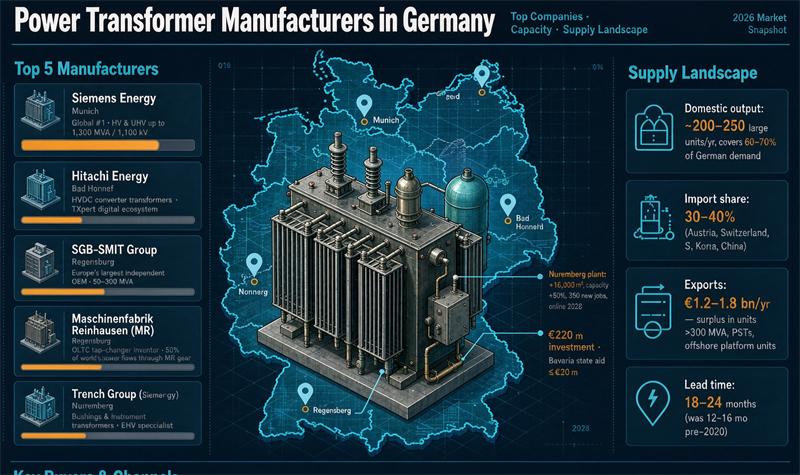
| Siemens Energy | Munich, Germany | Nuremberg, Kirchheim unter Teck | Large power transformers, HVDC converter transformers, to roughly 1,200 MVA and 800 kV | The only German-headquartered name at the top of the transmission tier |
| SGB-SMIT Group | Regensburg, Germany | Regensburg, Neumarkt | Medium and large power transformers, cast resin, compact substations | The largest independent German specialist |
| Hitachi Energy | Zurich, Switzerland | Bad Honnef, Halle | 110 to 400 kV units, HVDC converter transformers, service and refurbishment | Foreign-owned, deep German manufacturing footprint |
| Trench Group | Austria (Siemens Energy group) | Nuremberg | Instrument transformers, HV bushings, capacitors | Component tier, not a power transformer OEM |
| Maschinenfabrik Reinhausen | Regensburg, Germany | Regensburg | On-load tap changers, monitoring, components | The tap-changer supplier almost everyone uses |
| Starkstrom-Gerätebau | Regensburg, Germany | Regensburg | Distribution and dry-type transformers, special designs | SGB-SMIT group member |
| BLOCK Transformatoren-Elektronik | Leinburg, Germany | Leinburg | Power, control and isolation transformers | Smaller ratings and industrial |
| Trafomodern | Berlin, Germany | Berlin | Distribution, rectifier and special transformers | Custom and replacement work |
| Ritz Instrument Transformers | Hamburg, Germany | Hamburg | Current and voltage transformers | Measurement and protection |
| Trafo-Union | Berlin, Germany | Berlin | Distribution and power transformers | Part of CG Power Systems (India) |
| thyssenkrupp Electrical Steel | Germany | Gelsenkirchen, Bochum | Grain-oriented electrical steel | The European GOES mill on the critical path |
| Krenz Transformatoren | Stuttgart, Germany | Stuttgart | Industrial power transformers | Regional, medium ratings |
Two things worth noticing in that table.
First, the number of German-headquartered companies that build transmission-class power transformers is two. Siemens Energy and SGB-SMIT. Every other name in the 110 kV and above segment is either foreign-owned with German plants, a component supplier, or a builder of smaller ratings.
Second, the component tier is more concentrated than the machine tier. Reinhausen supplies the on-load tap changers that go into most German machines regardless of whose nameplate is on the tank, and thyssenkrupp’s Gelsenkirchen and Bochum works are the European source of grain-oriented electrical steel. When either of those is late, the whole German order book slips regardless of which OEM you chose.
You can see the machine range we build against IEC practice in the product index.
Who is buying, and how the buying actually works
Germany has no meaningful distributor layer for large units. The path is direct from manufacturer to end user.
The four transmission system operators are TenneT, 50Hertz, Amprion and TransnetBW. Market analysis puts their combined share of utility-scale transformer procurement by value at roughly 50 to 60 percent. All four publish their own grid connection rules, and all four run supplier prequalification. Reported qualification cycles before a new supplier can bid on critical projects run 12 to 24 months.
Distribution system operators and municipal utilities (Stadtwerke) buy the other large block. Their volume is framework agreements with annual call-offs rather than one-off tenders. Direct sales to grid operators account for an estimated 55 to 60 percent of distribution unit volume; wholesale distributors and system integrators cover the rest, serving industrial end users and machine builders.
Industrial buyers are the third group. Automotive, chemicals, steel and machinery, plus data centres around Frankfurt, which is the largest data centre hub in Europe. Industrial and commercial buyers are estimated at 45 to 55 percent of non-utility procurement. They usually specify through an engineering consultant or an in-house electrical department.
The mechanics matter more than the names:
- Major transmission tenders are published on the EU’s TED (Tenders Electronic Daily) platform, and award values are public afterwards.
- Procurement under German and EU rules weights technical compliance, delivery schedule, lifecycle cost and warranty terms. It is not a lowest-price contest.
- Tender prices routinely break out installation, on-site testing and warranty as separate lines, with warranty periods of five to seven years on large machines.
- Service contracts, including inspection intervals, oil sampling and end-of-life assessment, are commonly bundled with the new unit purchase and run 10 to 15 percent of total contract value.
The practical consequence for a supplier list: if you are not prequalified with the relevant TSO, being cheaper is not a way in. Budget two years for the qualification, not two months.
VDE-AR-N: the rulebook that writes your specification
German grid connection is governed by the VDE technical connection rules, called TAR. Each voltage band has its own, and each TSO then publishes its own additions on top.
| Rule | Band | Applies to |
|---|---|---|
| VDE-AR-N 4110 | Medium voltage | Generation and storage on the MV network |
| VDE-AR-N 4120 | High voltage, 60 kV to 150 kV, 50 Hz three-phase | Customer installations, generation, storage, mixed installations |
| VDE-AR-N 4130 | Extra-high voltage, 220 kV and above | Generators, consumers, storage, mixed installations |
| VDE-AR-N 4131 | HVDC | HVDC connections |
Under the Energy Industry Act (EnWG), the TSOs are obliged to define minimum technical requirements and publish them. TenneT’s grid connection regulations, for example, take the three VDE rules above and add TSO-specific annexes, including provisions for the offshore 2 GW standards and 66 kV offshore direct connections.
What this means for a transformer order:
The band sets the test envelope. A 110 kV connection falls under VDE-AR-N 4120, not 4130. Specifying against the wrong one produces a machine that is either over-built or non-compliant, and both cost money.
Grid behaviour requirements reach into the transformer. The 2024 amendments to VDE-AR-N 4120 bring in the European network codes, including fault ride through behaviour, reactive power provision for static voltage support, active power adjustment on over and under frequency, and protection settings. None of that is decided by the transformer alone, but the impedance, vector group and tap range you specify have to be compatible with it.
Certification is staged. The framework requires unit certificates, component certificates and system certificates, plus commissioning protocols. A supplier who cannot produce the certificate chain for the German band is not a supplier for that band, whatever their reference list says.
Paperwork is forms-driven. A 110 kV connection request to a German DSO typically requires forms E.1, E.2 and E.6 of VDE-AR-N 4120, a scale site plan to form E.4, and a single-line diagram to form E.4.
If you are coming from an IEC background outside Europe, or from ANSI practice, the standard families diverge on insulation levels and test values. Our IEC 60076 versus ANSI/IEEE comparison sets out where the two differ before you commit to a design.
The grid that is driving every order book
The demand side is not speculation. It is a legally binding energy transition with published investment figures.
Germany’s own installed base, per the BDEW industry association:
| Tier | Count | Derived ratio |
|---|---|---|
| Extra-high to lower voltage substations | about 250 | one per roughly 156 km of EHV line |
| High and medium voltage transformers | 8,600 | about 34 per EHV substation; one per 11 km of HV line |
| Low voltage transformers | about 460,000 | about 53 per HV/MV transformer |
Total German electricity network length is about 1.94 million km, of which roughly 39,000 km is extra-high voltage and about 95,700 km is high voltage.
The investment behind it: the Netzentwicklungsplan 2023 to 2037 identifies EUR 65 billion of transmission grid investment, most of which requires new or upgraded high-voltage transformers. On the distribution side, estimates run to EUR 40 to 50 billion for network upgrades between 2025 and 2035.
The bottleneck is the middle. BDEW has published twelve proposals aimed specifically at accelerating 110 kV high-voltage expansion, arguing that a typical ten-year realisation period for high-voltage projects no longer fits the electrification timetable. In the current Network Development Plan consultation, transmission operators proposed 159 expansion measures and the Federal Network Agency regarded 118 as eligible for confirmation.
That middle band is exactly where VDE-AR-N 4120 applies, and it is where most of the near-term German transformer demand sits. If you are sizing an opportunity, size it at 110 kV, not at 380 kV.
What changed on 25 September 2026: the core levy
This is the single most important commercial fact about sourcing transformers into Germany right now, and no page ranking for this keyword mentions it.
On 18 September 2026 the European Commission published Implementing Regulation (EU) 2026/2133. It imposes a provisional safeguard duty on grain-oriented electrical steel, on steel laminations, and on transformer cores. It entered into force on 25 September 2026 and runs for 155 days, to 26 February 2027. The Commission opened the investigation in March 2026 after requests from Germany, France and Poland.
Three features make it bite.
It reaches the core inside a finished transformer. Under Article 1(6), where a core is already built into a transformer falling in CN codes 8504 21 to 8504 34, the duty is a flat EUR 1,140 per tonne of core weight. No quota applies. The importer declares the core weight in tonnes at customs clearance.
The decisive date is customs clearance, not the order date. Orders placed well before 18 September 2026 that clear customs on or after 25 September 2026 are caught. If you have open orders in transit, this is a live line item on them.
Existing anti-dumping duties do not stack on top. Anti-dumping duties under Implementing Regulation (EU) 2022/58 are not collected while the higher safeguard duty applies.
For steel and cores imported on their own rather than inside a machine, the mechanism is a tariff-rate quota plus a minimum price threshold, not a flat rate:
| Product | CN codes | In-quota threshold | Out-of-quota threshold |
|---|---|---|---|
| Grain-oriented electrical steel | 7225 11 00, 7226 11 00 | EUR 2,800 to 3,400 per tonne, by grade | EUR 3,500 per tonne |
| Steel laminations | 8504 90 13 | EUR 4,000 per tonne | EUR 4,550 per tonne |
| Steel cores | 8504 90 13 | EUR 5,000 per tonne | EUR 5,600 per tonne |
| Cores built into transformers | 8504 21 to 8504 34 | Flat EUR 1,140 per tonne of core, no quota | Same |
Where the declared net free-at-Union-frontier price is below the applicable threshold, the duty equals the difference. Where it meets or exceeds the threshold, no safeguard duty is collected. Quotas are administered first-come, first-served, with country allocations and a residual quota.
Allocations for the 155-day window:
| Product | Country | Tonnes |
|---|---|---|
| GOES | China | 30,693.68 |
| GOES | Japan | 23,103.61 |
| GOES | South Korea | 4,789.93 |
| GOES | Other eligible origins | 5,360.39 |
| Laminations and cores | Türkiye | 14,161.55 |
| Laminations and cores | China | 4,241.07 |
| Laminations and cores | United Arab Emirates | 2,704.99 |
| Laminations and cores | Other | 2,694.36 |
Exempt origins for the levy on cores in transformers: Iceland, Liechtenstein, Norway, Ukraine and Kenya, plus developing WTO countries other than China, Türkiye and the United Arab Emirates. India, for example, is exempt on this measure.
That last row of the exemption list is why “where was it built” has become a pricing question rather than a marketing one.
What the levy costs in money
The arithmetic is simple: levy = core tonnes x EUR 1,140. What is not simple is the core weight, and that is the number you have to go and get from the manufacturer in writing.
| Core weight | Levy (EUR) | Levy (USD at EUR 1 = USD 1.1206) |
|---|---|---|
| 0.3 t | 342 | 383 |
| 0.5 t | 570 | 638 |
| 1.0 t | 1,140 | 1,277 |
| 1.5 t | 1,710 | 1,916 |
| 2.0 t | 2,280 | 2,554 |
| 5.0 t | 5,700 | 6,387 |
| 10.0 t | 11,400 | 12,774 |
| 20.0 t | 22,800 | 25,549 |
| 30.0 t | 34,200 | 38,324 |
Set against published European price anchors, with core weights estimated:
| Reference unit | Reference price | Assumed core | Levy | Share of unit price |
|---|---|---|---|---|
| 630 kVA oil distribution (Netherlands anchor) | EUR 12,000 to 18,000 | 0.55 to 0.70 t | EUR 627 to 798 | 3.5% to 6.7% |
| 400 to 630 kVA oil distribution (Austria anchor) | EUR 8,000 to 18,000 | 0.45 to 0.70 t | EUR 513 to 798 | 2.9% to 10.0% |
| 2.5 MVA with on-load tap changer (Netherlands anchor) | above EUR 45,000 | 2.2 to 3.0 t | EUR 2,508 to 3,420 | 5.6% to 7.6% |
The core weights in that table are our estimates, not measured values. The percentages are directionally useful and contractually useless. Ask for the number.
Why the quota will not cover the flow
The Commission’s preliminary findings put imports of the covered products at 135,140 tonnes in 2021 rising to 297,079 tonnes in 2025, while EU production fell from 336,555 to 306,539 tonnes and consumption rose from 397,698 to 525,088 tonnes. By 2025 imports were running at about 97 percent of EU production. China accounted for about 53 percent of EU imports in 2025, followed by Japan at 20 percent and Türkiye at 13 percent.
Now the arithmetic that matters for the next five months. Reported Chinese exports of GOES and related products to the EU ran about 149,700 tonnes in 2025. Pro-rated across the 155-day window that is roughly 63,600 tonnes against a Chinese country quota of 30,693.68 tonnes. The quota covers about 48 percent of that flow.
That is our arithmetic on a reported trade figure, and the actual outcome depends on shipping timing and quota drawdown. But the direction is clear: on a first-come, first-served quota that covers about half the expected volume, the second half of the window is where the pressure lands.
The Commission estimates grain-oriented electrical steel at 10 to 30 percent of a transformer’s cost. That range is why this levy is not a rounding error on a distribution unit, and why you should model it per shipment rather than assume a fixed uplift.
What to do about it
- Put core weight in tonnes on the bill of materials and the commercial invoice as a separate declared field.
- Get the non-preferential origin of the transformer confirmed in writing, because the levy attaches to that origin, not to the shipping country.
- Ask for the mill test certificate for the core steel, and match it to the declared core weight.
- State in the contract who bears statutory levies arising after the quotation date, and how they are evidenced.
- Model landed cost per shipment, not per project. First-come, first-served quota means two identical containers can clear differently.
And from 1 October 2026: prove where the steel was melted
A second change landed two weeks after the levy. From 1 October 2026, importers of steel covered by Regulation (EU) 2026/1384 must declare the country of melt and pour at import, under Implementing Regulation (EU) 2026/1963.
The evidence is a Mill Test Certificate stating the country of melt and pour and the heat number, or complementary evidence in its place: invoices, delivery notes, quality certificates, supplier declarations, cost and production documents, exporting-country customs documents, or commercial correspondence. The country is declared using TARIC document codes Y376 to Y387 and the evidence using codes C131 to C139.
The customs code structure changed too. New TARIC subdivisions split grain-oriented electrical steel by core loss, at most 0.7 W/kg versus over 0.7 up to 0.9 W/kg, and new lamination codes 8504 90 13 10 and 8504 90 13 90 were added.
If your supplier cannot produce a mill test certificate with a heat number, they are going to have a problem at the German border, and it will be your problem too.
The EU has an efficiency floor, and most published data sheets miss it
Germany applies the European ecodesign rules, and at the large end there is a hard floor.
Regulation (EU) 548/2014 covers power transformers from 1 kVA upward. For large power transformers, defined in this context as above 3,150 kVA with an insulation level above 36 kV, or of 40 MVA and above regardless of insulation level, the requirement is a minimum Peak Efficiency Index. Tier 2 has applied since 1 July 2021.
| Rating | Minimum PEI, Tier 2 (liquid immersed) |
|---|---|
| 20 MVA | 99.684% |
| 31.5 MVA | 99.712% |
| 40 MVA | 99.724% |
| 50 MVA | 99.734% |
| 63 MVA | 99.745% |
| 80 MVA | 99.758% |
| 100 MVA and above | 99.770% |
You can check a data sheet against that floor yourself. The index, ignoring cooling-system power and therefore giving an upper bound, is:
PEI = 1 – 2 x sqrt(P0 x Pk) / Sr
with P0 the no-load loss, Pk the load loss, both in watts, and Sr the rated power in VA.
We ran eight published 110 kV data sheets through it. Six fall below the floor.
| Data sheet | No-load loss | Load loss | PEI (our arithmetic) | Tier 2 floor | Result |
|---|---|---|---|---|---|
| Kerun Type 22 / class 1, 31.5 MVA | 14.9 kW | 111.0 kW | 99.742% | 99.712% | passes by 0.030 |
| Kerun Type 18 / class 3, 31.5 MVA | 21.6 kW | 117.0 kW | 99.681% | 99.712% | misses by 0.031 |
| Kerun Type 22 / class 1, 50 MVA | 21.0 kW | 175.0 kW | 99.758% | 99.734% | passes by 0.024 |
| Kerun Type 18 / class 3, 50 MVA | 30.6 kW | 187.0 kW | 99.697% | 99.734% | misses by 0.037 |
| Tailong S13, 31.5 MVA | 24.0 kW | 133.0 kW | 99.641% | 99.712% | misses by 0.071 |
| Tailong S13, 50 MVA | 34.0 kW | 189.0 kW | 99.679% | 99.734% | misses by 0.055 |
| Yuguang SFZ11, 50 MVA | 38.2 kW | 194.0 kW | 99.656% | 99.734% | misses by 0.078 |
| Yuguang SFZ11, 63 MVA | 45.4 kW | 232.0 kW | 99.674% | 99.745% | misses by 0.071 |
Across a wider sample of sixteen published 110 kV sheets we ran, thirteen missed the Tier 2 floor.
Two readings of that, and you should hold both. The first is that the default product at this rating is not automatically placeable on the EU market. The second is that the gap is small in percentage terms and therefore cheap to close at the design stage and expensive to close after delivery. Name the efficiency class in the enquiry. Our low-loss power transformer range is built around that requirement.
Write it into the enquiry as a guaranteed value with a penalty, not as a request for “high efficiency”.
Lead times, and the wall that arrives in 2028
| Unit type | Reported lead time |
|---|---|
| Standard catalogue distribution unit | 12 to 20 weeks |
| Custom medium power, 1 to 100 MVA | 40 to 60 weeks |
| Large power transformer, 100 MVA and above | 18 to 24 months |
| Generator step-up or phase-shifting, project specific | 104 to 156 weeks |
The pre-2020 baseline for custom large power transformers was 12 to 16 months. It is now 18 to 24 months. Tenders increasingly carry price escalation clauses and delay penalties, and the negotiation is about delivery slot more than unit price.
Now the part that catches people out. On 5 September 2025, Siemens Energy announced approximately EUR 220 million to expand its Nuremberg transformer factory: about 16,000 square metres of additional space, a production capacity increase of roughly 50 percent, and 350 new jobs. The Free State of Bavaria is supporting it with up to EUR 20 million. Transformers have been built at that site since 1912 and it employs close to 1,000 people today.
The new production areas are expected to be available in 2028.
From October 2026 that is about fifteen months away, and it arrives after a ramp. If your need is in 2027, this expansion does not exist for you. Neither does the EUR 90 million converter facility announced for the same site a year earlier, nor the roughly EUR 1 billion Siemens Energy has put into Germany over three years. All of it is real and all of it is late relative to the current order book.
The binding constraint is not floor space. It is grain-oriented electrical steel allocation, which is committed far in advance, plus the winding and testing labour that cannot be hired and trained on a project timetable. Reported vacancy rates for electrical engineers in the German power transformer sector run 10 to 20 percent depending on the source.
What it costs
Published European price anchors, all indicative and none of them carrying a date, an Incoterm, a winding material or an efficiency tier:
| Unit | Indicative price |
|---|---|
| 400 to 630 kVA oil-immersed distribution (Austria) | EUR 8,000 to 18,000 |
| 630 kVA oil-immersed distribution (Netherlands) | EUR 12,000 to 18,000 |
| 2.5 MVA with on-load tap changer, coastal specification (Netherlands) | above EUR 45,000 |
| Compact secondary substation | EUR 25,000 to above EUR 60,000 |
| Phase-shifting transformer type testing at an independent lab | EUR 500,000 to 1,500,000 per unit |
Cost structure: copper windings and electrical steel core together are reported at 40 to 55 percent of bill-of-material cost in one analysis, and copper at 25 to 30 percent with grain-oriented steel at 20 to 25 percent in another. The Commission’s own figure for grain-oriented steel is 10 to 30 percent of transformer cost. German labour for skilled winding, assembly and testing adds a reported 20 to 25 percent to fabrication cost relative to lower-wage locations. Oversize freight within Germany or on export adds 5 to 10 percent.
Against those anchors, a provisional core levy of EUR 513 to 3,420 depending on machine size is between roughly 3 and 8 percent of unit price. It will not by itself flip a sourcing decision. It will absolutely flip a tender decided on a 2 percent margin.
For reference on currency: EUR 1 = USD 1.1206, the ECB euro reference rate around 9 to 13 October 2026.
How to check a German supplier before you sign
Six questions, in this order. Each one is cheap to ask and expensive to discover later.
1. Which plant builds my unit, and can I audit it? Not “where is your head office”. Which building, which line, which slot.
2. What is the core weight in tonnes, and what is the non-preferential origin? Both are now customs-relevant. Both should appear on the quotation.
3. Can I have the mill test certificate, with the melt-and-pour country and the heat number? Mandatory for steel declarations from 1 October 2026.
4. Which VDE-AR-N band is this designed to, and where is the type-test evidence? A 110 kV machine is a VDE-AR-N 4120 machine. Ask for the certificate chain, not a statement of conformity.
5. What is the guaranteed no-load and load loss, with what tolerance and what penalty? Under IEC 60076-1 the standard tolerance on losses is not zero. If you do not write a penalty, you have bought the tolerance.
6. Where does the tap changer come from, and is it in the delivery slot? On-load tap changers are a reported 8 to 12 percent of unit cost on specialised machines and are frequently the long-lead item.
Four ways this goes wrong in practice:
- A group name hides a plant in another country. The brand is German, the unit is not, and the customs origin is therefore not what the buyer assumed for the levy.
- The efficiency class is never named. The machine arrives compliant with Tier 1 and unsellable on a Tier 2 project.
- The core weight is never declared. Customs assesses it on their own reading of the paperwork and the importer pays the difference.
- Delivery is quoted “ex works” and the slot is not firm. With 18 to 24 month lead times, a non-firm slot is not a quotation.
There is more background on each of those in the resources library, including the test evidence you should expect to see before an award.
When buying German is the wrong answer
It is worth saying plainly, because a page about German manufacturers should.
Standard distribution units at low ratings. This is the segment where the domestic advantage is thinnest and where Central and Eastern European supply already holds an estimated 38 percent or more of installed units. If the specification is a catalogue 630 kVA oil unit and there is no TSO prequalification requirement, a German premium buys you service proximity and not much else. Our distribution transformer manufacturer buying guide covers that segment on its own terms.
Anything needed before mid-2027. The capacity that would help you opens in 2028. If your schedule is inside that, sourcing geography matters less than finding a real slot.
Projects without a VDE-AR-N obligation. If the connection is outside Germany, German design conformity is a cost without a benefit. Match the standard family to the grid it lands on.
Replacement and refurbishment. Reconditioning cores, replacing oil and retrofitting bushings extends operational life by a reported 10 to 15 years at 40 to 50 percent of new-unit cost, and that service market is growing 5 to 7 percent a year. For a budget-constrained municipal utility, that is often the better buy.
If you are weighing a compact substation approach instead of a conventional build for a utility programme, there is a 11 kV and 33 kV compact substation programme for an overseas utility EPC in our project list that shows how that decision plays out on a real site.
A specification block you can paste into an enquiry
Fill in the blanks and send it. Every line is there because leaving it out costs money later.
1.  Standard: IEC 60076 series, edition and clause to be stated by supplier
2.  Application standard / grid code: VDE-AR-N [4110 / 4120 / 4130 / 4131]
3.  Rated power: ______ MVA, cooling class ______ (ONAN / ONAF / OFAF)
4.  Rated voltages: HV ______ kV, LV ______ kV, tertiary ______ kV
5.  Highest voltage for equipment Um: HV ______ kV, LV ______ kV
6.  Insulation levels: LI ______ kV, ACWV ______ kV rms, per winding
7.  Frequency: 50 Hz
8.  Vector group: ______ ; neutral brought out: yes / no
9.  Impedance at rated tap: ______ % ; tolerance ______ %
10. Tap changer: on-load / off-circuit ; range ______ ; steps ______ ; make and model ______
11. Guaranteed no-load loss P0: ______ kW at ______ degrees C
12. Guaranteed load loss Pk: ______ kW at ______ degrees C
13. Efficiency requirement: PEI not less than ______ % (state Tier 2 floor for the rating)
14. Loss tolerance: ______ % ; penalty for exceedance: ______ per kW
15. Sound level: sound power LwA ______ dB(A) and sound pressure at ______ m ______ dB(A)
16. Core steel: grade ______ , thickness ______ mm, mill ______ , melt-and-pour country ______
17. Core weight: ______ tonnes (to be stated on BOM and commercial invoice)
18. Non-preferential origin of the finished transformer: ______
19. Customs codes: ______ ; who bears statutory levies arising after quotation date: ______
20. Type-test evidence: list the tests, the laboratory and the date
21. Delivery: ______ (Incoterm) to ______ ; firm manufacturing slot: ______ (week/year)
22. Warranty: ______ years ; service response: ______ hours ; spare parts commitment: ______ years
Lines 11 to 14 and line 17 are the ones that change the outcome most. The first four turn efficiency from a marketing word into a number you can enforce, and line 17 is the number customs will ask you for.
Bottom line
Germany has two German-headquartered builders of transmission-class power transformers, Siemens Energy and SGB-SMIT, plus a deep tier of foreign-owned plants and component specialists. Everything else on the list is either smaller ratings or a brand whose machine may be built outside the country.
The rules changed on 25 September 2026 and again on 1 October 2026. A flat EUR 1,140 per tonne of core now applies to transformers cleared through EU customs, on the customs clearance date rather than the order date, and a melt-and-pour declaration is now required for covered steel. Both of those belong in your landed-cost model before they belong in your press release.
The efficiency floor is real and the default product often misses it. Tier 2 minimum PEI has applied since 1 July 2021, and in a sample of sixteen published 110 kV data sheets, thirteen fall short. Name the class, guarantee the watts, write the penalty.
And the capacity that would fix the lead times opens in 2028. A 50 percent expansion at Nuremberg is genuinely large and genuinely late. Plan around the slot you can actually get, not the plant that is being built.
FAQ
Who are the largest power transformer manufacturers in Germany?
Siemens Energy is the largest German-headquartered builder, with transformer plants at Nuremberg and Kirchheim unter Teck and ratings to roughly 1,200 MVA and 800 kV. SGB-SMIT Group, headquartered in Regensburg with plants at Regensburg and Neumarkt, is the largest independent German specialist. Hitachi Energy operates German plants at Bad Honnef and Halle but is headquartered in Switzerland. Trench Group, in Nuremberg, is part of Siemens Energy and builds instrument transformers and bushings rather than power transformers.
Is Hitachi Energy a German manufacturer?
No. It is headquartered in Zurich and was formed from ABB’s power grids business. It does have substantial German manufacturing at Bad Honnef and Halle, so a machine can be built in Germany while the company is Swiss-owned. If your requirement is about factory location, ask which plant. If it is about the group, ask who signs the warranty.
How long does a power transformer take to deliver in Germany in 2026?
Standard catalogue distribution units are reported at 12 to 20 weeks. Custom medium power units from 1 to 100 MVA run 40 to 60 weeks. Large power transformers at 100 MVA and above run 18 to 24 months, against a 12 to 16 month baseline before 2020. Generator step-up and phase-shifting units can reach 104 to 156 weeks.
What is the EU core levy and does it apply to my order?
Implementing Regulation (EU) 2026/2133 entered into force on 25 September 2026 and runs 155 days to 26 February 2027. Where a steel core is built into a transformer under CN codes 8504 21 to 8504 34, the duty is EUR 1,140 per tonne of core weight with no quota. The decisive date is release for free circulation, so orders placed earlier but cleared on or after 25 September are caught. Transformers originating in Iceland, Liechtenstein, Norway, Ukraine, Kenya, and developing WTO countries other than China, Türkiye and the UAE are exempt.
How much does the core levy add to a transformer’s price?
It depends entirely on core weight. At EUR 1,140 per tonne, a 1 tonne core adds EUR 1,140 and a 20 tonne core adds EUR 22,800. Against published European price anchors and using estimated core weights, that works out to roughly 3 to 8 percent of unit price for distribution and medium power machines. Get the actual core weight from the manufacturer in writing rather than estimating it.
What is melt-and-pour certification and when did it start?
From 1 October 2026, importers of steel covered by Regulation (EU) 2026/1384 must declare the country where the steel was melted and poured, under Implementing Regulation (EU) 2026/1963. The evidence is normally a Mill Test Certificate showing the melt-and-pour country and the heat number. TARIC document codes Y376 to Y387 declare the country and C131 to C139 carry the evidence.
Which German grid code applies to a 110 kV connection?
VDE-AR-N 4120, the technical connection rules for the high-voltage grid, which covers three-phase 50 Hz systems from 60 kV up to and including 150 kV. Each transmission system operator publishes its own additions on top. VDE-AR-N 4130 applies at 220 kV and above, VDE-AR-N 4110 at medium voltage, and VDE-AR-N 4131 to HVDC connections.
Do I need TSO prequalification to sell to a German utility?
For critical transmission projects, effectively yes. Reported qualification cycles run 12 to 24 months before a supplier can bid. Distribution utilities buy through framework agreements with annual call-offs, and those also require technical prequalification. Major transmission tenders are published on the EU’s TED platform with award values disclosed afterwards.
What efficiency standard applies to power transformers in Germany?
Regulation (EU) 548/2014. For large power transformers, meaning above 3,150 kVA with an insulation level above 36 kV, or 40 MVA and above regardless of insulation level, the requirement is a minimum Peak Efficiency Index, with Tier 2 applying since 1 July 2021. The Tier 2 floor for liquid-immersed units runs from 99.684 percent at 20 MVA to 99.770 percent at 100 MVA and above.
How do I check whether a data sheet meets the EU efficiency floor?
Use PEI = 1 – 2 x sqrt(P0 x Pk) / Sr, with P0 and Pk the no-load and load losses in watts and Sr the rating in VA. This ignores cooling-system power so it gives an upper bound. Compare the result with the Tier 2 minimum for that rating. In a sample of sixteen published 110 kV sheets we ran, thirteen fell short.
Are German transformers more expensive?
German labour for skilled winding, assembly and testing is reported to add 20 to 25 percent to fabrication cost relative to lower-wage locations, and oversize freight adds 5 to 10 percent. Whether that shows up as a higher price depends on the segment. At 220 kV and above the premium is defended by capability and service. At standard distribution ratings, import competition keeps pricing disciplined.
Can I buy a German transformer for delivery in 2027?
Probably not from the top tier. The largest announced capacity increase, about 50 percent at Siemens Energy’s Nuremberg plant following a EUR 220 million investment announced in September 2025, is not expected to be available until 2028. For 2027 delivery your realistic options are a slot someone else releases, a smaller specialist, or a non-German plant.