Ask five engineers what “high voltage” means and you will get five answers, and every one of them can point at a standard. IEC 61140 says high voltage starts at 1,000 V. ANSI C84.1 says it starts at 115,000 V. That is a spread of 115 times, and it is not an academic argument. A buyer in Texas and a supplier in Jiangsu can both read the same line in an RFQ that says “high voltage transformer” and end up eleven voltage classes apart.
So here is the practical answer, and it comes before everything else in this guide: never write the words “high voltage” in an enquiry. Write the kV. Write “138 kV primary, 13.8 kV secondary, 60 Hz, 50 MVA” and the ambiguity disappears. Nothing else you do in the procurement matters as much as that one substitution.
The rest of this guide assumes you have done it. It covers the seven machine types sorted by where they sit in the grid, the four types sorted by what insulates them, the current and insulation tables that nobody publishes in one place, how impedance actually gets chosen, the arithmetic behind loss evaluation, where these machines go, what one costs in 2026, how long it takes, how you get it onto a site, and which tests you should be paying for. There is a copy-paste RFQ block near the end.
Two numbers to hold in your head while you read. The first is that on a utility tender evaluated the way the US Department of Agriculture recommends, the capitalized value of the losses lands between 95% and 103% of the purchase price. The second is that the IEC tolerance on guaranteed no-load loss is +15%, and on a 200 MVA machine that tolerance alone is worth about $155,000 in thirty-year energy cost. Both are invisible if you only read the quotation.
What “high voltage” actually means, and why nobody agrees
Six different documents draw the line in six different places. None of them is wrong inside its own scope. The trouble starts when a page, a catalogue or an RFQ uses the term without saying whose definition it borrowed.
| Standard or source | Where HV starts | The actual wording |
|---|---|---|
| IEC 61140:2016 clause 4.2 (shock protection) | 1 kV | High voltage is any rated voltage above 1,000 V AC or 1,500 V DC; low voltage is up to and including 1,000 V AC |
| IEC 60076-3 (transformer insulation) | no HV term at all | Works in Um, the highest voltage for equipment, running from 3.6 kV to 1,200 kV |
| Industry voltage-band tables (MV 1 to 35 kV) | 35 kV | MV 1 to 35 kV, HV 35 to 230 kV, EHV above 230 kV |
| IEEE C2 NESC and the transmission voltage tables built on it | 69 kV | LV 600 V and below, MV 601 V to 69 kV, HV 69 to 230 kV, EHV 230 to 765 kV, UHV above 765 kV |
| NAVFAC MO-201 (US Navy shore facilities) | 72.5 kV | MV above 600 V to 72.5 kV, HV above 72.5 kV to 242 kV, EHV above 242 kV to 800 kV |
| ANSI C84.1-2020 (US nominal system voltages) | 115 kV | LV 240 to 600 V, MV 2.4 to 69 kV, HV 115 to 230 kV, EHV 345 to 765 kV, UHV 1,100 kV |
Read the first and last rows together. Under IEC 61140, an 11 kV distribution transformer is a high voltage transformer. Under ANSI C84.1, it is firmly medium voltage, and so is 34.5 kV, and so is 69 kV. Under ANSI C84.1 the high voltage band does not open until 115 kV.
One caveat on the ANSI row. Two widely used references reproduce it as 115 kV to 230 kV, and one engineering reference renders the lower bound as 100 kV. Either way, the US high voltage band starts two orders of magnitude above the IEC shock-protection band. That is the point, and it survives the discrepancy.
The IEC transformer standard quietly avoids the problem altogether. IEC 60076-3 never uses the phrase. It assigns every winding a highest voltage for equipment, written Um, and then reads the withstand levels off a table keyed to Um. That is the habit worth copying.
What happens when the definition is wrong
Three things, and all three cost money.
You get the wrong insulation schedule. A 34.5 kV winding sits in the 35 kV insulation class in North America, with a standard BIL of 150 kV and 200 kV as the common alternative. Under IEC, the same system voltage maps to Um 36 kV, where the table offers 145 kV or 170 kV. Those are different bushings, different creepage distances and different test certificates. If the RFQ only says “high voltage”, the supplier picks, and the supplier will pick the lower number, because the standard says the lowest value in the table is the minimum.
You get the wrong switchgear. Fault duty, interrupting ratings and clearances all follow from the voltage class. A machine bought against the wrong class lands on a site where the protection does not coordinate.
You get the wrong price, by a lot. Across the HV range, published 2026 figures run from about $150,000 for a small 69 kV unit to more than $10 million for a generator step-up or HVDC converter transformer. That is a factor of about 67 across the band. A single ambiguous phrase sits at the top of that range.
Here is a sentence you can paste into an enquiry, and it removes all of it:
> Rated highest voltage for equipment (Um): HV winding ___ kV, LV winding ___ kV. Insulation levels to IEC 60076-3 Table 2, list ___ : lightning impulse ___ kV, power-frequency withstand ___ kV rms. Nominal system voltage: HV ___ kV, LV ___ kV. Frequency ___ Hz.
If the machine is going to North America, add a second line giving the ANSI class and BIL. If you want the full comparison of how the two standard families treat the same piece of equipment, our write-up on IEC 60076 versus ANSI/IEEE for export transformers works through it in detail.
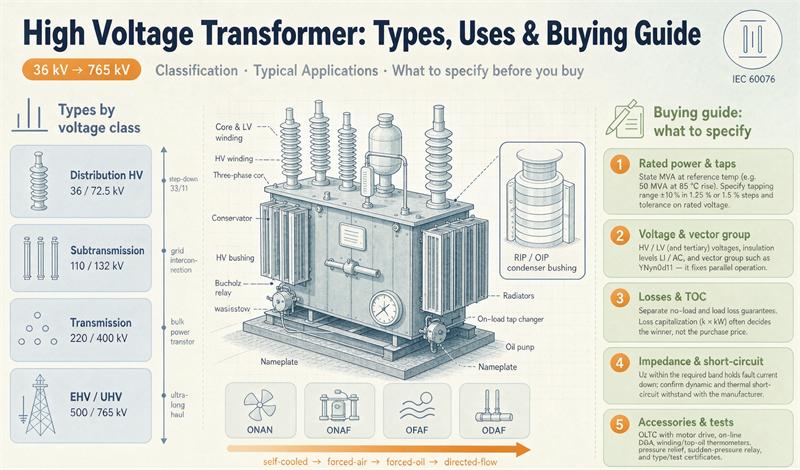
The seven types, sorted by where they sit in the system
Most pages sort transformer types by what insulates them. That is the wrong axis for an enquiry, because it does not tell the manufacturer what the machine has to do. Sort them by position on the single-line diagram instead, and the specification practically writes itself.
1. Generator step-up (GSU). Sits between the generator terminals and the station switchyard. Generator voltages run 11 to 25 kV, and the GSU lifts that to a transmission level of 132 kV to 765 kV. It sees continuous high load, and it is the most expensive thing in the yard. Lead times on a custom-wound GSU of 200 to 500 MVA were reported at 24 to 36 months as of Q2 2026.
2. Intertie or interconnecting transformer. Connects two transmission voltage levels, for example 400 kV to 220 kV. The difference from a GSU is that power flows both ways depending on system conditions, so the tap changer, the protection and the impedance all have to work in reverse.
3. Autotransformer. Shares winding turns between the two sides instead of using two separate windings. Smaller, lighter, cheaper and more efficient than an equivalent two-winding machine, and the advantage is largest when the ratio is below about 3 to 1, because most of the power transfers conductively rather than through the magnetic circuit. The trade-off is real: there is a direct electrical connection between the two sides, so you lose galvanic isolation and fault propagation is easier, and the short-circuit current is higher. Autotransformers are the usual choice for 500 kV to 220 kV and 400 kV to 220 kV interconnection, and they are the wrong choice where isolation is the point.
4. Transmission step-down. Takes a transmission voltage down to sub-transmission, typically 220 or 132 kV down to 66, 33 or 11 kV. This is the bulk of utility procurement by unit count.
5. Phase-shifting transformer (PST), also called a quadrature booster. Built from a series transformer plus a shunt exciting transformer that injects a voltage 90 degrees out of phase, which lets the operator push active power onto or off a particular corridor. Used for congestion management in meshed networks and for renewable integration.
There is a naming trap here worth flagging. A fixed phase-shifting transformer feeding a rectifier or inverter is a completely different machine. It uses several secondary windings at different phase angles to build a multi-pulse rectifier, and it has nothing to do with power flow control. Both are called “phase shifting” in quotes. If your enquiry says phase-shifting without saying which, you may get either.
6. HVDC converter transformer. The interface between the AC network and the converter valves. Beyond voltage matching it provides isolation and harmonic filtering, and it has to cope with DC stress superimposed on AC, which is why the insulation coordination is its own discipline under the IEC 61378 series. These are the most expensive units in the market: published figures put 500 kV and 800 kV converter transformers at $5 million to $10 million each.
7. Industrial and special-duty machines. Arc furnace transformers for steelmaking run to well over 100 MVA and are built to survive harmonics and violent load swings from the arc. Rectifier transformers feed electrolysis and chlor-alkali plants. Traction transformers feed rail. Mining units go underground or onto mobile substations. Our special transformer range covers this family, and there is a furnace transformer project for a steel plant modernisation programme in our project list if you want to see what one of these looks like in the flesh.
| Type | Where it sits | Typical ratio | Choose it when | Watch out for |
|---|---|---|---|---|
| Generator step-up | Generator to switchyard | 11 to 25 kV up to 132 to 765 kV | You are exporting plant output | Longest lead time in the yard; 24 to 36 months at 200 to 500 MVA |
| Intertie | Between two transmission levels | 400 to 220 kV, 500 to 220 kV | Power flows both ways | Tap changer and protection must work in reverse |
| Autotransformer | Between two transmission levels | Best below 3 to 1 | You want smaller, cheaper, more efficient | No galvanic isolation; higher short-circuit current |
| Transmission step-down | Transmission to sub-transmission | 220 or 132 kV down to 66, 33 or 11 kV | Feeding a regional load centre | Fault duty on the secondary usually governs the design |
| Phase-shifting | In series on a corridor | Small boost, controllable angle | You need to steer active power flow | Do not confuse with the fixed phase-shifting unit that feeds a rectifier |
| HVDC converter | AC network to converter valves | Matches the valve side | DC link or asynchronous interconnection | DC stress on AC insulation; IEC 61378 series; $5M to $10M |
| Industrial special | At the process | Very wide | Furnace, rectifier, traction, mining | Designed around the process, not around the grid |
The four types, sorted by what insulates them
Once the position in the system is settled, the insulation question decides the rest of the design.
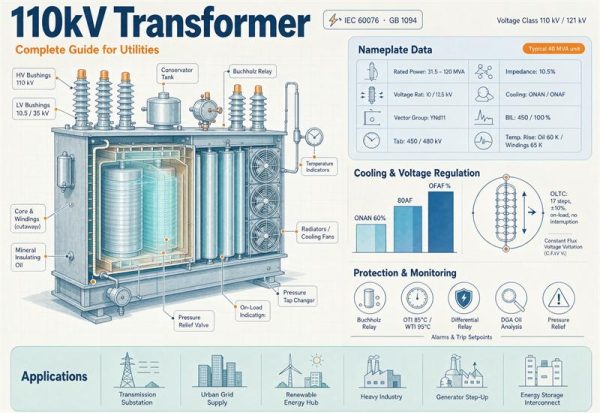
Liquid-immersed with mineral oil. The default for outdoor substations and everything above about 10 MVA. Oil carries heat away and insulates at the same time, which is why liquid-filled machines have the best overload capability and the longest service life. Cooling designations follow IEC 60076-2: ONAN is oil natural, air natural; ONAF adds fans; OFAF adds pumps as well as fans; ODAF forces oil through directed ducts.
Dry-type, cast resin or vacuum pressure impregnated. No liquid, so no fire load from a leaking flammable fluid. This is what goes inside hospitals, tunnels, high-rise buildings, data halls and anywhere the fire officer has a say. The ceiling on size and voltage is lower than for liquid-filled designs, and published figures put the price premium at 20% to 40% over an equivalent oil unit.
Gas-insulated. SF6 or alternatives, mostly for compact urban substations where footprint dominates. Environmental scrutiny of SF6 is tightening, so check what your jurisdiction allows before you commit.
High-temperature insulation with ester fluid. This one is worth understanding because it changes the civil works, not just the machine. A natural ester such as FR3 has a fire point around 360 °C against roughly 160 °C for mineral oil, and it is classified as a K-class less-flammable fluid under IEC 61100, recognised by both UL and FM Global. IEC 60076-14 and IEEE C57.154 cover the high-temperature insulation systems that go with it, and they allow a 15 °C to 20 °C higher hot spot than conventional designs, which translates into up to about 20% more load capability if you want to spend the margin that way.
The money is in the fire code. One published case study describes a North American utility that switched from mineral oil to a high-fire-point natural ester on a substation expansion. The fluid added $140,000 to the transformer. Eliminating the concrete expansion and the firewalls that NFPA 850 would have required saved $1.2 million. Net saving $1.06 million, about 12% of project capital, and four months earlier. That is a return of roughly 8.6 times on the fluid premium.
For context on why anyone bothers: ABB’s own technical paper on ester-filled designs puts the average cost of a transformer failure, counting replacement, clean-up and lost revenue, at about $3 million, with individual cases running to $86 million.
Current: a table you can use without a calculator
Line current per MVA, three-phase, line-to-line. Multiply by your rating in MVA.
| Voltage | Amps per MVA | A 100 MVA unit draws |
|---|---|---|
| 11 kV | 52.486 | 5,249 A |
| 33 kV | 17.495 | 1,750 A |
| 35 kV | 16.496 | 1,650 A |
| 66 kV | 8.748 | 875 A |
| 69 kV | 8.367 | 837 A |
| 110 kV | 5.249 | 525 A |
| 115 kV | 5.020 | 502 A |
| 132 kV | 4.374 | 437 A |
| 138 kV | 4.184 | 418 A |
| 161 kV | 3.586 | 359 A |
| 220 kV | 2.624 | 262 A |
| 230 kV | 2.510 | 251 A |
| 275 kV | 2.099 | 210 A |
| 345 kV | 1.673 | 167 A |
| 400 kV | 1.443 | 144 A |
| 500 kV | 1.155 | 115 A |
| 765 kV | 0.755 | 76 A |
The formula is 1,000,000 divided by (√3 × volts). Worth keeping because it sizes bushings, cables, current transformers and the switchgear frame in one step, and because it tells you instantly whether a quoted bushing rating makes sense.
One more thing from the US side. ANSI C84.1 gives every nominal class a maximum system voltage, and equipment is rated to the maximum, not the nominal. 69 kV nominal is 72.5 kV maximum. 115 is 121. 138 is 145. 161 is 169. 230 is 242. 345 is 362. 500 is 550, a full 10% above nominal. 765 is 800. Ordering to nominal instead of maximum is a common and expensive slip.
Insulation levels: IEC Um against ANSI BIL
This is the table that prevents the most expensive misunderstanding in HV procurement. IEC 60076-3 gives a lightning impulse level and a power-frequency withstand for each Um, and for the lower bands it offers two lists. Pick the list deliberately.
| IEC Um | Power-frequency withstand (kV rms) | Lightning impulse, list 1 | Lightning impulse, list 2 | ANSI class (nominal) | ANSI standard BIL |
|---|---|---|---|---|---|
| 12 kV | 28 | 60 kV | 75 kV | 15 kV class (12.47 / 13.2 / 13.8) | 95 kV (110 alt) |
| 24 kV | 50 | 95 kV | 125 kV | 25 kV class (24.94) | 125 kV (150 alt) |
| 36 kV | 70 | 145 kV | 170 kV | 35 kV class (34.5) | 150 kV (200 alt) |
| 72.5 kV | 140 | 325 kV | (single value) | 69 kV | 350 kV |
| 123 kV | 185 (230 available) | 450 kV | 550 kV | 115 kV | 550 kV |
| 145 kV | 185 / 230 / 275 | 450 kV | 550 / 650 kV | 138 kV | 650 kV* |
| 170 kV | 230 / 275 / 325 | 550 kV | 650 / 750 kV | 161 kV | 750 kV* |
| 245 kV | 360 / 395 / 460 | n/a (single set) | 850 / 950 / 1050 kV | 230 kV | 900 kV* |
| 420 kV | 570 / 630 | n/a (single set) | 1300 / 1425 kV | 345 kV | confirm per current table |
| 800 kV | 880 | n/a (single set) | 2100 kV | 500 kV and above | confirm per current table |
\* Commonly specified value. Confirm against the current edition of IEEE C57.12.00 before you write it into a contract.
Two things jump out of that table.
The first is that for Um 123 kV, the IEC list 1 value is 450 kV while the ANSI standard for the neighbouring 115 kV class is 550 kV. A machine built and tested to the lower IEC list is a full step below what a US utility specifies by default. Both are legal. They are not the same machine.
The second is the pattern at the bottom. Once you get past Um 245 kV, switching impulse starts to govern rather than lightning impulse, and IEC 60076-3 adds a switching impulse column entirely. If your specification for a 420 kV machine only mentions lightning impulse, it is incomplete.
Also note the rule from clause 7.2.2: all test voltages are phase to earth. When you read 395 kV against Um 245 kV, that is the line-to-earth figure applied during the test, not phase-to-phase.
Impedance is not a quality score
People ask for “low impedance” as if it were a virtue, and ask for “high impedance” when they are worried about fault current. Both instincts are half right, and both cost money when applied blindly.
Impedance does four jobs. It sets the fault current the machine will deliver, it sets the voltage drop under load, it affects the losses, and it decides whether two machines can run in parallel without circulating current between them.
Go too low and the short-circuit current climbs. Since the mechanical force on the windings goes with the square of the current, IEC 60076-5 short-circuit withstand becomes the binding constraint, and the manufacturer needs more copper and a stiffer structure to survive it. Go too high and you pay in regulation and in load loss, and the machine runs hot.
Published impedance for 230 kV machines spans roughly 10% to 18%, which is wide enough to tell you that there is no default. The right number is the one that keeps your switchgear within its interrupting rating while keeping regulation acceptable, and it comes out of a system study, not a rule of thumb.
There is a specific procurement trap here. Copying a legacy impedance value out of a 1990s specification into a 2026 RFQ forces the manufacturer to use a larger grain-oriented electrical steel core than a modern optimised design needs, and one published estimate puts the resulting bill-of-materials penalty at up to 15%. If your engineering team is quoting an impedance number from an old drawing, ask them to widen the acceptable band and let the manufacturer bid into it.
Cooling, temperature rise, and what the cooling code is hiding
The four-letter code on the nameplate is set by IEC 60076-2. First letter is the internal cooling medium, O for mineral oil, K for a fluid with a fire point above 300 °C, L for other insulating liquids, A for air, W for water. Second is the circulation method, N for natural, F for forced, D for directed forced. Third letter is the external medium. Fourth is its circulation method. So ONAN is oil natural, air natural. ONAF adds fans. KNAN means high-fire-point fluid, natural circulation, air natural.
Conventional limits under IEC 60076-2 are 60 K rise on the top oil and 65 K on the winding average, measured against a defined ambient. Hotspot behaviour and overload guidance live in IEC 60076-7, not in part 2, and that is a distinction worth knowing when you read a test report.
If you move to a high-temperature insulation system under IEC 60076-14 or IEEE C57.154, the limits move with you. Published guidance for ester-filled high-temperature designs puts the top liquid rise at 90 K rather than 60 K and the hottest-spot rise at 110 K rather than 90 K, with the solid insulation classed at 140 rather than 120. You buy that margin and then choose whether to spend it on overload capability or on insulation life.
| Medium | Fire point or class | Relative cost | Where it goes | The catch |
|---|---|---|---|---|
| Mineral oil | About 160 °C fire point, flash point near 145 °C | Baseline | Outdoor substations, everything above roughly 10 MVA | Fire walls, deluge systems and clearance under NFPA 850 |
| Dry-type, cast resin | No liquid, no fire load | +20% to +40% over oil | Hospitals, tunnels, high-rise, data halls | Lower ceiling on size and voltage |
| Gas, SF6 or alternative | No liquid | Higher than oil | Compact urban substations | SF6 faces tightening environmental rules |
| Natural or synthetic ester | About 360 °C fire point, K class under IEC 61100 | Fluid costs 2 to 4 times mineral oil per gallon, roughly +$140,000 on a large unit | Indoor, underground, near buildings, near water | Needs a high-temperature insulation design to use the thermal margin |
Our cooling class explainer goes through the full code if you want the decoding table.
Losses: the arithmetic nobody shows you
Every page on this topic says losses matter more than price. Almost none of them do the sum. Here it is.
Losses split into no-load loss, which is in the core and is there 24 hours a day whether you are carrying load or not, and load loss, which is in the windings and goes with the square of the current.
Utilities convert both into capital and add it to the bid. The US Department of Agriculture publishes the method for rural utilities in RUS Bulletin 1724E-301, and it gives rates: $2,450 per kW of no-load loss, $1,304 per kW of load loss, and $756 per kW of auxiliary loss. The bulletin walks through a real 30/40/50 MVA tender where manufacturer A bid $424,500 and manufacturer B bid $436,000, and where B won the evaluated total by about $10,600 despite the higher sticker price. On both bids the capitalized losses came to between 95% and 103% of the purchase price.
Run it on a 50 MVA 138/13.8 kV machine with 34 kW of no-load loss, 189 kW of load loss and 3 kW of auxiliary:
| Item | kW | Rate | Capitalized |
|---|---|---|---|
| No-load loss | 34 | $2,450/kW | $83,300 |
| Load loss | 189 | $1,304/kW | $246,456 |
| Auxiliary | 3 | $756/kW | $2,268 |
| Total | $332,024 |
That is added to the bid before the bids are compared. If the machine is quoted at $600,000, the losses are worth another 55% on top.
Now the tolerance, which is where the money hides. IEC 60076-1 permits a tolerance of +15% on no-load loss and +10% on total losses. A guarantee of 34 kW can legally arrive as 39.1 kW. On a 200 MVA machine with 95 kW of guaranteed no-load loss, the extra 14.2 kW is worth $34,912 at the RUS rate, and it is worth about $155,000 if you instead value it as pure energy at $0.10 per kWh over 8,760 hours a year with a thirty-year present-value factor of 12.409.
Two lines deal with it. First, ask for the measured routine-test value on the actual unit, not the design value. Second, put a penalty clause in the contract, and the RUS bulletin suggests setting the penalty rate at about 120% of the evaluation rate.
Peak efficiency is not at full load. The load factor at which total losses per unit of output are lowest is the square root of (no-load loss divided by load loss). On real HV data sheets that lands between roughly 30% and 45%. If someone tells you to run these machines at 60% to 80% for best efficiency, they are reading a distribution-transformer rule of thumb and applying it in the wrong place.
Regulation differs by region. In the United States, DOE 10 CFR 431.192 stops at a primary of 34.5 kV and a secondary of 600 V, so transmission-class machines have no federal efficiency floor. That is exactly why US utilities write their own loss evaluation clauses. In the European Union, Commission Regulation 548/2014 does cover them: a large power transformer is one above 3,150 kVA with an insulation level above 36 kV, or 40 MVA and above regardless of Um, and Annex I sets minimum peak efficiency index values that tightened on 1 July 2021. If you are exporting into the EU, name the efficiency tier in the enquiry. The default product is not automatically compliant.
Where these machines actually go
Generation. GSU transformers at thermal, hydro, nuclear, wind and solar plants. Generator output of 11 to 25 kV goes up to whatever the grid takes, most often 132, 220, 400 or 765 kV.
Transmission and interconnection. Autotransformers and two-winding machines tying voltage tiers together, plus intertie units at national and regional boundaries.
Renewables. Collector substations stepping 33 or 35 kV up to transmission, and the inverter duty that comes with it: harmonic content, variable loading, and often remote siting.
Heavy industry. Steel, aluminium, chlorine, cement. Arc furnace and rectifier duty, where the transformer is designed around the process rather than the grid.
Rail and metro. Traction supply, either AC at 25 kV or DC at 1.5 and 3 kV, in both cases fed through rectifier or converter transformers.
Data centres. The fastest-growing load class in 2026. A single hyperscale campus needs 100 to 400 MW, which means either a new transmission substation or a multi-transformer upgrade, and it is pulling hard on the same manufacturing queue as utility work.
Urban and constrained sites. Indoor or underground installations where fire code drives the choice toward dry-type or high-fire-point fluid, and where the fluid premium is usually dwarfed by what it saves in fire suppression and clearance.
What one costs in 2026, and how long it takes
Three published sources, all 2026, all in US dollars. Read them together and note where they disagree.
| Source | Class | Range | Per MVA |
|---|---|---|---|
| BBELC, 2026 pricing guide | 10 to 30 MVA at 69 / 115 kV | $450,000 to $800,000 | $15,000 to $80,000 |
| BBELC | 30 to 100 MVA at 115 / 138 kV | $800,000 to $1,800,000 | $8,000 to $60,000 |
| BBELC | 100 to 300 MVA at 138 / 230 kV | $1,800,000 to $3,500,000 | $6,000 to $35,000 |
| BBELC | 300 MVA and up at 345 / 500 kV | $3,500,000 to $6,000,000+ | $7,000 to $20,000 |
| IndexBox, Brazil market report | 69 to 138 kV, 10 to 50 MVA, liquid | $150,000 to $400,000 | $3,000 to $40,000 |
| IndexBox | 230 kV, 50 to 200 MVA | $500,000 to $1,500,000 | $2,500 to $30,000 |
| IndexBox | EHV 345 to 550 kV | $2,000,000 to $8,000,000 | n/a |
| IndexBox | GSU or HVDC converter | above $10,000,000 | n/a |
| Doscable, 230 kV ladder | 20 / 50 / 100 / 200 / 300 MVA | $200-350k / $400-700k / $800k-1.5M / $2-3.5M / $4-6M | $8,000 to $17,500 |
The Doscable ladder is the most useful thing on that list, because the per-MVA column barely moves: roughly $8,000 to $17,500 per MVA for the 230 kV class across the whole size range. That is a number you can carry into a budget meeting.
Now the disagreement. For the 10 to 30 MVA, 69 to 115 kV class, BBELC says $450,000 to $800,000 and IndexBox says $150,000 to $400,000. Those ranges do not overlap at all. BBELC’s floor is above IndexBox’s ceiling. Neither source states an Incoterm, a winding material, an efficiency tier or a date basis, and that is the whole explanation. The lesson is not which one to believe, it is that an unsourced price table on this keyword tells you the order of magnitude and nothing more.
Two independent benchmarks help you sanity-check. MISO prices transformers at about $4,600 to $18,500 per MVA installed, depending on winding voltages. Wood Mackenzie, reported in 2026, puts power transformer prices up 77% since 2019, with distribution units up 78% to 95%. Anything carrying pre-2022 pricing is stale on arrival.
Material mix explains why prices move so fast. Grain-oriented electrical steel is 30% to 40% of material cost and copper another 15% to 25%. One trade source puts copper at roughly 20% of manufacturing cost and notes that a 10% move in the LME copper index shifts the ex-works price by about 2%. Dry-type carries a 20% to 40% premium over liquid-filled, and the highest efficiency tier adds 10% to 15%.
Lead times are the real story.
| Source | Band | In years |
|---|---|---|
| BBELC, 10 to 30 MVA | 50 to 70 weeks | 1.0 to 1.3 |
| BBELC, 30 to 100 MVA | 80 to 100 weeks | 1.5 to 1.9 |
| BBELC, 100 to 300 MVA | 100 to 130 weeks | 1.9 to 2.5 |
| BBELC, 300 MVA and up | 120 to 150+ weeks | 2.3 to 2.9 |
| Wood Mackenzie average, Q2 2025 | 128 to 144 weeks | 2.5 to 2.8 |
| GSU 200 to 500 MVA, Q2 2026 | 24 to 36 months | 2.0 to 3.0 |
| Large autotransformers, 600 MVA and up | 30 to 48 months | 2.5 to 4.0 |
| The 2010 to 2019 baseline | 4 to 8 months | 0.3 to 0.7 |
The middle of that table is about 4.9 times the old baseline. One report describes utilities placing orders three to four years before a substation is needed, and some US utilities now pre-ordering for anticipated data-centre interconnections before the offtake agreements are signed, because missing the manufacturing queue can delay a $50 million substation by eighteen months or more.
The bottleneck is not assembly floor space. It is grain-oriented electrical steel, with quoted mill lead times of 9 to 15 months, and continuously transposed cable with order books quoted into 2027. Practical consequence: lock the core steel grade and thickness at the enquiry stage. That is worth more than any discount you will negotiate later.
Getting it on site: weight, rail cars and oil containment
The civil and logistics line items are where HV budgets break, and they are the items that never appear on a transformer price page.
Heavy haul is a booking problem, not a trucking problem. Large units move on Schnabel rail cars, which are purpose-built cars that clamp the transformer between two trucks and carry it as part of the structure. Fewer than 40 operate in North America. Booking one needs 8 to 12 months of notice. Miss your rail window and you pay factory storage, quoted at more than $50,000 per month: a twelve-week slip is about $138,000 before you count the schedule impact.
Oil volume triggers containment rules. Under the US SPCC rule at 40 CFR 112, oil-filled electrical equipment counts toward the 1,320-gallon threshold for facilities where a discharge could reach navigable water. An HV transformer crosses that line on its own, not after you count several of them. A 110 kV machine of 50 MVA was calculated at roughly 7,600 US gallons, about 5.8 times the threshold, from a single unit. Confirm the current rule text with your environmental team, because it has been amended more than once.
Fire code drives siting. NFPA 850 Chapter 9 governs the fire hazard analysis; NEC Article 450 Part III governs installation of liquid-filled transformers. Indoor installations generally require a dielectric liquid with a flash point above 300 °C, which is what the K prefix in the cooling code signals. Going to a K-class fluid can remove the firewall, the deluge system and part of the clearance requirement, which is how the $140,000 premium turned into a $1.2 million saving in the case study above.
Tests: routine, type, special, and which ones to pay for
IEC 60076-1 splits testing into three categories, and knowing which is which determines whether a test shows up in the price, whether it delays delivery, and whether a certificate from an earlier project can be accepted.
Routine tests run on every single unit and cannot be waived. Winding resistance on all taps, voltage ratio and vector group check, short-circuit impedance and load loss, no-load loss and no-load current, separate-source AC withstand, induced AC withstand, insulation resistance, oil tests, and a leak and pressure test on the tank. The routine loss figures are the ones that matter for your energy budget, because they were measured on the machine you are buying rather than on a sibling.
Type tests prove a design, once. The two classics are the temperature-rise test to IEC 60076-2 and the lightning impulse test to IEC 60076-3. A type test certificate from an identical earlier design is normally accepted, but check that it really is the same design family: same rating range, same core and winding construction. Not merely the same manufacturer.
Budget for these. One published estimate puts a full type test suite on a medium power transformer at 15% to 25% on top of the ex-works price.
Special tests are whatever you negotiate. Switching impulse for transmission voltages where switching surges govern. Chopped-wave lightning impulse. Short-circuit withstand to IEC 60076-5, which is the most demanding and the most expensive: budget another 8 to 12 weeks of lead time, and understand that the test unit is generally not saleable afterwards. Also zero-sequence impedance where earth fault settings must be precise, sound level measurement to IEC 60076-10, harmonic content of the no-load current, dissolved gas analysis as a delivery baseline, frequency response analysis as a fingerprint, and tan delta and capacitance as a condition-monitoring baseline.
Partial discharge matters at the top of the range. IEC 60076-3 Annex A gives limits of 100 pC at 1.5 Um/√3 and 200 pC at 1.3 Um/√3. It is a routine test for Um of 72.5 kV and above, or whenever you specify it.
A factory acceptance test is not a fourth category. It is the routine programme run with you or your inspector in the room. Nothing extra gets measured; you simply watch the measurements being taken and can question them on the spot. Allow three to five days, and note that the temperature-rise run alone can take anywhere from 8 to 48 hours depending on rating and method.
For independent witnessing, the three names that come up most are KEMA Laboratories in the Netherlands, part of CESI Group since 2021, CESI in Milan, and CPRI in India.
Our guide to transformer routine testing covers the full list, and there is more on evaluating quotations and total owning cost in the resource library.
If you are buying for 60 Hz North America
Three things change, and all three are cheap to get right and expensive to get wrong.
The voltage classes are different in name, not only in number. US distribution and transmission classes follow ANSI C84.1: 4.16 kV, 12.47 kV, 13.2 kV, 13.8 kV, 24.94 kV and 34.5 kV on the distribution side, then 69, 115, 138, 161, 230, 345, 500 and 765 kV above that. Insulation, arresters, cutouts and cable are ordered by class, not by nominal voltage, which is why “15 kV class” appears on US material specs even when the circuit runs at 12.47 kV.
The word “high voltage” means something else here. As the table at the top shows, 34.5 kV and 69 kV are medium voltage under ANSI C84.1. Calling them high voltage in a US-facing enquiry will get you a polite correction or, worse, no correction at all.
50 Hz designs do not simply re-label to 60 Hz. Four conversion paths are published: raise capacity and impedance by 10% each; raise capacity by 20% but accept 30% more no-load loss and 3 dB more noise, which cast resin designs cannot take; keep the parameters and accept a price reduction of about 5%; or take 10 K off the temperature rise and 15% off the load loss. Going the other way is the dangerous one: a 60 Hz design run on 50 Hz sees flux rise by about 20%, so the voltage has to come down by the same proportion or the core saturates.
US equipment also tends to be specified to IEEE C57.12.00 rather than IEC 60076, and the two families give different BIL schedules for neighbouring voltages, which is the comparison linked earlier in this guide. If you want to see the machine range we build against both, start from the product index.
The RFQ block
Paste this into an email and fill the blanks. Every line exists because leaving it out caused somebody a problem.
1.  Service: GSU / intertie / autotransformer / step-down / PST / HVDC converter / industrial special
2.  Rated power: ______ MVA  (ONAN ____ / ONAF ____ / OFAF ____)
3.  Highest voltage for equipment (Um): HV ____ kV, LV ____ kV, tertiary ____ kV
4.  Nominal system voltage: HV ____ kV, LV ____ kV, tertiary ____ kV
5.  Frequency: ____ Hz        Phase: ____     Number of windings: ____
6.  Vector group: ______      Neutral: HV ____ / LV ____ (earthing method)
7.  Insulation: IEC 60076-3 Table 2, list ____  LI ____ kV, AC ____ kV rms
    or ANSI class ____ , BIL ____ kV
8.  Impedance: HV-LV ____ %  HV-TV ____ %  LV-TV ____ %   Tolerance per IEC 60076-1
9.  No-load loss: ____ kW guaranteed at ____ kV, ____ Hz
10. Load loss: ____ kW guaranteed at ____ MVA, ____ deg C reference
11. Auxiliary loss: ____ kW    Efficiency tier required: ____
12. Loss evaluation rates: no-load $____/kW, load $____/kW, aux $____/kW
13. Penalty for exceeding guaranteed losses: ____ % of evaluation rate
14. Tap changer: off-circuit / OLTC, range +____ % -____ %, steps ____ %, make and model ____
15. Cooling: ____   Ambient: max ____ C, min ____ C, daily mean ____ C
16. Altitude: ____ m    Pollution / creepage class: ____    Seismic: ____
17. Noise: guaranteed sound power LwA ____ dB(A), sound pressure ____ dB(A) at ____ m
18. Terminals: HV ____ (bushing / cable box / GIS), LV ____ , neutral ____
19. Tests: routine (all) / type (____) / special (____)   Witness by: ____
20. Delivery: Incoterm ____ , site ____ , access restrictions ____
21. Drawing and data submission dates: ____    Liquidated damages: ____
22. Spares: ____    Warranty: ____ months from commissioning
Lines 12 and 13 are the two that change the outcome most. They turn losses from a sentence in a brochure into a number in the bid comparison, and they are what makes suppliers compete on efficiency instead of on sticker price.
Bottom line
Write the kV, not the word. Under IEC 61140 high voltage starts at 1 kV and under ANSI C84.1 it starts at 115 kV, and that 115-times gap is the single largest source of wrong quotations on this keyword.
Sort by position, then by insulation. What the machine does on the single-line diagram sets the specification. What insulates it then sets the fire code, the civil works and a good part of the price.
Buy on evaluated cost and buy early. Capitalized losses land at roughly 95% to 103% of the purchase price on utility tenders, the IEC no-load tolerance is worth about $155,000 on a 200 MVA machine, and lead times are running four to five times the pre-2020 baseline. The transformer, not the yard, sets your critical path.
FAQ
What voltage is considered high voltage? It depends entirely on which standard you are reading. IEC 61140 clause 4.2 sets the boundary at 1,000 V AC. ANSI C84.1-2020 puts the high voltage band at 115 kV to 230 kV. IEEE C2 and the NESC-based tables start it at 69 kV. NAVFAC MO-201 starts it at 72.5 kV. IEC 60076-3 does not use the term at all and works in Um instead. Always state the numerical voltage in an enquiry.
Is 11 kV high voltage? Under IEC 61140, yes, because it is above 1,000 V. Under ANSI C84.1, no, it is medium voltage, and so is 34.5 kV and 69 kV. This is exactly why the phrase causes problems: a European supplier and a US utility will read it differently.
Is 33 kV high voltage? Under IEC 61140 yes. Under the common industry band tables that put medium voltage at 1 to 35 kV, 33 kV sits just under the boundary and 35 kV sits just over it. Under ANSI C84.1 it is medium voltage. If you need a 33 kV machine, write “33 kV” and give the Um, which is 36 kV.
Is 34.5 kV high voltage in the United States? No. Under ANSI C84.1-2020 it is medium voltage. It belongs to the 35 kV insulation class, whose standard BIL for distribution transformers is 150 kV with 200 kV as the common alternative.
What is the difference between a power transformer and a distribution transformer? In practice the dividing line is about size and duty rather than a hard voltage cut-off. Distribution transformers feed end users and are usually sized in kVA with a secondary at utilisation voltage. Power transformers move bulk power between voltage levels and are sized in MVA. The ratings overlap, which is why capacity alone never settles it. Position on the single-line diagram does.
Should I use an autotransformer or a two-winding transformer? An autotransformer wins on cost, weight, size and efficiency, and the advantage is largest when the ratio is below about 3 to 1. You give up galvanic isolation, and the short-circuit current is higher. Use it for interconnecting two transmission levels such as 500 kV to 220 kV. Use a two-winding machine where isolation matters or where the ratio is large.
What impedance should I specify? The value that keeps your switchgear inside its interrupting rating while keeping voltage regulation acceptable. Published values for 230 kV machines span roughly 10% to 18%, so there is no default. It comes from a system study. Avoid copying a legacy value from an old specification, because an unnecessarily low impedance forces a larger core and one estimate puts the material penalty at up to 15%.
How much does a high voltage transformer cost in 2026? Published figures run from about $150,000 for a small 69 kV unit to more than $10 million for a large GSU or HVDC converter transformer, a factor of about 67. For the 230 kV class, one ladder gives roughly $8,000 to $17,500 per MVA across 20 to 300 MVA. MISO budgets $4,600 to $18,500 per MVA installed. Prices are up about 77% since 2019. Treat any table without a date, an Incoterm and a winding material as an order-of-magnitude guide only.
How long is the delivery time? 50 to 70 weeks for 10 to 30 MVA, 80 to 100 weeks for 30 to 100 MVA, 100 to 130 weeks for 100 to 300 MVA, and 120 to 150 weeks or more above that. Wood Mackenzie reported an average of 128 to 144 weeks in Q2 2025. GSUs of 200 to 500 MVA were reported at 24 to 36 months as of Q2 2026. That is four to five times the 4 to 8 months that was normal from 2010 to 2019.
Why are lead times so long? The constraint is materials, not assembly capacity. Grain-oriented electrical steel is quoted at 9 to 15 months of mill lead time and accounts for 30% to 40% of material cost. Continuously transposed conductor has order books running into 2027. The four dominant global manufacturers of units above 100 MVA have combined capacity of roughly 900 to 1,100 units a year, while North American demand has moved from about 180 to 220 a year in 2019 to 400 to 500 now.
Do high voltage transformers have to meet efficiency standards? In the United States, transmission-class machines do not. DOE 10 CFR 431.192 stops at a primary of 34.5 kV and a secondary of 600 V, so utilities write their own loss evaluation clauses instead. In the European Union they do: Regulation 548/2014 covers transformers above 3,150 kVA with an insulation level above 36 kV, or 40 MVA and above regardless of Um, and Annex I sets minimum peak efficiency index values that tightened on 1 July 2021. Name the tier in the enquiry.
Which tests should I require? Every routine test, always, with the report for your specific unit. Type tests for the design, and check the certificate really covers the same design family. Then special tests only where the application justifies them: partial discharge for high Um and long design life, sound measurement near occupied buildings, short-circuit withstand where mechanical withstand must be demonstrated rather than calculated, and switching impulse at transmission voltages where switching surges govern. Budget 15% to 25% on the ex-works price for a full type test suite and another 8 to 12 weeks if you want a short-circuit test.