Buying a power transformer from China can cut your equipment cost by 30 to 60 percent against a comparable Western quote, and the lead time is often half. That part of the story is true, and it is why utilities, EPCs, and data-center developers keep coming back.
The part nobody puts in the brochure is that the savings evaporate if you mishandle three things: the 2026 US tariff stack, the UL versus IEC compliance fork, and supplier verification. A unit that arrives non-compliant, or that fails in service because the factory was really a trading desk, costs more than buying local would have. This guide is the independent checklist we wish every procurement manager had before the first inquiry.
Browse our product range and the rest of our technical library for the deeper specs behind the steps below.
Why buyers go to China in the first place
Three numbers explain the pull.
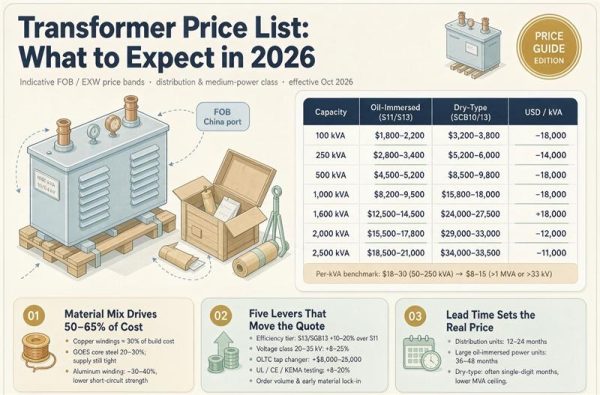
- Price. Chinese factories compete on volume and integrated supply chains. For standard liquid-immersed and dry-type units, ex-works pricing commonly lands 30 to 60 percent below equivalent US or EU manufacturing.
- Capacity. The top tier runs grain-oriented silicon steel, winding, vacuum drying, and test bays under one roof, and they are not choking on the same order backlog that has Western shops quoting 18 to 30 months.
- Lead time. Standard dry-type units typically run 20 to 32 weeks, oil-immersed distribution 30 to 45 weeks, and large custom power units about 10 to 12 months. Western shops commonly quote 18 to 24 months for comparable ratings.
None of that matters if the unit cannot be commissioned at your site. The rest of this guide is about protecting the saving.
The spec sheet you must send to every factory
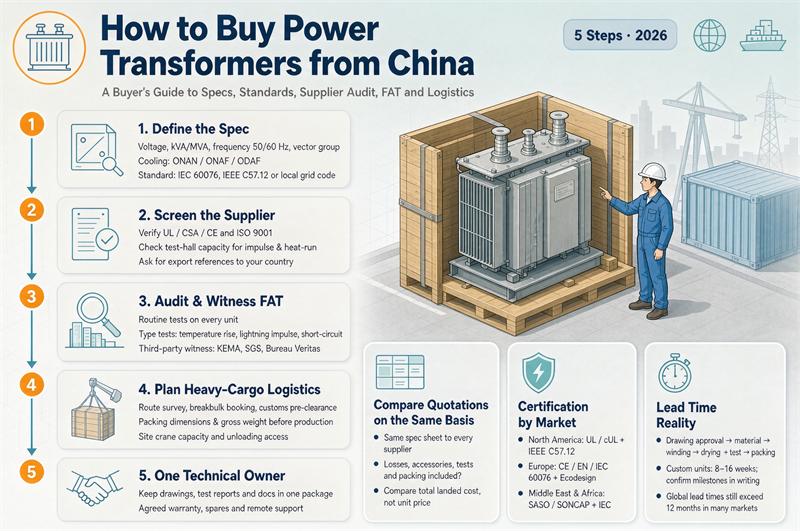
Vague specs are the top cause of wrong production and slipped dates. Send the same sheet to three to five candidates so you compare like for like.
| Field | Why it matters |
|---|---|
| Rated power (kVA or MVA) | Drives everything downstream; state the exact rating, not a range |
| Primary and secondary voltage | Match your grid; 11 kV / 0.4 kV is not the same as 13.8 kV / 0.48 kV |
| Vector group (Dyn11, Yyn0, etc.) | Wrong group means wrong phase behavior on energization |
| Impedance (%) | Sets fault current and parallel operation; changing it late resets the build clock |
| Cooling (ONAN, ONAF, AN, AF) | Affects tank size, fan power, and altitude derating |
| BIL and insulation level | Must match your system’s lightning and switching surge exposure |
| No-load and load loss limits | The number that decides 25-year operating cost |
| Altitude and ambient temperature | China factory defaults may not match your site; derating is mandatory above 1,000 m |
| Enclosure and IP rating | Indoor, outdoor, coastal, or desert change the build |
Get the supplier to sign the sheet before quoting. Reputable factories will. One that will not is telling you the spec is flexible on their end, which means it is flexible on yours too.
The compliance fork: IEC versus UL versus ANSI
This is the decision most first-time buyers get wrong, and it is where the brochures go quiet.
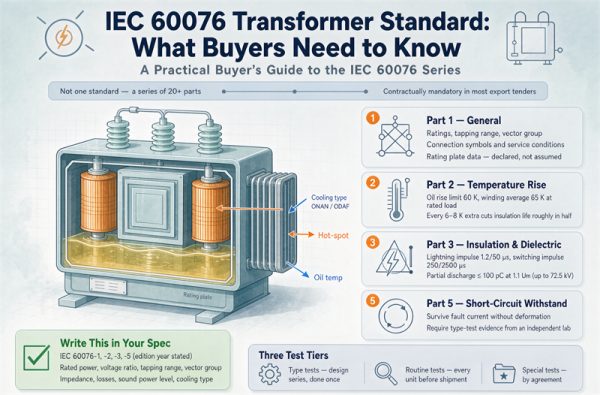
Most Chinese power transformers are built to IEC 60076 and backed by type-test reports from recognized labs (KEMA, CESI, ASTA, or accredited local equivalents). That is perfectly good equipment for IEC markets: the EU, most of the Middle East, Africa, Southeast Asia, and Latin America.
North America is different. US and Canadian grids expect ANSI/IEEE C57 performance and, for the vast majority of installations, a UL listing (UL 1561 for liquid-immersed, UL 1562 for dry-type). A unit with clean IEC test reports but no UL file generally cannot be energized on a US grid without authority-having-jurisdiction acceptance, which for power transformers is rare.
Here is the fork, stated plainly:
| Path | What it costs | Lead-time impact | Risk |
|---|---|---|---|
| Buy a factory with an existing UL listing for your exact model | 15 to 40 percent above the IEC price | Slower; listed models are a limited catalog | Low; permit goes smooth |
| Buy IEC-built, then pursue US field evaluation or relabel | Lower unit price, high per-unit approval fees | Adds weeks to months at the border | High; AHJ may reject |
| Specify IEEE C57 design with witnessed testing but skip UL | Middle price | Similar to IEC build | Medium; only works for private systems some AHJs exempt |
A lot of “UL-ready” language on factory websites means design-aligned, not listed. Ask for the UL file number and verify it covers the exact kVA and voltage you are buying. Our IEC versus ANSI/IEEE explainer for export transformers walks through the standard differences in detail.
Certifications by destination
Match the certificate to the market before you negotiate, not after the unit is built.
| Market | Baseline | Grid-specific |
|---|---|---|
| European Union | CE (LVD, EMC), IEC 60076 type test | EN 60076, Ecodesign efficiency tier |
| USA and Canada | ISO 9001, IEC or IEEE design | UL 1561 / UL 1562 listing, DOE efficiency |
| Middle East | IEC 60076 | SASO (Saudi), IECEE, or local type approval |
| Russia and CIS | IEC 60076 | EAC, GOST |
| India | IEC 60076 | BIS (IS 1180 / IS 11171) |
| Africa and SE Asia | IEC 60076 or CB scheme | SONCAP (Nigeria), national type test |
One note that saves arguments later: CE marking on a transformer is largely self-declared. A witnessed type-test report from an accredited lab carries more weight than a CE logo on the nameplate.
Factory verification: real plant or trading desk
Before you send a deposit, confirm you are dealing with a factory and not a reseller with a nice website.
- Check the business-license scope. It must say manufacturing or production at a factory address, not “sales of electrical equipment” at an office.
- Cross-check the ISO 9001 certificate on IAF CertSearch. Confirm it is valid, the issuer is accredited, and the scope covers transformer manufacturing at that address.
- Demand the full type-test report, not a cover page with a pass stamp. A real IEC 60076 or IEEE C57 report runs 50 to 120 pages with circuit diagrams, measured values, and lab signatures.
- Ask for recent routine-test reports tied to actual serial numbers, not a generic sample.
- Book a live video tour of the winding, casting, and test bays, or commission a third-party audit (SGS, Bureau Veritas, TUV) for orders above roughly 100,000 dollars.
A factory that welcomes witnessed testing is telling you something. One that refuses, citing confidentiality, is telling you more.
The tests you must witness
Routine tests catch the problems that matter. Your factory acceptance test (FAT) scope should include at minimum:
- Turns ratio and vector-group verification
- Winding resistance (and the copper-versus-aluminum proof if your spec requires copper)
- Insulation resistance and applied/induced voltage withstand
- Partial discharge, measured at or below 5 pC for the rating
- Oil breakdown voltage (BDV) for liquid-immersed units
- Nameplate verification against the signed specification
The economics are simple. A witnessed FAT with a third-party inspector runs a few thousand dollars. A failed batch on a substation project can mean six-figure penalties and a missed energization date. The routine testing guide lists every test a unit should pass and what a clean report looks like.
One buyer we spoke with ordered a single 1,000 kVA pilot before committing to 24 units. The witnessed FAT caught a bushing specification mismatch that would have hit the entire batch. The correction cost the factory two weeks. A full-order miss would have cost the project its commissioning slot.
The 2026 tariff reality
This is the part almost no ranking article mentions, and for a US buyer it is the difference between a win and a loss.
Two US tariffs stack on transformers from China:
- Section 301. Long-standing, 25 percent on HTS 8504 transformers.
- Section 232. Effective April 6, 2026, a 25 percent tariff on HTS 8504 transformers. Units above 10,000 kVA were deferred to December 31, 2027, so large power transformers currently avoid this portion.
That means a sub-10,000 kVA unit can face a combined 50 percent tariff stack. Confirm the exact rate and whether the two currently stack with a licensed customs broker, because both policy and stacking change. The HS code also splits the duty:
| HS code | Covers |
|---|---|
| 8504.21 | Liquid-immersed, not exceeding 650 kVA |
| 8504.22 | Liquid-immersed, 650 kVA to 10,000 kVA |
| 8504.23 | Liquid-immersed, exceeding 10,000 kVA |
| 8504.31 to 8504.33 | Dry-type, by power band |
Get the code right on the commercial invoice. A mismatch is a customs delay, not a detail.
A worked landed-cost model
Quoting ex-works price and calling it savings hides the real number. Here is a realistic 2,500 kVA liquid-immersed unit headed to a US site.
| Cost element | Amount (USD) |
|---|---|
| Ex-works unit | 85,000 |
| Ocean freight and insurance to US port | 5,500 |
| Section 301 tariff (25 percent) | 21,250 |
| Section 232 tariff (25 percent, sub-10k kVA) | 21,250 |
| Customs broker and inland freight | 3,500 |
| On-site acceptance and commissioning test | 4,000 |
| Landed, verified, ready | 140,500 |
A comparable US-made unit might quote 180,000 with an 18-month lead time. China still wins on price and schedule, but the naive “60 percent cheaper” becomes roughly “22 percent cheaper after tariffs,” and only if you do the verification. Skip the FAT and the math flips the other way.
If your unit is above 10,000 kVA, the Section 232 line drops off through 2027, which is why large power transformers are the sweet spot for China sourcing right now.
Payment terms and Incoterms risk
Standard export terms are 30 percent deposit and 70 percent against shipping documents (bill of lading copy). For larger or first-time orders, a letter of credit reduces risk but adds paperwork. Escrow through a B2B platform is an option for smaller buys.
Pick the Incoterm that matches your logistics comfort:
- EXW. You handle everything from the factory door. Cheapest unit, most work.
- FOB. Supplier delivers to the Chinese port; you take it from there.
- CIF. Supplier pays freight and insurance to your port; you clear customs.
- DAP. Supplier delivers to your site, duties cleared. Easiest, most expensive.
Red flag on price: a quote more than about 20 percent below the market almost always means material was removed somewhere, copper swapped for aluminum, or the certification scope does not cover your rating. The cheap unit is the expensive unit.
Logistics and packing
Power transformers are heavy, often over-dimensional, and sensitive to moisture during sea transit.
- Budget for marine-grade export packing: shock-resistant crating, desiccant, tilt and impact indicators.
- For oil-immersed units, insist on a nitrogen-filled sealed tank to prevent internal oxidation on the water.
- Use full container (FCL) or break-bulk for the main unit. Less-than-container (LCL) is not appropriate for a transformer.
- Many Chinese factories sit inland, which adds trucking to the port. A port-adjacent plant reduces this friction; ask where the factory actually is.
A paste-ready RFQ template
Send this to every candidate so the quotes are comparable.
PROJECT: [name]
QUANTITY: [n] units
RATED POWER: [kVA or MVA]
PRIMARY VOLTAGE: [kV]
SECONDARY VOLTAGE: [kV]
VECTOR GROUP: [e.g. Dyn11]
IMPEDANCE: [%]
COOLING: [ONAN / ONAF / AN / AF]
BIL: [kV]
TARGET STANDARD: [IEC 60076 / IEEE C57 / other]
DESTINATION MARKET: [EU / USA / other] and required certs: [UL / CE / SASO / BIS / EAC]
NO-LOAD LOSS LIMIT: [W] at [deg C]
LOAD LOSS LIMIT: [W] at [deg C]
ALTITUDE: [m]   AMBIENT: [deg C max]
ENCLOSURE / IP: [indoor/outdoor, IP__]
WINDING MATERIAL: [copper required, purity report requested]
DELIVERY TERMS: [FOB / CIF / DAP]  TARGET WEEK: [date]
PRICE BREAKDOWN REQUESTED: unit / packing / testing / freight
LOSS GUARANTEE: written, +15 percent tolerance, third-party test report
FAT: witnessed by [SGS / BV / TUV / client] at supplier cost? [Y/N]
PAYMENT: [30/70 T/T / LC]   DEPOSIT: [%]
Read the nameplate before you pay the balance
The nameplate is where the supplier’s promises meet the unit’s reality. Confirm the rated power, voltages, vector group, impedance, BIL, and the measured no-load and load losses against your signed spec. A loss number on a brochure is a claim; a loss number on the routine-test report, tied to the serial number, is data.
Our nameplate reading guide shows exactly which fields to check and how the test temperature (75 deg C for oil, 35 percent reference load for dry) changes the number you are comparing.
Common mistakes and red flags
| Mistake | What it costs you |
|---|---|
| Choosing on unit price alone | Failed batch, missed energization, six-figure penalties |
| Skipping factory verification | You may be buying from a trading desk, not a plant |
| Assuming CE means tested | Self-declared; a witnessed report matters more |
| Treating UL-ready as UL-listed | Unit cannot be permitted on a US grid |
| Ignoring the tariff stack | 30 to 50 percent landed-cost surprise |
| Waiving the witnessed FAT | Defects found after delivery, not before |
| Vague or changing spec | Build clock resets; lead time slips 28 to 80 weeks |
Bottom line
China is a legitimate, often smart source for power transformers, and the price and lead-time case is real. Protect the saving with a signed spec, verified factory, witnessed FAT, correct destination certification, and a landed-cost model that includes the 2026 tariff stack. Pick the UL-or-IEC path on purpose, not by accident. And treat the RFQ template above as the starting line, not the finish.
Our delivered project track record shows what verified, spec-matched units look like in the field, and the complete power transformer buying guide covers the technical selection steps this guide assumes.
FAQ
How long does it take to manufacture a power transformer in China? Standard dry-type units run about 20 to 32 weeks, oil-immersed distribution transformers 30 to 45 weeks, and large or custom power transformers roughly 10 to 12 months. Western shops often quote 18 to 24 months for comparable ratings, which is why China lead time is part of the appeal.
What certifications do I actually need to import a Chinese power transformer? It depends on the destination. The EU wants CE and IEC 60076 type tests. The US and Canada want UL listing (UL 1561 or UL 1562) plus DOE efficiency, on top of IEEE C57 performance. The Middle East wants SASO, India wants BIS, Russia and the CIS want EAC. Ask for the certificate number and verify it covers your exact rating.
Is a Chinese transformer with IEC reports legal to install in the United States? Usually not without a UL listing or AHJ acceptance, which is uncommon for power transformers. Most Chinese units are built to IEC 60076. If you need a US installation, either buy a model with an existing UL file or budget for field evaluation, which is slower and riskier.
What is the single biggest risk when buying from China? A supplier that is really a trading desk, not a factory, combined with a skipped witnessed test. The cheap quote hides a unit that may be non-compliant or substandard, and you find out after it arrives. Verification before deposit is the cheapest insurance you can buy.
How much tariff will I pay on a Chinese transformer in 2026? Two tariffs can stack: Section 301 at 25 percent and Section 232 at 25 percent, effective April 6, 2026. For sub-10,000 kVA units that can be a combined 50 percent. Units above 10,000 kVA were deferred from the Section 232 portion to December 31, 2027. Confirm the current stack with a customs broker.
How do I tell a real factory from a trading company? Read the business-license scope for manufacturing at a factory address, cross-check the ISO 9001 certificate on IAF CertSearch, demand full type-test reports tied to serial numbers, and book a live video tour of the winding and test bays. A trading desk will resist every one of these.
Should I specify copper or aluminum windings? If your spec requires copper, ask for a conductor purity report showing above 99.9 percent copper. Aluminum windings are legitimate for some ratings but are larger, less conductive, and must be declared. A supplier that will not document the winding material is a supplier to avoid.
What tests must I witness at the factory? At minimum: turns ratio and vector group, winding resistance, insulation resistance and voltage withstand, partial discharge at or below 5 pC, oil breakdown voltage for liquid units, and nameplate verification. A third-party witnessed FAT costs a few thousand dollars and prevents six-figure failures.
What Incoterm should a first-time importer choose? DAP (Delivered at Place) is easiest because the supplier handles freight and clears customs to your site, though it costs more. FOB is common if you have your own forwarder. EXW is cheapest but puts all logistics on you. Match the term to your logistics experience, not the lowest unit price.
How much should I pay as a deposit? Standard export terms are 30 percent deposit and 70 percent against shipping documents. For first-time or large orders, use a letter of credit or escrow to reduce risk. Be wary of any supplier demanding full payment up front.
What does a power transformer cost to ship from China? Ocean freight for a standard unit often runs a few thousand dollars to a US or EU port, plus insurance, customs broker, and inland freight. Over-dimensional or very large units need break-bulk and cost more. Always budget marine-grade packing and a nitrogen-sealed tank for oil-immersed units.
How do I avoid buying a non-compliant unit? Send one signed spec to three to five factories, verify the license and certificates, demand full type-test reports, witness the FAT on a pilot unit, and read the nameplate against the routine-test report before paying the balance. None of these steps is optional if the saving is going to survive contact with your grid.