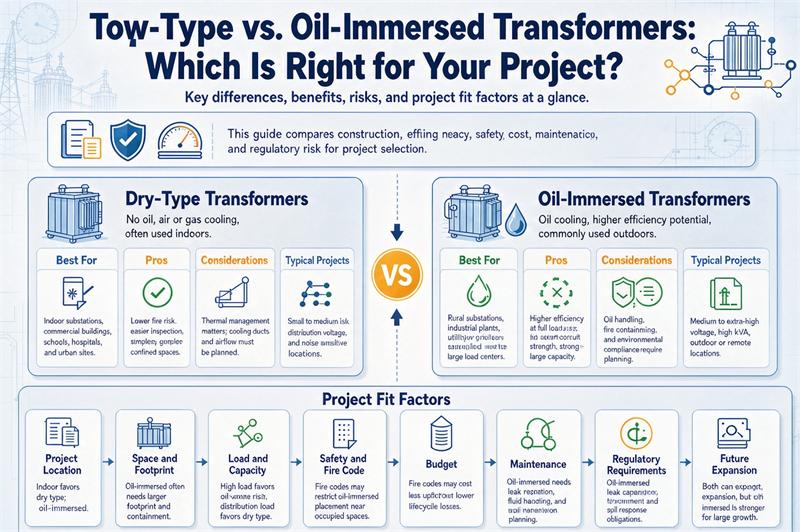
Choose a dry-type transformer when the unit has to sit indoors or in a fire-sensitive, occupied space — hospitals, offices, data centers, basements. Choose an oil-immersed transformer for outdoor substations, high-voltage lines, or budget-driven large-capacity jobs. The whole difference comes down to one thing: the medium that cools and insulates the windings. Dry-type uses air (sometimes epoxy resin); oil-immersed uses mineral or ester oil.
Picking between the two is one of the first real decisions you make on any power project, and it sets the tone for fire safety, install cost, maintenance, and even which codes you have to satisfy. This guide walks through how each type works, puts them side by side, and then gives you a plain-English decision path you can actually use — including the honest bits most supplier pages skip. Both technologies sit in our complete product catalog, so this isn’t a “buy ours” pitch; it’s the framework we use when engineers send us a spec.
Built and tested to IEC 60076-11 (dry-type), IEC 60076 / IEEE C57 series (oil-immersed), NEC Article 450 (U.S. installations), EU Ecodesign 548/2014 & 2019/1783, and ISO 9001.
How the Two Technologies Actually Work
Dry-type — air and resin do the job
A dry-type transformer sheds heat into the surrounding air. The windings are either cast in epoxy resin (cast-coil, the SCB family) or vacuum-impregnated with varnish (VPI). There is no tank, no oil, no sump. Fans kick in only when the load pushes past the natural-air rating (that’s the “AN” vs. “AF” you’ll see on the nameplate). Because there’s nothing flammable inside, you can park one next to the load — on a basement floor, inside a high-rise electrical room, beside a hospital operating theater.
Oil-immersed — oil does the cooling and the insulating
An oil-immersed transformer dips its core and windings in insulating oil. The oil does double duty: it stops the windings from arcing and it carries the heat out to radiators on the tank wall, where it dissipates. Circulation can be natural (ONAN) or fan-/pump-assisted (ONAF, OFAF). The oil’s thermal mass also gives the unit a short-term overload buffer that dry-type units simply don’t have.
Dry-Type vs. Oil-Immersed at a Glance
| Factor | Dry-Type | Oil-Immersed |
| Cooling & insulation | Air, epoxy resin, or varnish | Mineral or ester oil |
| Best location | Indoors, near the load | Outdoors or dedicated rooms |
| Fire risk | Very low (self-extinguishing, F1 class) | Flammable liquid; needs containment |
| Typical voltage | Up to ~35 kV | Up to 765 kV and beyond |
| Typical capacity | Up to ~2,500–5,000 kVA (distribution) | Essentially unlimited |
| Upfront cost | 20–40% higher per kVA | Lower |
| Maintenance | Minimal — cleaning and inspection | Periodic oil testing (DGA, dielectric) |
| Efficiency at full load | Good; premium classes excellent | Generally higher |
| Overload tolerance | Moderate | Strong (oil thermal mass) |
| Noise | Slightly higher (no oil damping) | Lower |
| Service life | 20–30 years | 30–40 years with care |
| Environmental risk | None (no fluid to leak) | Possible spill; ester fluid removes most risk |
Figures are typical industry ranges. Confirm exact ratings, loss values, and the compliance status for your market before you specify.
Start With the Only Question That Really Matters: Where Will It Live?
Every other factor is secondary to this one.
Indoor or occupied spaces → dry-type
If the transformer shares a building with people — a hospital, school, mall, office tower, data center, or basement room — dry-type is almost always the answer. Most building codes simply won’t let you put a tank of flammable oil above the first floor, and even at grade you’re looking at vaults, fire barriers, and separation distances. Dry-type sidesteps all of that.
Outdoor or dedicated rooms → oil-immersed
For a substation, a pad-mount on a commercial lot, a solar or wind step-up, or a heavy industrial plant, oil-immersed is the default. It’s cheaper per kVA, it handles higher voltage and capacity, and it shrugs off weather inside a sealed tank. Where the site supports it, oil is the workhorse.
Fire Codes and Standards (This Is Where Buyers Get Burned)
The “oil is dangerous” line is true but incomplete. Mineral oil ignites around a 160 °C fire point and does need secondary containment — a bund, a drain to an oil-water separator, and often a 5-meter separation from building openings. But natural ester fluids (vegetable-oil based) sit above 300 °C fire point, are over 95% biodegradable in 28 days, and are recognized by FM Global, UL, and IEC as “less flammable.” In some jurisdictions they’re allowed indoors with reduced clearances.
On the dry side, the spec that matters is IEC 60076-11, which grades units by climate (C1/C2), environment (E0/E1/E2), and fire (F0/F1). An F1 cast-resin unit self-extinguishes. In the U.S., NEC Article 450 governs installation; in the EU, Ecodesign 548/2014 and 2019/1783 set loss limits. Our technical resource library breaks these down by market if you need the clause numbers.
The Real Cost Conversation Isn’t the Sticker Price
Yes, an oil-immersed unit runs roughly 20–30% cheaper to buy (some suppliers quote up to 40% at larger ratings). But “cheaper to buy” and “cheaper to own” are different animals.
The oil unit’s install bill includes a containment pit, gravel, fire suppression, and often a purpose-built room. Over 30 years it needs oil sampling, dissolved-gas analysis, filter changes, and eventual reclamation. A dry-type unit drops onto a simple concrete pad, needs no vault, and asks for little more than dusting and a thermal scan. For indoor installations, that premium typically pays back in 8–12 years through avoided civil works and maintenance. One supplier’s 30-year total-cost model put oil-immersed at about 0.85× the cost of dry-type for large outdoor substations — and dry-type at the lower lifetime cost for indoor ones.
Translation: compare total installed cost, not the number on the quote.
Capacity and Voltage Ceilings
This is the cleanest tiebreaker after location. Dry-type transformers top out around 35 kV and are a distribution-class device — typically up to 2,500 kVA, with special designs reaching 5,000 kVA and, in rare large cast-resin builds, up to ~25 MVA. Above roughly 10 MVA, oil-immersed becomes the only practical choice for most projects, and it scales all the way to 765 kV transmission and hundreds of MVA.
If your spec calls for a 110 kV grid transformer or a 50 MVA unit, the dry-type question is already answered for you.
The Fluid Choice Inside Oil-Immersed (Mineral vs. Ester)
Don’t treat “oil-immersed” as one thing. The fluid changes the risk profile:
- Mineral oil — ~160 °C fire point, lowest cost, standard for most outdoor work.
- Natural ester (vegetable oil) — >300 °C fire point, >95% biodegradable in 28 days, the pick near wetlands, water, or residential areas.
- Silicone fluid — >300 °C, very low environmental impact, used in high-temperature or retrofit jobs.
If fire risk is the only thing steering you toward dry-type, an ester-filled oil unit might give you what you need outdoors while keeping the spill and flame concern off the table.
One Honest Warning: “Dry-Type” Is Not a Complete Specification
This is the part most pages gloss over. Writing “dry-type transformer” on a spec sheet is like writing “car” when you mean “a 4×4 with winter tires.” To get a unit that actually performs, you also have to pin down:
- Enclosure & IP rating — IP20 indoors, IP23/IP31 outdoors; a wrong rating cooks the unit or lets dust in.
- Ventilation and altitude — forced air (AF) adds capacity but adds noise; altitude above 1,000 m derates the nameplate.
- Harmonics (K-factor) — VFDs and UPS loads need a K-rated or carefully selected design, or the windings cook early.
- Noise limits — dry-type runs 5–10 dB louder than its oil twin; in a hospital or office that’s a complaint waiting to happen.
Get these wrong and the “maintenance-free” dry-type becomes the problem child.
Your Pre-Specification Checklist
Before you email a manufacturer, lock down these:
- Installation site — indoor room, basement, rooftop, outdoor pad, or pole?
- Voltage ratio — primary and secondary (e.g., 11 kV / 0.4 kV, or 34.5 kV / 480Y/277 V for North America).
- Rating and redundancy — kVA, plus N / N+1 / 2N?
- Load profile — continuous, intermittent, or frequent overloads? Harmonic content?
- Local codes — NEC Article 450 (US), IEC 60076-11 classes (EU), AHJ requirements.
- Fluid preference — for oil units, mineral or ester?
- Environmental constraints — near water, populated area, noise-sensitive?
- Standards to certify against — IEC, IEEE/ANSI, UL, CE, or a specific utility spec.
Hand a supplier these eight points and you’ll get a real quote instead of a catalog page. Our side-by-side selection worksheet turns this into a scored comparison if you want the full method.
Bottom Line
There is no universal winner. Dry-type wins the moment a transformer has to share space with people or sit where a fire or spill would be unacceptable. Oil-immersed wins outdoors, at high voltage, at large capacity, and wherever the lowest installed cost matters most. Start with location, then let fire code, total cost of ownership, capacity ceiling, and fluid choice narrow it down.
If you want a second set of eyes on your spec, the TransNin Electric engineering team will run your numbers against both technologies and tell you plainly which fits — and why. You can also browse our project reference list to see how these trade-offs played out in the field.
Frequently Asked Questions
Which is safer, a dry-type or an oil-immersed transformer? Dry-type is safer for indoor, occupied spaces because there’s no flammable liquid and nothing to leak. Oil-immersed carries a fire and spill risk, though ester fluids and proper containment cut that risk sharply.
Can an oil-immersed transformer be installed indoors? Sometimes. It depends on local code, the fluid used, and the fire-protection measures (containment, barriers, separation, AHJ approval). Ester-filled units are allowed indoors with reduced clearances in some jurisdictions; mineral-oil units rarely are above the first floor.
Why does a dry-type transformer cost more up front? Cast-resin and indoor-rated insulation systems are more expensive to build than an equivalent oil unit. You’re paying for the fire safety and the eliminated vault/containment, not for more kVA.
What’s the typical voltage and capacity limit for dry-type transformers? About 35 kV and, for distribution, up to ~2,500 kVA (special builds to 5,000 kVA, rarely to ~25 MVA). Beyond that, oil-immersed is the practical choice.
How long does each type last? Dry-type units run 20–30 years with proper ventilation. Oil-immersed units commonly reach 30–40 years when loading is controlled and maintenance is kept up.
What maintenance does each need? Dry-type: visual checks, dust removal, ventilation/fan checks, occasional thermal scanning. Oil-immersed: oil sampling, dissolved-gas analysis, seal and level checks, moisture monitoring, periodic reclamation.
Which should I pick for a hospital, data center, or substation? Hospital and data center → dry-type (indoor, fire-sensitive, occupied). Substation or outdoor utility → oil-immersed (capacity, voltage, cost).
What should I send a manufacturer to get an accurate quote? The eight-point checklist above: site, voltage ratio, kVA and redundancy, load profile and harmonics, applicable codes, fluid preference, environmental constraints, and the standards to certify against.